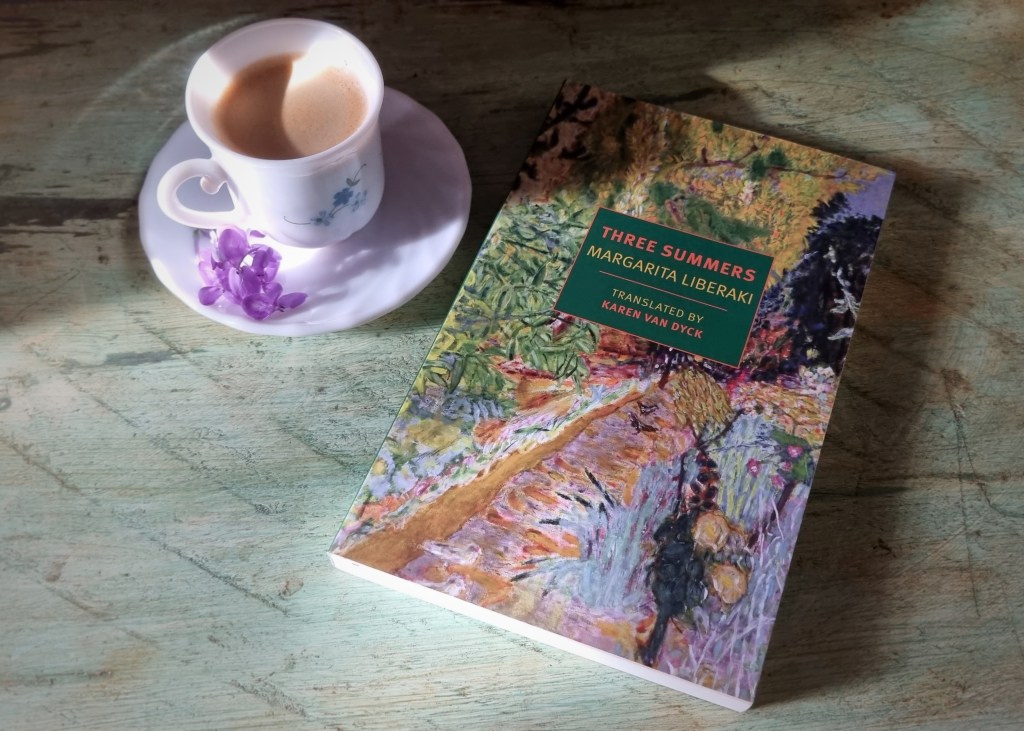
Margarita Liberaki: Three Summers

Fleeting patches of sunlight that decorate pieces of furniture linger on book pages furtively as I read, or momentarily set the crema of my espresso aglow, are lovely indications that summer is gently slipping into the Philippine islands after a sunless wet season. 

But why do I even dare write this in the face of a Liberaki who is an authority on sunshine? This Liberaki who does not merely write about it but makes it so tangible that one’s heart becomes dappled with sunlight, too?

There is a little bit of the Little Women in Liberaki’s three sisters in that it portrays in each sister how Woman can make different choices, pursue different interests, hold different priorities, think differently and still remain Woman; portrays how Woman can mean, or can be, “A great many things,” in the words of Alcott’s Jo March. Or as Liberaki’s Katerina replies, “Not just two, but thousands, Maria, or one which could be a thousand,” when Maria remarks on how Katerina seems to want to live two lives.

But Liberaki, daughter of Dionysus that she is, has a certain sensuality that Alcott did not make space for in her conservative depiction, although we love her just the same. This Liberaki sensuality is an elegant one, however, and treats female sexuality as part of life.

What made me pick this up for Women’s History Month was the curious case of an author who insisted on transliterating her name as Liberaki, rather than the more accurate Lymberaki, so that it would correspond to liberation. It is rare to come across an author’s name that already alludes to an untethered mind and sets the tone for a book. But how wonderful to discover that the same author has a command of artistic laws and lavishes attention to detail while creating an exquisite balance of light and shadow!

This sensitivity to art was what enthralled me! For what is sensitivity to art but a reinforced sensitivity to life? 


“The sun has disappeared from books these days. That’s why they hinder our attempts to live, instead of helping us. But the secret is still kept in your country, passed on from one initiate to another. You are one of those who pass it on.” —  Albert Camus to Margarita Liberaki

Three Summers was originally published in France through his recommendation.

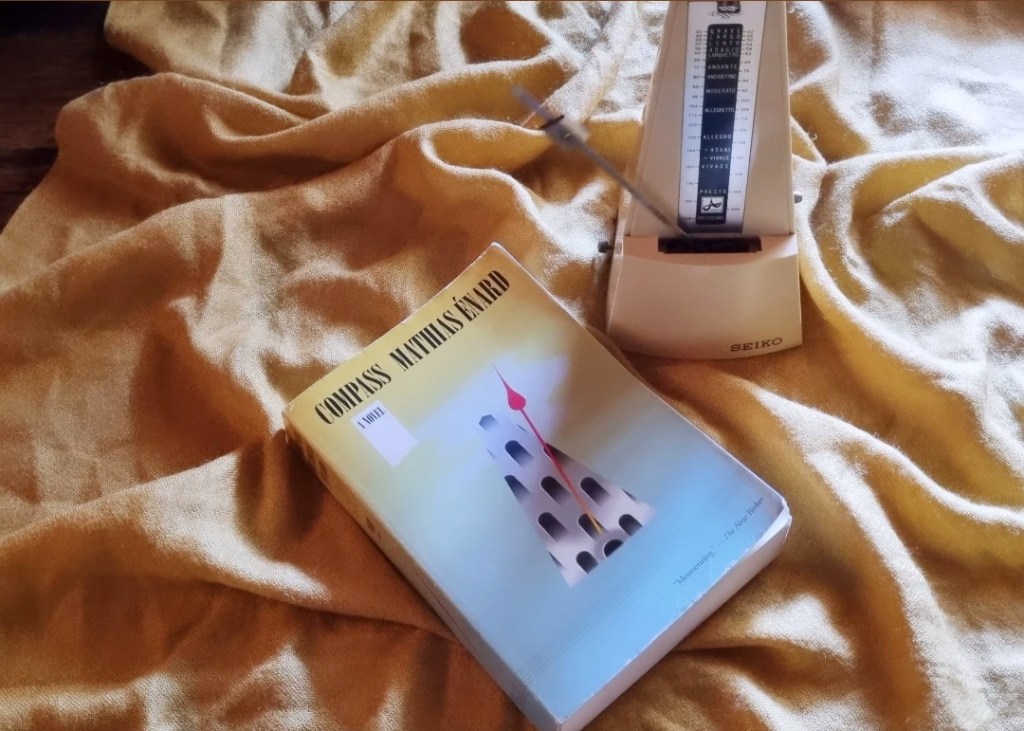
Mathias Énard: Compass

Mira, keep this close to Luis Sagasti’s A Musical Offering, close to Olga Tokarczuk’s Flights.

It is, after all, a musical offering — golden threads of western music’s entwining with the orient, of Liszt’s recitals in Constantinople, of how Nietzsche wanted to Mediterraneanize music, of the narrator’s replica of Beethoven’s compass that insisted on pointing east, but most of all because it reminds you beautifully that “music is a fine refuge against the imperfection of the world,” one that describes music as “time thought out, time circumscribed and transformed into sound… time domesticated, reproducible time, time shaped,” and cautions that “life is like a Mahler symphony, it never goes back, never retraces its steps…” but also that “this feeling of the passing of time is the definition of melancholy, an awareness of finitude from which there is no refuge.” Take note of how there is a metronome on the cover instead of a compass. Perhaps because a metronome goes back and forth between directions whilst keeping the music in time. 

It is about flights. A hypnotic trip across east and west, tick tock, east, west, art, love, time, self, other, literature, until they have intermingled and are present in each other, an adventure with Being — of traveling to the lands of your dreams and to your favorite cities, about crossing the borders of genres, art forms, literary forms, and geographical borders, but also flights from sanity, and traversing through memory, history, and dreams, suggesting that “our dreams might be more knowledgable than we.” Flights of flavors, an exotic dish not everyone will love; disturbing at times, an acquired taste with a scent of opium.

But keep this book close to Luis Sagasti’s A Musical Offering, close to Olga Tokarczuk’s Flights, close to your heart. Only you know how much this book means to you. Don’t forget you were constantly wide-eyed with wonder when you read it and you agreed with the following lines. How much you were in need of reading that last sentence!

“Sometimes I feel as if night has fallen, that western darkness has invaded the Orient of enlightenment. The spirit and learning, the pleasures of the spirit and learning, of Khayyam’s and Pessoa’s wine, have not been able to stand up to the twentieth century; I feel that the global construction of the world is no longer carried out by the interchange of love and ideas, but by violence and manufactured objects… You have to have… energy to constantly reconstruct yourself, always look mourning and illness in the face, have the perseverance to continue searching through the sadness of the world to draw beauty or knowledge from it.”

Olivia Manning: The Levant Trilogy

Despite being only approximately two-thirds the length of The Balkan Trilogy, it took me longer to finish reading The Levant Trilogy. 

Olivia Manning is not to blame, but rather the awry emotional state I was in when I read the latter. I even entertained the thought of setting it aside for a lighter read, but I was rewarded for pressing on. I’m glad I trusted the recommendation of friends who thought the trilogies are worth experiencing. As I approached the Levant’s third book, my pace finally picked up and I could hardly put it down again; and by the time I turned the last page, I was not ready to let Guy and Harriet Pringle go.

Among other things, I think the second trilogy is a surprising critique on imperialism and British presence in the Levant. (“Lord, the things we do to other people’s countries.”)

And as I re-viewed the six books mentally, it felt to me like the twenty years of writing between the first volume and the last is a peeling away of life’s layers of unrealistic romanticism; so that by the end, one is left with the stark nakedness of reality — of war, marriage, and life. 

Is it a bleak depiction of life? Not entirely. Manning seemed to say that it all depends on how you play the cards you’re dealt. 

Olivia Manning: The Balkan Trilogy

“The story of a marriage and of a war,” reveals the NYRB description. Thus it was with a sense of irony that I picked this up after learning that Emma Thompson and Kenneth Branagh met on the set of the 1987 BBC adaptation, married two years later, and divorced when Branagh had an affair with Helena Bonham Carter.

I have to admit that the silly curiosity in whether Guy and Harriet Pringle would meet a similar fate was partly what spurred me to read on. Lest this begins to sound like a gossip column, let me continue by writing that there is a certain ease in reading Olivia Manning.

That can hardly be said of other wartime books that have close to a thousand pages, and yet, here is The Balkan Trilogy; alive with the imperfections of being, the tragicomedy of the human condition, the uncertainties of love and life, and keen observations on history that kept me engaged up to the very end.

Manning is also an ideal literary guide for a place one rarely reads about. The last volume is set in Greece and the first two in Rumania. Despite my daring adventures in world literature, Rumania remains unfamiliar territory, but with her geospatial adeptness and descriptive prowess sustained by first-hand experiences, I was wholly transported to Bucharest’s golden domes, outdoor cafes, and societal hodgepodge, and baptized into the political currents of WWII through the stunning perspective of the Balkans.

My initiation to Manning’s work was School for Love. As if reading my thoughts, Rachel Cusk’s introduction addresses my reflection on why I was met with yet another orphan as a main protagonist: “A central metaphor for war, displacement, cataclysm, and the death of the old world in 1940s Europe.”

And yet, despite the solemn themes and the fight for a marriage in the face of disenchantment and war, the aforementioned ease stems from a writer who stops to smell the roses; someone who implies that doing so does not distract us from the more important things in life but nourishes us instead and gives our lives more meaning.

Sometimes we need a massive trilogy to be reminded that the only real fortune in this cruel world is to live and love.

Burhan Sönmez: Istanbul Istanbul & Labyrinth

“The beauty of a book, says the book dealer, lies in the fact that no other book can arouse the same feelings in you. That’s why you can’t compare good books.” — Burhan Sönmez, Labyrinth

When your desire to forget certain things mingles with a character’s desire to remember, and the words from the book and those unsaid in your heart cross paths, the sensation stays with you, the way your first sip of raki does — like drinking smooth, liquid embers as your insides become drenched with that distinctive Turkish melancholy.


One ends tragically, the other ambiguously, but the influential power of Istanbul that takes hold of writers is exquisitely manifested in this pair. Despite Istanbul being a bazaar of a thousand and one stories, Burhan Sönmez has his own approach to storytelling and his own approach to this alluring, Janus-faced city that readers who are just as enamored with it as I am will hold in esteem. As a certain character says, “Just as you can’t bathe in the same river twice, neither can you tell the same story twice in Istanbul.”

The interesting thing you’ll discover about these two books is that, despite being two entirely different novels by the same author, their titles are interchangeable. Both are about labyrinths, and both are about Istanbul; both can either be about the labyrinths of the mind and memory or the labyrinths of the city; and I find both to be best read successively.


The past — or the land of our birth — can be a burden from which we sometimes wish to be free, but who are we without it?

Thad Carhart: The Piano Shop on the Left Bank

Not the West Bank this time, just the Left Bank. The thing about my Silk Route | Fertile Crescent reading project is that — despite being a source of enlightenment through discovering underrated but astounding literature — novels from this route in question are usually emotionally taxing.

Although I have sensed that I am drawn to writings from places of conflict for the reason that they have a sensitivity to beauty commensurate with their heightened awareness of the fragility of life; once in a while, I need a breather, and that’s when I turn to books related to other interests. In this case, not merely an interest, but a love.

But as love would have it, we oftentimes become accustomed to a beloved’s presence and we slowly take its magic for granted. 

The Piano Shop on the Left Bank: Discovering a Forgotten Passion in a Paris Atelier refreshed me about the intricate workings of a piano; of how extraordinary this instrument is; of the alchemy and difficulty involved in piano-making and music-making; and how beautiful tone production relies so much on the precision of piano makers, the skill of piano technicians, and the heart and hands of a pianist. This rekindled a fire that led me straight to the piano after turning the last page.

But this book is not just about pianos and trivia from the music world. (Although, while we’re at it: Did you know that when the Eiffel Tower was built in 1889, the first thing to be hauled to the rooms at the top was a piano?) It is also about the Paris that is inaccessible to the tourist. In fact, this would make a lovely pair to Mercer’s Time Was Soft There: A Paris Sojourn at Shakespeare & Co.

Surely, these books did not intend to rival Hemingway’s A Moveable Feast or the aching poignancy of Truong’s Book of Salt, but at times, lesser-known books are beautiful for the simplicity that they lead us to find something that draws out music from within.

Antal Szerb: Journey by Moonlight

Have you ever read a novel by a Hungarian author that is not a page-turner?

I haven’t!

“I need a drink. Because I have to tell you who Tamás Ulpius was, and how he died,” on the fourteenth page, is the same bomb of intrigue that Magda Szabó drops on page three of The Door when she writes, “Thus far I have lived my life with courage, and hope to die that way, bravely and without lies. But for that to be, I must speak out. I killed Emerence.”

Intrigue is the paprika that flavors Hungarian pages up until the very end.


I was drawn to this book not for what the blurb promised, but for its writer: Antal Szerb, who sadly perished in a camp during the Holocaust. But like Irène Némirovsky, also a Catholic Jew who nonetheless shared a similar fate despite their conversion to another faith, there is nothing politically blatant in their writings.

There is, however, a certain psychological depth in Szerb’s style that makes it extremely appealing to me. The characters themselves are not that likeable but they seem to represent the state of disorientation of the generation between the first and the second world wars.

“‘There’s nothing wrong with you,’ said the doctor, ‘just horrendous exhaustion. What were you doing, to get yourself so tired?’

‘Me?’ he asked, meditatively. ‘Nothing. Just living.’ And then he fell asleep again.”

Death plays a role in this novel, but so does Life. An existential crisis and unresolved issues of his youth haunt the main character and result in the fickleness of his decisions. He abandons his wife on what was supposed to be an idyllic honeymoon in Italy, and there begins what seems to be a muted exploration into the psychopathology of guilt.


In this edition’s introduction, we learn of Szerb’s fascination for Italy; “its art, its history, its people, its language, its ancient towns and their narrow back streets.” He had lived there as a young man from 1924 to 1929 and the country took hold of him. He returned in 1936, suspecting that it was for the last time. In a travel journal entry, he wrote, “I initially wanted to go to Spain… but it occurred to me that I simply must go to Italy, while Italy remains where it is, and while going there is still possible. Who knows for how much longer I, or any of us, will be able to go anywhere? The way events are moving, no one will be allowed to set foot outside his own country.”

Needless to say, his suspicions tragically proved true, but this final trip to Italy gave birth to this novel, which is a poignant love letter to Italy.

But through all of what Szerb says with clarity or through undertones, what I found most disquieting were descriptions of the generation’s moral insanity, how they viewed war with indifference — “bore the changing times on their backs with astonishing passivity, and lived quite unconnected with their own remarkable history.”

And unfortunately, Antal Szerb did not live to tell the tale, but we all know what happened next.

Patrick Leigh Fermor: A Time to Keep Silence

The book had me at its cover; a landscape distinctly Cappadocia, one of my favorite places in the world, however otherworldly.

It had me at the introduction by Karen Armstrong. Who else more suited to introduce such a book?

Patrick Leigh Fermor had me at, “The book was based — whole passages of it word for word — on letters I wrote at the time to a correspondent (whom I later married) without the remotest thought of publication.”

He had me the entire time because reading his prose felt like meditation.

A Time to Keep Silence is a lovely exemplification of that Thomas Merton line I encountered through Rebecca Solnit earlier this year: “The inner journey is the interpolation of the meanings and signs of the outer pilgrimage. One can have one without the other. It is best to have both.”

Known for traveling to Turkey on foot and for being one of the finest travel writers of the past century, this is a record of Fermor’s travels to a more inward direction. Through Europe’s monasteries with their divine libraries, chanting monks, cloistered lives, and vows of silence, and to Cappadocia’s abandoned rock monasteries, we are made recipients of their histories and these letters, too; but most of all, of the contemplation on modern man’s need for silence and solitude.

For someone who recently took three weeks off from social media to retreat from its noise and with only one foot back inside, this book expressed many of my unspoken thoughts, and I can only agree with a constant book friend who thinks that the only problem with this book is that it is too short. 

Here’s to places, experiences, or books where “…the troubled waters of the mind grow still and clear, and much that is hidden away and all that clouds it floats to the surface and can be skimmed away; and after a time one reaches a state of peace that is unthought of in the ordinary world.”

Joseph Brodsky: Watermark

“In those days we associated style with substance, beauty with intelligence…
we didn’t know yet that style could be purchased wholesale, that beauty could just be a commodity.”

Venice, through the pen of a mediocre writer, can easily become cliché.

But this is Joseph Brodsky. 

If you, like me, have read Lawrence Durrell’s Prospero’s Cell and thought it was alone in its indefinable sub-genre or sur-genre (if there’s such a thing), we can rejoice! Venezia’s Watermark is the worthy soulmate of Corfu’s Prospero’s Cell.

Meditative with a sensual rhythm but not without intelligent humor, here is travel literature that casts an enchanting haze on the borders between poetry and prose, a place and the self.

I would slip this in my handbag in a heartbeat on a return trip to the best city to get lost in.

June 19, 2022 – Samarkand: Shah-i-Zinda

Afternoon light enters silently through the gaps of Shah-i-Zinda in Samarkand and transforms the whole necropolis into a prismatic vision that makes one understand why this place has earned illustrious names throughout the ages, and why it is most widely known as “The Mirror of the World”.

But as I sat there mesmerized, I became more inclined to believe that it mirrored constellations and galaxies… and that so much of what we find beautiful are mirrors of our joys, sorrows, and the distinct libraries of music and thoughts stored in our beings.

It probably was not the first time that a girl stood under its hypnotic gaze and made her contemplate on beauty and celestial realms; and I’d like to think that those reflective beings who came before me must have also gravitated towards its lesser-known epithet — “Garden of the Soul.”

© 2022 MDR
Shah-i-Zinda, Samarkand, Uzbekistan