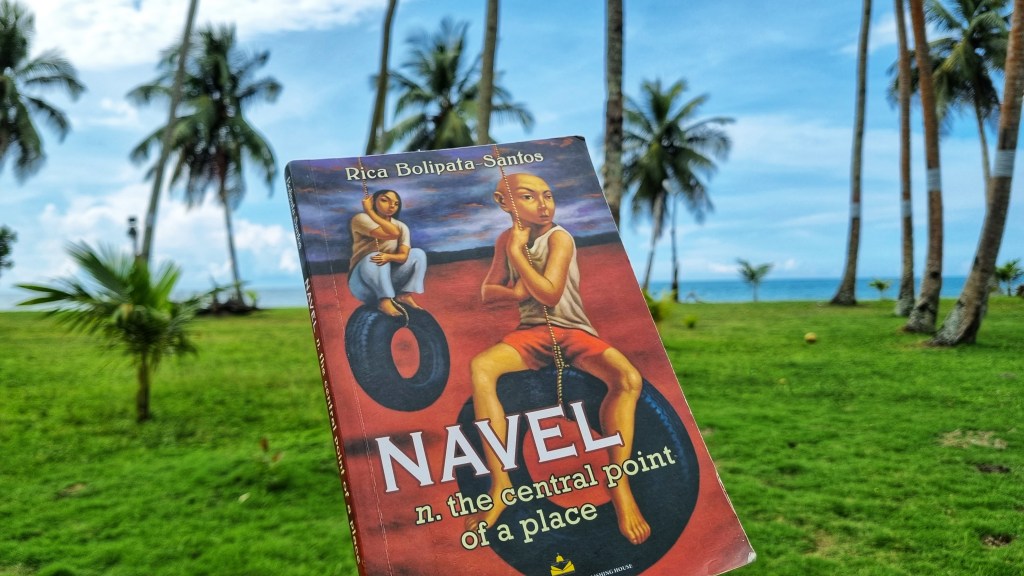
“So, here, my navel. Cleaned and gutted out,” she writes in the preface.
It is pungent with honesty and courage of life as a woman in the Philippines. While motherhood seemed to be the more obvious leitmotif of this compilation of essays (and I have friends whom I think would benefit even more from this book than I will), there was also so much to relate to as a Filipina.
The author, separated from me by so much less than six degrees, comes from a renowned musical family; and somehow, this makes her stories of life and family seem even more accessible to me.
This book is another piece of evidence that Filipinos are some of the best essayists.
She posits somewhere in these pages that writing, aside from being the best solution to finding your way after getting lost, is an added gift to the love of reading. “An added gift to the love of reading.” Isn’t that beautiful?
In fact, it seems to be the strongest takeaway for me. Writing. Even for questions like, “What to do with all the physical evidence of the growth of the heart?”
Writing seems to be the answer, too.
After a whole month of the most uninspired book posts I have ever written, I am grateful to be reminded of this outgrowth of reading, this gift, this home — writing.
“Writing is not the voice’s shadow but the track of its steps… only writing has the power to move a voice through time, and make it as immortal as the gods.”
In an attempt to read something that would get my mind off Philippine politics, I sought asylum at my Silk Route | Fertile Crescent shelf. This is one of the books from a hefty stack that a bookseller set aside for me because he knows of my current preferred literary flavors and reading project. And sure enough, I could hardly put this one down as soon as I started!
It is about a storyteller who loses his voice and the stories that allowed him to retrieve it.
As much as it is a wonderful reflection on writing and storytelling, Damascus Nights is, as you may have already guessed, a play on the Arabian Nights. But Rafik Schami makes the Arabian Nights what I would have preferred it to be! The fantastical quality of the original is still there, but he allows you to feel, smell, and hear the Syria before the humanitarian disaster, the lively early to mid-20th century Damascus, while weaving a social commentary on Damascene life, exploring identity and exile, foreign affairs, corruption, and a none too subtle criticism of its rulers! This turned out to be excessively political — without losing its humor and lightness!
Nevertheless, page 108 made me stop in my reading tracks. It is where an old man is insulted by an official, but his son who owns a teahouse begs him to refrain from retaliating: “‘That would ruin me,’ he said, ‘they’d shut down the place within hours.’ Someone would plant a handful of hashish somewhere, you see, or else a book by Lenin. The police would show up an hour later, and they’d find the hashish and the Lenin exactly where the man from the secret police had stashed them. The place would be closed and its proprietor thrown in prison for ten or twenty years.” Red-tagging and this so-called drug war abused to punish political or personal critics are some of the oldest tricks in the book, my friends. I will not write anything else on the matter. Even in reading, you cannot escape from something you care about.
Rafik Schami is another proof of the claim that we are missing so much as readers if we cease from exploring the literary wonders of this region. And isn’t his About the Author section the most charming you’ve ever encountered?
“…is an award-winning author who used to be a baker but didn’t like the flour and early hours. Since giving up baking, he has tried his hand at chemistry to discover the formula for immortality. What he found was that he could only do that through writing, because only literature lives forever.”
Excuse me as I go hunt for more books by Rafik Schami…
“‘You begin to liquidate a people,’ Hübl said, ‘by taking away its memory. You destroy its books, its culture, its history. And then others write other books for it, give another culture to it, invent another history for it. Then the people slowly begins to forget what it is and what it was.’”
It was this quote from the book making the rounds on social media recently that led me to re-read The Book of Laughter and Forgetting, but then I found more to retrieve from the margins of memory.
“…but the past is filled with life, and its countenance is irritating, repellent, wounding, to the point that we want to destroy or repaint it… we fight for access to the labs where we can retouch photos and rewrite biographies and history.”
“They wanted to efface hundreds of thousands of lives from memory and leave nothing but an unstained age of unstained idyll.”
“…erased from the country’s memory, like mistakes in a schoolchild’s homework.”
“The constitution did indeed guarantee freedom of speech, but the laws punished anything that could be considered an attack on state security. One never knew when the state would start screaming that this word or that was an attempt on its security.”
Fortunately and unfortunately, Kundera reminds us that we are not alone in this plight, and there are still those who remember.
“The struggle of man against power is the struggle of memory against forgetting.”
It’s funny how this book made more sense when I read it as a younger person — the passages about music and literature I glorified, the obscenities I took as metaphors and almost everything else as literary symbols. Now that I’m older, it all seems absurd.
And it is absurd because of how real it has become.
Along with my old yellowed notes tucked between its pages lie the pretentiousness of a young reader and the confounding of an older one.
“You don’t have to burn books to destroy a culture. Just get people to stop reading them.” — Ray Bradbury, Fahrenheit 451
Scheherazade in A Musical Offering, Penelope in Fireflies. I see what you did there, Mr. Sagasti! The mother weaver of stories of the East, and the mother un-weaver of storytelling of the West. Spun and spanned. And spangled.
“Now I’m drunk, with universe.”
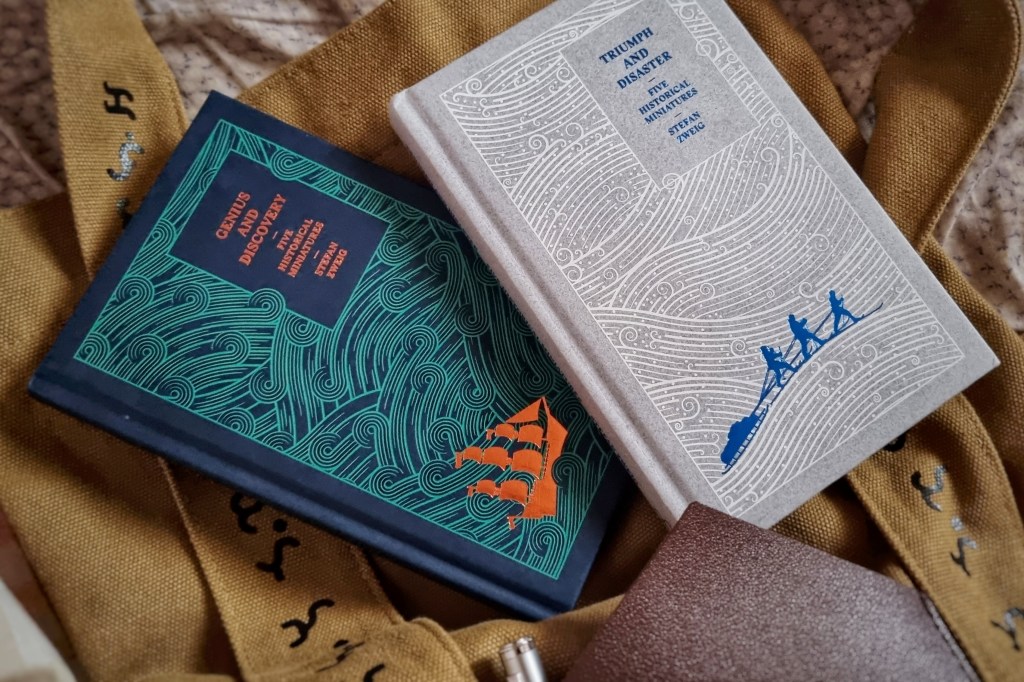
Ever since the two Zweigs that got me through the long wait at the polling precincts, I have only found myself turning pages of several books but absorbing nothing, only to reread the same pages and still end up drifting. The way many people have treated our national elections like they would a mere cockfight is confounding. Your books are beautiful reprieves. Write some more, please. This is going to be a tough ride. We will need more of your magic.
“…in history as in human life, regret can never restore a lost moment, and 1,000 years will not buy back what was lost in a single hour.”
The day of the Philippine Elections has finally come! And no queue at the polling precinct is too long if you have the right books with you!
Five historical miniatures in each of these lovely books from Pushkin Press by distinguished Austrian writer, Stefan Zweig. There is nonetheless nothing “miniature” about the writing! In fact, they magnify some of history’s crucial moments and characters in such glorious and vibrant ways, you can only wish Zweig wrote more of these!
It was this line that leapt off the pages from the foreword of both books: “…a single Yes, a single No, a Too Soon or a Too Late makes that hour irrevocable for hundreds of generations while deciding the life of a single man or woman, of a nation…”
A single vote.
Dear Philippines, tomorrow we find out how we did.
Imagine a Serbian little boy being taken away from his mother as “blood tribute,” an Ottoman practice of forcibly recruiting soldiers from Balkan Christian subjects. Imagine the screams and the cries as the mother follows them to the Drina River, until the janissaries and the child embark on a ferry where they are parted forever.
This is the agony with which the book begins, and it made me wonder if I should shelve it for later. It felt too heavy to be read amid the volatile climate of the Philippine elections. But the writing made me want to read more, and I do not regret doing so.
This boy rose through the military ranks and became known as Mehmed Paša Sokolović, and in his later years, Grand Vizier of the Ottoman Empire. But the painful memory of separation never left him: “…he thought that he might be able to free himself from this discomfort if he could do away with that ferry on the distant Drina, around which so much misery… gathered and increased incessantly, and bridge the steep banks and the evil water between them, join the two ends of the road which was broken by the Drina and thus link safely and forever Bosnia and the East, the place of his origin and the places of his life. Thus it was he who first, in a single moment behind closed eyelids, saw the firm graceful silhouette of the great stone bridge which was to be built there.” Thus began the construction of the bridge over the Drina, at the part of the river where he last saw his mother.
The main character in this novel is the bridge. This bridge that has withstood over four hundred years of tumultuous history.
— — —
Elif Shafak was a reading staple between November 2020 to January 2022 when I was steeped in my reading project to cover and uncover as many writings from places affected by the Silk Route; so when a friend learned that Elif Shafak had said that The Bridge on the Drina caused something in her to shift forever, this was enthusiastically recommended to me.
Of the nine books by Shafak that I read, the first one was The Architect’s Apprentice, set in sixteenth century Istanbul about a fictional apprentice working with the legendary Ottoman court architect, Sinan. The one commissioned to design the bridge on the Drina, the Mehmed Paša Sokolović Bridge, is none other than Mimar Sinan.
— — —
But authors are stories in themselves, and Ivo Andrić’s life is literally one for the books. Born to a poor family in Bosnia, he grew up playing on the very bridge he would later immortalize and earn him the Nobel Prize for Literature in 1961. The years in between include two World Wars and an extraordinarily rich and eventful life.
The introduction to this edition claims, “No better introduction to the study of Balkan and Ottoman history exists… no anthropologist has ever reported the process of cultural change so sensitively; no historian has entered so effectively into the minds of the persons with whom he sought to deal…” I can only agree!
Andrić arranges the perplexing layers of this region’s history from the 16th to the 20th century into an impassioned song that constantly returns to its main theme — the bridge.
“…The life and existence of every great, beautiful and useful building, as well as its relation to the place where it has been built, often bears within itself complex and mysterious drama and history… Therefore the story of the foundation and the destiny of the bridge is at the same time the story of the life of the town and of its people…”
“Life…renews itself despite everything and the bridge does not change with the years or with the centuries or with the most painful turns in human affairs. All these pass over it, even as the unquiet waters pass beneath its smooth and perfect arches.”
There is an excess of lessons to be learned from this work, and much to be said about the exceptional writing, but what made me read on was the pervading refrain of the enduring power of art and architecture, and the comforting thought that no matter the course of history, life always renews itself.
“…that was Cleopatra, she was Queen of a great country. She was an enemy to Rome; but she was a brave woman, and she loved her country as much as any Roman might love his; she gave her life so that she might not have to look upon its defeat.”
This passage is an example of the compassion with which John Williams treats his characters.
My copy of Augustus being secondhand, it was a lovely surprise to find this pressed beauty tucked between the pages featuring Cleopatra.
“Father, has it been worth it? Your authority, this Rome that you have saved, this Rome that you have built? Has it been worth all that you have had to do?”
To have made palpable not only history, but the scope of human nature and the heart’s confidentialities; to have justly raised some of history’s forgotten women from the footnotes of the annals; to have retrieved a legendary man from his pedestal so he could tread in our minds as a mere mortal; to have given pensive credence to a line from that famous Quartet by Durrell in that the real ruins of Europe are its great men; there is but one word for the man, this book, the writing — august.
I have not read a more majestic novel!
As much as I want to reiterate the praises heaped upon this work and repeat the passages that moved me, I wish to put emphasis on what makes it meaningful to me as a woman — the noteworthy backstory, underscored by John McGahern in this edition, about the catalyst that gave us this book. In a conversation with writer Morton Hunt, John Williams learned the story of Augustus’ daughter Julia, whom the emperor deeply loved, but whom he sent into exile because she had broken the laws on adultery that he himself had enacted. The fascination with the fact that the only child of the first emperor of the Roman Empire had been overlooked in the histories led Williams to an immersion into the Roman world, which resulted in this work in which Julia is the heart.
It is this heart that grants us a compassionate portrait of Augustus. With this work published in 1971, and with that subtle power distinctly his, John Williams penned a revolutionary and enlightening approach on how to treat history’s women alongside the men — not to raise them unreasonably into women who played bigger roles in history than they actually did, but to remind us that they existed, they lived, and that they mattered.
Greeting this month with Memoirs of Hadrian and ending it with Augustus feels like a paradox at a time in my country when “history” is crafted to suit narratives and facts are doubted because they are purportedly written by the victors.
Friends, Romans, countrymen… in this, our history differs, because we have history written not by the victors but by the victims, and by those who became victims by speaking the truth. If we have the courage to question our history, we need also the courage to question our motives, and most of all, ask ourselves what kind of people our convictions empower.
“…nor did I determine to change the world so that my wealth and power might be enhanced… it was more instinct than knowledge, however, that made me understand that if it is one’s destiny to change the world, it is his necessity first to change himself.”