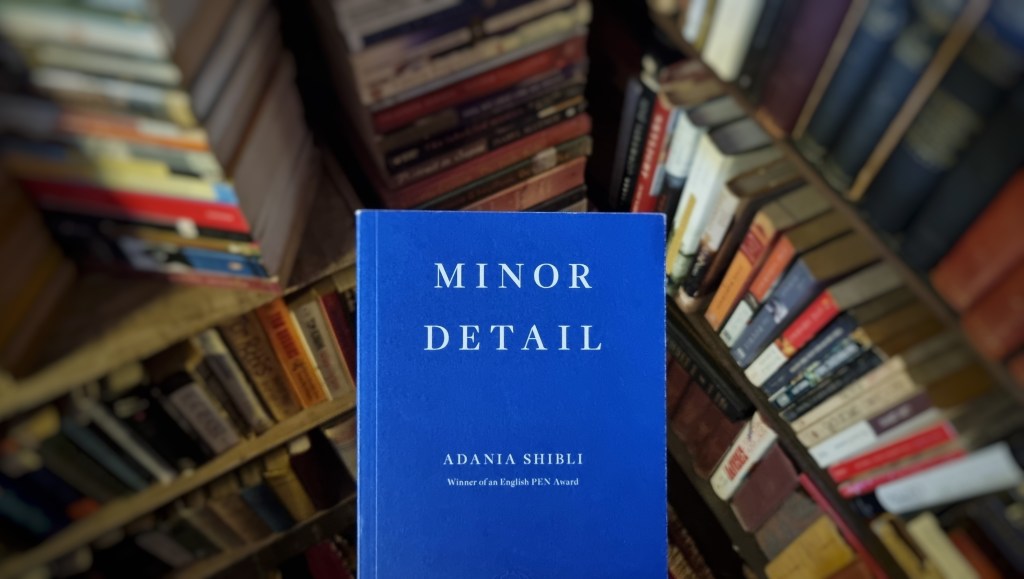
in her choice of words and in her choice of details major or minor,
in her choice of literal depictions that have the power to stand as metaphors,
even in splitting the book accurately in half to give an equal number of pages for the first part and the second part of the story,
in her sense of irony in picking a character who seems to have an inability to identify physical borders and who is obsessed with an actual news report of a rape and murder case that was committed exactly twenty five years prior to the day she was born,
and in her choice of singling out a story of the rape of a Palestinian woman by Israeli soldiers in a place where senseless killings occur on a regular basis.
What Adania Shibli does not need to spell out is that a story of violated boundaries is always a story of rape, and vice versa.
This incisive portrait of the Palestinian plight begins as a bullet in motion, without you knowing.
“In those days we associated style with substance, beauty with intelligence… we didn’t know yet that style could be purchased wholesale, that beauty could just be a commodity.”
Venice, through the pen of a mediocre writer, can easily become cliché.
But this is Joseph Brodsky.
If you, like me, have read Lawrence Durrell’s Prospero’s Cell and thought it was alone in its indefinable sub-genre or sur-genre (if there’s such a thing), we can rejoice! Venezia’s Watermark is the worthy soulmate of Corfu’s Prospero’s Cell.
Meditative with a sensual rhythm but not without intelligent humor, here is travel literature that casts an enchanting haze on the borders between poetry and prose, a place and the self.
I would slip this in my handbag in a heartbeat on a return trip to the best city to get lost in.
Whenever something momentous happens anywhere in the world, the first instinct of a reader is to read. Whether they be articles, books, or contrasting views on social media posts, a reader reads. And books, even when they are not capable of telling you everything, can still tell you a lot.
As soon as Sri Lanka’s protesters occupied their president’s palace and called for his resignation, I paused from this month’s reading goal to look into Sri Lanka.
The bad news: There is only one Sri Lankan on my shelf. The good news: It is Michael Ondaatje.
“Ceylon falls on a map and its outline is the shape of a tear,” writes this favorite author who is none other than the one who wrote about “the sadness of geography”.
Although I initially hoped otherwise, Running in the Family is not a thorough overview of the nation’s history or politics and turned out to be about family history; and yet I became so absorbed in it that I forfeited an early morning run to read it and finished it on the same day. Because after all, you learn a lot about a country through its people, through its literature, and reading along or between the lines.
There were times when it felt like I was reading about my own country: From superstitions, to drinking tubâ (coconut toddy), the humidity, the smell of durian, the attitudes, and our colonial past — “… the wife of many marriages, courted by invaders who stepped ashore and claimed everything with the power of their sword or bible or language.”
The ousting of leaders has been one of the recurring themes in my readings these past few years and I have read quite a bit to know enough that overthrowing a corrupt leader is not always an assurance of a better government (but also enough to know that the faults of the successor should never erase the sins of the previous one from the memory of its people, otherwise the vicious cycle only continues).
By the end of the book, I already felt a kinship with Sri Lanka’s people; and for now, we wait with bated breath for what is to come. While it is tempting to hope that, by some stroke of serendipity, my country and this land that used to be called “Serendip” by Arab sea traders will stumble upon great things in the future of our governments, we know we cannot leave it all to chance.
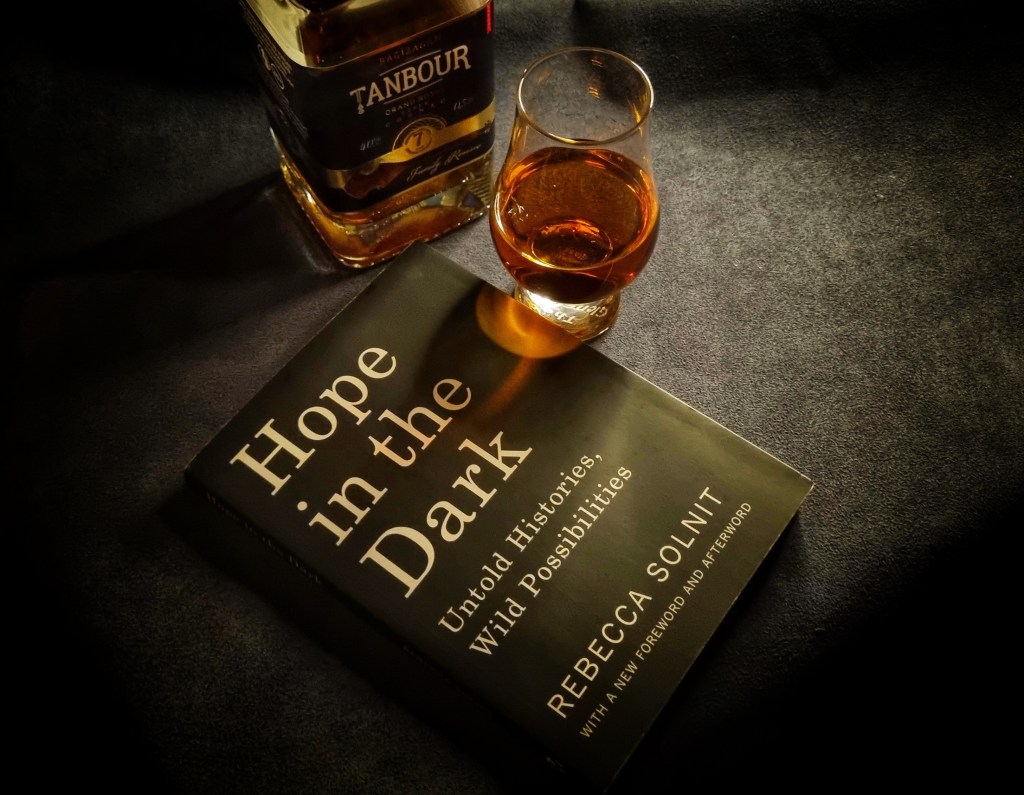
If it were not Rebecca Solnit who wrote this, I would have dismissed the title as another one of those inspirational books that I do not gravitate towards so much. But having experienced four Solnits this year prior to this, which all proved to be books I needed at the exact time I read them, I seized this as soon as it arrived. And once again, she delivered.
I felt it was written for me, who, upon returning from an exhilarating trip, returned to my country with a new president whom I did not vote for. Solnit’s books are extremely political, but she wrote this to make the case for hope, especially for those who, on the surface, seemingly lost:
To point out that just because my side did not win the election, does not mean we are not victorious in many things. To challenge myself to live the same way with the leadership I did not choose as I would have had my candidate won, and to continue being a responsible citizen and human being — because being victorious and seemingly right is small comfort when, around the world, and around the country, there is still injustice and there are still people dying and living horribly.
“Hope doesn’t mean denying these realities. It means facing them and addressing them by remembering what else the twenty-first century has brought, including movements, heroes, and shifts in consciousness that address these things now.”
“The hope I’m interested in is about broad perspectives with specific possibilities, ones that invite or demand that we act. It’s also not a sunny everything-is-getting-better narrative, though it may be a counter to the everything-is-getting-worse narrative.”
Consider reading this if you, like me, paid your taxes dutifully and was called “self-righteous” when you pointed out that our new president failed to pay his; if you campaigned for your candidate without insulting anyone but the many enjoyed branding everyone on your side as toxic, even though poisonous ones were actually present on both sides if we care to admit (I have screenshots); if you were maligned and called names because of who you supported while the same people demanded respect but has been disrespecting your candidate for six years; if you, hopefully, like some of them, just wished for a better country. Consider reading this if you are frustrated and you think hope is lost, because it just made me realize that it isn’t.
This book reminded me that hope and action feed each other, and that every action and inaction have more impact than we know; to not merely demand change but to embody it.
Hope, above all, is action; and as long as we do our part and, if possible, do more than what’s required of us, there is hope.
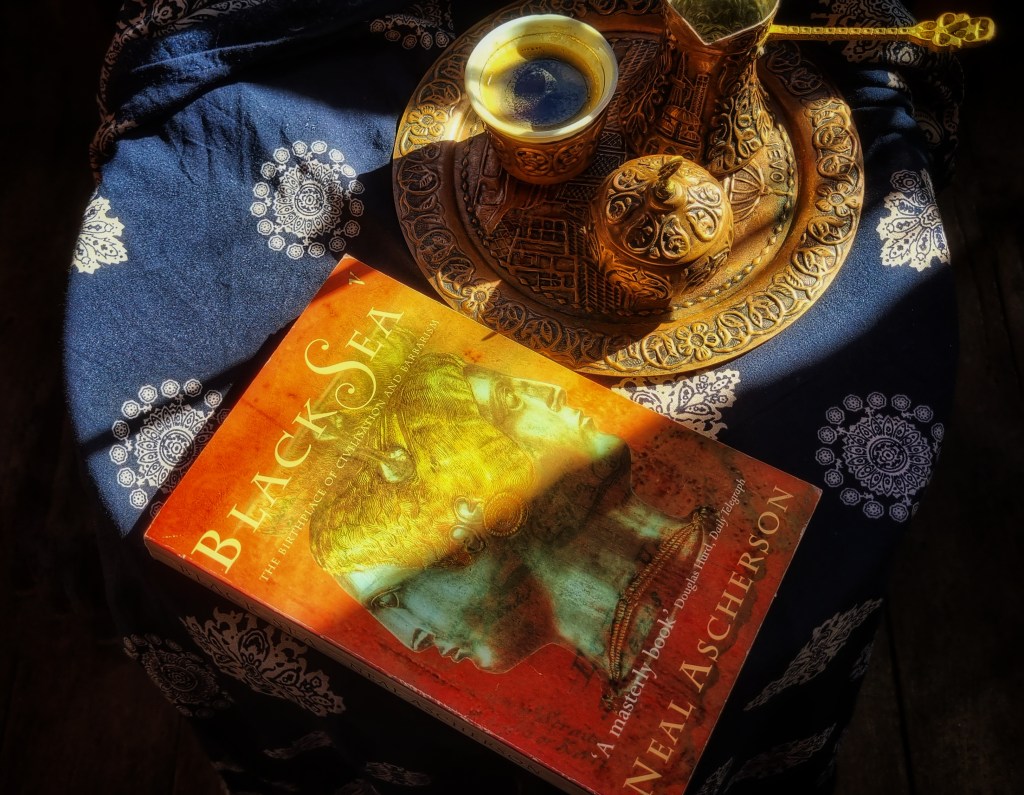
On a trip to Turkey in 2016, we landed at Sabiha Gökçen International Airport, which is on the Asian side of Turkey and closer to the Marmara Sea. The Istanbul Airport that opened in 2018 is on the European side, and just before landing on the meeting point of the world, one is gifted with a breathtaking view of the Black Sea.
I saw the Black Sea thrice from an airplane window on my most recent trip, and the irony dawned on me that this body of water that has sadly become the “largest mass of lifeless water in the world,” in fact, teems with so much history and so much… life!
This book written by Neal Ascherson about this birthplace of civilization and barbarism accompanied me, although I only finished reading it on my way back home. I don’t think I’ve read a more poetic history book!
“Human settlement around the Black Sea has a delicate, complex geology accumulated over three thousand years. But a geologist would not call this process simple sedimentation, as if each new influx of settlers neatly overlaid the previous culture. Instead, the heat of history has melted and folded peoples into one another’s crevices, in unpredictable outcrops and striations.”
Reading it brought me back to the landscapes of Tokarczuk’s The Books of Jacob and to where I’ve just been, merging the lands of my dreams with those places that are the epicenters of current world events. Because somewhere in the midst of this all, is the history of the Black Sea.
From its first mention in literature in the Bronze Age (where Jason and the Argonauts sailed upstream the Bosphorus to the Black Sea); to the different Central Asian tribes and kingdoms; to chapters that made me understand better the Russian Revolution and Communism’s life, course, and death in that region; to the question of Crimea, Russia and Ukraine’s relationship and to many things in between, I am in awe of how Ascherson sustained a poetic voice!
In a way, it answers our suspicions about how, despite all the earlier discoveries of the East in almost all fields, the West is still seen as more superior and more “civilized”. It is an enlightening investigation on the definitions of civilization and barbarism that surprisingly touches on feminism and immigration, which is quite different from what most minds have been programmed to believe.
Here is a history book that does not merely record events and dates, but most importantly, relationships. For as the author compellingly reveals, the Black Sea is not just a place but a pattern of relationships, and nothing like the symbiosis of the Bosporus Kingdom has ever happened.
A beautiful thing about traveling and reading is to be able to measure ourselves against the expanse of time and history, with the intention of acquiring more perspective, if only to acquire more life.
My last few days in Uzbekistan were supposed to be spent in Termez, a place bordering Afghanistan where Alexander (considered not so great in these parts of the world) founded a town. But after learning about the tragic earthquake in Afghanistan, and for the peace of mind of those I love (not that I’ve given them so much of that), I decided to be practical (yes, I can be, sometimes) and come back to Tashkent to be closer to the airport. Termez will have to wait; and perhaps, it is a romantic idea to leave something to come back for.
It is risky to travel these days, and it is crazy how the fate of some dreams and travel plans hang in the balance between two words — Positive or Negative. And when I asked my niece who works in a bank to change some currency for me, she reported that the bank declined upon learning of my destination, “Kay duol sa na-ay gyera.” (It is close to areas of conflict.) She had to go out of her way to another money changer. If one looks at the map, the bank is not wrong.
But here I am. Because when something feels right, it feels right. I booked my ticket with so much faith, and the itinerary that has been ready since 2020 finally came in useful.
“But I thought you wanted to go to Iran?” friends asked. I am in what used to be part of Persia. “Stan” is a Persian suffix that means “place of”. This is the place of the Uzbeks that was once of Persia. When the Achaemenids expanded their empire, they sought not to Persianize whomsoever they conquered but allowed different peoples and cultures to thrive — as long as they paid tribute, of course. And since we know borders are all but manmade, I am in the region of which I have been reading and dreaming for a long time… and it is intoxicating, and beautiful, and enriching.
The books I have been reading did not end on their last pages. The best books never do. They only give the reader a deeper yearning to continue the journey and the learning beyond the pages. They give one an urgency to live.
In the alley right below, a child sings in a language both strange and familiar to me. Strange because she sings in the Khorezmcha dialect, familiar because it is music.
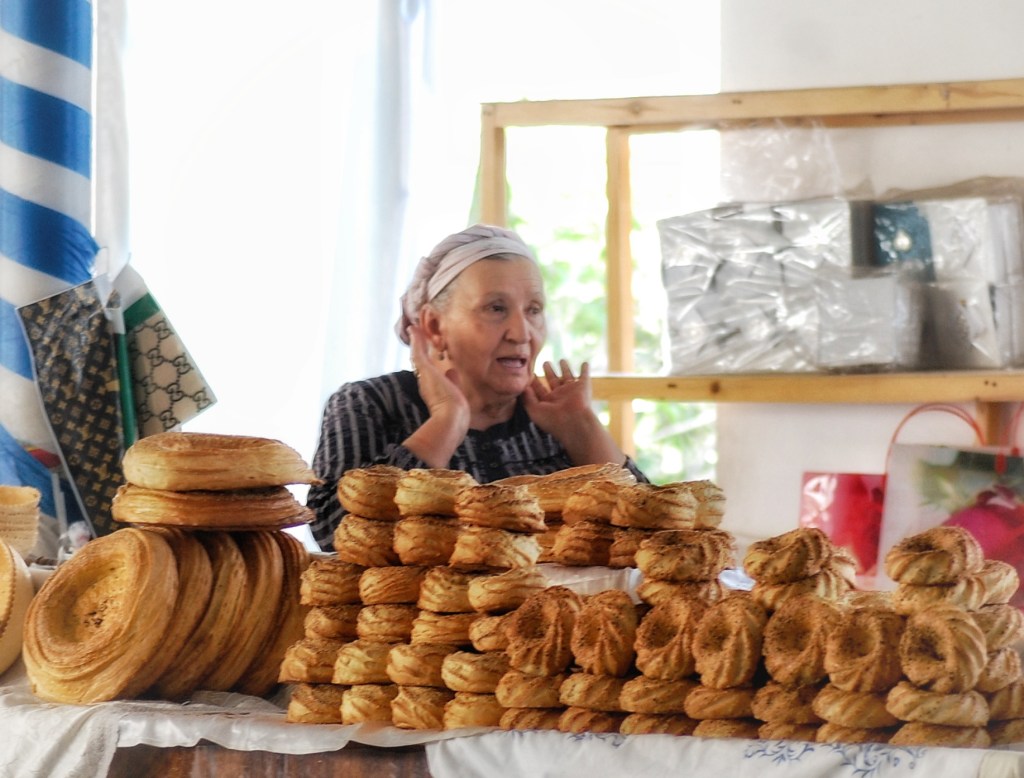
A few meters away from her, women in traditional dress eclipse the child’s voice as they bargain with her mother, a scarf seller. These women are tourists from the other “Stan” nations. They flock the streets by sundown. (Western tourists tend to forego Khiva because it is out of the way. To get here from Bukhara, one has to drive for hours through an expanse of steppeland that seems to stretch to infinity, and the usual tourist would usually opt for another stamp on the passport from another Stan than come to Khiva. I am now closer to Turkmenistan than I am to Bukhara.)
But I also see Khiva changing right before my eyes. I see workers installing LED lights, replacing some crumbling bricks, and fixing the cracks of the old city, making it look new. And although they have the tourist’s best interest in mind, I feel a pinch in my heart. I know Khiva will not look the same in a few months, or weeks… and there is a bittersweetness in realizing that I came just in time — or perhaps, a few centuries late.
In the distance, the tallest minaret in Central Asia calls my attention, calls to prayer, calls time to stand still, and all falls silent.
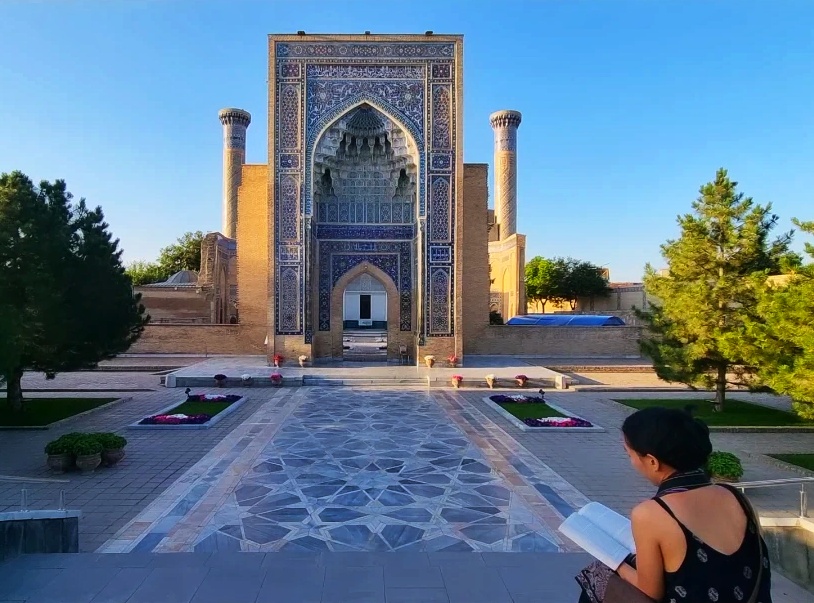
Does this balcony right outside my bedroom explain enough why I chose to stay in Khiva longer?
On the question of loneliness: “Isn’t that lonely, what you’re doing?”
(I have just returned from a solo trip to Uzbekistan.)
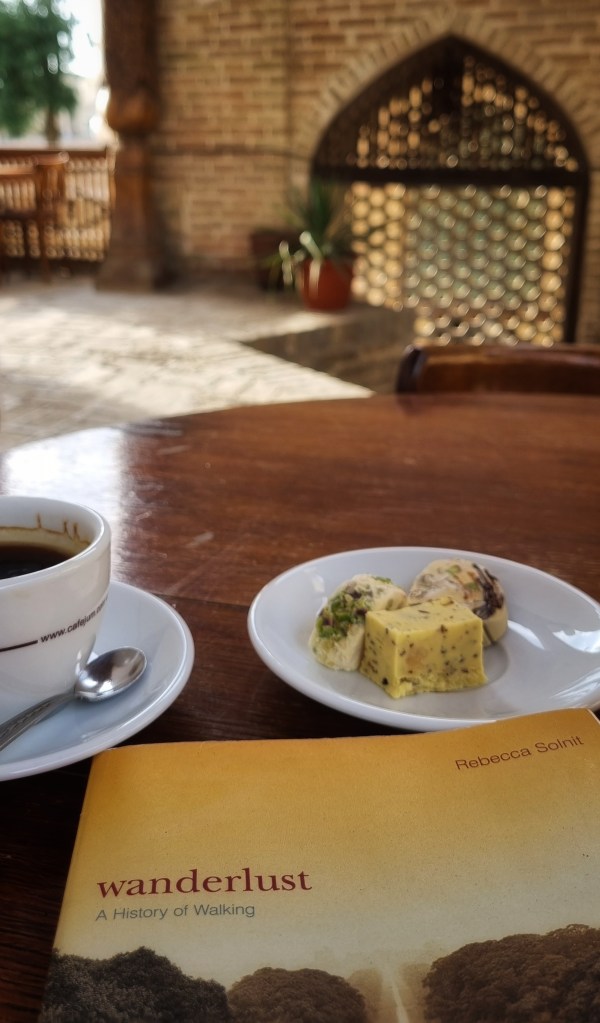
Well, these friends came along for the ride: The Naive and the Sentimental Novelist by Orhan Pamuk, for the long Istanbul flight; The Captain’s Daughter by Alexander Pushkin that was fortunate enough to have a photo at the Pushkin Metro Station in Tashkent and was enjoyed under the shade of the trees of Amir Timur Square; Wanderlust by Rebecca Solnit, read during those days at the Halva Book Cafe whilst waiting for the Bukharan sun to soften; and A Carpet Ride to Khiva by Turkish-British Christopher Aslan Alexander, which accompanied me through Khiva’s storied alleys.
As there is currently so much more outside book covers to commit to paper, I release myself from the discipline of writing book reviews this month. “Regular programming” will resume in this blog in July. Haha
But I have to mention that Pamuk, who sacrificed painting and architecture school so he could paint with words, taught me a Greek word through this book — “Ekphrasis”. Simply put, ekphrasis is, “To describe something, via words, for the benefit of those who have not seen it.” This inspired me to somehow practice ekphrasis in my little way as I traveled through Uzbekistan, and doing so has allowed me to savor experiences twice.
Pushkin, although political, was not as existentially heavy as Dostoevsky and not as heavy literally as Tolstoy — a purely delightful travel companion!
A Carpet Ride to Khiva seems to have left no stone unturned about Khivan society. It is written in simple prose, bursting at the seams with honest observations, this book is an entertaining overview of the country’s history and politics — which is, perhaps, one of the reasons why the author is banned in Uzbekistan, and why I only brought the e-book with me. I, too, have my own observations, but will keep them to myself for the time being. But it has to be noted that along with reading, traveling is a most comprehensive education on geopolitics, among other things, if one cares to engage and observe.
Solnit, with a title perfect for a trip, shared this Eskimo custom of offering an angry person release by walking the emotion out of his or her system by going in a line across the landscape; “The point at which the anger is conquered is marked with a stick, bearing witness to the strength or length of the rage.”
I, who had no anger to release, did mark the places that bore witness to the strength and length of… something else. I enjoy traveling solo. I would not keep doing it if I didn’t. It is almost like a sort of essential meditation for me and I always go home a better person. I do not feel sad with my own company. But I did mark those places, those experiences so ineffable I could think of only one person to share them with. I would prefer to call it love than loneliness. (But why is conquering anger about letting go and conquering something else the opposite? But I digress.)
As I reluctantly tuck in this unforgettable trip lovingly and a little bit pensively in the folds of memory, I am reminded that the Old Uzbek language had a hundred words for different kinds of crying. And I wonder, what about laughter? What about happiness?
There is something therapeutic and enlightening about these essays that are of diverse scope but which are bound with a single string. That string is language — and not just the spoken, but also the unspoken; the pre-verbal, the danced, the hidden, the sung, the articulate, the inarticulate, the visual.
Just a few books ago, Rica Bolipata – Santos beautifully expressed that writing is, “An added gift to the love of reading.”
For John Berger, writing is, “An offshoot of something deeper… our relationship with language.” Language, to him, is a creature, “A quivering almost wordless ‘thing’.”
Language is that which acquires a body when it is sung, or played, or danced, as in music; it is el duende of which Federico Garcia Llorca wrote, the spirit, the gestures, “Gestures that are the mothers of all the dances of the ages”!
But these string of thoughts also hint at the things that distract us from it, the diversions from what is “true, essential, and urgent.” More than that other book of his, this one will somehow recalibrate our ways of seeing, and if we allow it further, our ways of living.
The pre-verbal, the danced, the hidden, the sung, the articulate, the inarticulate, the visual, the musical… all at once, there is a sudden inspiration to live in every language I know.
Reading this reminded me of a trip to the National Museum of the Philippines. I went there for the masterpieces, but found myself spending more time, and being most delighted, in a room full of practice sketches by Amorsolo.
Exteriors are sketches, little fragments of writing that feel like ingredients for a larger canvas; and Annie Ernaux is the great artist who guides readers to become keener observers of people, of gestures, of the world beyond the intimacy of the self, of exteriors.
Peruse the sketches more carefully and find priceless lessons on writing and observing. Once in a while, we need an artist to lead us to details we should pay attention to. Once in a while, we need an Annie Ernaux to take our hand.