“Boris tells me what he’s seen on television. Lots of politics in the Ukraine, in Russia, and in America. I don’t pay too close attention. Politics are important, of course, but at the end of the day, if you want to eat mashed potatoes it’s up to you to put manure on the potato plants. The important thing is that there’s no war.”
Alina Bronksy’s wit has been on my radar for quite some time but it took one Sunday that badly begged for light reading to make me read her.
Having parents who are advancing in years, I find myself increasingly drawn to elderly protagonists. And so it was a joy to discover Baba Dunja. Her spunk, her kindness, her practicality, and her comic observations make her one of the most endearing characters one will encounter in books.
But don’t think it’s all light-hearted fun. Alina Bronsky, being a Russian-born German writer, seems to have married dark Russian humor with good old Teutonic political satire.
Even though the government appears to be apathetic about this town near Chernobyl, and despite warnings of radiation levels, Baba Dunja and her cast of amusing friends and neighbors are undeterred by the discrimination against its residents and consider Tschernowo home. And I think that’s what this book is all about — the idea and process of home that we choose and make for ourselves, no matter what.
“Wojnicz had noticed that every discussion, whether about democracy, the fifth dimension, the role of religion, socialism, Europe, or modern art, eventually led to women.”
Reading Olga with UP Symphony rehearsing Shostakovich as background.
Mischief. More literary mischief from Olga.
That the first death in the book happens to be of a woman whom our dear Wojnicz mistakes for a servant, when she is in fact the guesthouse proprietor’s wife, is not negligible.
And then, mushrooms. Then the puns in the names: January and August, two characters named after months, months named after a two-faced Roman god and a Roman Caesar; Dr. Semperweiss, because, always white; and it’s not a mere coincidence how the owner of the Guesthouse for Gentlemen where Wojnicz lodges is named Wilhelm “Willi” Opitz (see Opitz syndrome, especially in males); the Tuntschi, definitely a nod to the Sennentuntschi of Alpine folklore involving an ill-treated doll that retaliates; and Empusium, after Empusa, the female shape-shifter of Greek mythology.
The Empusium is Thomas Mann’s The Magic Mountain reframed, they say. Friends who have known me way back from my Thomas Mann reading phase know the story of how I developed a fever while reading the Magic Mountain. (They tried to assuage my sickness by saying that it’s the best state in which to read Thomas Mann. Hah!) Strangely enough, I also got sick a day after I started reading The Empusium. Whether that’s part of Olga’s mischief, I cannot say for sure, but, “The story has a spirit of sickness,” says my mom ominously.
While Mann’s mountain was an allegory for a sick Europe, Olga’s mountain is glaringly sick with misogyny. In the author’s note, Olga divulges that the chauvinistic passages were paraphrased from the words of history’s famous men, and she names all of them. Why do you think it’s labeled as a “horror story”?
The books I’ve read on two consecutive weekends; of Libya and Tunisia; and it so happens that they are neighbors on the world map.
In the Country of Men has been languishing on my shelf for over a decade, and Matar’s appearance on this year’s Booker Prize longlist reminded me of his silent presence in my library. On the other hand, This Tilting World was recently acquired after Fellous’s work caught my attention in an anthology.
Aside from the geographic proximity of their respective settings, these two books surprisingly have more in common: In the Country of Men often feels painfully autobiographical, while This Tilting World admits to being utterly personal. They are simultaneously love letter and farewell letter to their homelands; they explore questions of nationalism, and both present a character’s fraught, and yet loving, relationship with a father and a country; and the writing seems to be an attempt at making sense of the loss of innocence, of the violently shattered idyll of their childhood and hometowns.
However, these are books which, I feel, have unfulfilled potential: In the Country of Men left me wishing for characters with more integrity, This Tilting World left me in want of a more cohesive opus for Fellous’s luscious and elegant prose.
But both contain their own beauty and remain valuable records of Libya’s and Tunisia’s recent history. The books are, therefore, still worth reading.
In response to what the mother in In the Country of Men recounted, (…part of the punishment was to leave me with no books. “Don’t give her any more ammunition,” your grandfather had said…) we say: the more “ammunition” the better! It’s the only way we can make sense of this tilting world.
After immersing myself in a variety of literature from the region, and after reading nine of her books, singing praises at the time I read them, then ultimately realizing that I prefer her two nonfiction works to the seven novels, it eventually felt like I had outgrown Elif Shafak.
Nawal el Saadawi, Sema Kaygusuz, Farnoosh Moshiri, Dunya Mikhail, Adania Shibli, and other lesser known women authors that I encountered through this reading project, made Shafak’s fiction feel diluted and elementary…
…until I learned that There are Rivers in the Sky involves Mesopotamia, The Epic of Gilgamesh, and one of the books that fueled my obsession with the Fertile Crescent, Sir Austen Henry Layard’s Nineveh and its Remains.
Needless to say, I purchased the e-edition of There are Rivers in the Sky on the day it launched, and veered away from this month’s plan to read Women in Translation. Apparently, Shafak still manages to lure me with her chosen topics and setting.
And I’m glad I read it. I’m glad I did not deceive myself into believing that my literary taste has become too sophisticated for Elif Shafak. Because after all, maybe she does not water it down. Maybe what she does is a deliberate simplification, so that her books become stepping stones to forgotten stories, accessible pathways to pressing matters that we don’t even stop to think about, and springboards that launch readers into deeper inquiry about issues that are not discussed enough.
In There are Rivers in the Sky, Shafak still transcends her pretty book covers and continues to be an activist for those who do not have a voice — in this case, buried history, looted artifacts, dying rivers, and the dwindling Yazidis and the continual decimation of their people and their stories.
Reading this has taught me many lessons, and it is not without its beautiful lines: “…the world is changing faster than minds can grasp… all these smartly turned out people with their polished boots and affected airs, you look at them and you think they must know everything, educated and cultured as they are, but… when times are confusing, everybody is a little lost. No one is inwardly confident as they present to be. Hence the reason we must read… books… provide us with light amidst the fog.”
That’s why we need to read women. What does that have to do with it? It has everything to do with it.
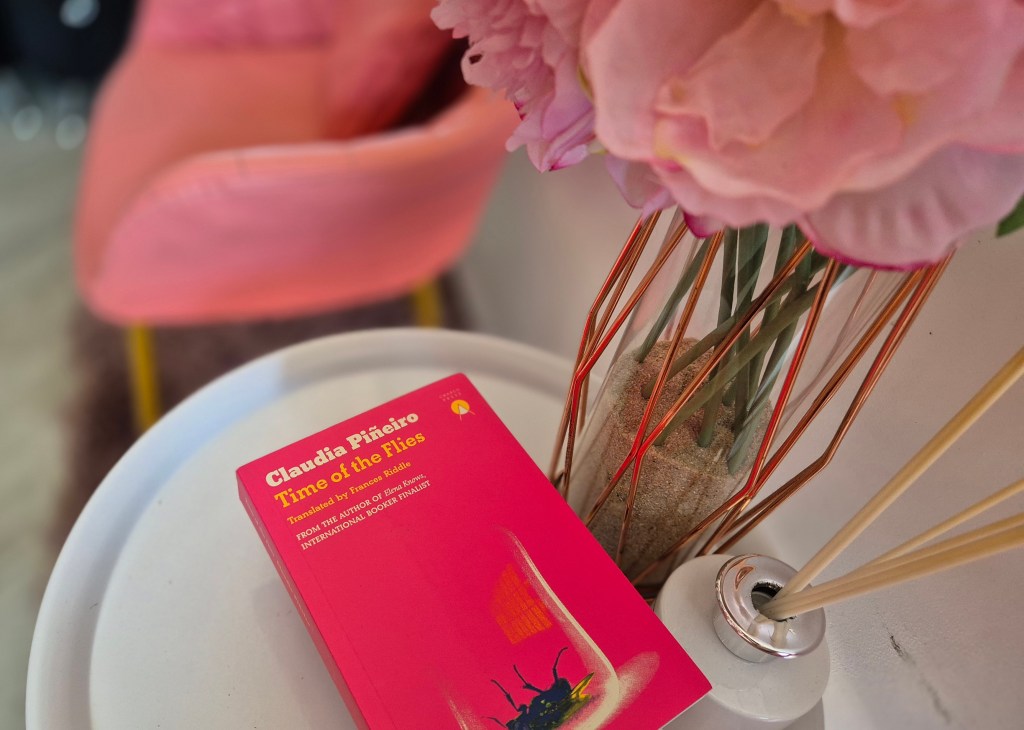
Give me a back cover blurb without telling me the book is by Piñeiro and I would notbe very interested. The descriptions of her novels are unattractive to me, especially if they are about flies and women killing their husbands’ lovers.
But tell me a book is written by Piñeiro and I would read it without even asking what it’s about, even if it seems to be about flies.
Because if you just trust Piñeiro’s storytelling prowess and allow her to take you on a satisfying ride, you eventually learn that when it comes to the word “fly,” there is the noun, and there is the verb, and she’s ultimately writing about freedom.
Predictably unpredictable. She does it again. But this time, more heartwarming than one would expect, and more blatantly feminist.
“That’s the thing about love, it likes to leave its mark.” — Nathalie Handal
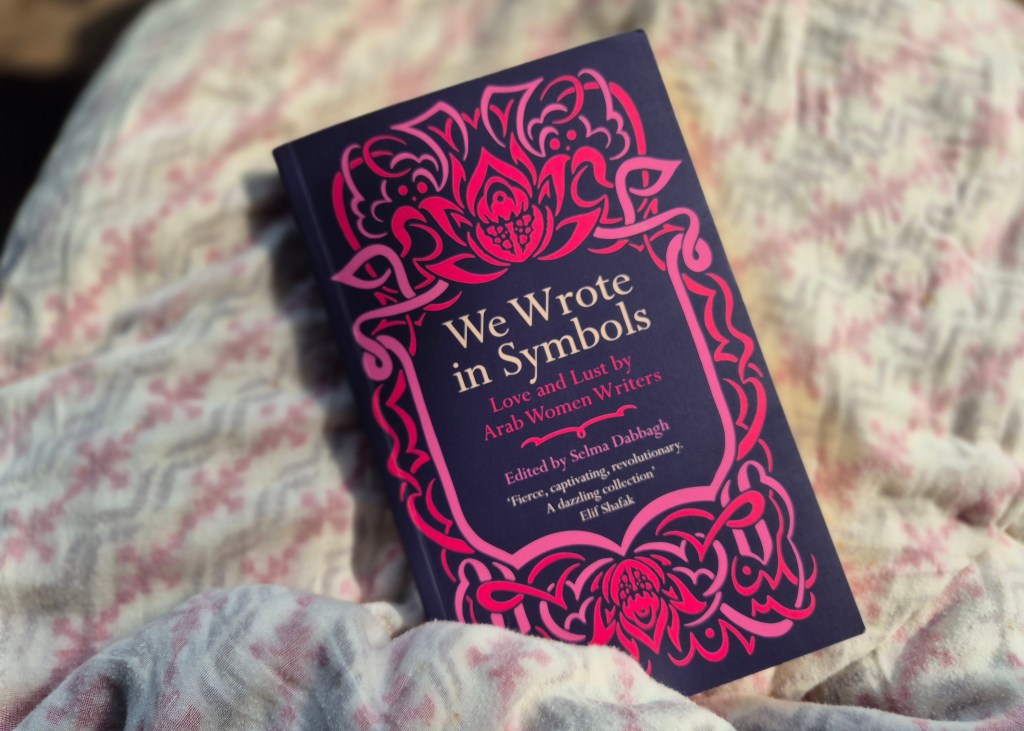
This collection of writings by Arab women turned out to have more erotic passages than I expected, and the conservative reader who cannot appreciate this as an act of defiance against authoritarian patriarchal societies might prefer to stay away.
I value this book as a reminder, as the introduction mentions, of how women were writing in Arabic centuries before women began writing in English; and as a reminder of the treasure troves of Arabic literature that hardly make it into our consciousness simply because they are not on the Western radar.
Poems by Arab women throughout the ages pepper this collection alongside contemporary essays and excerpts from novels, including those by Palestinian authors, Adania Shibli, Suad Amiry, and Naomi Shihab Nye. The translations are no less significant as it has works by Man Booker International Prize awardee, Marilyn Booth, and Ernaux translator, Sophie Lewis.
More than a treasury of sensuality, I see this book as a celebration of women who strive to steer the gaze away from centuries of male perspective, and a celebration of women in translation, but who are translating forceful statements beyond mere words.
What I think will stay with me, however, is a line from Tunisian-French author, Colette Fellous — an imagery of two lovers’ bodies, likened to a closing book.
Because it is August; because it is set in rural Patagonia; because it is translated by Jennifer Croft; because it is Women in Translation Month.
This was an uneasy read. It bares a twenty-one-year-old mind in that unsettling stage before growth. The whole book is an interior monologue addressed to a best friend lost to suicide. As Emilia returns to her hometown to scatter the ashes of Andrea, she has to confront loss, death, and living.
Given such weighty themes perused from a different perspective, this had the potential of being a great book. It had touching passages that hit the mark, but also too many that missed. But then again, we rarely hit the mark at twenty-one. My literary palate should be more forgiving.
Because it is August; because it is set in rural Patagonia; because it is translated by Jennifer Croft; because it is Women in Translation Month.
“Literacy, Vaso-dzhan, has no place here,” said Satenik, tapping a finger on her cousin’s forehead.“It’s here in the heart,” she said, placing her palm against his chest.
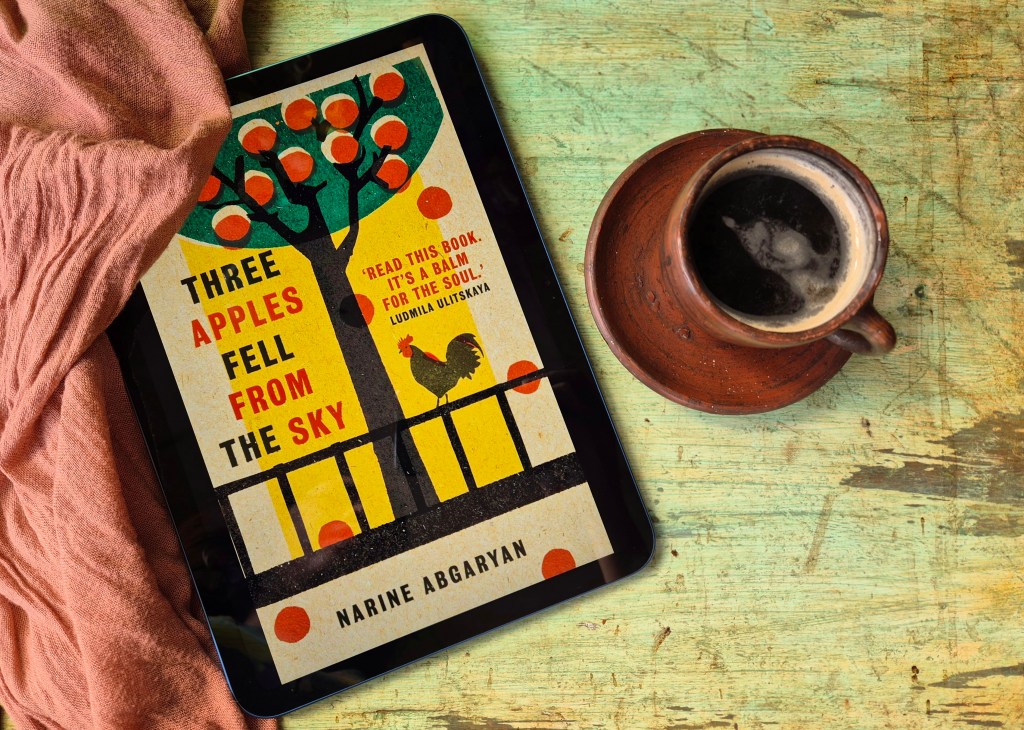
In a picturesque Armenian mountain village where its people have been scarred by time, and happiness is few and far between, a woman prepares for her imminent death.
And yet, I was not prepared for how much joy this book ushered! Yes, joy!
Despite its bleak opening, Three Apples Fell from the Sky is an unexpected playful balance of friendship, conflict, small-town superstition and traditions, finding refuge in reading, love found in a couple’s twilight years, communal and personal griefs, and healing — which all transmutes into a heart-warming embrace in literary form.
Whenever Armenia is mentioned, the first thing that comes to mind is the ethnic cleansing of Anatolia that resulted in the deaths of between 600,000 to 1.5 million Armenians. While it is important to keep the genocide in memory, it is noteworthy how this book only hints at it along with its suffering under Soviet rule — as if to remind the world that there is more to Armenia than its pain.
If you need a literary hug (and a lovely way to begin Women in Translation Month), consider this book.
These mangoes were purchased from a side street in Jaipur to refute Aimee Nezhukumatathil’s claim that — *gasp* — India’s Alphonso mangoes are sweeter than Philippine Carabao mangoes!
Don’t get me wrong. I love A.N. She is the most wholesome and heartwarming author one can find on bookstore shelves these days. Her World of Wonders still keeps my heart soft. Before leaving for this trip, I suggested her latest book, Bite by Bite: Nourishments and Jamborees, to two friends who are also traveling, and then hinted that we discuss it over wine when we’re all back in Dipolog. But after scanning the first few pages, I ended up reading the whole thing even before I left! It was the last book I read in May.
I just had one problem with it: The mango verdict.
“I am the daughter of a man from India and a woman from the Philippines,” She writes. “They have argued all my life about whose mangoes are the sweetest, the best. Both have asked me to take sides, and for years I’ve refused until now. Alphonso mangoes, hands down. From India.”
And these were the lines that led me to a dark side street in India. I began to worry on my way back to the haveli. Not for my safety, but for the reason that, from within the bag hanging from my hand, the unbelievable fragrance of the mangoes were already invading my nostrils! I think my heart raced when I sliced one open with my Swiss knife.
My verdict? Maybe THAT will endanger my safety! Haha!
What I realized, however, as the two juicy mangoes were immediately reduced to seed and skin, was that THIS is nourishment — tasting, exploring, discovering, learning, reading, traveling, and eating the mangoes of another country. Once in a while, our hearts need this.
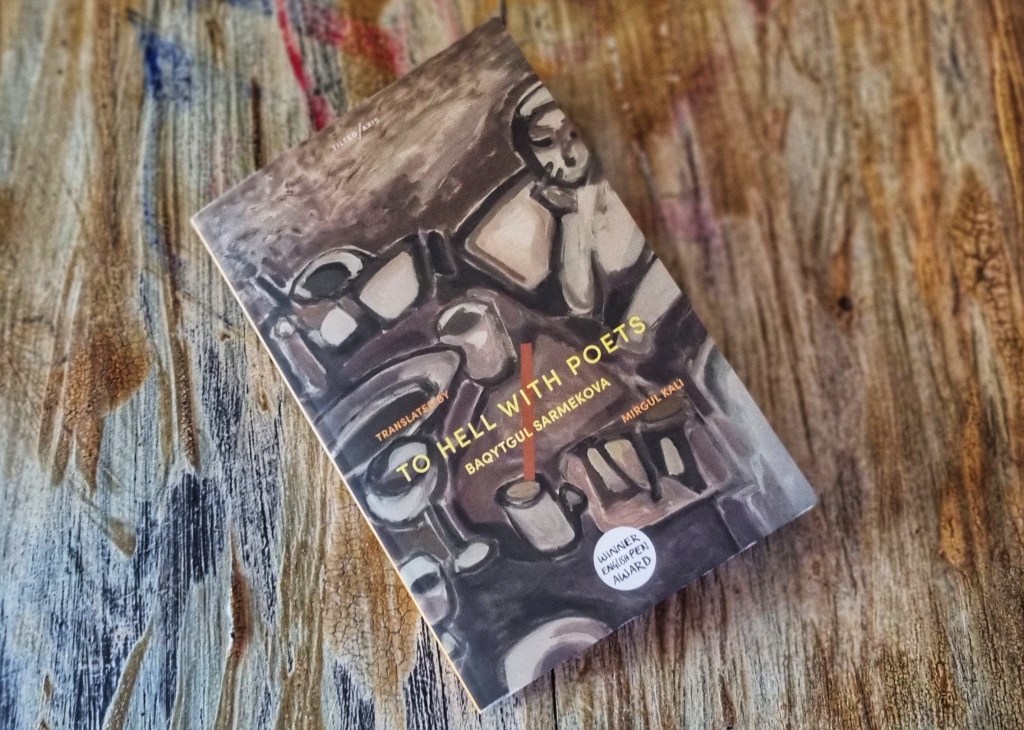
Having loved the Hamid Ismailov Uzbek trio published by Tilted Axis Press, it was exciting news to me when they announced the release of a Kazakh work earlier this year.
When there’s a dearth of Central Asian literature in circulation, what’s a girl (who arranges her books by political geography and who loves to broaden the scope of her literary horizons) to do? She rushes to get her hands on it.
Any reader could have finished this in one sitting, but I read the stories bit by bit and in random order — as one should read anthologies, I’ve been told. Although the reason I took it in small doses was because of its bleakness.
I’m grateful to have read my first Kazakh work, but sad that it turned out to be an intimate peek into a joyless and disquieting world. Even its sunshine felt gray.
Tilted Axis Press describes this as “a sharp and honest rendering of daily life in Kazakhstan.” If it is, it makes you wonder if there is ever room for wonder or an enthusiasm for living in such a place, because one cannot find any of that in this volume.
Nevertheless, this book succeeds in wakening a slumbering part of one’s consciousness. And so I look forward to a Tajik and Kyrgyz release, Tilted Axis Press!




 The Book-Butterfly