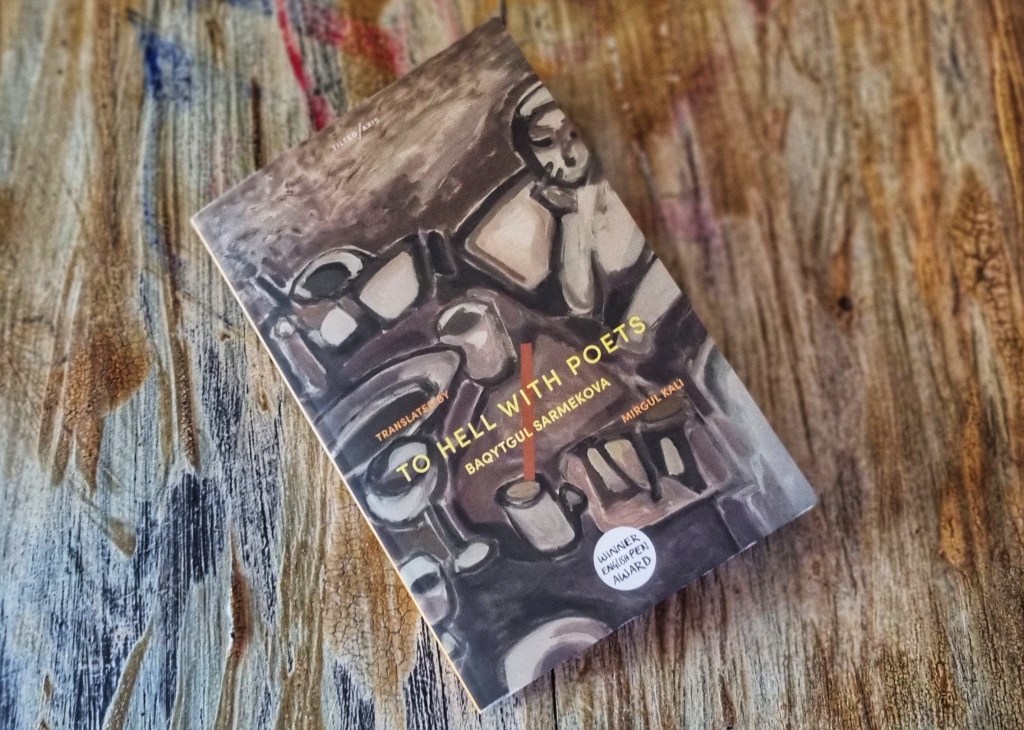
Baqytgul Sarmekova: To Hell With Poets

Having loved the Hamid Ismailov Uzbek trio published by Tilted Axis Press, it was exciting news to me when they announced the release of a Kazakh work earlier this year.

When there’s a dearth of Central Asian literature in circulation, what’s a girl (who arranges her books by political geography and who loves to broaden the scope of her literary horizons) to do? She rushes to get her hands on it.

Any reader could have finished this in one sitting, but I read the stories bit by bit and in random order — as one should read anthologies, I’ve been told. Although the reason I took it in small doses was because of its bleakness. 

I’m grateful to have read my first Kazakh work, but sad that it turned out to be an intimate peek into a joyless and disquieting world. Even its sunshine felt gray. 

Tilted Axis Press describes this as “a sharp and honest rendering of daily life in Kazakhstan.” If it is, it makes you wonder if there is ever room for wonder or an enthusiasm for living in such a place, because one cannot find any of that in this volume.

Nevertheless, this book succeeds in wakening a slumbering part of one’s consciousness. And so I look forward to a Tajik and Kyrgyz release, Tilted Axis Press!

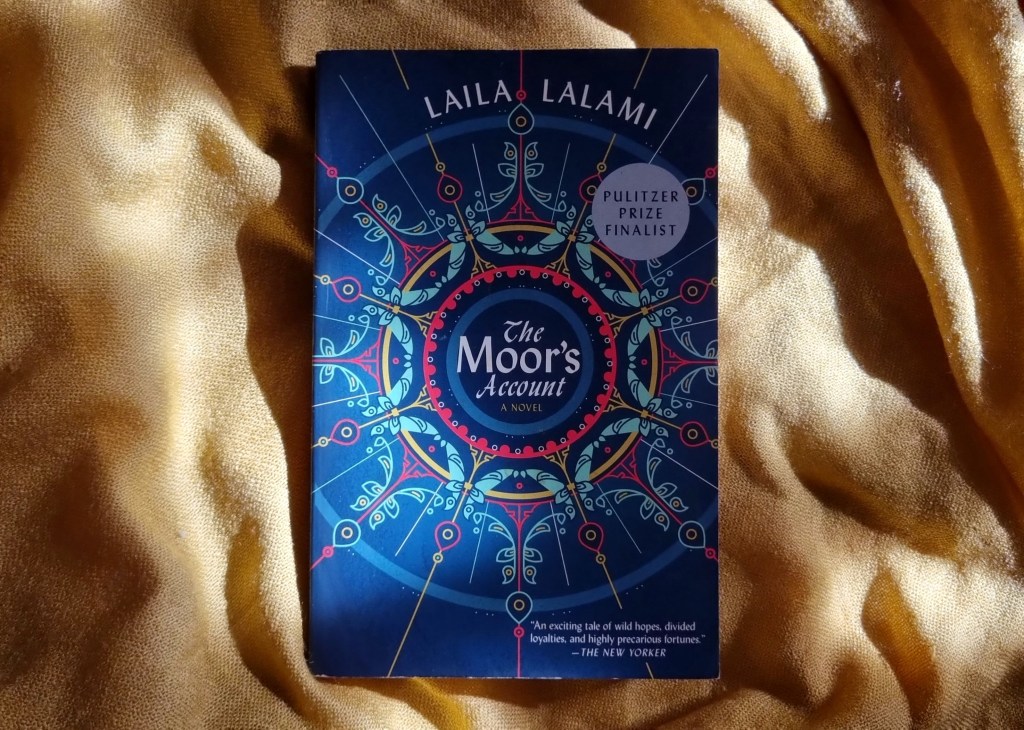
Laila Lalami: The Moor’s Account

Literature continues to witness the exciting rise of old stories and histories told in new perspectives. We now have Greek mythology narrated through the vantage point of the misunderstood or footnoted women, we have world history that challenges purely Eurocentric lenses, the Crusades recounted through the Arab viewpoint, and various retellings of otherwise prevailing narratives that have been unquestioned for years.

The Moor’s Account falls in the category of books that offer readers a new point of view. It is an imagined memoir of the first black explorer to the Americas. Although history will not remember him as such, as he was the Moroccan slave of Andrés Dorantes de Carranza. Together they would be half of only four survivors of the unfortunate Narváez Expedition, a Spanish expedition that set sail in 1527 with the aim of establishing settlements in La Florida.

The Moor in question is Mustafa al-Zamori, baptized Estebanico when he became a slave. This event at the beginning already hints at how, through an imposed name change, an entire history is erased: “A name is precious; it carries inside it a language, a history, a set of traditions, a particular way of looking at the world.” It was the first of many erasures, Estebanico would later learn.

My first attempt at reading this book was unsuccessful, but the recent announcement of Pulitzer nominees reminded me of this 2015 finalist that has remained sitting on my shelf for a while. Now that I have finally reached its last page, I have realized that the value of this novel lies in its reflections on identity, in its acknowledgment of the precarious power of stories, and in its critique on how history is written — how “unfounded gossip can turn into sanctioned history if it falls in the hands of the right storyteller.”

“How strange, I remember thinking, how utterly strange were the ways of the Castilians — just by saying that something was so, they believed that it was. I know now that these conquerors, like many others before them, and no doubt like others after, gave speeches not to voice the truth, but to create it.”

After dodging an ambush led by Indians, I found in Ruiz, a member of the expedition, an arrogant colonizer who felt victimized when natives tried to protect what was theirs — an embodiment of entitled powers that still plague the present: “‘Do you think we did something to them?’ Ruiz said. ‘No one did anything. That is just how the heathens are. Look what they did to me. He pointed to the dark socket where his left eye had been, oblivious to the role he had played in his own predicament.’”

This book does not contain literary acrobatics. The style is quite simple. But it lends the reader old truths and a new set of eyes. 

Sophy Roberts: The Lost Pianos of Siberia

Before Iran, before Persian history, it was Russia, its music, literature, and history that I was preoccupied with for years. (Remember how I named a pet fish “Shosta,” after Shostakovich, who leapt out of the fishbowl to his doom, and died a very dramatic Russian death?) Adulting eventually distracted me from this obsession until Iran took over and began to burn as big a flame in my consciousness.

This book brought me back to my teen years of being fascinated with Russia. As I turned the last page of this beauty, the traveler, the pianist, and the lover of stories in me were all brimming.

After all, Russia is the country of Tolstoy and Dostoevsky, of Rachmaninoff, and “piano music has run through the country like blood.”

Sophy Roberts, however, zones in on Siberia, that immense region that covers eleven percent of the world’s land mass, and home to ninety percent of Russia’s natural resources.

So, what does it have to do with pianos? A lot, apparently. This account traces how the instrument began to grip the heart of the country during the reign of Catherine the Great, how this mania was fueled by concert tours by Liszt and Clara Schumann, and how political prisoners from Poland, the land of Chopin, and Decembrist intellectuals (members of the unsuccessful revolt against Tsar Nicholas I in December 1825) who were exiled to Siberia made culture flourish in the hinterlands by bringing their books, their learning, and their music with them, leaving precious pianos in their wake. It also poignantly mentions that the only thing that survived the Romanov massacre was the piano that the young tsarevnas brought with them and on which they played during their last days.

But who would be insane enough to go to Siberia and track the lost pianos of Russia’s history? Sophy Roberts. And she’s my kind of insane. This book is already making me dream of becoming this kind of journalist and writing this kind of book when I grow up. Haha

Which lost things should I go looking for? 


P.S. One simple paragraph also made me understand the rise of Putinism and why he still has a strong following. This doesn’t mean I’m going to start being a Putin apologist, far from it. But it is a sign of a good work of journalism when it makes you see the other side of the coin.

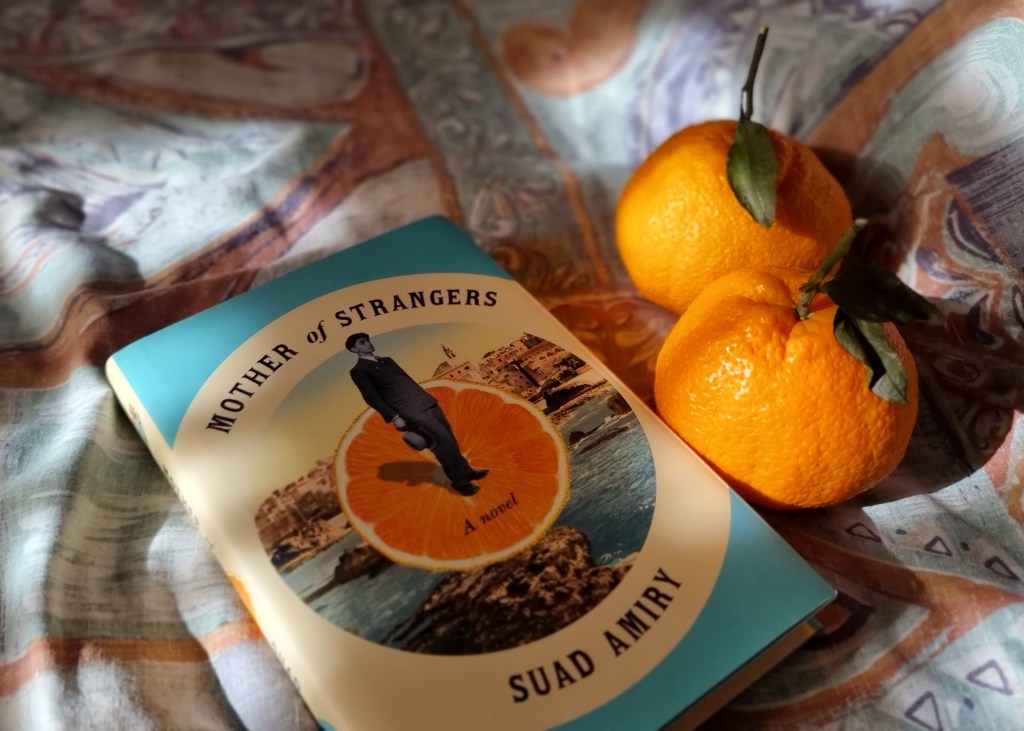
Suad Amiry: Mother of Strangers

“It is human kindness, rather than religion or nationality, that conquers the human heart.”

The “Mother of Strangers” is Jaffa. In case you, like me, wondered to whom or what the title referred.

Jaffa that was the richest and largest Arab city in Palestine. Jaffa, known all over the world for its pure gold — its oranges and orange groves. Jaffa, named after one of Noah’s sons who purportedly built the city after the great flood. Jaffa, a major city during the Ottoman Empire. Jaffa that was designated as part of Mandatory Palestine / the Arab state through the Partition Plan, but which Irgun decided to conquer before the end of the British mandate when Arab armies (Egyptian, Iraqi, Syrian, and Jordanian) could enter Palestine. And therefore, the helpless Jaffa that surrendered to the Haganah who promised to protect Jaffa and its people. (“However, before the ink had dried on the agreement, the city was violated, robbed, and the Haganah forces terrorized the few thousand Jaffans who remained.”)

It is more than a sad tale of young love as the blurb describes. Based on a true story, it tracks a seldom mentioned, but significant aspect, of history that is vital in our understanding of the Palestinian struggle. This is one of those books that show us that what is happening in Gaza is never so simple, and that it did not abruptly begin on October 7, 2023.

Barbara Comyns: The Juniper Tree

Take care, dear Bella. Happiness is a very fragile thing… 

Barbara Comyns is such a skillful writer who can string you along with hope despite a sense of foreboding right from the beginning. It is the same thing that oddly lures you deeper into the story until the previously unknown but anticipated event suddenly confronts and startles you.

It is a book too dark for a Sunday read, but perhaps it was written to reveal the madness that could ensue when women go against their intuition and trade their freedom for something else. 

Balsam Karam: The Singularity

“I come from a tradition of loss.”

Kurdish authors — whether their Kurdish-ness belongs to the Iranian, Iraqi, Turkish, or Syrian side — all come from the same amorphous tradition of storytelling, and they have an artful way of wrapping their own originality around this. But they also come from another kind of tradition; that of loss. 

Balsam Karam describes herself as, “a Kurdish writing in Swedish.” That is exactly why, even without checking what this novel is about, I immediately purchased a copy. There is a scarcity of Kurdish voices in literature, and this scarceness urges me to listen to each one.

Now I have found that this book is about mothers losing children; and children losing mothers; motherlands being uprooted of her children; and children being separated from their motherlands; written by a woman who is in the process of retrieving her voice when she thought she had lost it along with her firstborn; and all these meld into each other in a mosaic of poetry and prose.

Yes, it is fragmented and it is painful. That’s what loss feels like.

Linda Ty-Casper: The Three-Cornered Sun

“The chief glory of every people arises from its authors.”

Debatable to some, for sure. But I am inclined to agree with Samuel Johnson, and with Susan Sontag. Especially after having read The Three-Cornered Sun.

Read the review at exlibrisphilippines.com.

Nawal el Saadawi: Two Women in One

While I have long discovered that I prefer the nonfiction writer in Nawal, her fiction remains to be in a class by itself. (That’s why I still continue collecting what I can of her books, fiction and nonfiction, especially now that I’ve discovered these excellent editions — in terms of publication quality and translation — from Saqi Books.)

Two Women in One is not straightforward storytelling. There’s a tinge of Clarice in the free indirect prose. Unsettling, like any piece by Nawal; claustrophobic, and therefore, effective.

It’s not a good place to start if one is new to Nawal. The angst of a young woman, wanting to be an artist but who’s forced into medical school, is potent here. 

Conformity becomes suffocating to her, “Everything had the same color and shape to her. All bodies were similar, and all gestures and voices. She found herself running aimlessly… fleeing the deadly sameness within and without…” When she realizes that none of her life is her doing or her own choice, she unleashes a rebellious other woman in her. “Freedom is dangerous, but life without it is no life at all.”

But what I found most powerful in this work is the underlying message that unless Egypt is free, she cannot be free. “Egypt was not free. The chains were still there.” Because when all is said and done, how a nation treats their women, is always a measure of that nation. A woman’s personal freedom is often symbiotic and synonymous with national freedom. 

My Pen is the Wing of a Bird: New Fiction by Afghan Women

This book came into my possession on International Women’s Day. That day I was asked to speak at an event in celebration of Woman; and as one who never goes out without a book (in case of emergency), I slipped this in my bag on the way out. I was early at the venue so I took this out and flipped the title page. It read:

“My pen is the wing of a bird; it will tell you those thoughts we are not allowed to think, those dreams we are not allowed to dream.”

Batool Haidari, Untold Author, International Women’s Day 2021

The line was written on exactly the same day three years earlier. That’s when I knew I brought the right book with me.

The first open call inviting Afghan women to submit short fiction came in 2019. The creation of this anthology and the translation of the pieces from Afghanistan’s two principal languages, Dari and Pashto, pressed on through more than just power outages and internet service interruptions, but also a global pandemic lockdown and the Taliban takeover in 2021. The book that now sits on my shelf is a triumph.

As anyone might have guessed, there is little happiness here. But it makes us see that there is humanity, kindness, and so much more to Afghanistan’s stories than just war. As in any short story collection, some stories have more literary merit than others, but every single one deserves our attention if we wish to educate ourselves and see a more thorough picture of Afghanistan and the world we live in — especially when their humanitarian crisis continues even as the world’s attention is no longer on them.

“My pen is the wing of a bird; it will tell you those thoughts we are not allowed to think, those dreams we are not allowed to dream.”

This line made me realize the wide gulf between literature by women from places of conflict and the first world. In literature from the first world, this would refer to careless and obsessive romantic affairs, and the women who write about these things are lauded for their rawness and honesty. In literature from marginalized communities, the thoughts they are not allowed to think and the dreams they are not allowed to dream are education, work, the freedom to do the right thing, and the freedom to live. A dose of the latter is always a healthy reality check on the disparity present even within women’s literature.

Susan Sontag: At the Same Time

Reading on Women’s Month is something I look forward to each year. There’s simply nothing like communing with some of the fiercest minds in literature for an entire month!

I’m glad to have kicked off with Hurricane Clarice and Hanne Ørstavik, but this month’s reading goals are not too unrealistic: One Sontag essay a day (although I will definitely squeeze in what I can). I cannot fully express how much her words feed me so profoundly.


“…literature was a criticism of one’s own reality, in the light of a better standard.” — From The World As India

“Literature can train, and exercise, our ability to weep for those who are not us or ours. Who would we be if we could not sympathize with those who are not us or ours? Who would we be if we could not forget ourselves, at least some of the time? Who would we be if we could not learn? Become something other than we are?” — From Literature is Freedom

“To have access to literature, world literature, was to escape the prison of national vanity, of philistinism, of compulsory provincialism… Literature was the passport to enter a larger life; that is, the zone of freedom. Literature was freedom. Especially in a time which the values of reading and inwardness are so strenuously challenged, literature is freedom.” From Literature is Freedom

 “And one of the resources we have for helping us to make sense of our lives, and make choices, and propose and accept standards for ourselves, is our experiences of singular authoritative voices, not our own, which make up that great body of work that educates the heart and the feelings and teaches us to be in the world, that embodies and defends the glories of language: namely, literature. From At the Same Time: The Novelist and Moral Reasoning

 “The writer’s first job is not to have opinions but to tell the truth… and refuse to be an accomplice of lies and misinformation. Literature is the house of nuance and contrariness against the voices of simplification… the job of the writer is to make us see the world as it is, full of many different claims and parts and experiences.” From The Conscience of Words

“A writer is first of all a reader. From The World As India

“The capacity to be overwhelmed by the beautiful is astonishingly sturdy and survives amidst the harshest distractions.”  — From An Argument About Beauty