October’s Horrors

The Ex Libris October horror theme and Krasznahorkai being awarded the Nobel Prize in Literature seemed to point to one title on my shelf for my book of choice, the author’s debut novel, Satantago. Although set in post-communist Hungary, it reminds me of another Nobel laureate’s masterpiece, Olga Tokarczuk’s Books of Jakob, in the way the direst of circumstances require a savior and people recklessly fall for a con man that they believe could fill the longing for a messianic figure, inevitably leading to grim consequences. Its chapter numbers reveal a curious anomaly: Upon reaching VI, it counts down to I, apparently resembling the tango steps that go six steps forward and then six steps backward. If I’m right in thinking that this devilish dance, this Satantango, is a depiction of the cycles of history and society, then it is a rather bleak portrayal of humankind, but it is not far from the truth.

Thankfully, Krasznahorkai’s eerie shadows and unrelenting rain were tempered by Lasco’s ever hopeful outlook, despite raising questions about uncomfortable truths, demanding accountability and transparency from our leaders, making us understand that a crime against the environment is violence, while simultaneously encouraging moral response rather than moral panic. This reader prescribes Lasco’s Second Opinion for a healthy and much-needed dose of social medicine.
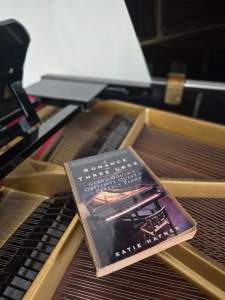
Aboard the Voyager I is a “golden record,” compiled by a NASA committee chaired by Carl Sagan, that includes Gould’s recording of Bach’s Prelude and Fugue in C. Gould’s piano tuner is quoted to have said, “…it was like a dream. There’s Bach writing the music, Glenn is playing the music, and it’s my tuning that’s giving it voice. And it’s going somewhere in outer space.” A Romance on Three Legs is an essential and enriching read for pianists that, as promised, chronicles Gould’s “obsessive quest for the perfect piano” but goes beyond his brilliance and his eccentricities and ventures deep into the world of pianos and uncommonly highlights the often undervalued contribution of piano technicians. For this reading pianist, this book was read in the key of fascination.
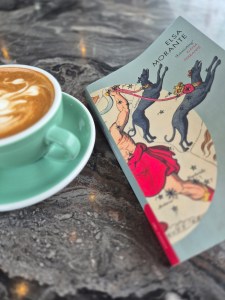
But it was Arturo’s Island that exceeded my expectations. It has the allure, the perturbing quality, and the devastating effect of a Greek tragedy — where the tragedy, if one reads deeper into it, is to live without love, especially a mother’s love. (Now that 800-page NYRB doesn’t seem so daunting anymore. Now I understand why every significant Italian author reveres Morante.) This book has prose so lush that I want to steep in it all day!

We did not have to seek after books that portrayed the supernatural; we only had to look into literature depicting history, current events, corrupt politicians, and human nature to be reminded that there is horror enough in the real world. But it is through reading that we can try to make sense of it all.

Han Kang: We Do Not Part

“In every story, without exception, the woman looks back. She turns to stone on the spot.”

“Because Koreans don’t win the Nobel prize for literature,” says the young Nora in Past Lives when Hae Sung asked the aspiring writer why she was moving to Canada.

As much as I love that film that’s lodged in a heart space that I thought was only reserved for the Before Sunrise/Sunset/Midnight trilogy, I was glad Nora proved to be wrong when Han Kang became the first Korean and the first female Asian writer to be awarded the Nobel Prize in Literature.

Lauded for her “intense poetic prose that confronts historical traumas and exposes the fragility of human life,” it then became a goal to read Han Kang for Women’s Month this year.

It is one of the most atmospheric books I’ve read. I can almost feel the snowflakes falling on my heart until now.

The novel takes place on Jeju Island, a place that I regarded merely as a popular vacation spot thanks to KDrama and the island’s visa-free policy for Filipinos. It also drew international attention on December 29, 2024, when a Jeju Air flight overshot the runway and resulted in 179 fatalities. That’s all I knew of Jeju — until I read this.

What begins as a woman having a series of nightmares and discernibly living with an unnamed trauma, builds suspense when a friend in the hospital asks her to rescue a pet bird that was left alone at home after an accident occurred. What Kyungha discovers in her friend Inseon’s home in the dead of winter gradually opens her eyes to the Jeju massacre of 1948. It is such a hallucinatory reading experience that I had to verify if something that horrific really happened in idyllic Jeju Island’s history.

“Extermination was the goal. Exterminate what? The reds.” But Jeju’s inhabitants were not all reds, and yet it was easier for the military to operate by decimating the population. For nearly fifty years after the massacre, it was a crime punishable by law for a South Korean to mention the event. A huge percentage of the thousands that perished were innocent.

“Collateral damage.” That’s what they call it. Now where have I heard that term recently?

Jon Fosse: Trilogy

The fate of the fiddler is fatal… always giving yourself to others… always trying to make others whole

…and if he was asked where it (music) came from, he answered that it probably came from grief, grieving over something, or just grief, and in the music grief could lighten and become soaring and the soaring could become happiness and joy, so therefore music was needed, therefore he had to play… 


It was the violin on the cover that decided my first Jon Fosse. I wouldn’t have known where to start, and I have been eager to start ever since he received the Nobel for prose which “gives voice to the unsayable”.

And so it was the violin, or rather the fiddle. And because of the fiddle, I sit here a day after reading the last line. A day, because for an entire day I could not write anything about it. I could only feel and think of it and nurse this prolonged pinch in my heart. And maybe that’s how it’s supposed to be, and I should drop my attempt to say something clever about it. 

Because I sit here and feel drenched by the weight of simplicity. Because in his words there is a childlike simplicity that humbles what we think we know about expressing life and about storytelling. Because Jon Fosse is a poet, and his poetry and prose bleed into each other, leaving no borders between them.

September 8, 2023 – The Cairo of Naguib Mahfouz

The Cairo that was introduced to me as a reader was not the Cairo of travel posters. The same way that the Istanbul I know is the Istanbul seen through the soul of Orhan Pamuk, the Cairo I know is the Old Cairo of Naguib Mahfouz.

If you’ve read works of both Nobel laureates, you can attest that the constant main characters of their novels are the cities of their birth.

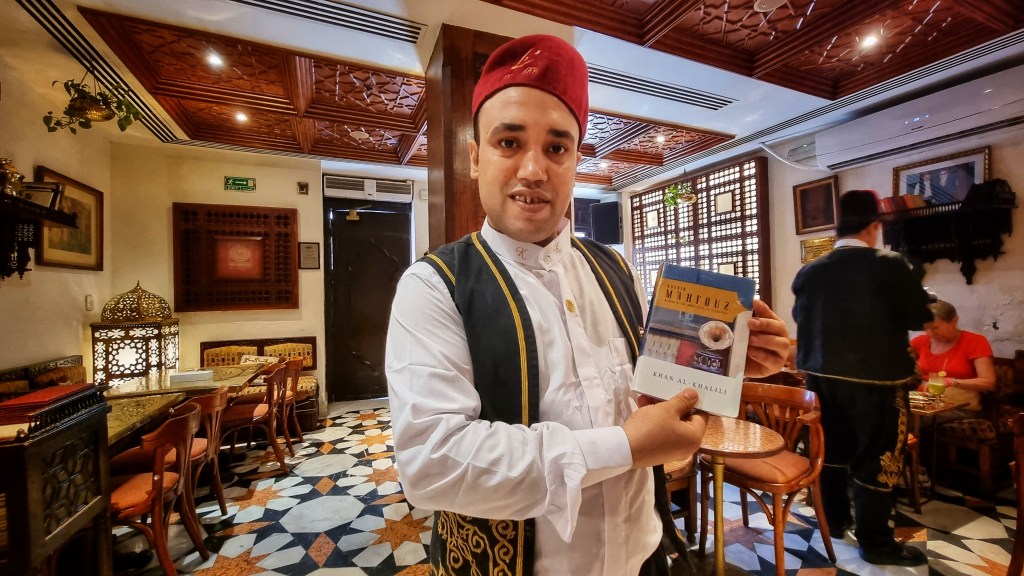
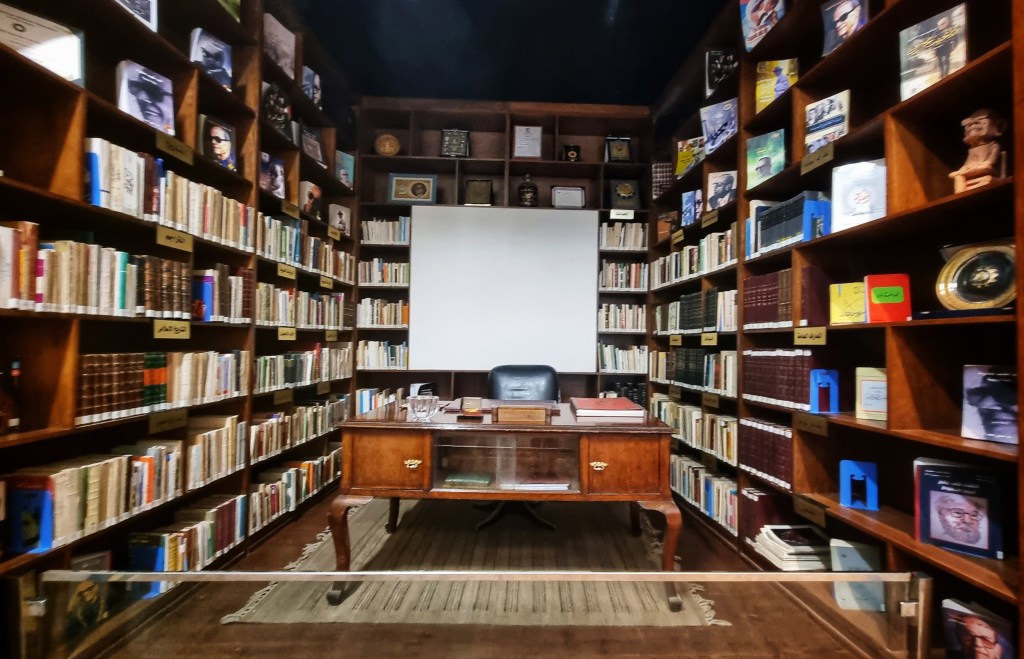
And just as I crossed to the European side of Istanbul to visit Pamuk’s museum, the first thing I did after only a few hours of sleep post-MNL-DIA-CAI flights was to visit the Naguib Mahfouz House Museum and the Naguib Mahfouz Coffee Shop (a coffee house Mahfouz used to frequent so that when he was awarded the Nobel, the owner renamed it in his honor).

On Google Maps, the distance between the two establishments is near. But I turned out to be like an Israelite who fled Egypt and wandered for 40 years traversing a distance that can be done in 9 hours and 5 minutes by car, if you consult Google Maps.

The confused directions came from locals who mistook the coffee shop for the museum and vice versa, and this had me going in circles. It took me a while to finally realize what was going on. But it was as if Mahfouz planned the excursion himself. He did not want me to have it easy. I had to experience his Cairo before arriving there — the Cairo of chaos, of spices, of squawking chickens, of tantalizing fragrances and unpleasant smells, of shouting vendors, dirt, heat, of wonderfully claustrophobic alleys, of uncomfortable stares but also friendly and curious smiles. What I saw today was not the sugarcoated Cairo, and definitely not the whitewashed Cairo. It was the Cairo I came a long way to experience.

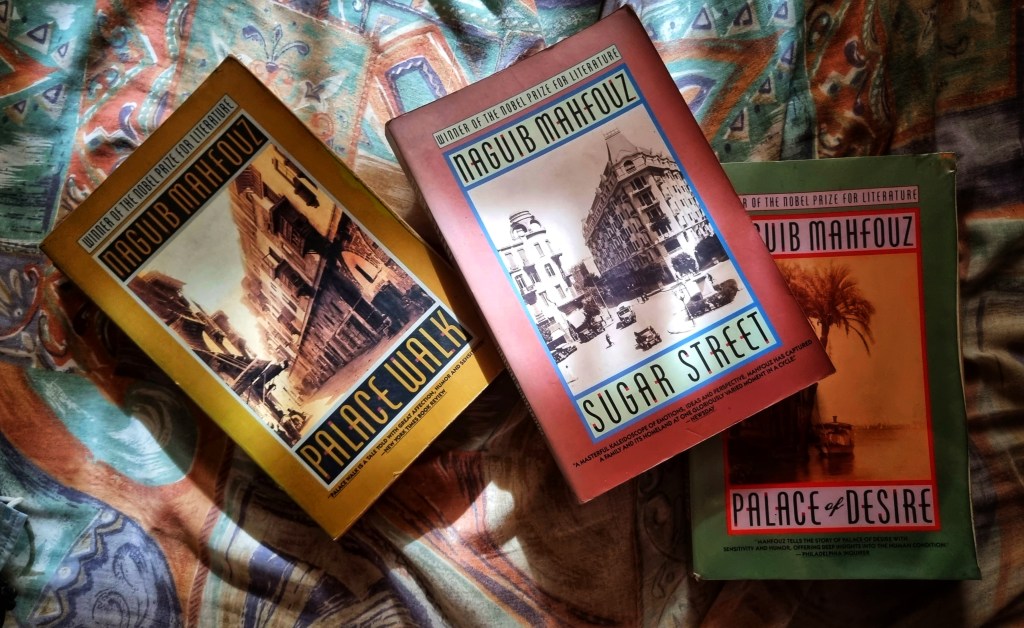
Naguib Mahfouz: The Cairo Trilogy

There are better editions with attractive new covers now. Mine still carry the designs of the first American edition of the English translation, but I love how the first volume depicts the antique mashrabiyas of Old Cairo. These projecting windows with intricate latticework are some of my favorite features of traditional Islamic architecture. They seem to me exemplars of how a thing of beauty and tradition can become a refuge or a prison.

And yet, not even these mashrabiyas could shield Ahmad Abd al-Jawad and his family from life, love, death, and a changing world.

It is often said that the Cairo Trilogy is a family saga spanning three generations, from the period of the Egyptian revolt against British colonizers in 1919 to the final days of the Second World War. But it is more than a family saga: It is an astute record of a society, a city, a nation, and a world in transition. 

I admit that I found good reason to put the first volume down. I was constantly infuriated by how women were perceived and treated by the male characters, by how men justified their immorality and hypocrisy and got off scot-free while women were punished severely for the most innocent blunders, and by how women themselves accepted this as the natural order of things. Those passages were deeply frustrating.

But Mahfouz’s exquisite storytelling carried me through. He does not so much describe Cairo as transport me there — into the volatile political scene of an Egypt yearning for independence, through its wondrous or disreputable backstreets and alleys, and especially into the women’s cloistered lives so I could hear the questions brewing in their hearts, and eventually to the reflection of society’s gradual development through the change in attitude toward women and their education.

In this trilogy, imperial tyranny juxtaposes with tyranny in the family, but through it all, an incredible compassion and empathy emanates from Mahfouz who humanizes everyone, even the tyrants.

Before I knew it I was at the final page of the last volume, not quite ready to let go, and contemplating on the fact that I had just read one of the finest works of literature ever written.

Naguib Mahfouz: Three Novels of Ancient Egypt

Cleopatra’s era is closer to the invention of the iPhone than it is to the construction of the pyramids of Giza. A podcast episode that I listened to years ago pointed this out. The fact still blows my mind. When they are mere numbers written on a page, the breadth of history’s timeline cannot be fully grasped until such a comparison is made; but to make those epochs come alive is a task for the novelist.

Khufu’s Wisdom is set in Ancient Egypt’s Fourth Dynasty (circa 2625 – 2500 BCE). Khufu, also known as Cheops, whose sarcophagus rests in the Great Pyramid of Giza, is the pharaoh to whom Egypt’s biggest pyramid is commonly attributed when people are not busy attributing it to aliens. Rhadopis of Nubia in the Sixth Dynasty (circa 2350 – 2710 BCE), gravitates around a courtesan and King Merenra’s short-lived reign. Thebes at War, set between the Seventeenth to Eighteenth Dynasty (1630-1292 BCE), reimagines the interval when Egypt was ruled by the Hyksos or “foreign kings”.

I have read several works by Naguib Mahfouz before taking on this trilogy but have found this to be the easiest to read and the most entertaining thus far! Yes, the language is grand and often pompous — it has to match its pharaonic subjects! Yes, some details can be politically incorrect by today’s standards — the publication years of each volume are as follows: 1939, 1943, and 1944! But reading this made me feel like a very young girl again; one who cannot help but be swept away with abandon into wondrous tales of the past. How I was able to imagine the stories as grand cinematic adaptations in my head is proof of Mahfouz’s skill as a storyteller!

Although the stories are easy to read, they are not as simple as they seem on the surface:

Khufu’s Wisdom is a classic contemplation on fate and duty, and about the difficult submission to both. My favorite passage comes from a secondary character who asks the protagonist, a skilled warrior, “And now, tell me, are you reading anything useful? …the virtuous mind never dismisses wisdom even for a day, just as the healthy stomach does not renounce food for a day… The virtue of the science of war is that it trains the soldier to serve his homeland and his sovereign with might, though his soul does not benefit at all. And the soldier who is ignorant of wisdom is like the faithful beast — nothing more… if the soul isn’t nourished by wisdom then it sinks to the level of the lesser creatures.”

It was in Rhadopis of Nubia where I felt the political undertones deepen. While it also questions the role of beauty and art, there are questions posed to corruption in theocracies and the tricky relationship between king and clergy. In the hall of Rhadopis, politicians and all manner of men gathered to be entranced, even though it was believed to be a most dangerous thing to set eyes upon her. Her tragic tale left me wondering whether she inspired Salman Rushdie’s Enchantress of Florence and whether she is, as I continue to reckon Rushdie’s enchantress, an allegory for Power.

Thebes at War is the most dramatic out of all the three and a most fitting finale for the trilogy. It is where one will find this line, “Weeping is no use, gentlemen. The past will disappear into ancient times and obliteration so long as you are content to do nothing but mourn it.” 

Mahfouz is a man who did more than mourn Egypt’s past. He has built literary edifices forged from existing architectural wonders and archaeological findings, constructed modern allegories out of ancient lives and times, and transformed them into timeless political missives — knowing that there will always be those who are doomed to forget and repeat the follies of history.

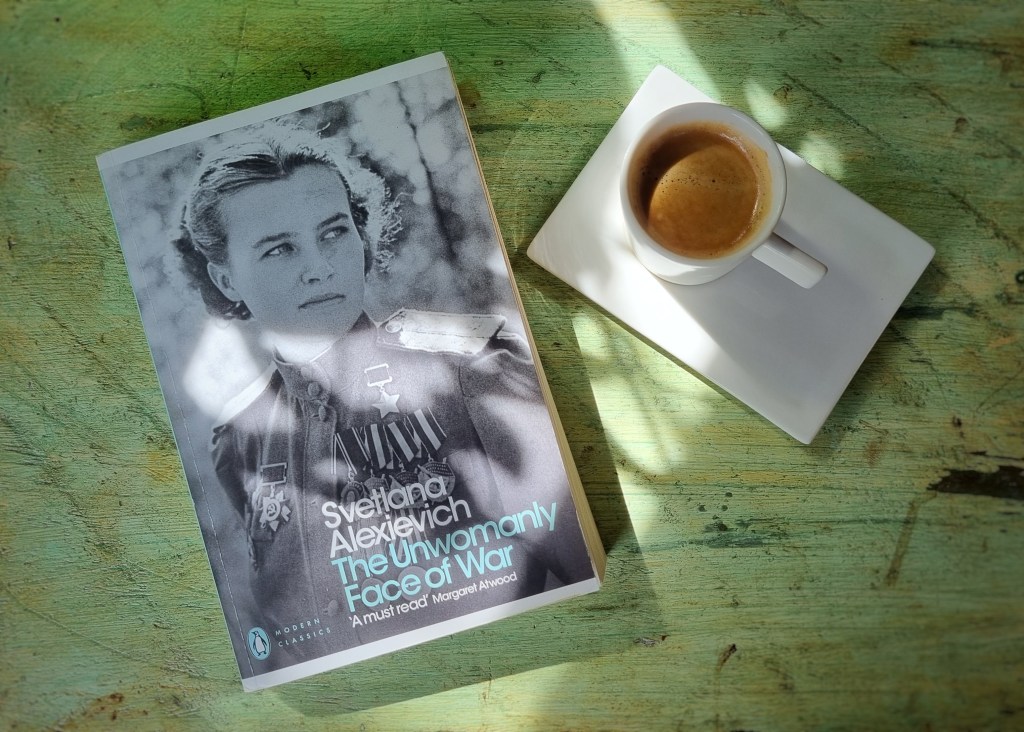
Svetlana Alexievich: The Unwomanly Face of War

During WWII, women served in all branches of the military: 225,000 in the British, 450,000-500,000 in the American, and about a million in the Soviet army. The women in the Soviet army contributed to the German defeat, but little was known and little was said about them and the price they had to pay for victory.

Over the course of twenty six years, Svetlana Alexievich sought out many of these women and became the repository for their untold stories. This is part of the body of work that earns her a place as one of only seventeen women out of a hundred and fifteen Nobel Laureates in Literature.


Maybe it’s because Svetlana Alexievich says that she isn’t writing about war nor the history of a war, “but about human beings in a war… the history of feelings.” Maybe it’s because she is what she says she is, “A historian of the soul.” Maybe it’s because she believes, for good reason, that suffering is “a special kind of knowledge,” “the highest form of information,” that suffering has a direct connection with the mystery of life. (“All of Russian literature is about that. It has written more about suffering than about love. And these women tell me more about it…”) Maybe it’s because she makes this book of unburdening into an overwhelming choir of over two hundred voices singing a soulful rendition of an unsung threnody for the first time, that it answers my question as to why a piercing account of war can be so beautiful and so important. 


Special thanks to Gabi for encouraging me to read this and for giving it to me as a birthday present last year. 🤍

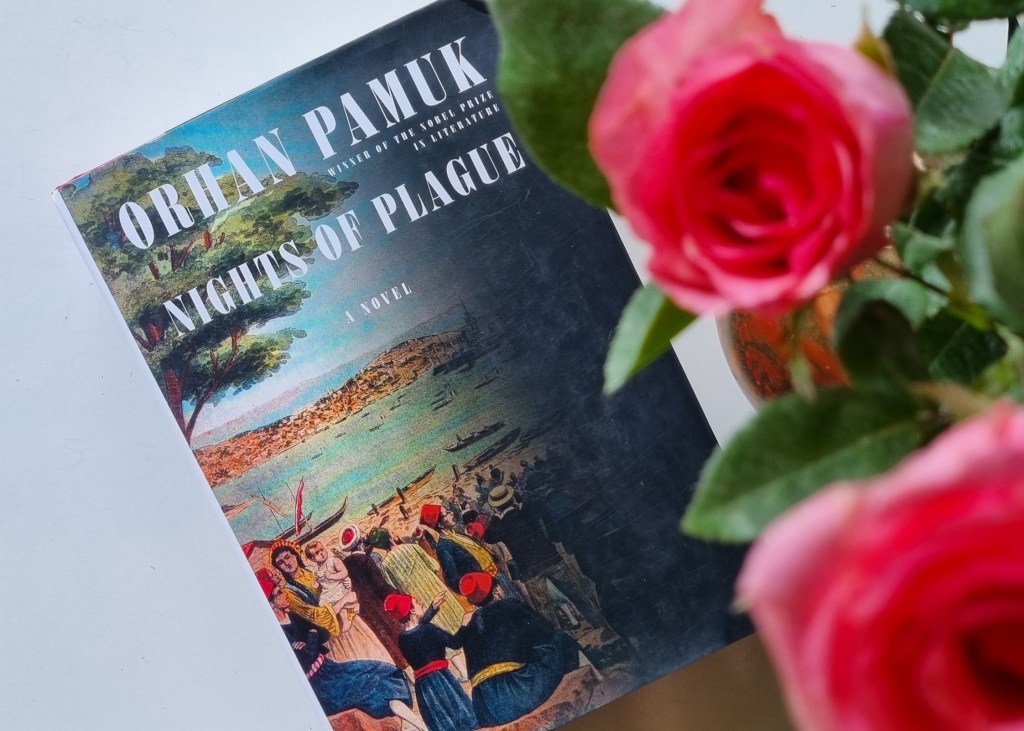
Orhan Pamuk: Nights of Plague

Orhan Pamuk’s longest novel to date unravels with a pace that tends to linger, to wit: it is not for readers who are in a hurry. For that reason, I found it strangely refreshing. Strange because it is a plague narrative that is not meant to be refreshing, refreshing because of the reading experience it provided; defiant of the modern reader’s preference for a literary quick fix, and defiant of our silly reading goals that have more to do with the number of books rather than the languid relishing in an author’s descriptive prowess.

Perhaps I simply feel at home in the expression of an author whose mind is a museum of melancholy, but I am now sensing that part of the allure is in how his books are written for their own sake — written because he felt they needed to be written rather than written for their salability. Isn’t that pure art?

Set in 1901, in the fictional island of Mingheria, “on the route between Istanbul and Alexandria,” it is a curious deviation from a usual Pamuk novel that stays within reach of Istanbul. While Snow is set farther in eastern Turkey, an invented island between Crete and Cyprus is still a surprising backdrop for seasoned Pamuk readers; but only until we realize that the creation of Mingheria allows for a certain leverage and freedom for political criticism. Methinks Mingheria speaks more about Turkey than it does about an imaginary island nation in 1901. 

This novel can teach a thing or two about running a nation during a plague; about epidemiology; how to deal with resistance from different sectors against quarantine measures; how plagues do not distinguish between Christian or Muslim; how failed attempts at containing a plague can fan the flames of a revolution; how revolutions can be exploited; the similarities between solving a murder and stopping an epidemic; and living or loving through the sickness and political ferment. It is about plagues, revolutions, nationalism, the administrative and language reforms that ensue, the fickleness of governments, about the accidents of history, how history is made, and how history is written.

It echoes Camus’ The Plague in the way that the narrator’s significance is revealed only at the end and also for the chilling reminder that plagues reappear throughout history “for the bane and enlightenment of men”.

Unfortunately, man easily forgets, and unwittingly asks to be reminded ever so often.

Halldór Laxness: Wayward Heroes

“With these words, she drew back the bolts that Kolbakur had made to fasten her window frame, pulled the frame aside, and let the man into her bower. Images of gods were carved on the bower’s pillars and stiles and rails of her chair, but they were only half done — Christianity having come to Iceland before the artist completed his work.”

And with this fleeting imagery, a beautiful and ingenious depiction of the religious landscape in which the story is set. An age on the cusp between the fading world of paganism and the force of a new religion of peace, ironically preached by adventurers and men waging selfish crusades in the name of Christ. It was this melancholy conflict that I heard playing as a soundtrack throughout its pages.


It seemed revolutionary when Hollywood recently began to highlight the dark side of legends and heroes. These have become sombre reminders that even superhuman abilities are not enough to protect one from ego, the perilous thirst for fame, power, revenge, and from mere mortals’ tragedies.

Then there’s Halldór Laxness who had Wayward Heroes published way back in 1952, part of the body of work that earned him the Nobel Prize in 1955.

Written in the style of ancient Icelandic sagas, it is replete with violence, adventures amorous and otherwise, and the barbarism of medieval Europe. But how wonderfully Laxness refashions the old to become accessible and relevant to the new.

On the surface, these are the exploits of blood-brothers, Þorgeir and Þormóður. One can read it as such and it will remain entertaining. But one can always choose to go beyond that and take note of the language, the veiled ironies, how wit and sarcasm remain elegant, and the subtleties that only a master can pull off, and how this story remains especially timeless for being a cautionary tale about the heroes, kings, and causes to whom and to which we pledge fealty.

But do we ever listen?

Joseph Brodsky: Watermark

“In those days we associated style with substance, beauty with intelligence…
we didn’t know yet that style could be purchased wholesale, that beauty could just be a commodity.”

Venice, through the pen of a mediocre writer, can easily become cliché.

But this is Joseph Brodsky. 

If you, like me, have read Lawrence Durrell’s Prospero’s Cell and thought it was alone in its indefinable sub-genre or sur-genre (if there’s such a thing), we can rejoice! Venezia’s Watermark is the worthy soulmate of Corfu’s Prospero’s Cell.

Meditative with a sensual rhythm but not without intelligent humor, here is travel literature that casts an enchanting haze on the borders between poetry and prose, a place and the self.

I would slip this in my handbag in a heartbeat on a return trip to the best city to get lost in.