A reader’s response to uncertainty, war, misogyny, grief, or happiness, is to read, and March was not lacking in any of these.
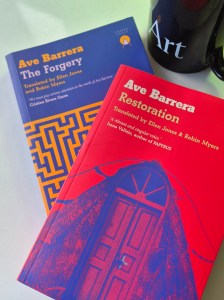
Restoration, Ave Barrera 03/04/2026
Misogyny has roots in the foundations of society, it escapes through the cracks of our country’s great houses, and cultivated inside rooms where women are not supposed to enter.
Misogyny is perpetuated in careless conversation and by those who laugh in response to what some presidents, law makers, and important men consider funny or normal. It is also perpetuated by women who allow it.
“We all know what happens in stories to women who open doors that men have forbidden them from opening,” Jasmina says, in Restoration.
If the forbidden room in this novel feels like a metaphor for the Epstein Files… it is. Because such rooms have always existed.
And if there’s one thing I know about Ave Barrera, it’s that she doesn’t hand the story on a silver platter. Harnessing her knowledge of art and architecture, she asks you to confront rooms, hunt for symbols, open locked doors, and lead you to the dark labyrinths of the male gaze.
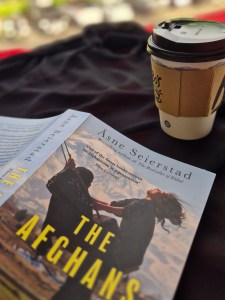
The Afghans, Asne Seierstad 03/08/2026
Here’s a journalist at the peak of her prowess, one who doesn’t draw attention to herself but brings her subjects at the forefront while encapsulating one of the world’s most complex histories in 428 pages; from the monarchy in the 1920s, to its courtship with the Soviets, to the abolishing of its monarchy, to the numerous transitions of power in the 70s, to the Soviet withdrawal, to the civil war, to the rise of the Taliban, the arrival of Bin Laden, to defining the difference between al-Qaeda, the mujahideen, and the Taliban, through Afghanistan’s unfortunate role as chessboard under different US presidents, to the Taliban takeover in 2021.
In a rare insider view across Afghanistan’s social strata, Seierstad takes us right to the heart of a Taliban commander’s home, where women in the family are active participants in jihad, making explosives and suicide vests, and serving the fighters. She also acquaints us with Ariana, a law student whose studies were severed after the Taliban takeover, but who devotes her time home-schooling children in her community. In a place where girls and women are not supposed to desire anything, especially education, this book introduces us to Jamila, a hero for women’s education who persevered through disability, war, and terror, and who is as remarkable as Malala in continuing the fight for girls’ rights to education.
After carefully studying the Quran, Jamila realized that she could use it as a tool for women’s emancipation, so that no one could dismiss it as a Western idea. Nowhere in the Quran does it forbid women from participating in society or getting an education: “When it said ‘Read!’, it was to all. When it said ‘Write!’, it was to all. To men and women. This was a revelation.” How beautiful that their holy book opens with the word “Iqra!” (Read!)
That is a command I can rally behind.
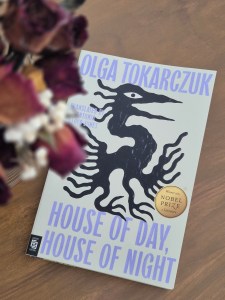
House of Day, House of Night, Olga Tokarczuk 03/12/2026
Olga’s Empusium would have been a more fitting novel to read this Women’s Month, given that it is a work that rightly identifies misogyny as an illness. But reading House of Day, House of Night, written way earlier than her initial works that were translated into English, is like discovering the fount from which all of the other books that we’ve already enjoyed flow.
The mushrooms in Empusium? There’s more here! Fragments of Flights and Yente’s out-of-body experience in Books of Jacob? Present! Here we’ll find the signature literary mischief accompanied by that unique eeriness that lingers in the borderlands of dreams and reality, of history and fiction, borderlands geographical and metaphysical.
Not my favorite Tokarczuk, but a vital piece in her oeuvre.
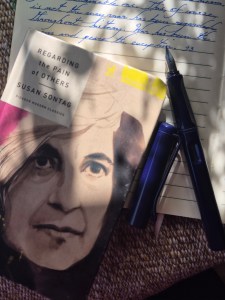
Regarding the Pain of Others, Susan Sontag 03/16/2026
“Is there an antidote to the perennial seductiveness of war? And is this a question a woman is more likely to pose than a man? (Probably yes.)”
Fourth consecutive year of reading my favorite essayist during Women’s Month, and once again, she turns my perspective on its head while tackling the most relevant topics. At times when the first impulse is to disagree with her, I end up conceding that the view I hold of the world and of politics is such a naive one.
Regarding the Pain of Others is known for being a contemplation on contemporary man’s response to, and relationship with, images of war and violence, and how being a witness to the sufferings of others has become a “quintessential modern experience.”
And unless we learn from this constant barrage of other people’s sufferings through various media, we are really just voyeurs.
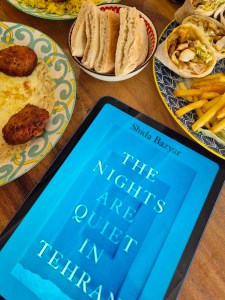
The Nights are Quiet in Tehran, Shida Bazyar 03/20/2026 (Nowruz)
The irony of reading this at a time when the nights are NOT quiet in Tehran does not escape me.
For someone who has an ample Iranian section in her library, I can attest that this one does not fall among those novels about the Revolution that bend toward the sentimental and the cliché.
This book does not offer a rewarding story, but it lends deeper insight and understanding. Do not let the lack of a satisfying ending distract you from its clever device of having a different family member narrate one chapter, each set ten years apart. It is a brilliant tool that subtly reveals how the years and the distance alter the way the Iranian diaspora reflects on the Revolution and how every generation carries hope differently, how differently they choose their battles, and how differently they hold on to memory. If there is one thing the characters agree with, it is this: The real Revolution is not over.
Free Iran (from anyone trying to delegitimize the Iranian people’s struggle, from within or from without)!
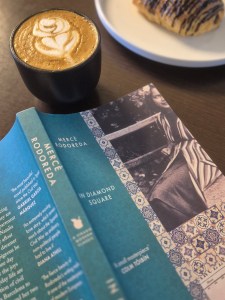
In Diamond Square, Mercè Rodoreda 03/24/2026
“And between gulps of coffee he told me it was better to read about history in books than write it with bullets.”







 The Book-Butterfly