He vanishes. After seasons of being together and meeting every Tuesday in that restaurant overlooking the Nile, Farid does not show up. This catapults Fouada into a period of searching.
“How had a man become her whole life? She didn’t know how it happened. She wasn’t the sort of woman who gives her life to anyone. Her life was too important to give to one man. Above all, her life was not her own but belonged to the world, which she wanted to change.”
And yet, here she was, searching; for him? or has his disappearance allowed her to seek out a purpose and a deeper meaning to life? What was she seeking, exactly?
A female chemist in Cairo’s patriarchal society, Fouada is intelligent and strong-willed. But our daring author impales a nerve here, an uncomfortable truth rarely dissected and examined — the existential torment and uncertainty that women of strong character endure.
A Nawal El Saadawi work of fiction is an art film; one where nuanced cinematography captures the reflection of the sun on a window pane and which slowly pans toward the distress coursing through a woman’s veins; one that disquiets with its honesty; one with an unbroken tension that does not resolve, but bleeds into a thousand provoking questions as the end credits fade into darkness.
It struck an evocative chord when Aciman indicated that writing about places are coded ways of writing about himself. I, too, have been doing this unintentionally… even when the pandemic caused travel destinations to be proxied by books.
Writing to excavate, rearrange, cipher, decipher, lace a narrative, find a certain space, leave things behind, and even to hold on, are what these essays on elsewhere are inadvertently teaching me as it accompanies me on my current meanderings across this breathtaking archipelago.
“I like thinking that perhaps this is how we should travel, without foresight or answers, adventitiously,” he writes.
My brain violently disagrees, but my heart seems inclined; and it appears to have been orchestrating adventitious travels behind the former’s back.
The first trips post-lockdown are not to places, but to people — to my nerve centers, my life’s capital cities.
As subtle but as vital as breath, the passage of ideas and wonder surges with life through these pages and straight to the reader.
Marguerite Yourcenar carves and immortalizes the many aspects of the great Roman emperor that was Hadrian, but unlike any work of history, she resuscitates his heart and offers it to us, pulsating and bleeding, as only Marguerite Yourcenar can.
Written in the form of a letter to his successor, Marcus Aurelius, whose Meditations endure up to this day, Memoirs of Hadrian is the introspection of a man at the end of his days, stripped away of life’s pretensions and left only with his truths. I suspect that this, too, shall endure.
“I have known men infinitely nobler and more perfect than myself…There is but one thing in which I feel superior to most men: I am freer…For my part I have sought liberty more than power, and power only because it can leadto freedom.”
It is partly an ode to Hadrian the traveler, the only emperor in the empire’s history to have traveled to almost every part of its vast realm. Of traveling, he writes, “It disrupts all habit and endlessly jolts each prejudice.”
An ode to a man who could accept with calm the vicissitudes of Rome Eternal after his time (“If ever the barbarians gain possession of the world they will be forced to adopt some of our methods; they will end resembling us”) but could not understand a resignation to ignorance; and thus promoted Greek philosophy and culture and patronized the arts, literature, music, architecture.
A man who perceived that knowledge and literature were as important as food to a civilization, and libraries, dispensaries to the soul: “The founding of libraries was like constructing more public granaries, amassing reserves against a spiritual winter which by certain signs, in spite of myself, I see ahead.”
An ode to Hadrian the builder who believed in the richness of an architecture more varied than Vitruvius’ four orders would allow (“Our great stone blocks, like our tones in music, are amenable to endless regrouping”) and thus amassed inspiration even from faraway Ctesiphon, Babylon, and Egypt, drew the plans himself, and put emphasis on building from vernacular materials.
“To build is to collaborate with the earth, to put a human mark upon a landscape, modifying it forever thereby…To reconstruct is to collaborate with time gone by, penetrating or modifying its spirit, and carrying it toward a longer future… My cities were born of encounters… Each building stone was the strange concretion of a will, a memory, and sometimes a challenge. Each structure was the chart of a dream… I have wanted to live as much as possible in the midst of this music of forms.”
“In the evenings the art of building gave way to that of music, which is architecture, too, though invisible.”
And so it is also an ode to a man who applied the laws of art and governance interchangeably: “Strength was the basis, discipline without which there is no beauty, and firmness without which there is no justice. Justice was the balance of the parts, that whole so harmoniously composed which no excess should be permitted to endanger. Strength and justice together were but one instrument, well tuned… all forms of dire poverty and brutality were things to forbid as insults to the fair body of mankind, every injustice a false note to avoid in the harmony of the spheres.”
It is an ode to the man who first ventured to call Rome “eternal”; who counted desperately on the eternity of stone, as we are able to continue to witness through Hadrian’s Wall, Hadrian’s Villa, Castel Sant’Angelo, the Pantheon; a man who believed that, “Anything made by man which aspires to eternity must adapt.” And therefore it is an ode to a man who looked for and looked to eternity — and thus, he loved.
Above all, it is an ode to a man who loved. For what is eternity without it?
Yesterday was a proper Monday, exhausting; and by nine in the evening I was off to the Ithaca of my subconscious.
Naturally, I woke up too early. Some strange urge made me go straight to my shelf and reach out for this.
And despite being in the middle of another book, I curled back into bed with this and a cup of coffee. Ambrosia was unavailable.
The epic, echoed into a play by the incomparable Margaret Atwood through the eyes of Penelope, read within the length of one cup savored slowly against a gentle rain, and Penelope’s Naiad mother’s reminder to her daughter, was all I needed to read before the sun appeared.
“Remember this — water does not resist. Water flows… Water always goes where it wants to go, and nothing in the end can stand against it. Water is patient. Dripping water wears away stone. Remember that my child. Remember you are half water. If you can’t go through an obstacle, go around it. Water does.”
“The woman is you,” remarked those who saw me with this book.
I can only hope to be half as courageous.
But who is she? “To read is to pray,” she taught. “To write is to trust.” Her words had claws, they said, but at the same time they recognized that her silence were double the weight of her words.
She believed in these: That sometimes, illiteracy was fear; that truth conquered fear; that denial was difficult in the face of truth; that the best told lies can prove short-sighted before the long truths of eternity; and that there was no escape for those who took refuge in their ignorance. And of pride? “Love had nothing to do with it.”
Who was she again? Throughout the story we only know her as the woman who read too much. All the women in the book were not given names. Set during the Qajar Dynasty in the 1800s when literacy among women in Persia was not encouraged, and the details of their lives were largely invisible and unrecorded — as it had been for centuries, and as it had been for most parts of the world; this clever literary trick by Bahiyyih Nakhjavani is most likely a curtsy to Virginia Woolf who wrote, “For most of history, anonymous was a woman.”
“No marker on her grave then? None.” Her death is something readers will know right from the beginning. Her story is written in such a peculiar way that it moves forward while moving backwards simultaneously, proving that the best of these Iranian women writers are masters not only in subtlety but also in form, and one can only try not to blink and miss allusions or be helplessly lost.
“History is filled with screams that are ignored.” The reading woman is executed for what she stands, for opposing unreasonable orthodoxy, “for stating the obvious rather than for deviating from the truth,” condemned for showing other women “how to inscribe their lives on the pages of history… giving them the tools by which to be autonomous.” Her death only fanned the flames of the emancipation of women, especially the emancipation of the mind.
Nakhjavani surprises us in the afterword by revealing that the woman who read too much; who, after all, had a name, was a real woman. Tahirih Qurratu’l-Ayn, the symbolic mother of literacy in Iran.
I glance around my library as I write and wonder at the sudden awareness that, on my shelves organized by geography, the Iran section is the only one where women authors outnumber the men. What better way to honor her!
Here in the midst of “look how far we’ve come” and “miles to go before we sleep,” reading this makes me ponder on the women who came before us; back to Enheduanna (2286-2251 BCE), a woman, the first known author, and to the endless library of history we long to fill… and read.
We’ve always had the rights of the mind at our disposal. We need only take up courage to use them.
“The world changed when definitions of womankind were altered.”
“At one level, reflection means we see ourselves. At another, it’s another word for the thought process. We can choose to use it to look into the light of our own eyes, or we can be light sensitive, we can allow all things to move over and through us… Broken things become pattern in reflection. The way a kaleidoscope works is to allow fragmentary or disconnected things to become their own harmony.” Ali Smith, Artful
Grief and loss without the melodrama. Spews musings on art and literature in one breath. Pinches the heart and tickles the punny bone simultaneously.
“Simile, though your heart is breaking,” writes Ali Smith.
Witty.
Quirky.
Artful. Of course.
Genius.
Lovely.
“Great books are adaptable; they alter with us as we alter in life, they renew themselves as we change and re-read them at different times in our lives. You can’t step into the same story twice — or maybe it’s that stories, books, art can’t step into the same person twice, maybe it’s that they allow for our mutability, regardless of time, that makes them art, because real art… will hold us at all our different ages like it held all the people before us and will hold all the people after us, in an elasticity and with a generosity that allow for all our comings and goings.”
When you turn to a book for solace and get chills instead.
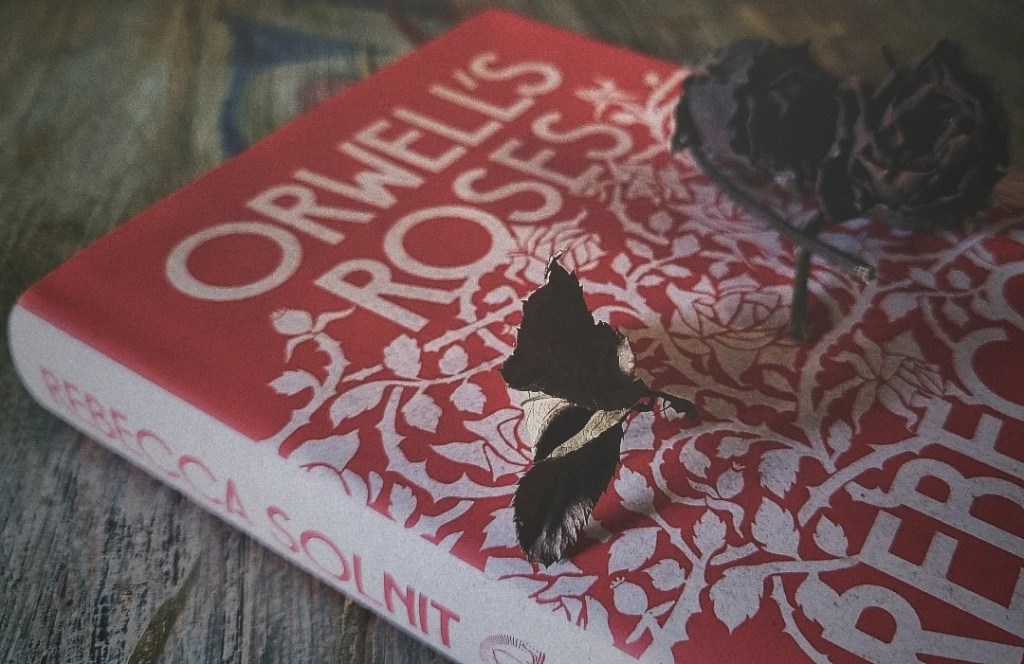
Yes, this has got to be the most beautiful literary criticism of Nineteen Eighty-Four: It rethinks the man that was George Orwell, it guides us to reassess beauty, and it reviews Nineteen Eighty-Four in a light that is distinctly hers. But with Rebecca Solnit, you never know where she will take you next; it is only guaranteed to be a place of startling insight and perspective.
Written and published amid the Covid-19 pandemic, it surprisingly mentions and describes Putin as an admirer and rehabilitator of Stalin’s reputation; even calling to mind the Holodomor, also known as the Terror-Famine, recognized by 16 nations as a genocide carried out by the Soviet government that killed 3-5 million Ukrainians from 1932-1933… and it seems like George Orwell’s Nineteen Eighty-Four will not be the only prescient book in question here.
What is chilling is the reminder that, “To be corrupted by totalitarianism, one does not have to be in a totalitarian country.” Orwell set Nineteen Eighty-Four in England, “To emphasize that totalitarianism could triumph anywhere.”
And what buttresses totalitarianism? Lies. “Lies gradually erode the capacity to know and to connect… Lies are integral to totalitarianism… demands, in fact, the continuous alteration of the past, and in the long run probably demands a disbelief in the very existence of objective truth.”
“Who controls the past controls the future: who controls the present controls the past. The attack on truth and language makes the atrocities possible. If you can erase the witnesses, convince people of the merit of supporting a lie, if you can terrorize people into silence, obedience, lies, if you can make the task of determining what is true so impossible or dangerous they stop trying, you can perpetuate your crimes. The first victim of war is truth.”
And yet, despite these ominous warnings for which Orwell is known, Solnit asks us to reconsider the word “Orwellian” and look at the man who, in the spring of 1936, planted roses. Beautiful is far from the first word that comes to mind when confronted with his writings, but there is a definition of beauty, Solnit emphasizes, that does not have to do with prettiness. “Another kind of beauty, of a toughness that is life…” The beauty to which Orwell was most committed and for which he strove was “this beauty in which ethics and aesthetics are inseparable, this linguistic beauty of truth and of integrity as a kind of wholeness and connectedness, between language and what it describes, between one person and another, or between members of a community or society.”
What was beautiful to him was truth, clarity, honesty — and roses. “Orwell was passionate about the beauty and gestures and intentions, ideals and idealism when he encountered them, and it was to defend them that he spent much of his life facing their opposites.”
“Orwell’s work was about ugliness of various kinds, but what he found hideous serves as a negative image of what he found beautiful.”
There is, after all, solace through the roses telling us that stopping to smell them does not necessarily distract us from the seemingly more important things in life, but strengthens us instead. Through Rebecca Solnit, and through the man who made my birth year significant in literary history, we are spurred to recalibrate what we deem beautiful, to acknowledge our need for beauty, and to always strive to pursue it.
“The snow would just melt, the green Ukrainian grass would grow again and weave its carpet over the earth… The gorgeous sunrises would come again… The air would shimmer with heat above the fields and no more traces of blood would remain.”
— Mikhail Bulgakov, The White Guard —
Bulgakov, whose death anniversary is today, was born in Kyiv. The White Guard, his first full-length novel, is set in the Ukrainian capital.
Try as we might to hope that the two apian titles speak only of positive lessons from bees — of how theirs is a society where each one functions for the good of the entire colony, of how they continue to work even when everything around them is dying — I am afraid they don’t.
Two beekeepers of neighboring nations; one real, the other fictional. Both written by women; one an Iraqi journalist and poet, the other a novelist who volunteered in refugee centers, herself a daughter of Cypriot refugees.
The Beekeeper of Sinjar is Abdullah Shrem. When DAESH (ISIS) began terrorizing Yazidi communities and abducting their women including Abdullah’s sister, he took advantage of his knowledge of the terrain and select personal contacts to rescue and smuggle women back to safety. Each time he saved a captive woman, he felt that he was also saving his sister.
Among the stolen women was Nadia Murad, who received the Nobel Peace Prize in 2018, the first Iraqi and Yazidi to be awarded the prize.
Dunya Mikhail initially inserts poems into a journalistic approach and recounts distressing interviews with the rescued women who were sold, beaten, and raped repeatedly, but who nonetheless opened up to the author so that she could write about their suffering. “It’s important that your book see the light of day, so that the world will know what’s going on here.” The journalistic eventually veers into the poetic, and I feel that this is one of the books from the region that will endure not only as an overwhelming account but also as a literary work.
The Beekeeper of Aleppo is the fictional Nuri Ibrahim, but through him and the plight he shares with his blind wife, Christy Lefteri expresses the unspeakable realities and consequences of war, of lives ended, uprooted, wasted, abused, and destroyed.
“War,” writes Dunya Mikhail, “comes with various names but with only one face.”
Even though it seems that love and hope is universal, unfortunately, so is war.
“The problem isn’t that the world is going to end, but that it continues without any change.” — Nadia Murad




 The Book-Butterfly