There has been a significant increase of Maghrebi literature in my reading repertoire, and the recent discovery of Malika Moustadraf is yet another strong force that pulls my literary compass in that direction.
She is Morocco’s answer to Egypt’s Nawal el Saadawi whose depictions of how women are viewed and treated are unflinching. But Malika has a distinct style that draws the reader right into a scene, into the midst and into the cracks of such a society, sometimes forcing us to look through the eyes of the scoundrels themselves. I daresay she is the more masterful fiction writer.
But fiction, as we know, is just a tool to reveal the rawest of truths, and Malika has succeeded in this. The tragedy is that she will no longer be writing. The few works that she leaves in her wake are glimpses of the undeniable literary powerhouse she would have become had she not passed away from a chronic illness at the age of thirty-seven in 2006.
One thing I’ve noticed in Maghrebi authors is the sensitivity and the softness of the men and the forcefulness of the women. Their literature can teach us many things, but among these is the truth that softness can be extremely masculine, and forcefulness immensely feminine.
This book was, indeed, a fitting way to start this reading month. Wishing you a rewarding Women’s Month!
“Only love and art can do this: only inside a book or in front of a painting can one truly be let into another’s perspective. It has always struck me as a paradox how in the solitary arts there is something intimately communal.”
An understated book that is a meditation and an education in art and life.
“I hope that when there is laughter, it’s laughter made wise by having known real grief — and when there is grief, it is made wise by having known real joy,” Kaveh Akbar writes in Martyr! Whether writing about art, architecture, Libya, or politics, Hisham Matar’s books are often so heartfelt — wholly made wise by having known sorrow and loss.
Fires, Marguerite Yourcenar
…because maybe, subconsciously, this month’s reading theme is about finding solace in the works of authors whose masterpieces have already left an impression on me, that I immediately dove into Yourcenar’s Fires without hesitation, having been incredibly moved by Memoirs of Hadrian in 2022.
She does admit, and warn, in the Preface that this book is, “the product of a love crisis” and that writing this was, in a way, “exorcising a very concrete love”; and yet it still surprised me that the elegance I encountered in Hadrian was replaced in Fires by a certain violence and ferociousness in the prose.
Antigone, Sappho, Clymenestra, and Achilles are just some of the main characters of the nine lyrical prose pieces, or stories, that Yourcenar amalgamates with her own experiences. I was left wondering if I understood the allusions correctly, or whether I understood anything at all.
One thing is certain, Fires is a masterclass on opening lines:
Phaedra’s piece begins with, “I hope this book will never be read.”
The Patroclus opening, “A heart is perhaps something unsavory. It’s on the order of anatomy tables and butcher’s stalls. I prefer your body.”
Lena’s? “Loving eyes closed is to love blindly. Loving eyes open is perhaps to love madly.”
“Love is a penalty. We are punished for not having been able to stay alone.” Clymenestra’s.
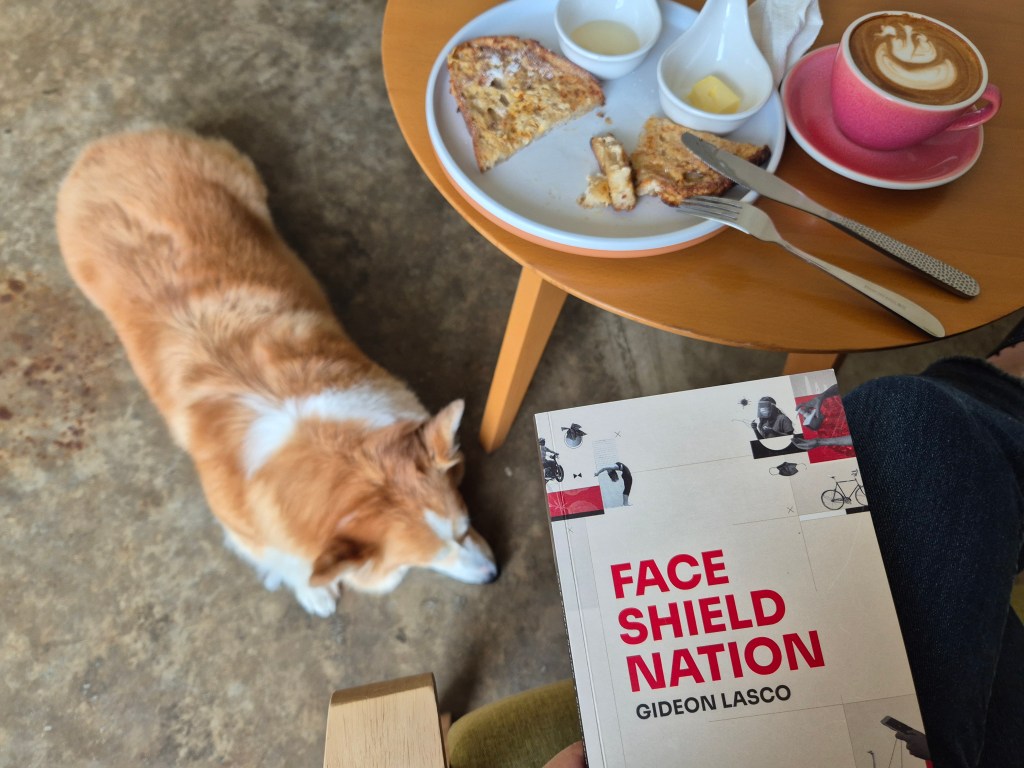
Face Shield Nation, Gideon Lasco
Articles that I looked forward to during the pandemic compiled in a book. Lasco was the voice of calm and reason at a time of confusion; evoking through his column the architectural definition of a column as a sturdy pillar of support. An essential time capsule of an era that we cannot afford to forget if we intend to learn from it. Read full entry here.
One Hundred Years of Solitude, Gabriel Garcia Marquez (a re-reading)
Growing up is realizing that Gabo is the real Melquiades who brought us magnets, magnifying lenses, astronomical observations, and mercurial storytelling. It was he who made imagination and literary possibilities flourish in the fertile and pristine Macondos of our minds, and who never really died. Read full entry here.
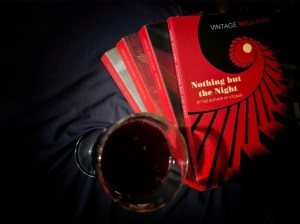
Nothing but the Night, John Williams
Maybe the first disappointment that assails the reader is the realization that, despite the slenderness of this volume, there is a heaviness in each page that restrains forward motion.
“Boring,” the lazy might judge hastily somewhere within the first three chapters. But one should not be too quick to criticize even though I myself could only read a couple of pages per sitting. For if one looks closer, and feels deeper, isn’t this genius, how John Williams conveys exactly what depression feels like?
“…there came to him that peculiar loneliness which is felt only in the monstrous impersonality of a multitude…”“What was the senseless circumstance which led him on and on, deeper and deeper into what seemed to him a maze labyrinth, devoid of pattern or meaning? …some unnameable power pushed him from one place to another, down paths he had no wish to travel, through doors he did not know and had no wish to know. All was dark and nameless and he walked in darkness.”
But then the reader is momentarily allowed to come up for air. I’m referring to the fourth chapter that is briefly set alight with a Proustian beauty! “That is the very best time of life, he thought: lost time.” And then John Williams proceeds to craft this fleeting tribute to the master searcher of lost time before he relinquishes the ethereal chapter to the fading light.
As the novel finally builds suspense, it spirals into a nihilistic darkness that ends with a violent and repulsive slap in the face.
Written in Burma when he was only twenty-two while recovering from injuries brought about by a plane crash over the Himalayas during WWII, he wrote this first novel at a particularly dark time when there was nothing else but the night.
The John Williams here is not the John Williams that gave us Stoner and Augustus. The John Williams here is the John Williams that would eventually give us Stoner and Augustus.
The Black Book, Orhan Pamuk
This reader has been through Pamuk’s longest novels and still felt the density of the mystery and prose in this book’s mere four hundred pages.
It explores the writing process and the precariousness of identity. It is also about how much the books we read, the stories we hear, the movies we watch, the everyday objects in our lives, and our city’s history shape the multiplicities of our being.
I enjoyed that twist at the end and relished the familiarity of Istanbul as a breathing character in a Pamuk novel. But maybe, just maybe, The Black Book is not for the Pamuk newbie, and not for those who are in a hurry.
The Golden Road, Willliam Dalrymple
It is not only the Silk Roads that are rising again, as Peter Frankopan proclaims in a forceful last line that gave me goosebumps. Rising, too, are buried or forgotten histories that have now resurfaced to challenge centuries of unquestioned narratives.
Frankopan’s The Silk Roads was an eye-opener, but The Golden Road takes this non-Eurocentric view of ancient and early medieval history to an intriguing direction by revealing India as a catalyst that transformed the world. Read full review here.
It is not only the Silk Roads that are rising again, as Peter Frankopan proclaims in a forceful last line that gave me goosebumps. Rising, too, are buried or forgotten histories that have now resurfaced to challenge centuries of unquestioned narratives.
Frankopan’s The Silk Roads was an eye-opener, but The Golden Road takes this non-Eurocentric view of ancient and early medieval history to an intriguing direction by revealing India as a catalyst that transformed the world.
The evidence lies in the art discovered in Afghanistan’s mountains and caves; in the archaeological treasures of an ancient Egyptian seaport; in Baghdad where the knowledge of ancient India converged with that of ancient Greece and Abbasid viziers were Sanskrit-literate; in Spain where Sa’id Al-Andalus championed Indian contribution to mathematics and astronomy; in Pisa where Fibonacci popularized what we call “Arabic numerals” but which are actually Indian; in Roman texts, some written by Pliny; in the jungles of India, or in its museums that appear to hold more Roman coins than any other country outside the Roman Empire; in China’s overlooked history where once upon a time it looked to India for enlightenment; in Sri Lanka and Central Java where Indian Buddhist literature achieved peak expression in architecture; in Cambodia’s Angkor Wat which Dalrymple refers to as the most spectacular of all Indic temples, and where one can find the oldest inscription that represents the number zero; in Brahmagupta’s 7th century writings that made him the first mathematician to record his exploration of the properties of zero, defining it as a number akin to the other nine rather than a void; in the numbers that dictate our most advanced technology to those we use in simple day-to-day calculations, “arguably the nearest thing the human race has to a universal language…”
[…and also in, if I may add, the Philippines where currently displayed in the Ayala Museum as part of the Gold of Our Ancestors exhibit is an intricately crafted, four-kilo gold sash from 10th to 13th century Mindanao that massively echoes the sacred thread, or upavita, in Hindu culture. (Dear William Dalrymple, or your cute son, Sam, please come to the Philippines to look into this? Haha)]
To engage in this book is also to question why India’s extraordinary role in world history has been subdued. The pulsating arteries of India’s influence that crossed continents and oceans, “spread not by the sword but by the sheer power of ideas,” has been brushed aside. It has never even been given a name. William Dalrymple calls it The Golden Road.
Although I prefer the William Dalrymple who does not make the “I” completely disappear in his travelogues, thereby giving his text a more endearing and personal touch, I like how this history book is not tediously academic and does not promise to be all-encompassing. Its readability serves as an introduction for those who would like to have a general idea of these trade, cultural, and intellectual routes that seem to have a life of their own apart from — although intersecting at times — the often romanticized Silk Roads.
The prolific stream of fascinating history from Dalrymple’s writings makes this reader feel fortunate to be alive in this age of rediscovery and information. The generosity of his work is encapsulated in my favorite line from this book: “The possession of knowledge is not weakened when shared with others but made more fruitful and more enduring.”
Many years later, as she faced the esplanade, Miracle Romano was to remember that distant afternoon when her bestfriend took her to discover Gabriel Garcia Marquez.
Rather than a rereading, this felt more like a revisit of our teenage years. Nostalgia accompanied me on every page. These characters who ushered us into adulthood were so real to us then. They lived in our conversations and in our heads, they colored our loves and we went through growing pains with them. Yellow flowers raining down from narra trees of Cebu’s Osmeña Boulevard would often transport us to the day of Jose Arcadia Buendia’s death. Magic realism was delivered to us by a master; it was new to us and it was… magic!
(Who was crazy enough to think they could make a successful screen adaptation?)
But how could we have dismissed how unhinged the characters actually are? How did I, a young girl, go through the depictions of sexual violence unfazed; or was I too innocent to know what that’s actually like in real life? How could we not have known that the banana company strike which led to the massacre that Jose Arcadio Segundo witnessed and which drove him to madness was a real event in Colombia; and that the banana company was relatable for Filipinos in the way first-world corporations exercise control over developing nations? And was it from GGM where GRRM drew inspiration for the aunt-nephew bonds?
But Gabo is the real Melquiades. He brought us magnets, magnifying lenses, astronomical observations, and mercurial storytelling. It was he who made imagination and literary possibilities flourish in the fertile and pristine Macondos of our minds, and who never really died.
Read Gabo when you’re young and you don’t know better. But also read Gabo when you’re older, to realize that what was Sanskrit in our innocence was ultimately a revelation about politics, time, memory, and history — “a machine with unavoidable repetitions, a turning wheel that would have gone on spilling into eternity were it not for the progressive and irremediable wearing of the axle” — because one day you can only wish you could read Gabo again for the first time as a juvenile and simply resign to the fact that the book you are reading is a literary masterpiece.
Gideon Lasco’s articles in the Philippine Daily Inquirer were among the things I looked forward to during the pandemic lockdown. His was the voice of calm and reason at a time of great confusion; evoking, through his column, the architectural definition of a column as a sturdy pillar of support.
To have those pandemic articles compiled in a book is to possess an essential time capsule of an era that disrupted our lives and brought the world to its knees; and an era that we cannot afford to forget if we intend to learn from it.
Looking back will not be as easy as it is for others, but it only seems right that reading this should make us feel uneasy at times, despite Lasco’s endeavor to maintain a hopeful tone. When read as an entire book, what’s louder than his leitmotif of hope in these essays is the tone of dissent — a refusal to stay silent amidst injustice and corruption, and a refusal to accept the blunders of our leaders without holding them accountable.
It calls on us, readers and citizens, to demand better leadership and to remain critical toward those in power in the service of nation-building: “If we believe that life is more than survival or subservience, then ‘to live’ should involve the willingness to stand up for our right to do so.”
“…what’s at stake in what we write… art, truth, and social justice.”
That is what’s at stake in everything we do, even in our silence.
“Only love and art can do this: only inside a book or in front of a painting can one truly be let into another’s perspective. It has always struck me as a paradox how in the solitary arts there is something intimately communal.”
Yesterday was heavy. Not only for me but for a lot of people I care for, and for different reasons. It somehow made me yearn for Hisham Matar’s prose, because I don’t think I have read any other writer who speaks straight to my heart about life with such authenticity and accuracy and with such emotional and artistic intelligence. (I read three of his books in 2024, and one of them, My Friends, was the best book I read last year. Until now I cannot find the words to do it justice.)
So, I tried to see if there was an older book of his that escaped my attention. A Month in Siena was the answer. I finished reading it last night and had taken five pages worth of notes by midnight. I’m glad today is a Sunday so that I can reread my notes and fully process the beauty of this understated book that is a meditation and an education in art and life.
“I hope that when there is laughter, it’s laughter made wise by having known real grief — and when there is grief, it is made wise by having known real joy,” Kaveh Akbar writes in Martyr! Whether he is writing about art, architecture, his homeland, or politics, Hisham Matar’s books are often so heartfelt — wholly made wise by having known such things.
an author named Laszlo and an architect named Laszlo
a character who is a librarian and a character who builds a library
postmodern literature, modern architecture
asymmetry in form, symmetry in symbolism
stunning imagery and visuals; flashes of genius; wanting, plot-wise
striking passages from the book:
“…art is a cloud that provides shade from the sweltering heat, or a flash of lightning that splits the sky, where, in that shade’s shelter, or that lightning’s flash, the world simply becomes not the same as before.”
“…libraries (as I wrote near the end of my first notebook) are the most exceptional and exalted works of art…”
“Resist the idea that architecture is a building.”
striking passages from the film:
Van Buren: So, answer me one question; why architecture?
Laszlo: Is it a test?
Van Buren: Not at all.
Laszlo: Nothing can be of its own explanation – is there a better description of a cube than that of its construction? You know, some years ago, in March, a stranger knocked at the classroom door of the university where I frequently lectured. At once, all that was familiar and important to us was gone. We were too well-known at home. I thought my reputation might help to protect us but- it was the opposite. There was no way to remain anonymous; nowhere for my family to go. There was a war on, and yet it is my understanding that many of the sites of my projects have survived and are still there in the city. When the terrible recollections of what happened in Europe have ceased to humiliate us, I expect them to serve instead as a political stimulus, sparking the upheavals that so frequently occur in the cycles of peoplehood. I already anticipate a communal rhetoric of anger and fear; a whole river of such frivolities may flow un-dammed, but my buildings were devised to endure such erosion of the Danube’s shoreline.
Erzsebet: Losing a mother – it’s an unfathomable loss, you see. To lose one’s birth mother is to lose the very foundation on which we stand. The mind may not know its loss but the heart does.
Erzsebet: I suppose that deep inside, he worships at the altar of only himself…
Zsofia: We are going to Jerusalem… Binyamin has family there.
Binyamin: My older brothers relocated with their families in 1950. They became citizens.
Erzsebet: Life is difficult there. Have you thought this through?
A friend sent me a signed copy of Dalrymple’s The Golden Road from overseas a few months ago, and it still hasn’t arrived thanks to our lousy postal system. But as I wait, another friend lends me her copy of City of Djinns. It’s comforting to know that I won’t run out of Dalrymples (and kind, reading friends).
City of Djinns is Dalrymple’s second book after his debut, In Xanadu. Published only four years apart and yet the Dalrymple of Djinns is already so much wiser and more thoughtful than the one in Xanadu. It is one of his best books. City of Djinns is a precious gem in a brilliant bibliography that is a testament to how a series of meaningful travels can profoundly ripen a person and a writer.
And Delhi, this book’s chosen city, is one such city that seems like a heaving anarchy on the surface; but as this book’s adept writer shows us, if one dares to steep oneself in its murky river of humanity, one comes out of it acquiring a thousand and one lessons about the layers of its incredible history, about different faiths and cultures, and about the rise and fall of empires.
“The civilization I belong to — the civilization of Delhi — came into being through the mingling of two different cultures, Hindu and Muslim. That civilization flourished for one thousand years undisturbed until certain people came along and denied that that great mingling had taken place,” laments Twilight in Delhi author, Ahmed Ali.
India was where the sun finally set on the British Empire, and this book is another witness to how much the Partition — the British Empire’s parting gift to the Indian sub-continent — wreaked havoc on this particular city, whose towers, ironically, used to be, “The resting place of the sun”.
Delhi is not a destination and subject for the faint-hearted. It takes a Dalrymple to deftly paint the interplay of light and dark, of myth and truth, of what was and what is.
Serenade for Nadia brings to light seldom-discussed tragedies of Turkish history: The 1942 Struma disaster, wherein hundreds of Jews fleeing the Axis nations in Europe perished when their refugee ship was torpedoed in the Black Sea; the Armenian Genocide; and the plight of the Crimean Turks who were oppressed and slaughtered by the Soviet government for being seen as Nazi collaborators.
This novel, however, is set in modern-day Istanbul where Maya Duran works at Istanbul University while single-handedly raising a teenage son. Her life is turned upside down when she is assigned to assist a visiting octogenarian, Maximillian Wagner, a German-born professor from Harvard. Little by little, the untold stories of her family and her nation come back to haunt her and beg to be uncovered and told. If a reader pays close attention, it will not be difficult to see that Maya’s character is also an accusing finger pointed at prevailing misogynistic attitudes in Turkey.
Aside from music playing a big role, this reader is extremely impressed by the number of intricate social issues that appear organically in this novel. Because Turkish history and culture are so rich, and its government and society are often paradoxical, it takes a good writer to pack all of this in a novel without making it feel contrived. Zulfu Livaneli succeeds in this, and one can understand why Orhan Pamuk himself hailed him as, “An essential force in Turkey’s musical, cultural, and political scene.”
Having read Disquiet in 2023, this is my second Livaneli. Although I admired Disquiet for its eye-opening qualities, I had qualms with the translation. If I have any qualms with Serenade For Nadia, it is only that this book should come with tissues. Tears are guaranteed.







 The Book-Butterfly