As subtle but as vital as breath, the passage of ideas and wonder surges with life through these pages and straight to the reader.
Marguerite Yourcenar carves and immortalizes the many aspects of the great Roman emperor that was Hadrian, but unlike any work of history, she resuscitates his heart and offers it to us, pulsating and bleeding, as only Marguerite Yourcenar can.
Written in the form of a letter to his successor, Marcus Aurelius, whose Meditations endure up to this day, Memoirs of Hadrian is the introspection of a man at the end of his days, stripped away of life’s pretensions and left only with his truths. I suspect that this, too, shall endure.
“I have known men infinitely nobler and more perfect than myself…There is but one thing in which I feel superior to most men: I am freer…For my part I have sought liberty more than power, and power only because it can leadto freedom.”
It is partly an ode to Hadrian the traveler, the only emperor in the empire’s history to have traveled to almost every part of its vast realm. Of traveling, he writes, “It disrupts all habit and endlessly jolts each prejudice.”
An ode to a man who could accept with calm the vicissitudes of Rome Eternal after his time (“If ever the barbarians gain possession of the world they will be forced to adopt some of our methods; they will end resembling us”) but could not understand a resignation to ignorance; and thus promoted Greek philosophy and culture and patronized the arts, literature, music, architecture.
A man who perceived that knowledge and literature were as important as food to a civilization, and libraries, dispensaries to the soul: “The founding of libraries was like constructing more public granaries, amassing reserves against a spiritual winter which by certain signs, in spite of myself, I see ahead.”
An ode to Hadrian the builder who believed in the richness of an architecture more varied than Vitruvius’ four orders would allow (“Our great stone blocks, like our tones in music, are amenable to endless regrouping”) and thus amassed inspiration even from faraway Ctesiphon, Babylon, and Egypt, drew the plans himself, and put emphasis on building from vernacular materials.
“To build is to collaborate with the earth, to put a human mark upon a landscape, modifying it forever thereby…To reconstruct is to collaborate with time gone by, penetrating or modifying its spirit, and carrying it toward a longer future… My cities were born of encounters… Each building stone was the strange concretion of a will, a memory, and sometimes a challenge. Each structure was the chart of a dream… I have wanted to live as much as possible in the midst of this music of forms.”
“In the evenings the art of building gave way to that of music, which is architecture, too, though invisible.”
And so it is also an ode to a man who applied the laws of art and governance interchangeably: “Strength was the basis, discipline without which there is no beauty, and firmness without which there is no justice. Justice was the balance of the parts, that whole so harmoniously composed which no excess should be permitted to endanger. Strength and justice together were but one instrument, well tuned… all forms of dire poverty and brutality were things to forbid as insults to the fair body of mankind, every injustice a false note to avoid in the harmony of the spheres.”
It is an ode to the man who first ventured to call Rome “eternal”; who counted desperately on the eternity of stone, as we are able to continue to witness through Hadrian’s Wall, Hadrian’s Villa, Castel Sant’Angelo, the Pantheon; a man who believed that, “Anything made by man which aspires to eternity must adapt.” And therefore it is an ode to a man who looked for and looked to eternity — and thus, he loved.
Above all, it is an ode to a man who loved. For what is eternity without it?
“At one level, reflection means we see ourselves. At another, it’s another word for the thought process. We can choose to use it to look into the light of our own eyes, or we can be light sensitive, we can allow all things to move over and through us… Broken things become pattern in reflection. The way a kaleidoscope works is to allow fragmentary or disconnected things to become their own harmony.” Ali Smith, Artful
Grief and loss without the melodrama. Spews musings on art and literature in one breath. Pinches the heart and tickles the punny bone simultaneously.
“Simile, though your heart is breaking,” writes Ali Smith.
Witty.
Quirky.
Artful. Of course.
Genius.
Lovely.
“Great books are adaptable; they alter with us as we alter in life, they renew themselves as we change and re-read them at different times in our lives. You can’t step into the same story twice — or maybe it’s that stories, books, art can’t step into the same person twice, maybe it’s that they allow for our mutability, regardless of time, that makes them art, because real art… will hold us at all our different ages like it held all the people before us and will hold all the people after us, in an elasticity and with a generosity that allow for all our comings and goings.”
When you turn to a book for solace and get chills instead.
Yes, this has got to be the most beautiful literary criticism of Nineteen Eighty-Four: It rethinks the man that was George Orwell, it guides us to reassess beauty, and it reviews Nineteen Eighty-Four in a light that is distinctly hers. But with Rebecca Solnit, you never know where she will take you next; it is only guaranteed to be a place of startling insight and perspective.
Written and published amid the Covid-19 pandemic, it surprisingly mentions and describes Putin as an admirer and rehabilitator of Stalin’s reputation; even calling to mind the Holodomor, also known as the Terror-Famine, recognized by 16 nations as a genocide carried out by the Soviet government that killed 3-5 million Ukrainians from 1932-1933… and it seems like George Orwell’s Nineteen Eighty-Four will not be the only prescient book in question here.
What is chilling is the reminder that, “To be corrupted by totalitarianism, one does not have to be in a totalitarian country.” Orwell set Nineteen Eighty-Four in England, “To emphasize that totalitarianism could triumph anywhere.”
And what buttresses totalitarianism? Lies. “Lies gradually erode the capacity to know and to connect… Lies are integral to totalitarianism… demands, in fact, the continuous alteration of the past, and in the long run probably demands a disbelief in the very existence of objective truth.”
“Who controls the past controls the future: who controls the present controls the past. The attack on truth and language makes the atrocities possible. If you can erase the witnesses, convince people of the merit of supporting a lie, if you can terrorize people into silence, obedience, lies, if you can make the task of determining what is true so impossible or dangerous they stop trying, you can perpetuate your crimes. The first victim of war is truth.”
And yet, despite these ominous warnings for which Orwell is known, Solnit asks us to reconsider the word “Orwellian” and look at the man who, in the spring of 1936, planted roses. Beautiful is far from the first word that comes to mind when confronted with his writings, but there is a definition of beauty, Solnit emphasizes, that does not have to do with prettiness. “Another kind of beauty, of a toughness that is life…” The beauty to which Orwell was most committed and for which he strove was “this beauty in which ethics and aesthetics are inseparable, this linguistic beauty of truth and of integrity as a kind of wholeness and connectedness, between language and what it describes, between one person and another, or between members of a community or society.”
What was beautiful to him was truth, clarity, honesty — and roses. “Orwell was passionate about the beauty and gestures and intentions, ideals and idealism when he encountered them, and it was to defend them that he spent much of his life facing their opposites.”
“Orwell’s work was about ugliness of various kinds, but what he found hideous serves as a negative image of what he found beautiful.”
There is, after all, solace through the roses telling us that stopping to smell them does not necessarily distract us from the seemingly more important things in life, but strengthens us instead. Through Rebecca Solnit, and through the man who made my birth year significant in literary history, we are spurred to recalibrate what we deem beautiful, to acknowledge our need for beauty, and to always strive to pursue it.
The sound of sirens woke me up. Whose witty idea was it to celebrate Women’s Month with Fire Prevention Month in the Philippines? Woman is a fire you cannot prevent. Sirens are also women.
These were my tangled thoughts as I got up on the first day of March, a month I look forward to as a reading woman. It’s when I devote most of my reading time to women authors.
Rebecca had to be the first choice, because maybe my mind treats literature like medicine and it cyclically hankers for a more potent dose to achieve efficacy, and she lives up to this promise — this sort of writing that painfully confronts the hurts and pinpoints the ills but becomes the balm through impeccable information-giving and matchless storytelling, all administered with strength and grace.
The title is an acknowledgement to how the artist Georgia O’Keefe signed her letters for the people she loved, “from the faraway nearby.” A way to measure physical and psychic geography together, Rebecca observes. “We’re close, we say, to mean that we’re emotionally connected, that we are not separate… emotion has its geography, affection is what is nearby…” We can be distant from the person next to us but be hopelessly attached to another who is hundreds of miles away. Was it Ondaatje who asked, “Do you understand the sadness of geography?” It seems Rebecca understands and she holds your hand through this sadness.
But that is only one of the myriads of things meaningful to me that she weaves artfully into this narrative. The curious format of this book is a nod to the Arabian Nights. It was only recently when I remarked how Latin American and Eastern European literature are under Scheherazade’s spell, but this book makes me ask, “Who isn’t?”
“The fairy-tale heroines spin cobwebs, straw, nettles into whatever is necessary to survive. Scheherazade forestalls her death by telling a story that is like a thread that cannot be cut; she keeps spinning and spinning, incorporating new fragments, characters, incidents, into her unbroken, unbreakable narrative thread. Penelope at the other end of the treasury of stories prevents her wedding to any of her suitors by unweaving at night what she weaves by day… By spinning, weaving, and unraveling, these women master time itself, and though master is a masculine word, this mastery is feminine.”
“Stories are compasses and architecture; we navigate by them, we build our sanctuaries and our prisons out of them…” This is the line with which Rebecca opens this book.
And this is how she ends. “Who drinks your tears? Who has your wings? Who hears your story?”
“Who has your wings?” Who else can ask such a poignant question?
This mastery is, indeed, feminine. Happy Women’s Month!
“Weren’t you just reading The Books of Jacob?” My mom asked when she saw me with this a day after I finished reading Olga Tokarczuk’s magnum opus.
“Recovery read,” I answered with a wink.
She shot me a questioning look.
“You know how runners do a short recovery run within 24 hours after a marathon?”
She could only laugh and shake her head.
It was the perfect easy run for this reader! In fact, I think every little detail of this book is perfect!
From the cover design, to the French flaps, to the first page that quotes Leonard Cohen:
Now, I’ve heard there was a secret chord / That David played, and it pleased the Lord / But you don’t really care for music, do you?
And truly, if you care for art and music, brilliant is an understatement of how this book is written. Think Apeirogon, think When We Cease to Understand the World but instead of physicists and mathematicians, musicians and artists — Bach, The Beatles, Brahms, Messiaen, Glenn Gould, Rothko, Mahler, Scheherazade… yes, Scheherazade!
Haven’t we already noticed that literature around the world is still undoubtedly under her spell, especially the Eastern Europeans and South Americans? Argentine Luis Sagasti’s musical offering puts us in the shoes of the bewitched Persian King Shahryar.
What a pleasure to have spent the past few days eavesdropping on these conversations!
My introduction to Edward W. Said was not through my current reading project but through classical music years ago via the Daniel Barenboim connection when they co-wrote an illuminating book and founded the West-Eastern Divan Orchestra — Said a Palestinian intellectual and Barenboim an Israeli pianist and conductor, bringing together musicians from areas of conflict to show the world that it is possible to create peace among people from these nations, to harmonize, and produce beautiful music. And now, I am reintroduced to Said through the enlightening forewords he has written for many of the literary works I am reading from that part of the world.
As for dear Gabo, I still vividly remember the day my best friend presented me with my first Marquez in our teens and I gave him John Fowles’ The Magus in return. This act of his, which was not entirely innocent, led to a Latin American reading stage that brought me to magical literary adventures.
When asked whether the inability to love is very serious, Gabo replies, “I don’t think there’s any human misery greater than that. Not only for the person afflicted but for all those whose misfortune it is to come within his orbit.” Love is something to be learned, he adds, and even lets one of his fictional characters echo this.
Said on the hand, gave me more lines to note in my journal and reminded me why he was once an intellectual crush.
“I’ve never felt myself to belong to any establishment of any kind, any mainstream. I’m interested in mainstreams, I’m jealous of them, I sometimes, occasionally, envy people who belong to them—because I certainly don’t—but on the whole I think they’re the enemy. I feel that authorities, canons, dogmas, orthodoxies, establishments, are really what we’re up against. At least what I’m up against, most of the time. They deaden thought.”
“I think a lot of this business we were talking about earlier, about politics and culture being separate, is really laziness. There’s a critical establishment that says you’re supposed to only study this, and that’s because you don’t have the time or the energy to study other things. For me it’s a manifestation of laziness and idleness. And all of them, it seems to me, in the end, really don’t advance to anything.”
“And far from being right, I think it’s important to be critical.”
These conversations bring together two significant reading phases of my life.
What struck me this time was in realizing how much their musical tastes influenced their writings greatly. Chopin among others for Said, Bartok and Caribbean music for Gabo. Because he was a revolutionary says the former and the mixture of the two had to be explosive says the latter. Through this we see that they did not confine themselves to one form of art but saw art as something encompassing rather than something to be compartmentalized.
Said and Gabo are very much alive in these pages. These great minds that impacted and straddled two centuries while they lived; and even in death, continue to change the way we think, read, and perceive the world; their inspiration consistently outliving the last page of each of their books; saying it in their own distinct way but always reminding us to live as fully and as passionately as we can.
When a poet writes a memoir, the entire book is a poignant song. Exiled from his homeland after the Six Day War, Mourid Barghouti returns after thirty years and sings of his experience and his memories.
“And now I pass from my exile to their… homeland? My homeland? The West Bank and Gaza? The Occupied Territories? The Areas? Judea and Samaria? The Autonomous Government? Israel? Palestine? Is there any other country in the world that so perplexes you with its names?”
And yet, as Edward W. Said intimates in the foreword, the account is free of bitterness and recrimination.
“I know that it is the easiest thing to stare at the faults of others and that if you look for faults you see little else. Which is why—after each setback that befalls us—I look for our faults too; the faults of our song. I ask if my attachment to the homeland can reach a sophistication that is reflected in my song for it. Does a poet live in space or time? Our homeland is the shape of the time we spent in it.”
The pages teem with beautiful questions…
“Who has stolen our gentleness?”
“Are they really afraid of us or is it we who are afraid?”
“What should we remember and what should we forget?”
“Did I paint for strangers an ideal Palestine because I had lost it?”
…and express in simple ways the everyday sorrows of displacement.
“I have never been able to collect my own library. I have moved between houses and furnished apartments, and become used to the passing and the temporary. I have tamed myself to the feeling that the coffeepot is not mine.”
But in the vast desert of pain, there is room for love and joy…
“Love is the confusion of roles between the giver and the taker.”
“Joy needs training and experience. You have to take the first step.”
…and even vaster spaces for art.
“I said to myself that the heart of the matter was in a detailed knowledge of life, and of the human maturity that is the foundation for all artistic maturity. These are features that no work of art worthy of the name can do without, whatever the lived experience. What is important is the piercing insight and the special sensitivity with which we receive experience, not simply our presence at the event, which, important as it is, is not enough to create art.”
I Saw Ramallah — read, once again, to humanize what we tend to generalize.
The Language of Passion is an excellent education on writing and thinking.
The topics in this Nobel laureate’s book of essays and articles are broad — from politics and religion to art, literature, and spaces; and the scope of the material manifests the breadth of his mind.
“That two truths are ‘contradictory’ doesn’t mean they can’t exist side by side,” Llosa writes. This reminds me of another line I encountered in Maria Popova’s Figuring, “It seems to be difficult for anyone to take in the idea that two truths cannot conflict.”
Llosa was writing about both the Israeli and Palestinian right to a particular piece of land and Popova was referring to the conflict between religion and science.
This is the sort of contemplation that I am subscribing to at this point in life; and that I did not have to embrace all of his opinions while admiring the way he expressed his thoughts is, I believe, part of the immediate result of a Llosa education.
The sound of sirens woke me up. Whose witty idea was it to celebrate Women’s Month with Fire Prevention Month in the Philippines? Woman is a fire you cannot prevent. Sirens are also women.
These were my tangled thoughts as I got up on the first day of March, a month I look forward to as a reading woman. It’s when I devote most of my reading time to women authors.
Rebecca had to be the first choice, because maybe my mind treats literature like medicine and it cyclically hankers for a more potent dose to achieve efficacy, and she lives up to this promise — this sort of writing that painfully confronts the hurts and pinpoints the ills but becomes the balm through impeccable information-giving and matchless storytelling, all administered with strength and grace.
The title is an acknowledgement to how the artist Georgia O’Keefe signed her letters for the people she loved, “from the faraway nearby.” A way to measure physical and psychic geography together, Rebecca observes. “We’re close, we say, to mean that we’re emotionally connected, that we are not separate… emotion has its geography, affection is what is nearby…” We can be distant from the person next to us but be hopelessly attached to another who is hundreds of miles away. Was it Ondaatje who asked, “Do you understand the sadness of geography?” It seems Rebecca understands and she holds your hand through this sadness.
But that is only one of the myriads of things meaningful to me that she weaves artfully into this narrative. The curious format of this book is a nod to the Arabian Nights. It was only recently when I remarked how Latin American and Eastern European literature are under Scheherazade’s spell, but this book makes me ask, “Who isn’t?”
“The fairy-tale heroines spin cobwebs, straw, nettles into whatever is necessary to survive. Scheherazade forestalls her death by telling a story that is like a thread that cannot be cut; she keeps spinning and spinning, incorporating new fragments, characters, incidents, into her unbroken, unbreakable narrative thread. Penelope at the other end of the treasury of stories prevents her wedding to any of her suitors by unweaving at night what she weaves by day… By spinning, weaving, and unraveling, these women master time itself, and though master is a masculine word, this mastery is feminine.”
“Stories are compasses and architecture; we navigate by them, we build our sanctuaries and our prisons out of them…” This is the line with which Rebecca opens this book.
And this is how she ends. “Who drinks your tears? Who has your wings? Who hears your story?”
“Who has your wings?” Who else can ask such a poignant question?
This mastery is, indeed, feminine. Happy Women’s Month!
A Field Guide to Getting Lost
January 25, 2022
Life is unpredictable, but nothing highlights this fact more than the pandemic. If we care to admit it, everyone feels a little lost in the midst of this all.
This beauty of a book is the fresh perspective on being lost that I did not know I needed, for Solnit invites you to be at home with being lost and to be comfortable with it. She encourages you to “leave the door open for the unknown” and calls it art.
“That thing the nature of which is totally unknown to you is usually what you need to find, and finding it is a matter of getting lost. The word ‘lost’ comes from the Old Norse ‘los,’ meaning the disbanding of an army, and this origin suggests soldiers falling out of formation to go home…”
The first two chapters took possession of me, the rest of it was simply a bonus. There are passages that are painful to read but in a cathartic way.
Sometimes, in our arrogance as readers, we approach a book as confident as Alexander on a Persian conquest; and in our confidence, we allow ourselves and others to believe that we have conquered it. Only to learn and be humbled, again and again, that the ones that matter, are those that conquer us.
Orwell’s Roses
March 11, 2022
When you turn to a book for solace and get chills instead.
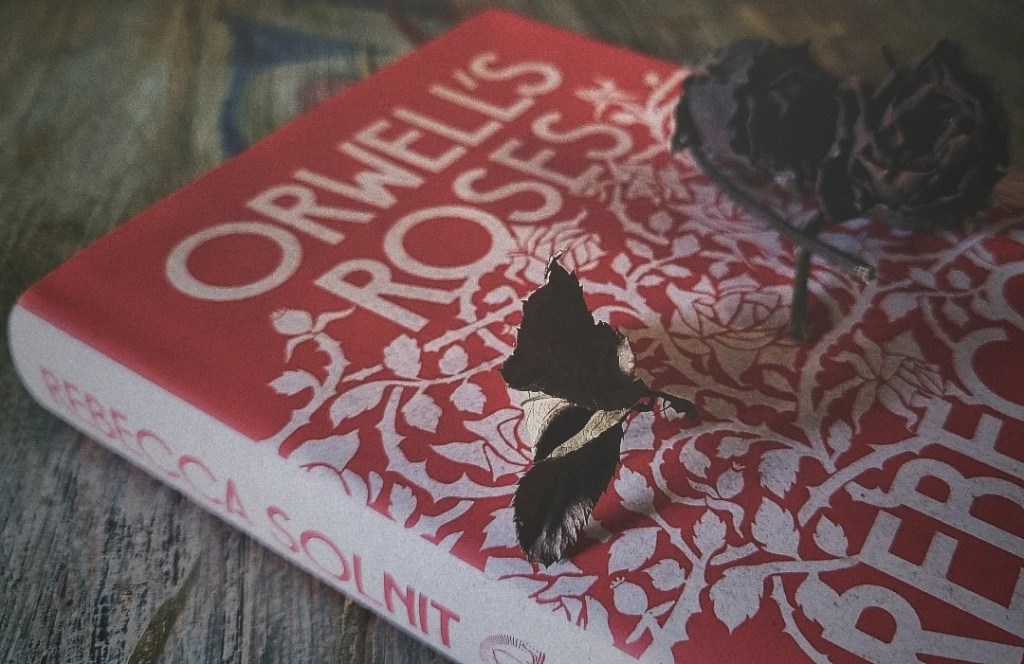
Yes, this has got to be the most beautiful literary criticism of Nineteen Eighty-Four: It rethinks the man that was George Orwell, it guides us to reassess beauty, and it reviews Nineteen Eighty-Four in a light that is distinctly hers. But with Rebecca Solnit, you never know where she will take you next; it is only guaranteed to be a place of startling insight and perspective.
Written and published amid the Covid-19 pandemic, it surprisingly mentions and describes Putin as an admirer and rehabilitator of Stalin’s reputation; even calling to mind the Holodomor, also known as the Terror-Famine, recognized by 16 nations as a genocide carried out by the Soviet government that killed 3-5 million Ukrainians from 1932-1933… and it seems like George Orwell’s Nineteen Eighty-Four will not be the only prescient book in question here.
What is chilling is the reminder that, “To be corrupted by totalitarianism, one does not have to be in a totalitarian country.” Orwell set Nineteen Eighty-Four in England, “To emphasize that totalitarianism could triumph anywhere.”
And what buttresses totalitarianism? Lies. “Lies gradually erode the capacity to know and to connect… Lies are integral to totalitarianism… demands, in fact, the continuous alteration of the past, and in the long run probably demands a disbelief in the very existence of objective truth.”
“Who controls the past controls the future: who controls the present controls the past. The attack on truth and language makes the atrocities possible. If you can erase the witnesses, convince people of the merit of supporting a lie, if you can terrorize people into silence, obedience, lies, if you can make the task of determining what is true so impossible or dangerous they stop trying, you can perpetuate your crimes. The first victim of war is truth.”
And yet, despite these ominous warnings for which Orwell is known, Solnit asks us to reconsider the word “Orwellian” and look at the man who, in the spring of 1936, planted roses. Beautiful is far from the first word that comes to mind when confronted with his writings, but there is a definition of beauty, Solnit emphasizes, that does not have to do with prettiness. “Another kind of beauty, of a toughness that is life…” The beauty to which Orwell was most committed and for which he strove was “this beauty in which ethics and aesthetics are inseparable, this linguistic beauty of truth and of integrity as a kind of wholeness and connectedness, between language and what it describes, between one person and another, or between members of a community or society.”
What was beautiful to him was truth, clarity, honesty — and roses. “Orwell was passionate about the beauty and gestures and intentions, ideals and idealism when he encountered them, and it was to defend them that he spent much of his life facing their opposites.”
“Orwell’s work was about ugliness of various kinds, but what he found hideous serves as a negative image of what he found beautiful.”
There is, after all, solace through the roses telling us that stopping to smell them does not necessarily distract us from the seemingly more important things in life, but strengthens us instead. Through Rebecca Solnit, and through the man who made my birth year significant in literary history, we are spurred to recalibrate what we deem beautiful, to acknowledge our need for beauty, and to always strive to pursue it.
Hope in the Dark
July 4, 2022
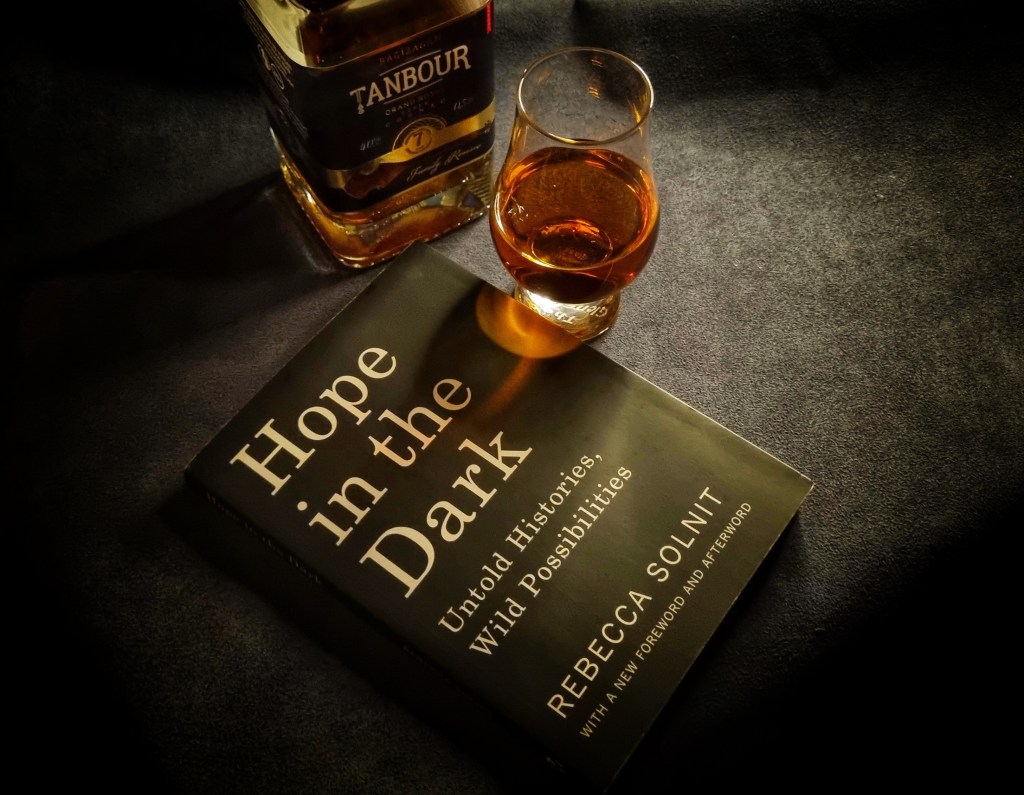
If it were not Rebecca Solnit who wrote this, I would have dismissed the title as another one of those inspirational books that I do not gravitate towards so much. But having experienced four Solnits this year prior to this, which all proved to be books I needed at the exact time I read them, I seized this as soon as it arrived. And once again, she delivered.
I felt it was written for me, who, upon returning from an exhilarating trip, returned to my country with a new president whom I did not vote for. Solnit’s books are extremely political, but she wrote this to make the case for hope, especially for those who, on the surface, seemingly lost:
To point out that just because my side did not win the election, does not mean we are not victorious in many things. To challenge myself to live the same way with the leadership I did not choose as I would have had my candidate won, and to continue being a responsible citizen and human being — because being victorious and seemingly right is small comfort when, around the world, and around the country, there is still injustice and there are still people dying and living horribly.
“Hope doesn’t mean denying these realities. It means facing them and addressing them by remembering what else the twenty-first century has brought, including movements, heroes, and shifts in consciousness that address these things now.”
“The hope I’m interested in is about broad perspectives with specific possibilities, ones that invite or demand that we act. It’s also not a sunny everything-is-getting-better narrative, though it may be a counter to the everything-is-getting-worse narrative.”
Consider reading this if you, like me, paid your taxes dutifully and was called “self-righteous” when you pointed out that our new president failed to pay his; if you campaigned for your candidate without insulting anyone but the many enjoyed branding everyone on your side as toxic, even though poisonous ones were actually present on both sides if we care to admit (I have screenshots); if you were maligned and called names because of who you supported while the same people demanded respect but has been disrespecting your candidate for six years; if you, hopefully, like some of them, just wished for a better country. Consider reading this if you are frustrated and you think hope is lost, because it just made me realize that it isn’t.
This book reminded me that hope and action feed each other, and that every action and inaction have more impact than we know; to not merely demand change but to embody it.
Hope, above all, is action; and as long as we do our part and, if possible, do more than what’s required of us, there is hope.
Wanderlust
June 19, 2022
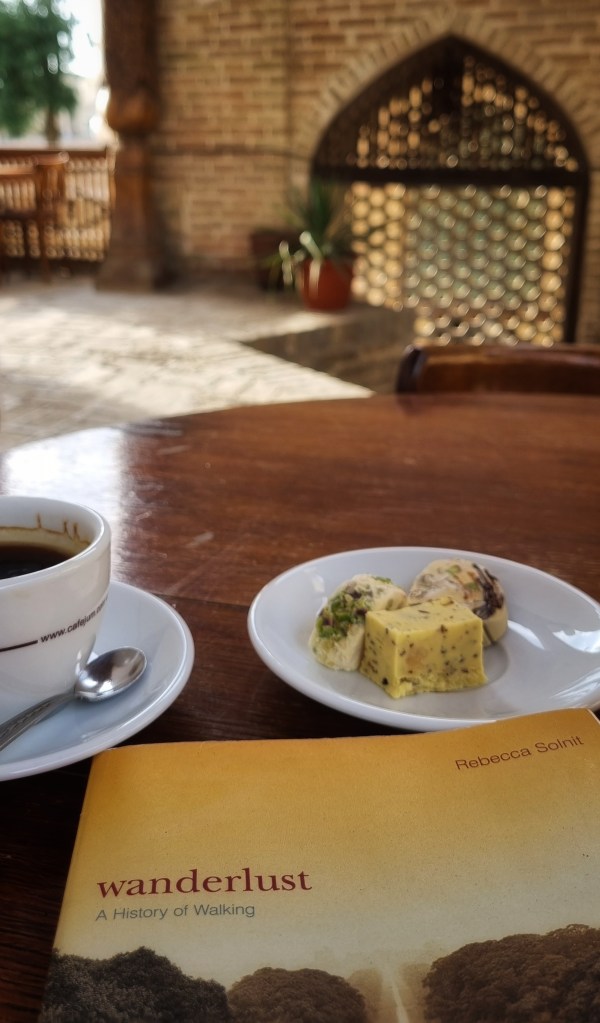
…with a title perfect for a trip, Solnit shared an Eskimo custom of offering an angry person release by walking the emotion out of his or her system by going in a line across the landscape; “The point at which the anger is conquered is marked with a stick, bearing witness to the strength or length of the rage.”
Because I heard about this book through Bjork, my mind immediately appointed her as the protagonist’s voice in my head. If you don’t know how oddly endearing that is, search for that video of Bjork talking about her TV.
So although our main character is a nonagenarian, the whimsical nature of the book had no problem merging with my brain’s choice of voice.
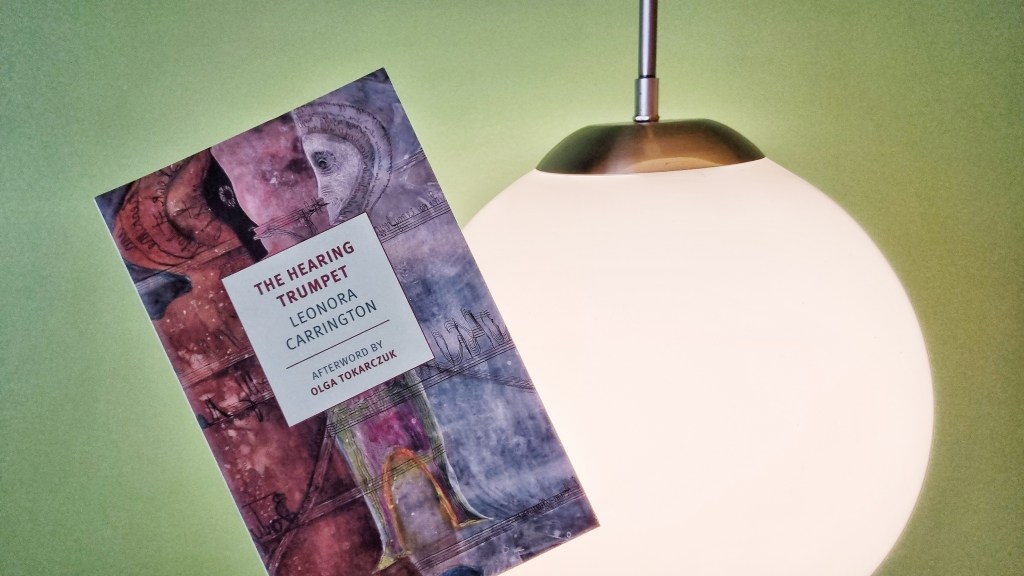
The author was unknown to me, but I soon learned that I am acquainted with her former lover’s art — that of Max Ernst. Apparently, Leonora Carrington herself was also a surrealist painter; and yes, that is her work on the cover of this NYRB edition.
And as it is with art, it overflows through different channels of your being and explores different media, but it stems from the same soul. Needless to say, this is also a surrealist novel.
And as it is with surrealist art, we find ourselves wading through allusions, symbolisms; reality becomes warped, and rules are contorted, and it certainly gets weird. But as it is with paintings, there are only certain people you would gift with surrealist art, those are the same people to whom you would recommend this book.
But why do we read novels in the first place? Olga Tokarczuk asks and answers in the afterword — an afterword which, I believe, is already a ratification of her Nobel: “To gain a broader perspective on everything that happens to people on Earth. Our own experience is too small, our beings too helpless, to make sense of the complexity and enormity of the universe; we desire to see life up close, to get a glimpse of the existence of others… we are seeking a communal order, each of us a stitch in a piece of knitted fabric. In short, we expect novels to put forward a certain hypotheses that might tell us what’s what. And banal as it might sound, this is a metaphysical question: On what principles does the world operate?” She continues to write that a nongenre novel like this “passes disturbing comment on things we never stop to question.” As it is with Bjork’s music, so it is with this novel.
There is an act that the protagonist commits close to the end that seemed most monumental to me (a potential spoiler, so I will refrain from mentioning it, although I am up for a discussion with those who have read this) but which Tokarczuk does not mention in the afterword. It is possible that she left it out to urge us to develop our own thoughts. Besides, what is the point of all this art if we don’t?