It seemed to have been written in the stars that the first place I would be drawn to in Samarkand is the remnant of an observatory that was the most well-known throughout the Islamic Golden Age and the largest in Central Asia, preceding Tycho Brahe’s Uraniborg and Taqi al-Din’s observatory in Constantinople by more than a hundred years.
The great mathematician and astronomer behind this observatory, whose computation of the length of the sidereal year was more accurate than that of Copernicus’s, is Ulugh Beg.
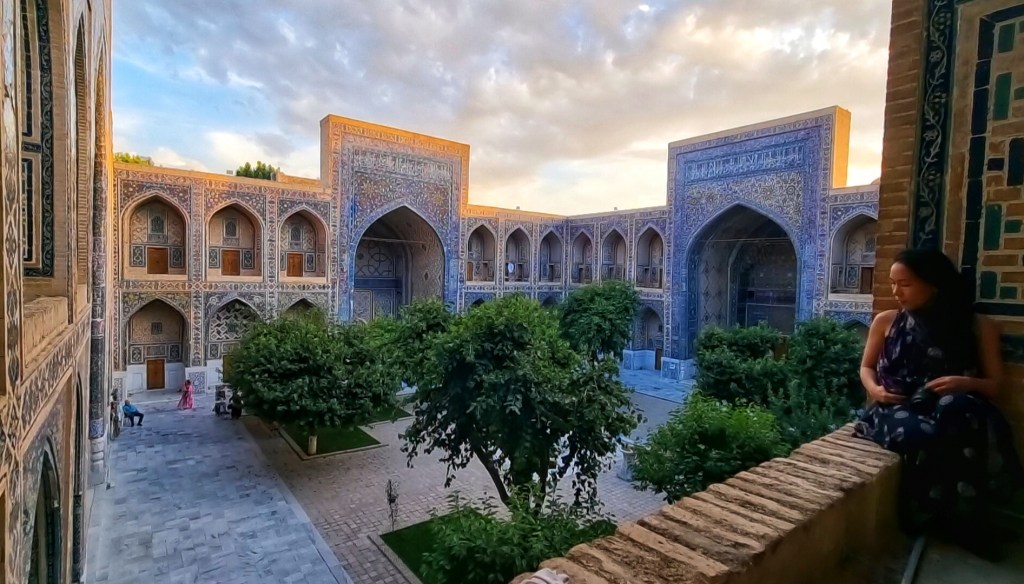
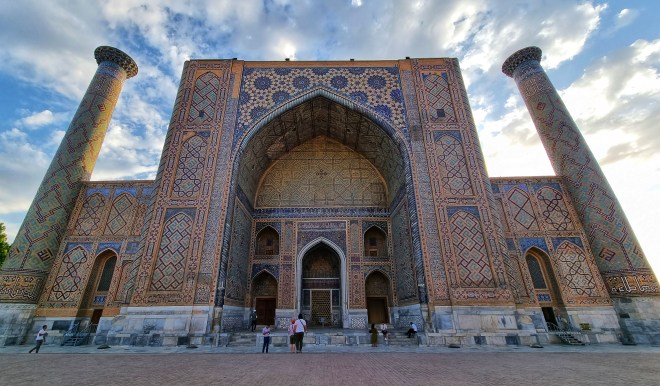
Although what remains of the observatory is the arc of a gigantic sextant (used to measure the transit altitudes of the stars and to produce the most comprehensive star catalogue in the period between Ptolemy and Tycho Brahe); the splendid madrasa that he built right at the heart of the city still stands.
He turned Samarkand into an intellectual center, inviting mathematicians and astronomers to study there — but no longer by force. He was, after all, a sultan of the Timurid Empire, the grandson of Tamerlane, and his tomb lies at the foot of his grandfather’s in the Amir Timur Mausoleum.
When Soviet archaeologists exhumed this tomb in 1941, they allegedly found this inscription inside: “When I rise from the dead, the world shall tremble. Whoever opens my tomb shall unleash an invader more terrible than I.”
In a matter of hours, Hitler’s men invaded Russia resulting in millions of deaths. Stalin ordered the remains to be reinterred in 1942, and soon after, the Germans surrendered at Stalingrad. Coincidence or not, it is a remarkable story.
Two years ago, I listened to a series of podcasts about this man for whom this mausoleum was built. I found him frightening and intriguing! There aren’t enough books written about him, and eurocentric history merely dedicates one or two measly paragraphs to him!
This man, known in the West as Tamerlane, is Amir Timur, “iron” in their language. It was he who freed his people from the yoke of the Mongols and proceeded to establish the Timurid Empire in 1370 and conquered lands spanning parts of Russia, and north western India to Syria.
During his reign, he and his armies decimated 5 percent of the world’s population! On his Persian conquest, they massacred and constructed towers out of the bodies. He was as brutal as the Mongol Khans, but unlike them, he spared the intellectuals, the architects, the writers, the rug makers, the craftsmen, the artistic and the educated, and brought them to Samarkand. And thus began the flourishing of Timurid arts and architecture, well exhibited in this very mausoleum up to this day.
Where I am staying in Samarkand is a wall away from this mausoleum.
The moon was still up when I walked over this morning and the muezzin’s call to prayer accompanied my quiet footfalls.
I sat on the steps with a book thinking it would still be off limits at such an early hour, but the caretaker noticed me and offered to let me in and left me on my own!
Heart pounding and knees slightly trembling, I entered and thought I heard throat singing along with the muezzin’s call…
There is something therapeutic and enlightening about these essays that are of diverse scope but which are bound with a single string. That string is language — and not just the spoken, but also the unspoken; the pre-verbal, the danced, the hidden, the sung, the articulate, the inarticulate, the visual.
Just a few books ago, Rica Bolipata – Santos beautifully expressed that writing is, “An added gift to the love of reading.”
For John Berger, writing is, “An offshoot of something deeper… our relationship with language.” Language, to him, is a creature, “A quivering almost wordless ‘thing’.”
Language is that which acquires a body when it is sung, or played, or danced, as in music; it is el duende of which Federico Garcia Llorca wrote, the spirit, the gestures, “Gestures that are the mothers of all the dances of the ages”!
But these string of thoughts also hint at the things that distract us from it, the diversions from what is “true, essential, and urgent.” More than that other book of his, this one will somehow recalibrate our ways of seeing, and if we allow it further, our ways of living.
The pre-verbal, the danced, the hidden, the sung, the articulate, the inarticulate, the visual, the musical… all at once, there is a sudden inspiration to live in every language I know.
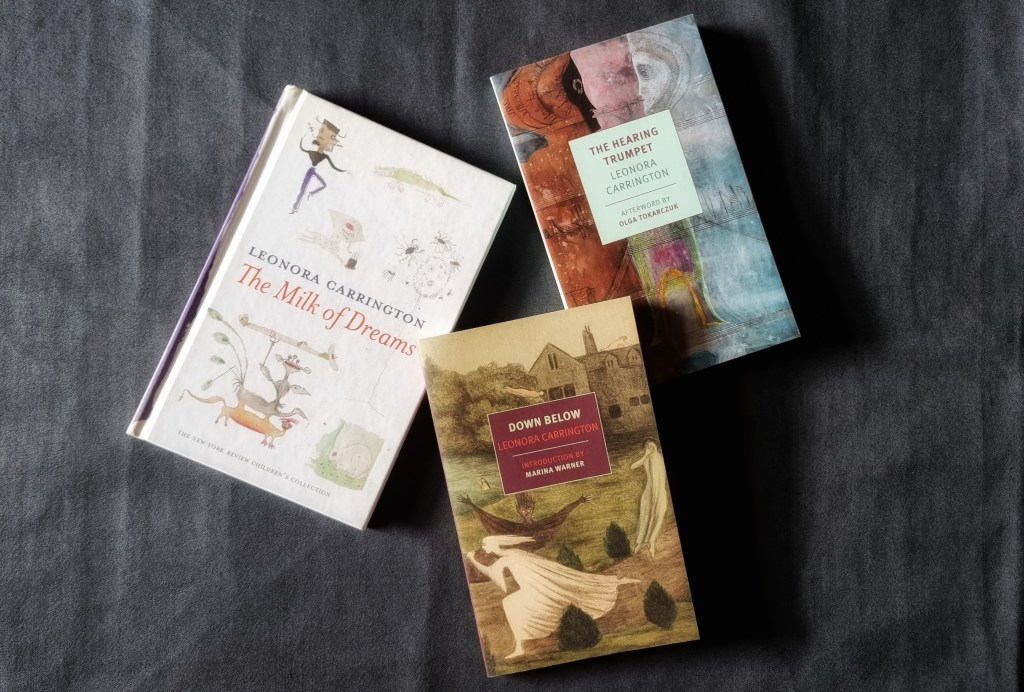
Dated 23rd of August 1943, this personal account begins with these plain words: “Exactly three years ago, I was interned in Dr. Morales’s sanatorium in Santander, Spain, Dr. Pardo, of Madrid, and the British Consul having pronounced me incurably insane.”
Down Below is a short but unpleasant read, devoid of the whimsy of her two other books that I read earlier this year. This one ironically chronicles a life’s descent into madness — rationally.
The life in question endured the turmoil of WWII; stormy relationships; the arrest of her lover, surrealist artist, Max Ernst, by the Nazis; rape, abuse, and suffering in a mental institution.
Reading her writings and looking at her paintings is to catch wind of that unique and bizarre voice from her depths, from down below… an abyss where only painting and writing would provide moments of reprieve.
Leonora Carrington died in 2011 without knowing that she, along with her otherworldly imagination, would be honored in the art world when the Venice Art Biennale would borrow its 2022 title from one of her books, The Milk of Dreams.
But she did know certain things while she lived: she knew how to shield herself from what she considered “the hostility of conformism”, and gave little mind to what others thought of her… and perhaps, in that respect, she was free.
Scheherazade in A Musical Offering, Penelope in Fireflies. I see what you did there, Mr. Sagasti! The mother weaver of stories of the East, and the mother un-weaver of storytelling of the West. Spun and spanned. And spangled.
“Now I’m drunk, with universe.”
Ever since the two Zweigs that got me through the long wait at the polling precincts, I have only found myself turning pages of several books but absorbing nothing, only to reread the same pages and still end up drifting. The way many people have treated our national elections like they would a mere cockfight is confounding. Your books are beautiful reprieves. Write some more, please. This is going to be a tough ride. We will need more of your magic.
Imagine a Serbian little boy being taken away from his mother as “blood tribute,” an Ottoman practice of forcibly recruiting soldiers from Balkan Christian subjects. Imagine the screams and the cries as the mother follows them to the Drina River, until the janissaries and the child embark on a ferry where they are parted forever.
This is the agony with which the book begins, and it made me wonder if I should shelve it for later. It felt too heavy to be read amid the volatile climate of the Philippine elections. But the writing made me want to read more, and I do not regret doing so.
This boy rose through the military ranks and became known as Mehmed Paša Sokolović, and in his later years, Grand Vizier of the Ottoman Empire. But the painful memory of separation never left him: “…he thought that he might be able to free himself from this discomfort if he could do away with that ferry on the distant Drina, around which so much misery… gathered and increased incessantly, and bridge the steep banks and the evil water between them, join the two ends of the road which was broken by the Drina and thus link safely and forever Bosnia and the East, the place of his origin and the places of his life. Thus it was he who first, in a single moment behind closed eyelids, saw the firm graceful silhouette of the great stone bridge which was to be built there.” Thus began the construction of the bridge over the Drina, at the part of the river where he last saw his mother.
The main character in this novel is the bridge. This bridge that has withstood over four hundred years of tumultuous history.
— — —
Elif Shafak was a reading staple between November 2020 to January 2022 when I was steeped in my reading project to cover and uncover as many writings from places affected by the Silk Route; so when a friend learned that Elif Shafak had said that The Bridge on the Drina caused something in her to shift forever, this was enthusiastically recommended to me.
Of the nine books by Shafak that I read, the first one was The Architect’s Apprentice, set in sixteenth century Istanbul about a fictional apprentice working with the legendary Ottoman court architect, Sinan. The one commissioned to design the bridge on the Drina, the Mehmed Paša Sokolović Bridge, is none other than Mimar Sinan.
— — —
But authors are stories in themselves, and Ivo Andrić’s life is literally one for the books. Born to a poor family in Bosnia, he grew up playing on the very bridge he would later immortalize and earn him the Nobel Prize for Literature in 1961. The years in between include two World Wars and an extraordinarily rich and eventful life.
The introduction to this edition claims, “No better introduction to the study of Balkan and Ottoman history exists… no anthropologist has ever reported the process of cultural change so sensitively; no historian has entered so effectively into the minds of the persons with whom he sought to deal…” I can only agree!
Andrić arranges the perplexing layers of this region’s history from the 16th to the 20th century into an impassioned song that constantly returns to its main theme — the bridge.
“…The life and existence of every great, beautiful and useful building, as well as its relation to the place where it has been built, often bears within itself complex and mysterious drama and history… Therefore the story of the foundation and the destiny of the bridge is at the same time the story of the life of the town and of its people…”
“Life…renews itself despite everything and the bridge does not change with the years or with the centuries or with the most painful turns in human affairs. All these pass over it, even as the unquiet waters pass beneath its smooth and perfect arches.”
There is an excess of lessons to be learned from this work, and much to be said about the exceptional writing, but what made me read on was the pervading refrain of the enduring power of art and architecture, and the comforting thought that no matter the course of history, life always renews itself.
As subtle but as vital as breath, the passage of ideas and wonder surges with life through these pages and straight to the reader.
Marguerite Yourcenar carves and immortalizes the many aspects of the great Roman emperor that was Hadrian, but unlike any work of history, she resuscitates his heart and offers it to us, pulsating and bleeding, as only Marguerite Yourcenar can.
Written in the form of a letter to his successor, Marcus Aurelius, whose Meditations endure up to this day, Memoirs of Hadrian is the introspection of a man at the end of his days, stripped away of life’s pretensions and left only with his truths. I suspect that this, too, shall endure.
“I have known men infinitely nobler and more perfect than myself…There is but one thing in which I feel superior to most men: I am freer…For my part I have sought liberty more than power, and power only because it can leadto freedom.”
It is partly an ode to Hadrian the traveler, the only emperor in the empire’s history to have traveled to almost every part of its vast realm. Of traveling, he writes, “It disrupts all habit and endlessly jolts each prejudice.”
An ode to a man who could accept with calm the vicissitudes of Rome Eternal after his time (“If ever the barbarians gain possession of the world they will be forced to adopt some of our methods; they will end resembling us”) but could not understand a resignation to ignorance; and thus promoted Greek philosophy and culture and patronized the arts, literature, music, architecture.
A man who perceived that knowledge and literature were as important as food to a civilization, and libraries, dispensaries to the soul: “The founding of libraries was like constructing more public granaries, amassing reserves against a spiritual winter which by certain signs, in spite of myself, I see ahead.”
An ode to Hadrian the builder who believed in the richness of an architecture more varied than Vitruvius’ four orders would allow (“Our great stone blocks, like our tones in music, are amenable to endless regrouping”) and thus amassed inspiration even from faraway Ctesiphon, Babylon, and Egypt, drew the plans himself, and put emphasis on building from vernacular materials.
“To build is to collaborate with the earth, to put a human mark upon a landscape, modifying it forever thereby…To reconstruct is to collaborate with time gone by, penetrating or modifying its spirit, and carrying it toward a longer future… My cities were born of encounters… Each building stone was the strange concretion of a will, a memory, and sometimes a challenge. Each structure was the chart of a dream… I have wanted to live as much as possible in the midst of this music of forms.”
“In the evenings the art of building gave way to that of music, which is architecture, too, though invisible.”
And so it is also an ode to a man who applied the laws of art and governance interchangeably: “Strength was the basis, discipline without which there is no beauty, and firmness without which there is no justice. Justice was the balance of the parts, that whole so harmoniously composed which no excess should be permitted to endanger. Strength and justice together were but one instrument, well tuned… all forms of dire poverty and brutality were things to forbid as insults to the fair body of mankind, every injustice a false note to avoid in the harmony of the spheres.”
It is an ode to the man who first ventured to call Rome “eternal”; who counted desperately on the eternity of stone, as we are able to continue to witness through Hadrian’s Wall, Hadrian’s Villa, Castel Sant’Angelo, the Pantheon; a man who believed that, “Anything made by man which aspires to eternity must adapt.” And therefore it is an ode to a man who looked for and looked to eternity — and thus, he loved.
Above all, it is an ode to a man who loved. For what is eternity without it?
“At one level, reflection means we see ourselves. At another, it’s another word for the thought process. We can choose to use it to look into the light of our own eyes, or we can be light sensitive, we can allow all things to move over and through us… Broken things become pattern in reflection. The way a kaleidoscope works is to allow fragmentary or disconnected things to become their own harmony.” Ali Smith, Artful
Grief and loss without the melodrama. Spews musings on art and literature in one breath. Pinches the heart and tickles the punny bone simultaneously.
“Simile, though your heart is breaking,” writes Ali Smith.
Witty.
Quirky.
Artful. Of course.
Genius.
Lovely.
“Great books are adaptable; they alter with us as we alter in life, they renew themselves as we change and re-read them at different times in our lives. You can’t step into the same story twice — or maybe it’s that stories, books, art can’t step into the same person twice, maybe it’s that they allow for our mutability, regardless of time, that makes them art, because real art… will hold us at all our different ages like it held all the people before us and will hold all the people after us, in an elasticity and with a generosity that allow for all our comings and goings.”
When you turn to a book for solace and get chills instead.
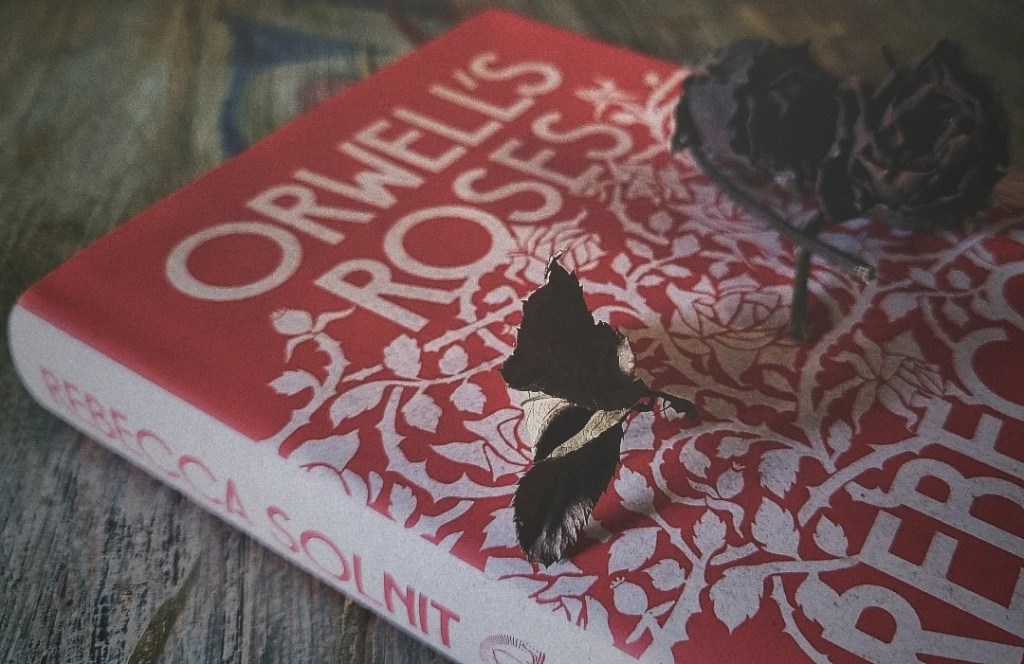
Yes, this has got to be the most beautiful literary criticism of Nineteen Eighty-Four: It rethinks the man that was George Orwell, it guides us to reassess beauty, and it reviews Nineteen Eighty-Four in a light that is distinctly hers. But with Rebecca Solnit, you never know where she will take you next; it is only guaranteed to be a place of startling insight and perspective.
Written and published amid the Covid-19 pandemic, it surprisingly mentions and describes Putin as an admirer and rehabilitator of Stalin’s reputation; even calling to mind the Holodomor, also known as the Terror-Famine, recognized by 16 nations as a genocide carried out by the Soviet government that killed 3-5 million Ukrainians from 1932-1933… and it seems like George Orwell’s Nineteen Eighty-Four will not be the only prescient book in question here.
What is chilling is the reminder that, “To be corrupted by totalitarianism, one does not have to be in a totalitarian country.” Orwell set Nineteen Eighty-Four in England, “To emphasize that totalitarianism could triumph anywhere.”
And what buttresses totalitarianism? Lies. “Lies gradually erode the capacity to know and to connect… Lies are integral to totalitarianism… demands, in fact, the continuous alteration of the past, and in the long run probably demands a disbelief in the very existence of objective truth.”
“Who controls the past controls the future: who controls the present controls the past. The attack on truth and language makes the atrocities possible. If you can erase the witnesses, convince people of the merit of supporting a lie, if you can terrorize people into silence, obedience, lies, if you can make the task of determining what is true so impossible or dangerous they stop trying, you can perpetuate your crimes. The first victim of war is truth.”
And yet, despite these ominous warnings for which Orwell is known, Solnit asks us to reconsider the word “Orwellian” and look at the man who, in the spring of 1936, planted roses. Beautiful is far from the first word that comes to mind when confronted with his writings, but there is a definition of beauty, Solnit emphasizes, that does not have to do with prettiness. “Another kind of beauty, of a toughness that is life…” The beauty to which Orwell was most committed and for which he strove was “this beauty in which ethics and aesthetics are inseparable, this linguistic beauty of truth and of integrity as a kind of wholeness and connectedness, between language and what it describes, between one person and another, or between members of a community or society.”
What was beautiful to him was truth, clarity, honesty — and roses. “Orwell was passionate about the beauty and gestures and intentions, ideals and idealism when he encountered them, and it was to defend them that he spent much of his life facing their opposites.”
“Orwell’s work was about ugliness of various kinds, but what he found hideous serves as a negative image of what he found beautiful.”
There is, after all, solace through the roses telling us that stopping to smell them does not necessarily distract us from the seemingly more important things in life, but strengthens us instead. Through Rebecca Solnit, and through the man who made my birth year significant in literary history, we are spurred to recalibrate what we deem beautiful, to acknowledge our need for beauty, and to always strive to pursue it.







 The Book-Butterfly