Five Indian Forts

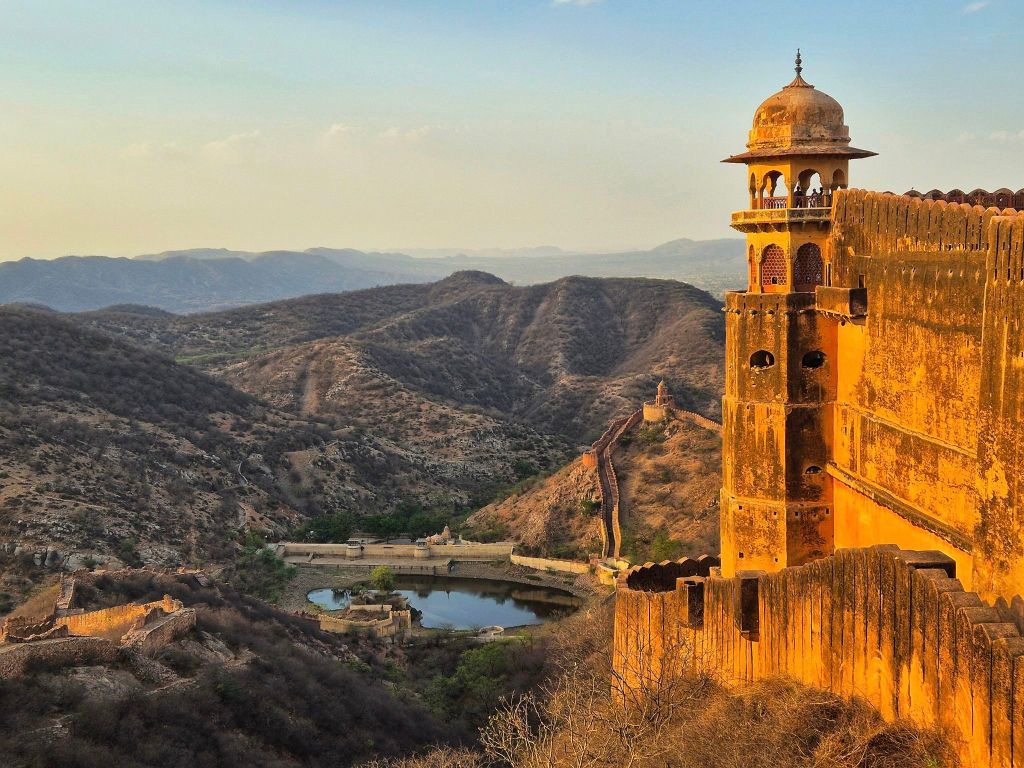
Although the stories about these places are just as intriguing and twisted as Game of Thrones, what may look like promotional shots for season two of House of the Dragon, are photos of five out of approximately a thousand forts in India that are triumphs of strategy and engineering.

Amber Fort: The most picturesque. Jaigarh: Where one will find what used to be the largest cannon in the world, and along with Amber Fort and Nahargarh, has the best views overlooking the city of Jaipur and the sunset. Chittorgarh: The largest living fort in Asia, and where I was congratulated for being named “Mira” and being a musician, as Chittor residents are devotees of the mystic musician, Meera, or Mirabai. Agra Fort: The only Mughal fort among these, commanding a majestic view of the Taj Mahal, standing since 1530 and is still being used by the Indian Army up to this day!


Benjamin Labatut: The MANIAC

Robert Downey Jr. as Lewis Strauss appeared in my mind’s eye when I encountered the lines about Strauss being the person John von Neumann was speaking to on the telephone when the latter collapsed and was subsequently diagnosed with cancer; the person by von Neumann’s bedside as he lay dying; and the person who delivered von Neumann’s eulogy at the Princeton Cemetery.

It was Cillian Murphy as J. Robert Oppenheimer that I imagined when he was quoted as saying, “With the creation of the atom bomb physicists have known sin, and this is a knowledge which they cannot lose”; and when he was mentioned opposing the building of the hydrogen bomb through the MANIAC (Mathematical Analyzer, Numerical Integrator and Computer) — The MANIAC, whose chief architect was von Neumann.

The movie, Oppenheimer, and its characters are still fresh in our minds. But who is John von Neumann? And why doesn’t he figure in the film when these people were his contemporaries and colleagues, and when he played such a huge role in the Manhattan Project, aside from being credited for calculating the optimal height for the detonation of the bombs over Hiroshima and Nagasaki?

The second question can be answered by various speculations. Benjamin Labatut answers the first: He was the smartest human being of the 20th century.

“The cleverest man in the world… a genius, a very great genius,” according to Albert Einstein. The back cover sums up von Neumann as, “…the individual who birthed the modern computer, laid down the mathematical foundations of quantum mechanics, written the equations for the implosion of the atomic bomb, fathered the Theory of Games and Economic Behavior, heralded the arrival of digital life, self-reproducing machines, artificial intelligence, and the technological singularity…”

Labatut, rockstar that he is, goes beyond what we can find in Wikipedia; simplifies alien quantum talk into plain language; constructs a complex and eerie portrait of a flawed superhuman through the different lenses of von Neumann’s peers, rivals, friends, and family; and charts the seemingly unstoppable advancement of AI.

The book highlights the irony of what comes hand in hand with technological progress, how the rise of the computer was tied to and hastened by the nuclear arms race: “Just think about this for a second: the most creative and the most destructive of human inventions arose at exactly the same time. So much of the high-tech world we live in today, with its conquest of space and extraordinary advances in biology and medicine, were spurred on by one man’s monomania and the need to develop electronic computers to calculate whether an H-bomb could be built or not.”

In the first chapter we find an account of Austrian physicist Paul Ehrenfest waiting for the train and heading to his suicide, and it makes for a strong allegory for the shared fate of humanity and technology: “…even though he could not hear it, could not feel its faint rumbling in the distance, he still knew that it would come, there was no stopping it, in fact it had just arrived, he could see it rolling slowly into the platform, smoke billowing all around him as the whistle shrieked, but even then he still had time to turn back…and walk away, he still had time, and yet he stood, machinelike, propelled by a force he neither recognized nor understood, and took five steps with his legs as stiff as an automaton’s, to board the wagon and take his place among the rest.”

By reading this book, one can see why it was important for Labatut to write it: The portrait of John von Neumann is the portrait for, and of, our age.

Who needs science fiction when reality is this chilling?

Susan Sontag: At the Same Time

Reading on Women’s Month is something I look forward to each year. There’s simply nothing like communing with some of the fiercest minds in literature for an entire month!

I’m glad to have kicked off with Hurricane Clarice and Hanne Ørstavik, but this month’s reading goals are not too unrealistic: One Sontag essay a day (although I will definitely squeeze in what I can). I cannot fully express how much her words feed me so profoundly.


“…literature was a criticism of one’s own reality, in the light of a better standard.” — From The World As India

“Literature can train, and exercise, our ability to weep for those who are not us or ours. Who would we be if we could not sympathize with those who are not us or ours? Who would we be if we could not forget ourselves, at least some of the time? Who would we be if we could not learn? Become something other than we are?” — From Literature is Freedom

“To have access to literature, world literature, was to escape the prison of national vanity, of philistinism, of compulsory provincialism… Literature was the passport to enter a larger life; that is, the zone of freedom. Literature was freedom. Especially in a time which the values of reading and inwardness are so strenuously challenged, literature is freedom.” From Literature is Freedom

 “And one of the resources we have for helping us to make sense of our lives, and make choices, and propose and accept standards for ourselves, is our experiences of singular authoritative voices, not our own, which make up that great body of work that educates the heart and the feelings and teaches us to be in the world, that embodies and defends the glories of language: namely, literature. From At the Same Time: The Novelist and Moral Reasoning

 “The writer’s first job is not to have opinions but to tell the truth… and refuse to be an accomplice of lies and misinformation. Literature is the house of nuance and contrariness against the voices of simplification… the job of the writer is to make us see the world as it is, full of many different claims and parts and experiences.” From The Conscience of Words

“A writer is first of all a reader. From The World As India

“The capacity to be overwhelmed by the beautiful is astonishingly sturdy and survives amidst the harshest distractions.”  — From An Argument About Beauty


Andre Aciman: Letters of Transit

No, that’s not Aciman on the photo. Haha That’s the BFF having a reading session with me at midnight in Cebu.

It’s only now that I’ve noticed how often I’ve opted to travel with André Aciman. On a brief trip to Cebu last week, I took this anthology with me, mainly for the Edward W. Said essay. (Is there a more relevant writer to read these days?) 

But as soon as I opened this slim volume at the airport’s pre-departure area, I found myself falling in love with Andre Aciman’s lines once again.

“Does a place become one’s home because this is where one read the greatest number of books about other places?” He ponders.

Cebu sports a different look and feel each time I visit. My trips to this city have dwindled down to once-a-year. To think I used to spend months there for work and music-related projects. 

But to paraphrase Aciman who wrote, “…even if I don’t disappear from a place, a place disappears from me,” I would write this of Cebu: “Even if I disappear from a place, a place never disappears from me.”

It is, of course, because of the people that I still consider it one of the capital cities of my life. Second to Dipolog, Cebu is where I read the greatest number of books about other places; and though it often seems unrecognizable these days, it is home for the aforementioned reasons of books and people.

Susan Sontag

Reading, writing, art, dance, music, photography, theatre, travel — every book brims with profound thoughts on what Sontag cared about. She takes your hand and leads you to art, and shows you why it matters, despite a world that tries to convince us otherwise. Her words feed me so profoundly and leave me overflowing.

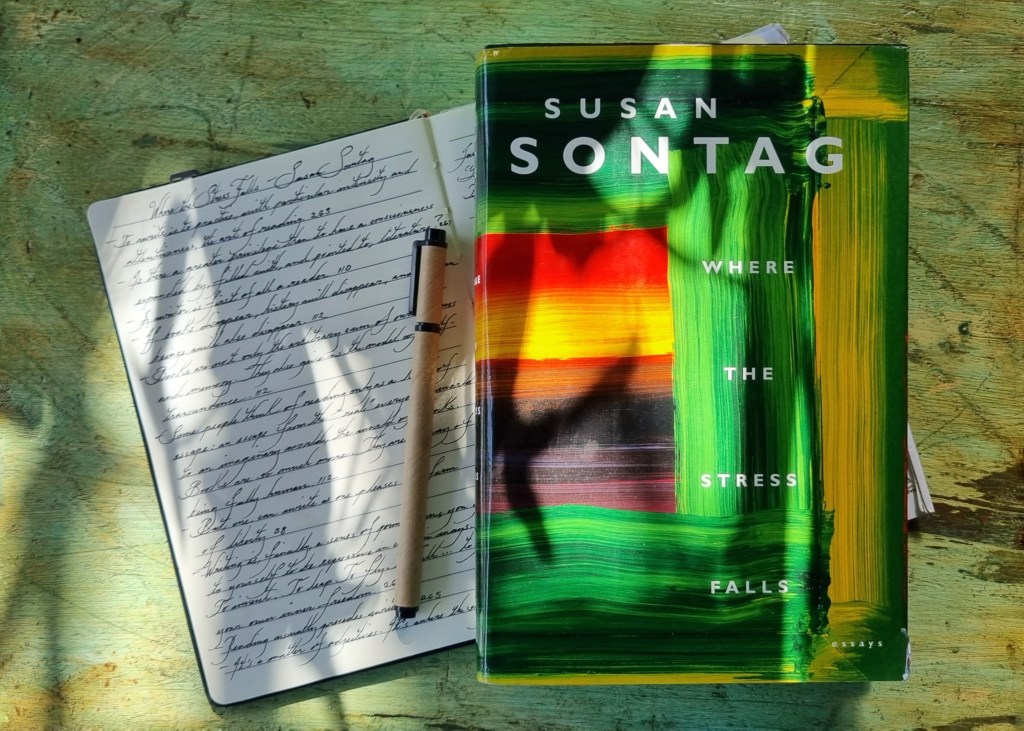
Where the Stress Falls


“Is there a greater privilege than to have a consciousness expanded by, filled with, pointed to, literature?”

“Some people think of reading only as a kind of escape: an escape from the ‘real’ everyday world to an imaginary world, the world of books. Books are so much more. They are a way of being fully human.”

“If books disappear, history will disappear, and human beings will also disappear.”

…a citizen of literature — which is an international citizenship.

“Reading usually precedes writing.”

“A writer is first of all a reader.”

“…to write is to practice, with particular intensity and attentiveness, the art of reading.”

“But one can write as one pleases — a form of liberty.”

“Writing is, finally, a series of permissions you give to yourself to be expressive in certain ways. To invent. To leap. To fly. To fall… to find your own inner freedom.”


At the Same Time


“…literature was a criticism of one’s own reality, in the light of a better standard.” — From The World As India

“Literature can train, and exercise, our ability to weep for those who are not us or ours. Who would we be if we could not sympathize with those who are not us or ours? Who would we be if we could not forget ourselves, at least some of the time? Who would we be if we could not learn? Become something other than we are?” — From Literature is Freedom

“To have access to literature, world literature, was to escape the prison of national vanity, of philistinism, of compulsory provincialism… Literature was the passport to enter a larger life; that is, the zone of freedom. Literature was freedom. Especially in a time which the values of reading and inwardness are so strenuously challenged, literature is freedom.” From Literature is Freedom

 “And one of the resources we have for helping us to make sense of our lives, and make choices, and propose and accept standards for ourselves, is our experiences of singular authoritative voices, not our own, which make up that great body of work that educates the heart and the feelings and teaches us to be in the world, that embodies and defends the glories of language: namely, literature. From At the Same Time: The Novelist and Moral Reasoning

 “The writer’s first job is not to have opinions but to tell the truth… and refuse to be an accomplice of lies and misinformation. Literature is the house of nuance and contrariness against the voices of simplification… the job of the writer is to make us see the world as it is, full of many different claims and parts and experiences.” From The Conscience of Words

“A writer is first of all a reader. From The World As India

“The capacity to be overwhelmed by the beautiful is astonishingly sturdy and survives amidst the harshest distractions.”  — From An Argument About Beauty


June 24, 2022 – Goodnight, Khiva

As the veins of the Silk Route on land dwindled and acquiesced to naval routes, and explorers discovered treasures deemed more valuable than the fiber that changed the world, Khiva continued to treasure silk just as much as gold. Even up until 1924, the silk money of Khiva were hand-woven (and literally laundered when it required cleaning).

As I wistfully think about the ephemerality of places never to be seen, as they are, ever again; I also take joy in the experience of being changed by these places. I suppose it is unfair to ask them to stay the same while I am constantly being transformed?

And maybe this is why I travel, and read, and write… because how can one explore the world to its deepest, if one does not also attempt to explore the terrains of the self and the mind?

Good night, Khiva. Thank you for a thousand and one… lessons.

© 2022 MDR
Khiva, Uzbekistan

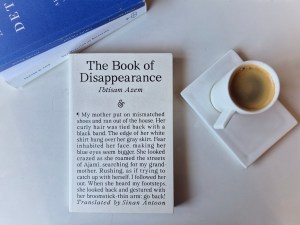
John Williams: Augustus

“Father, has it been worth it? Your authority, this Rome that you have saved,
this Rome that you have built? Has it been worth all that you have had to do?”

To have made palpable not only history, but the scope of human nature and the heart’s confidentialities; to have justly raised some of history’s forgotten women from the footnotes of the annals; to have retrieved a legendary man from his pedestal so he could tread in our minds as a mere mortal; to have given pensive credence to a line from that famous Quartet by Durrell in that the real ruins of Europe are its great men; there is but one word for the man, this book, the writing — august.

I have not read a more majestic novel!

As much as I want to reiterate the praises heaped upon this work and repeat the passages that moved me, I wish to put emphasis on what makes it meaningful to me as a woman — the noteworthy backstory, underscored by John McGahern in this edition, about the catalyst that gave us this book. In a conversation with writer Morton Hunt, John Williams learned the story of Augustus’ daughter Julia, whom the emperor deeply loved, but whom he sent into exile because she had broken the laws on adultery that he himself had enacted. The fascination with the fact that the only child of the first emperor of the Roman Empire had been overlooked in the histories led Williams to an immersion into the Roman world, which resulted in this work in which Julia is the heart.

It is this heart that grants us a compassionate portrait of Augustus. With this work published in 1971, and with that subtle power distinctly his, John Williams penned a revolutionary and enlightening approach on how to treat history’s women alongside the men — not to raise them unreasonably into women who played bigger roles in history than they actually did, but to remind us that they existed, they lived, and that they mattered.


Greeting this month with Memoirs of Hadrian and ending it with Augustus feels like a paradox at a time in my country when “history” is crafted to suit narratives and facts are doubted because they are purportedly written by the victors.

Friends, Romans, countrymen… in this, our history differs, because we have history written not by the victors but by the victims, and by those who became victims by speaking the truth. If we have the courage to question our history, we need also the courage to question our motives, and most of all, ask ourselves what kind of people our convictions empower.


“…nor did I determine to change the world so that my wealth and power might be enhanced… it was more instinct than knowledge, however, that made me understand that if it is one’s destiny to change the world, it is his necessity first to change himself.”

Alan Bennett: The Uncommon Reader

“I read… because one has a duty to find out what people are like.”

There is no travel companion like a book. This is especially true for delayed inter-island flights and boat trips, and long waits at the airport.

The final pages of the books I’ve read this month, so far, were closed just as the plane touched the runway: Yourcenar’s Memoirs of Hadrian, Aciman’s Alibis, Berger’s Ways of Seeing, and Bennett’s The Uncommon Reader

Only Yourcenar has been reviewed properly in writing. The last couple of weeks have been spent with reading people, and it’s lovely how conversations naturally turned into in-depth book reviews entwined with life experiences that we otherwise would not have written for all social media to see. And I would not have exchanged these communions for anything post-able. My first line has to be rephrased: There is no travel companion like a book that leads you to people, places, and experiences.

Out of the four, it was The Uncommon Reader that surprised me. I have to admit that the British monarchy has not been of much interest to me, but I’ve been shelving this book for the reason that I felt it was the kind that would not stand in the way of real life and vice versa. And so, I reserved it for traveling. 

The insights about reading are more profound than I expected! From Proust to Ancient Ur, to Iran, it mentions things I find delightful! It is true, it did not stand in the way of real life, but it is apparently the kind that enhances life — especially a reader’s life — in a warm, hilarious, and light-hearted way.

‘Books are wonderful, aren’t they?’ she said to the vice-chancellor, who concurred. ‘At the risk of sounding like a piece of steak,’ she said, ‘they tenderize one.’

Is there anything we need more these days than to be “tenderized”?