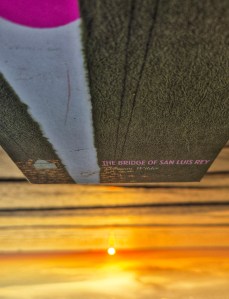
Thornton Wilder: The Bridge of San Luis Rey

04/05/2026 | Concerned about the rise of books adulterated by AI, our book club’s aim for our April session was to present a book that could not have been written by AI. 

First published 99 years ago, and awarded the Pulitzer the following year, it makes one certain that The Bridge of San Luis Rey could not have been written by AI. Let people say what they want to say about classics, but the rise of AI has only increased the value of literary works written prior to its advent.

My pick was rather redundant, for it was already chosen by another Ex Libris member for our February session when we were asked to present a book that talked of love in any form. That same recommendation led me to read it, and reading it made me realize how it was the most clever pick for the theme of Love. Despite such a slim volume, it unexpectedly contains and expresses the Four Loves (Storge, the love we have for family; Philia, the love between friends based on shared values and interests; Eros, romantic love; Agape, the altruistic and self-sacrificing kind of love) with an understated brilliance.

How the story is framed is impressive. The chapters end with the bridge collapsing, but it is a different character’s backstory that’s introduced in each one. How Wilder ties these different characters together conveys how everything is connected, and how our actions create ripple effects that are broader than we think.

And yet, the story or the publishing date is not the reason why I chose this. It is because this book contains a line that, for me, hits the bullseye as to why AI should have no place in literature. In a long sentence from the early part of the novel, Thornton Wilder writes, “…the whole purport of literature, which is the notation of the heart.”

And here lies our whole argument against AI in literature: Why entrust it to something that does not have a heart?

Benjamin Labatut: The MANIAC

Robert Downey Jr. as Lewis Strauss appeared in my mind’s eye when I encountered the lines about Strauss being the person John von Neumann was speaking to on the telephone when the latter collapsed and was subsequently diagnosed with cancer; the person by von Neumann’s bedside as he lay dying; and the person who delivered von Neumann’s eulogy at the Princeton Cemetery.

It was Cillian Murphy as J. Robert Oppenheimer that I imagined when he was quoted as saying, “With the creation of the atom bomb physicists have known sin, and this is a knowledge which they cannot lose”; and when he was mentioned opposing the building of the hydrogen bomb through the MANIAC (Mathematical Analyzer, Numerical Integrator and Computer) — The MANIAC, whose chief architect was von Neumann.

The movie, Oppenheimer, and its characters are still fresh in our minds. But who is John von Neumann? And why doesn’t he figure in the film when these people were his contemporaries and colleagues, and when he played such a huge role in the Manhattan Project, aside from being credited for calculating the optimal height for the detonation of the bombs over Hiroshima and Nagasaki?

The second question can be answered by various speculations. Benjamin Labatut answers the first: He was the smartest human being of the 20th century.

“The cleverest man in the world… a genius, a very great genius,” according to Albert Einstein. The back cover sums up von Neumann as, “…the individual who birthed the modern computer, laid down the mathematical foundations of quantum mechanics, written the equations for the implosion of the atomic bomb, fathered the Theory of Games and Economic Behavior, heralded the arrival of digital life, self-reproducing machines, artificial intelligence, and the technological singularity…”

Labatut, rockstar that he is, goes beyond what we can find in Wikipedia; simplifies alien quantum talk into plain language; constructs a complex and eerie portrait of a flawed superhuman through the different lenses of von Neumann’s peers, rivals, friends, and family; and charts the seemingly unstoppable advancement of AI.

The book highlights the irony of what comes hand in hand with technological progress, how the rise of the computer was tied to and hastened by the nuclear arms race: “Just think about this for a second: the most creative and the most destructive of human inventions arose at exactly the same time. So much of the high-tech world we live in today, with its conquest of space and extraordinary advances in biology and medicine, were spurred on by one man’s monomania and the need to develop electronic computers to calculate whether an H-bomb could be built or not.”

In the first chapter we find an account of Austrian physicist Paul Ehrenfest waiting for the train and heading to his suicide, and it makes for a strong allegory for the shared fate of humanity and technology: “…even though he could not hear it, could not feel its faint rumbling in the distance, he still knew that it would come, there was no stopping it, in fact it had just arrived, he could see it rolling slowly into the platform, smoke billowing all around him as the whistle shrieked, but even then he still had time to turn back…and walk away, he still had time, and yet he stood, machinelike, propelled by a force he neither recognized nor understood, and took five steps with his legs as stiff as an automaton’s, to board the wagon and take his place among the rest.”

By reading this book, one can see why it was important for Labatut to write it: The portrait of John von Neumann is the portrait for, and of, our age.

Who needs science fiction when reality is this chilling?