The Georgia Book Stack


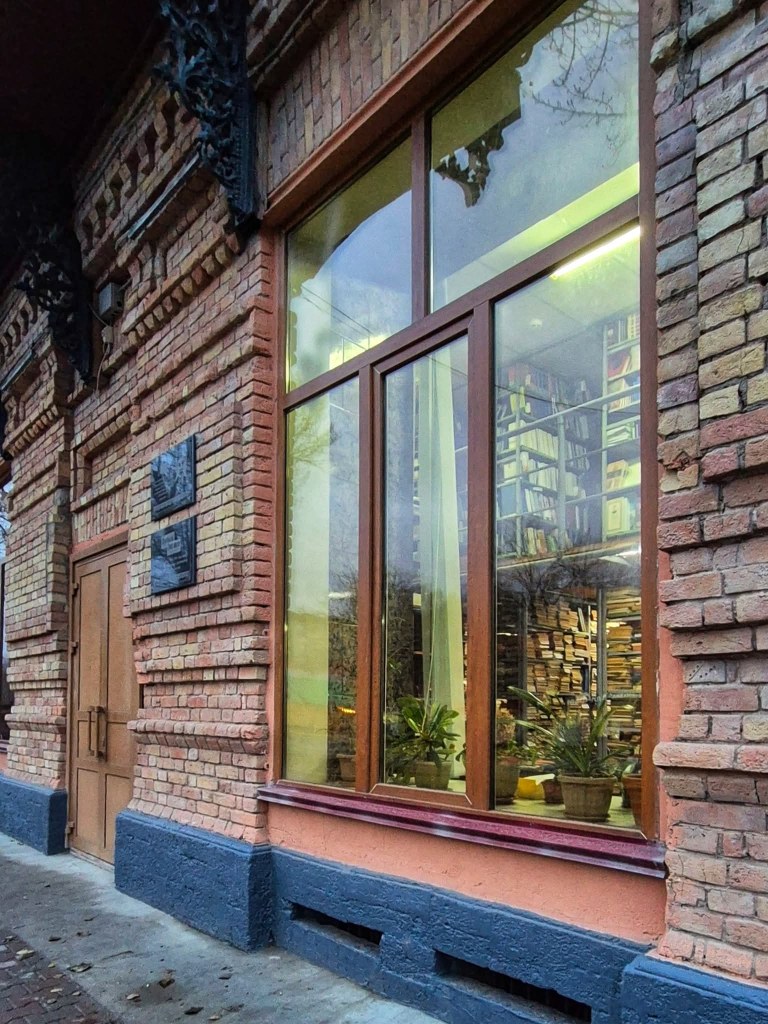
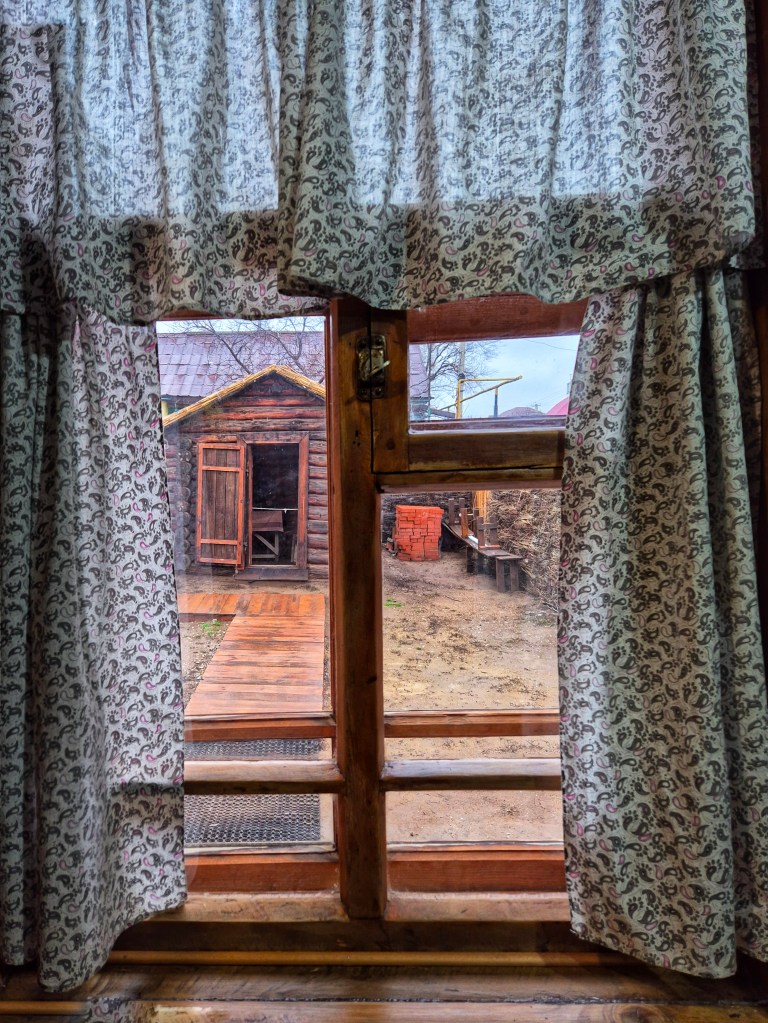
A light rain was falling, a fine spray, unlike what rain is in the tropics. Within a couple of hours the deep purple of evening entered through that same window and transformed the spray into delicate snowflakes that vanished even before you could touch them; inconspicuous magic in the micro details when one season gives way to another.

It was toward the end of the trip when I took this photo of my traveling companions on the windowsill. Absent from the stack, but verily lodged in my consciousness, are Euripedes’ Medea and Percival Everett’s For Her Dark Skin.

I went to Georgia accompanied by seven books, and after jaunts to Tbilisi’s charming bookshops, a modest number of three Georgian masterpieces were read on the train and during long drives, then added to the pile. 

The eclectic curation is an education in itself as it includes a Greek tragedy, a rather feminist and modern retelling of the tragedy, a wonderful and informative chronicle of Georgia’s unique wine culture, journalistic reports and stories from the early years of post-Soviet Georgia, the greatest love story of the Caucasus, literary criticism, a portrait of young Stalin that is also a portrait of a nation, a painful recollection of the Georgian-Abkhazian armed conflict in the 90s, epic poetry, and Tolstoyan short stories.

Once again, people wondered whether I had gone to another destination just to read. But I know they’re only kidding. 

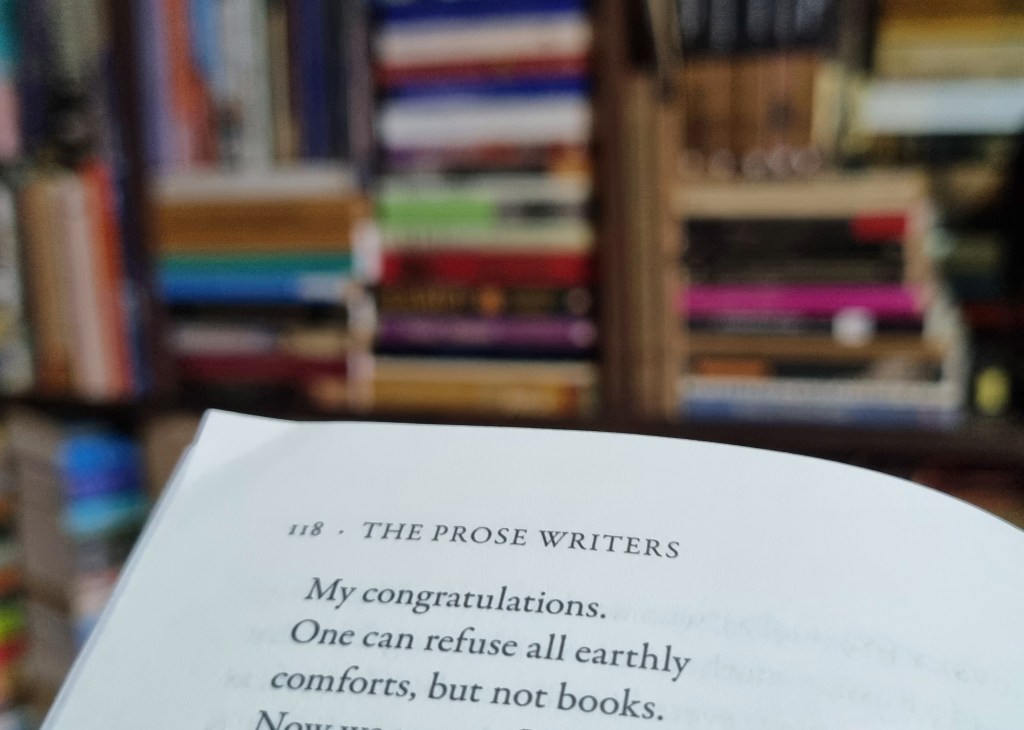
For who isn’t aware that reading and traveling are not separate experiences? They are halves of a whole that lend clarity and depth to each other.

In our travels, what we notice, perceive, and experience — and what we contribute to meaningful interactions, or how we overflow — largely depend on what is already inside us. “Nothing flows out of a jar except that already inside it,” writes the preeminent Georgian author, Shota Rustaveli in The Knight in the Panther’s Skin.

In life, reading and traveling are merely expressions of how one chooses to take their fill.

Alina Bronsky: Baba Dunja’s Last Love

“Boris tells me what he’s seen on television. Lots of politics in the Ukraine, in Russia, and in America. I don’t pay too close attention. Politics are important, of course, but at the end of the day, if you want to eat mashed potatoes it’s up to you to put manure on the potato plants. The important thing is that there’s no war.”

Alina Bronksy’s wit has been on my radar for quite some time but it took one Sunday that badly begged for light reading to make me read her.

Having parents who are advancing in years, I find myself increasingly drawn to elderly protagonists. And so it was a joy to discover Baba Dunja. Her spunk, her kindness, her practicality, and her comic observations make her one of the most endearing characters one will encounter in books. 

But don’t think it’s all light-hearted fun. Alina Bronsky, being a Russian-born German writer, seems to have married dark Russian humor with good old Teutonic political satire.

Even though the government appears to be apathetic about this town near Chernobyl, and despite warnings of radiation levels, Baba Dunja and her cast of amusing friends and neighbors are undeterred by the discrimination against its residents and consider Tschernowo home. And I think that’s what this book is all about — the idea and process of home that we choose and make for ourselves, no matter what.

Sophy Roberts: The Lost Pianos of Siberia

Before Iran, before Persian history, it was Russia, its music, literature, and history that I was preoccupied with for years. (Remember how I named a pet fish “Shosta,” after Shostakovich, who leapt out of the fishbowl to his doom, and died a very dramatic Russian death?) Adulting eventually distracted me from this obsession until Iran took over and began to burn as big a flame in my consciousness.

This book brought me back to my teen years of being fascinated with Russia. As I turned the last page of this beauty, the traveler, the pianist, and the lover of stories in me were all brimming.

After all, Russia is the country of Tolstoy and Dostoevsky, of Rachmaninoff, and “piano music has run through the country like blood.”

Sophy Roberts, however, zones in on Siberia, that immense region that covers eleven percent of the world’s land mass, and home to ninety percent of Russia’s natural resources.

So, what does it have to do with pianos? A lot, apparently. This account traces how the instrument began to grip the heart of the country during the reign of Catherine the Great, how this mania was fueled by concert tours by Liszt and Clara Schumann, and how political prisoners from Poland, the land of Chopin, and Decembrist intellectuals (members of the unsuccessful revolt against Tsar Nicholas I in December 1825) who were exiled to Siberia made culture flourish in the hinterlands by bringing their books, their learning, and their music with them, leaving precious pianos in their wake. It also poignantly mentions that the only thing that survived the Romanov massacre was the piano that the young tsarevnas brought with them and on which they played during their last days.

But who would be insane enough to go to Siberia and track the lost pianos of Russia’s history? Sophy Roberts. And she’s my kind of insane. This book is already making me dream of becoming this kind of journalist and writing this kind of book when I grow up. Haha

Which lost things should I go looking for? 


P.S. One simple paragraph also made me understand the rise of Putinism and why he still has a strong following. This doesn’t mean I’m going to start being a Putin apologist, far from it. But it is a sign of a good work of journalism when it makes you see the other side of the coin.

Maylis de Kerangal: Eastbound

What a ride! How Kerangal builds suspense that makes the entire book feel like one long, deep, drawn breath that you would not want to interrupt!

The majesty of Russia’s landscape appears through the window of the trans-Siberian train, but it is surprisingly subtle in portraying a vulnerable Russia.

Yes, it is a serendipitous train ride shared by a man and a woman, but don’t expect the deep conversations of Celine and Jesse from Before Sunrise. Aliocha and Hélène practically pantomime their way throughout the journey; he being Russian and she being French.

Yes, it concerns an army conscript who wants out, but don’t expect Francis Mirković of Mathias Enard’s Zone. Aliocha won’t sing to you a threnody of the crimes of nations. He is only concerned about his escape.

I love the aforementioned titles and I feel relieved that Eastbound did not turn out like any of those. They are only alike for the reason that they are each in a league of their own.

On the surface, it stays true to its promise of being an adventure story, but I see it as an intelligent political novel. Not because the characters discuss politics, they don’t. But can there be a more political story than two people pursuing their individual freedoms?

Vladimir Nabokov: The Defense

“…and when Luzhin left the balcony and stepped back into his room, there on the floor lay an enormous square of moonlight, and in that light — his own shadow.”

The awareness of this being a story of a man possessed by chess (“…sleep could find no way into his brain; it searched for a loophole, but every entrance was guarded by a chess sentry…”) makes the allusion to the white square of a chessboard more impeccable.

Nabokov is a writer that allows a reader to experience cinematography in literature. The deliberate composition of each frame is so visually satisfying that I’m tempted to say it’s the reason I read him. But I would be lying. I’m also here for the traces of his synesthesia.

“Hearing” the chess moves — “combinations like melodies”, chess notations synthesize with musical scores, games begin “softly, softly, like muted violins” then without the least warning, a chord sings out tenderly, a trace of another melody manifests, some other deep, dark note chimes elsewhere…

Sometimes I, too, ask myself if I’m missing the point and reading Nabokov incorrectly by fixating on those passages and often forgetting that this is a tragic tale about how our sanctuaries can turn into obsessions and lead to madness, or the fact that this novel belongs up there with Stefan Zweig’s Chess Story; but then I find myself falling for those passages all over again. Part of me asserts that if this is me reading him wrong then I’m reluctant to be right!

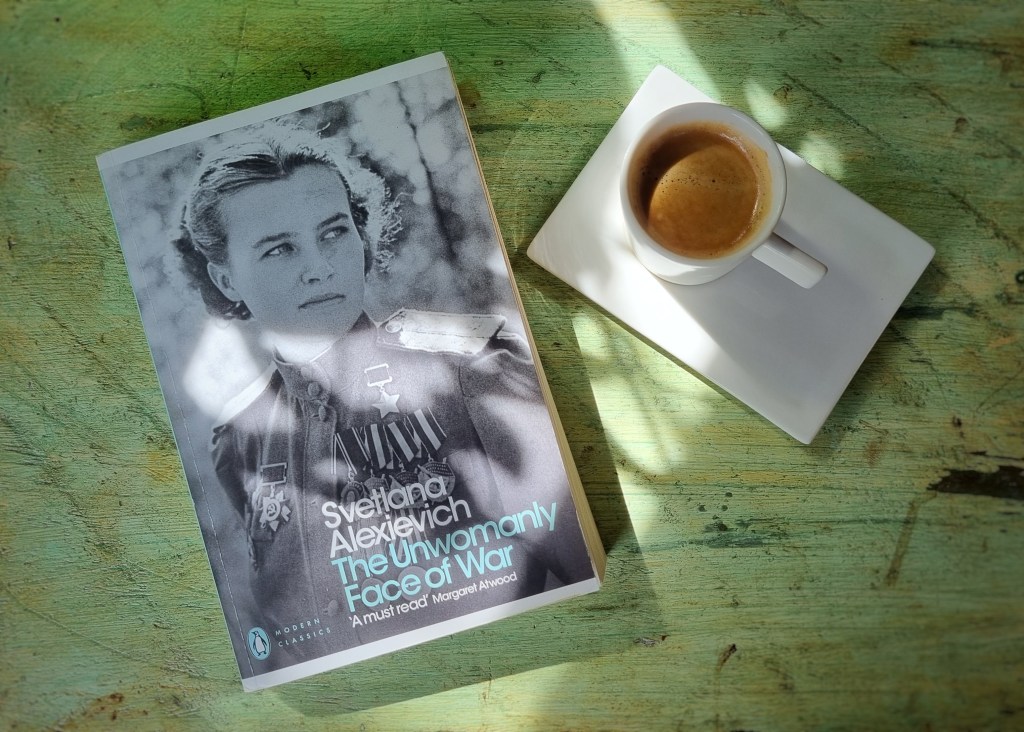
Svetlana Alexievich: The Unwomanly Face of War

During WWII, women served in all branches of the military: 225,000 in the British, 450,000-500,000 in the American, and about a million in the Soviet army. The women in the Soviet army contributed to the German defeat, but little was known and little was said about them and the price they had to pay for victory.

Over the course of twenty six years, Svetlana Alexievich sought out many of these women and became the repository for their untold stories. This is part of the body of work that earns her a place as one of only seventeen women out of a hundred and fifteen Nobel Laureates in Literature.


Maybe it’s because Svetlana Alexievich says that she isn’t writing about war nor the history of a war, “but about human beings in a war… the history of feelings.” Maybe it’s because she is what she says she is, “A historian of the soul.” Maybe it’s because she believes, for good reason, that suffering is “a special kind of knowledge,” “the highest form of information,” that suffering has a direct connection with the mystery of life. (“All of Russian literature is about that. It has written more about suffering than about love. And these women tell me more about it…”) Maybe it’s because she makes this book of unburdening into an overwhelming choir of over two hundred voices singing a soulful rendition of an unsung threnody for the first time, that it answers my question as to why a piercing account of war can be so beautiful and so important. 


Special thanks to Gabi for encouraging me to read this and for giving it to me as a birthday present last year. 🤍

Lev Ozerov: Portraits Without Frames

“Fifty shrewd and moving glimpses into the lives of Soviet writers, composers, and artists caught between the demands of art and politics.”

Fifty portraits in words by this man born in Ukraine when it was part of the Russian Empire, this man with Jewish origins who extraordinarily survived the Shoah, and who walked among Akhmatova, Pasternak, Prokofiev, and Shostakovich and many others “who lived / in times that were hard to bear.”

Fifty poignant poems, written “so that those who did not know will know” and read by this reader as “what happened long ago / becomes current again.”

Fifty intimate portraits that initially seem to be of individual people but soon become apparent as an exceptional, panoramic depiction of an era of art choked by tyranny.

Little did I know that it would become one of my most treasured volumes of Russian literature. I love how clueless we sometimes are of a book’s value until we read it and become acquainted with its soul.

Teffi: Tolstoy, Rasputin, Others, and Me

Oh, what would it have been like to be Teffi, born into a remarkable time that made personal encounters with Tolstoy, Rasputin, Gorky, and Lenin possible, and to have made a name for herself as a writer in an androcentric literary world?

These delightful autobiographical essays answer that question. From childhood recollections, what her multipurpose desk was like, how her pseudonym came to be, to encounters with history’s formidable men, Teffi writes with a poetic simplicity that makes for light reading while never lacking depth. 

“I adore oranges. They are round and golden, like the sun, and beneath their peel are thousands of tiny pockets bursting with sweet, fragrant juice. An orange is a joy. An orange is a thing of beauty.

And suddenly I thought of Ganka. She didn’t know about oranges. Warm tenderness and pity filled my heart.”

Stealing from the crate of oranges, she managed to give one to Ganka, who, in return, “Bit off a piece together with the peel, then suddenly opened her mouth wide, made a horrible face, spat everything out and hurled the orange far into the bushes.”

“I had become a thief in order to give her the best thing I knew in all the world. And she hadn’t understood, and she spat it out.”

And dear Teffi who apparently knew what it’s like to give one’s best and have it discarded just like that, called this short piece “Love”.

Julian Barnes: The Noise of Time

How do reading friends try to lift your spirits? One brought me to Solidaridad, the legendary bookshop founded by the late National Artist for Literature, F. Sionil Jose, and forbade me to exit the shop empty-handed.

“It’s on me,” they’ll say, and treat books like a drink in which you’ll drown your pains.

Thousands to choose from, and yet I clung to this one as soon as I saw it. I was unaware that 2011 Man Booker Prize-winning author, Julian Barnes, wrote a novel about Shostakovich! For an idea of how fond I am of Shostakovich’s music: I performed his Piano Concerto No. 2 on my first solo recital and named a pet fish “Shosta” after him — never mind that this pet fish leapt outside of the fishbowl to his doom and died a very dramatic Russian death.

But I digress… needless to say, I took The Noise of Time home with me and finished reading it on the day the 2022 Man Booker Prize winner is expected to be announced.


It is surprisingly an apt read for a time when many Russian musicians and artists are being cancelled worldwide for not publicly denouncing Putin and the war against Ukraine.

This book suggests that it is not always as easy as it seems to make a public stand.

Shostakovich, who enjoyed international success after his first symphony, dealt with a blow when his opera Lady Macbeth of Mtsensk (a title familiar to NYRB editions enthusiasts) was condemned by the Soviet government in 1948, endangering his life, family, and career. Although the aforementioned work was a success after its premiere in 1934, Barnes highlights the capriciousness of the Soviet state: “What the party had said yesterday was often in direct contradiction of what the party was saying today.” As if under similar laws of energy, Soviet power evolved and mutated from one form to another.

How Shostakovich had never joined the Party initially, but had allowed himself to be seen as supportive of the Party, and how his subsequent decisions played out, appear to be a question between cowardice or courage. But wasn’t this too much to ask from a man who simply wanted to compose music?

What becomes of art when it is suppressed or governed under tyranny — “art made tongue-tied by authority”?

This book has some beautiful answers:

“Art belongs to everybody and nobody. Art belongs to all time and no time. Art belongs to those who create it and those who savor it. Art no more belongs to the People and the Party than it once belonged to the aristocracy and the patron. Art is the whisper of history, heard above the noise of time.”

“Because music, in the end, belonged to music. That was all you could say or wish for.”

But if those lines still cannot convince one of the purity and the incorruptibility of great art, the second movement of Shostakovich’s Piano Concerto No. 2 just might.

Némirovsky: Fire in the Blood | Gille: The Mirador

Fire in the Blood by Irène Némirovsky

Because I arrange my books based on geography, Nikolai Gogol, Mikhail Bulgakov, Vasily Grossman, and Irène Némirovsky among a few others share a spot on my shelf. They were all born in Ukraine while it was still under the Russian Empire.

Fire in the Blood was thought to be unfinished when Némirovsky died in Auschwitz in 1942. It was only through subsequent research years later that the rest of the manuscript was found and published posthumously.

She wrote this around the time she was arrested and deported to Auschwitz, but there is no pain of epic proportions in this book. There are none of Gogol’s ghosts, none of Bulgakov’s political caricatures, and none of Grossman’s wars.

At the beginning I was so convinced that this was simply a charming picture of rural life in an idyllic French village. She makes the reader believe that, until one surprising revelation after another piles up towards the end, and it reveals its own unique depth.

“Are we not all somewhat like these branches burning in my fireplace, buckling beneath the power of the flames?”

Fire in the Blood, the fire of youth contrasted with the sobriety of old age through the introspection of Sylvio and the lives of those around him leaves the reader with a subtle sting that leads to a silent contemplation on, or the questioning of, passion, love and life.

There may have been none of Gogol’s dark humor, none of Bulgakov’s satire, and none of Grossman’s reportage on tragedy, but perhaps Némirovsky deserves her place alongside these men as someone who lays bare the human heart.

 “No, it wasn’t that simple. The flesh is easy to satisfy. It’s the heart that is insatiable, the heart that needs to love, to despair, to burn with any kind of fire… That was what we wanted. To burn, to be consumed, to devour our days just as fire devours the forest.”

The Mirador by Élisabeth Gille

Don’t you love it when an underexposed book surprises and transcends expectations? I had not anticipated The Mirador to contain this much beauty!

Having read nothing by Élisabeth Gille prior to this, I approached it as someone who was simply curious about her famous mother, Irène Némirovsky.

From her mother’s journals, letters, unpublished notes, “dreamed memories”, and with the help of her elder sister’s own memories and research, Gille recreates a striking portrayal of the mother they lost to Auschwitz when they were mere children.

Regardless of the applause that her novels garnered and despite her tragic fate, it was for her indifference and lack of political sense that Némirovsky was criticized. Gille, however, does not justify her mother’s shortcomings. She allows a beautiful irony to unfold through the pages and writes a lyrical and clearsighted grasp of her forebears, literature, history, and the political arena that surrounded Némirovsky from her early childhood in Kyiv, growing up in St. Petersburg, fleeing to Finland in the wake of the Russian Revolution, and building a life and a successful writing career in France until the German Occupation.

I must admit that I personally prefer the daughter’s writing over the mother’s, and it was saddening to learn that Gille died from cancer in 1996, only four years after The Mirador was published. But I beam at the thought that Némirovsky would have been so proud.

How cathartic it must have been for a daughter to write this! It makes one wonder at the mysterious power of writing — how it can liberate the writer and the subject at the same time, how it can be a simultaneous act of holding on and letting go.