Grace is a multifaceted word, but even when I contemplate its various meanings, this book still embodies all of its definitions.
The parcel containing Tethered arrived many months ago as I was on my way out to the airport, and I gladly welcomed an additional book in my carry-on luggage.
Dear Mira,
I hope this book transports you to where you need to be.
Tracy
An apt dedication for a book-butterfly. I turned to the sky and the clouds framed by the plane window, and smiled at the perceptive mind behind the message. A page turn revealed a Rabindranath Tagore quote about a violin string that could only be free to sing once bound to the violin. Even the epigraph felt personal, and I paused to ponder its deeper meaning.
Soon enough, the plane landed in the capital. The urban bustle was not conducive to the stillness and attention that this book required, seeing that the initial passages already felt like the beginnings of an intimate conversation with a friend. Thus, it was tucked away and saved for the reading environment it deserved.
Months passed, dozens of other books were read. But just as I was starting to see the light at the end of a mentally and physically exhausting three-week tunnel when a loved one fell ill, this book seemed to beckon. And sure enough, it transported me to a place where I needed to be — a place of faith and gratitude, and I cannot think of a better place to be. What a gift, this book.
Tethered is grace exemplified, the same way Tracy is grace personified. I’ve only exchanged a few messages with her through Blithe Books, but even electronic messages cannot dilute the light in her soul that shines through her words. Imagine an entire book of it!
This is described as an account of a remarkable journey of recovery from a brainstem stroke that attacked all bodily functions and left only the mind to operate; but more than that, it is a beautiful note of gratitude for life, and a celebration of the mind and the spirit. The author’s optimism is apparent, but as one reads on, one realizes that it is not optimism but faith.
For the believer, faith is the thing that both tethers and liberates. Only when the strings are bound to a violin can they be free, for the first time, to sing.
Our ecological crisis is also a ‘crisis of forgetfulness’… we have forgotten how sacred the nature of creation is,” Iraqi-British writer, Dalia Al-Dujaili, reminds us in Babylon, Albion.
Although I read this in a perfect setting on a weekend getaway — amidst soothing sounds of nature, enveloped by clean air, and surrounded by mountains blanketed by mist — this ‘crisis of forgetfulness’ where the greed of many has replaced the sanctity of nature manifests in international and national news, and in the floodwaters that lap on my own doorstep back home.
Readers who find the lyrical wisdom of Aimee Nezhukumatathil refreshing will surely love this wholesome rumination into identity, migration, land, rivers, borders, national and personal myths, familial and arboreal roots, and humanity’s natural heritage. While these somber topics usually weigh down on the reader, Al-Dujaili imparts a hopeful outlook while encouraging us to make our very own existence into a form of praise, and challenging us to scrutinize how we carry identity. Needless to say, Babylon, Albion was a profoundly beautiful way to end August.
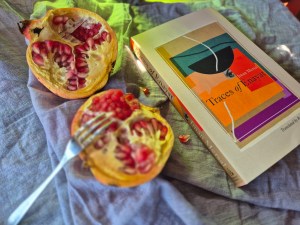
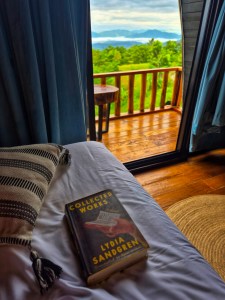
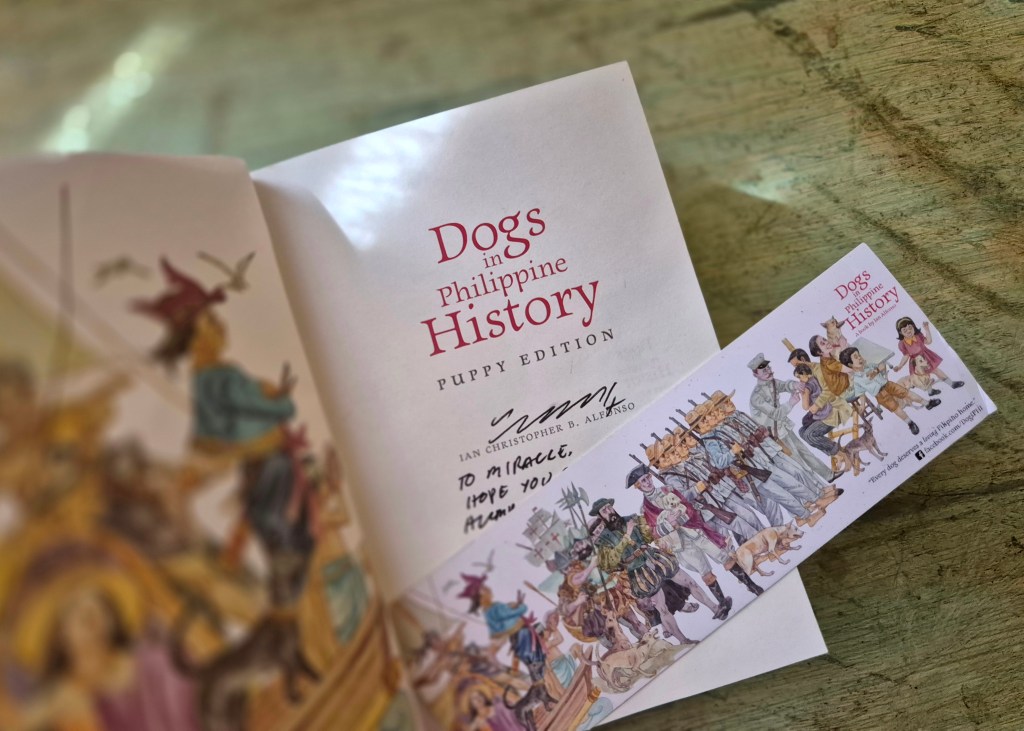
August is Women in Translation Month and Buwan ng Wika (National Language Month). To celebrate the latter: Munting Aklat ng Baybayin by Ian Alfonso. No better way than through learning more about our pre-colonial script! To celebrate the former: Iman Mersal’s Traces of Enayat and Lydia Sandgren’s Collected Works.
“The best investigative reporting is storytelling,” says journalist Jane Mayer. Traces of Enayat is proof of this as Iman Mersal takes the reader on a quest to find traces of Enayat, an Egyptian writer who took her own life in 1963. Mersal affectingly expresses the attachment and resonance we find in the authors we encounter and whose works derail us from an otherwise uneventful trajectory. It also begs the question: How many Enayats has the world lost into oblivion?
As for Collected Works, seven pages shy of six hundred, this novel quietly draws you into its world. It acquaints you with its setting and its characters without haste. It knows how to linger. It lingers on one’s thoughts on literature and art, on a character’s indecision to call someone or not, whether to read a book or not. It often lingers on everyday scenes where words turn into still life paintings and everyday portraits. But these scenes and characters exist in the shadow of Cecilia’s disappearance. Almost fifteen years after she vanished without a trace, her daughter, Rakel, believes it is her missing mother she is reading about in a novel, and measured suspense and mystery begin to replace the monotony of their lives. I would recommend this to the unhurried reader. Ultimately, Collected Works is a meditation on what one’s life amounts to.
As for reading life in August? This is what it amounted to. It felt very much like a defiance of my country’s frustrating political climate.
With its 384 pages and the sun of the Philippine flag on its cover, Concepcion was the perfect candidate to accompany this voter in anticipation of the long queues on Election Day.
“History ripples into perpetuity. Decisions, actions, mistakes, and triumphs of one day shape the days that follow, setting irreversible paths into the future…”
The book choice was especially validated by this line on page 38; the line, a double-edged sword, both encouraged and cautioned the part of myself that is gradually growing cynical toward the government and the electoral system; the line that reminded me that our choices, decisions, and votes are still of consequence.
But journalist Albert Samaha does not preach. Thankfully, he does not stop at reporting either. While he is not shy about American atrocities and their meddling with the fates of weaker nations, the repercussions of colonial subjugation, or the realities of immigration, this reader is in awe of the hakawati of the author’s Lebanese roots manifesting in pages that reveal more about his Filipino origins. This family tale that traces back to the Sultanate of Maguindanao up to the present is extensive and requires nothing less than a modern-day hakawati to tell the story.
In Concepcion, Philippine history ceases to be a structured chronology but a fluid tale that merges with the timeline of world history, personal history, and geopolitics.
Ten full days after the election, this reader finally found herself at the last page already feeling attached to the author’s artist uncle and his mother; fascinating characters that would animate fiction but who are incredibly non-fiction. Samaha writes about them the way he writes about country — with wit, fondness, love, acceptance, and hope — that by the end of the book, one would also have a rejuvenated fascination, with all its wounds and flaws, for the nation.
First, prepare a cup of tablea tsokolate. Kapeng barako will do, but because cacao seeds arrived in the Philippines earlier than coffee through the Galleon Trade, I’ll opt for the former to pair with this book. When the chocolate brew is ready, steep yourself in the richness of both history and drink.
Every essay in this collection discloses an aspect of Philippine history that this reader was oblivious to: Mindanao was once christened “Caesarea,” Spanish maps reveal that “ships could sail in straight from the West Philippine Sea, into Balayan Bay and up a causeway straight into Taal Lake.”
But this book does not contain mere trivia: The essays also confront Manila’s dark chapters. Swastika Manila tells of how the claws of Nazism managed to reach the Philippines, and in Silk, Silver, Spices, Slaves, it is exposed how Manila unfortunately became the center of the Transpacific slave trade.
Also, a Broadway show that premiered in 1902 called The Sultan of Sulu?! Written by anti-imperialist, George Ade, whose work has been praised by Mark Twain; at first glance, an unflattering and fictional depiction of a sultan of Sulu, but fundamentally a satire on America’s colonial designs in the region. It went on to have a sold-out run of 192 shows.
And while I’ve been aware of how Filipinos dominate the world of music gigs in cruise ships and clubs nowadays, thanks to Mangubat’s exploration into colonial archives there is a record showing that this is not a recent phenomenon. Over a hundred years ago, a group of talented Filipinos earned a reputation for being “foreign piano devils” when a Spanish bandmaster brought nineteen musicians to the port city of Shanghai in 1881!
The aforementioned are just the tip of the iceberg, however. It’s a book every Filipino should have on their shelf. These long-forgotten stories from Philippine colonial times have a way of making the past come alive beyond the usual facts and dates we’ve been required to memorize in our school years. Mangubat does not merely reiterate the details he uncovers through research but strings the tales captivatingly and transmits his enthusiasm for history to the reader.
As I relish in how readable these essays are, I am reminded of a historian’s line from I, Claudius: “For every word I wrote I must have read many hundreds.” Our generation is fortunate to have a Lio Mangubat in our midst who does the hard work for us and renders history a vital and accessible thing.
This reader is eager for a second cup and a second volume!
“Only love and art can do this: only inside a book or in front of a painting can one truly be let into another’s perspective. It has always struck me as a paradox how in the solitary arts there is something intimately communal.”
An understated book that is a meditation and an education in art and life.
“I hope that when there is laughter, it’s laughter made wise by having known real grief — and when there is grief, it is made wise by having known real joy,” Kaveh Akbar writes in Martyr! Whether writing about art, architecture, Libya, or politics, Hisham Matar’s books are often so heartfelt — wholly made wise by having known sorrow and loss.
Fires, Marguerite Yourcenar
…because maybe, subconsciously, this month’s reading theme is about finding solace in the works of authors whose masterpieces have already left an impression on me, that I immediately dove into Yourcenar’s Fires without hesitation, having been incredibly moved by Memoirs of Hadrian in 2022.
She does admit, and warn, in the Preface that this book is, “the product of a love crisis” and that writing this was, in a way, “exorcising a very concrete love”; and yet it still surprised me that the elegance I encountered in Hadrian was replaced in Fires by a certain violence and ferociousness in the prose.
Antigone, Sappho, Clymenestra, and Achilles are just some of the main characters of the nine lyrical prose pieces, or stories, that Yourcenar amalgamates with her own experiences. I was left wondering if I understood the allusions correctly, or whether I understood anything at all.
One thing is certain, Fires is a masterclass on opening lines:
Phaedra’s piece begins with, “I hope this book will never be read.”
The Patroclus opening, “A heart is perhaps something unsavory. It’s on the order of anatomy tables and butcher’s stalls. I prefer your body.”
Lena’s? “Loving eyes closed is to love blindly. Loving eyes open is perhaps to love madly.”
“Love is a penalty. We are punished for not having been able to stay alone.” Clymenestra’s.
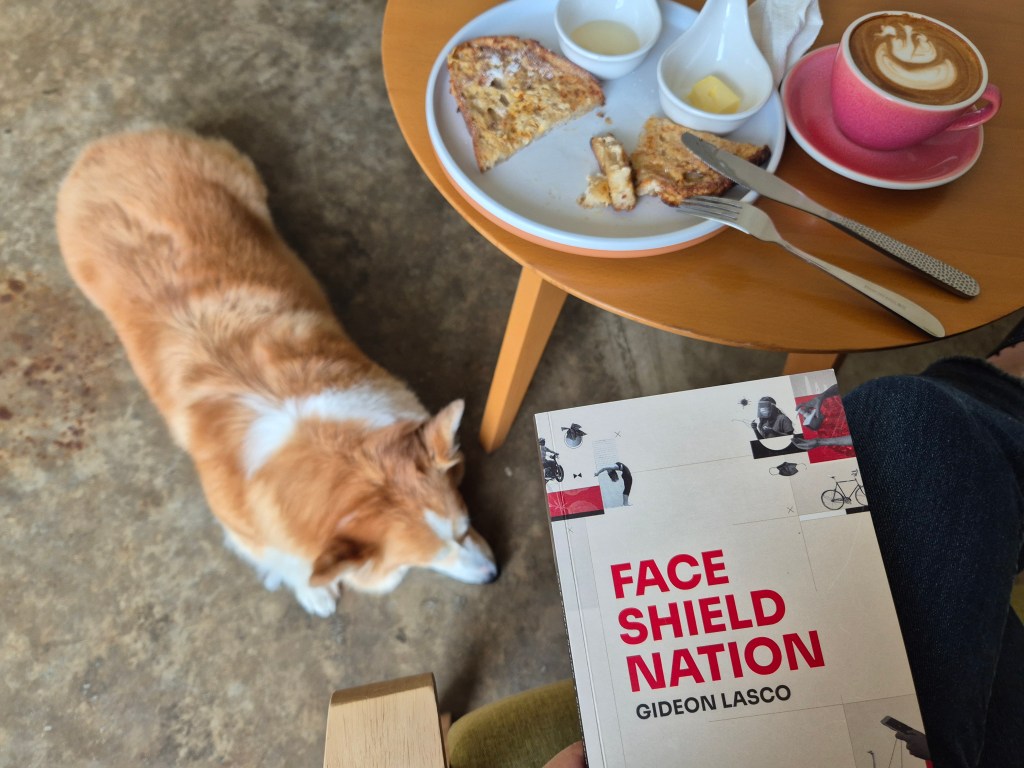
Face Shield Nation, Gideon Lasco
Articles that I looked forward to during the pandemic compiled in a book. Lasco was the voice of calm and reason at a time of confusion; evoking through his column the architectural definition of a column as a sturdy pillar of support. An essential time capsule of an era that we cannot afford to forget if we intend to learn from it. Read full entry here.
One Hundred Years of Solitude, Gabriel Garcia Marquez (a re-reading)
Growing up is realizing that Gabo is the real Melquiades who brought us magnets, magnifying lenses, astronomical observations, and mercurial storytelling. It was he who made imagination and literary possibilities flourish in the fertile and pristine Macondos of our minds, and who never really died. Read full entry here.
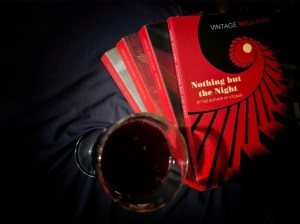
Nothing but the Night, John Williams
Maybe the first disappointment that assails the reader is the realization that, despite the slenderness of this volume, there is a heaviness in each page that restrains forward motion.
“Boring,” the lazy might judge hastily somewhere within the first three chapters. But one should not be too quick to criticize even though I myself could only read a couple of pages per sitting. For if one looks closer, and feels deeper, isn’t this genius, how John Williams conveys exactly what depression feels like?
“…there came to him that peculiar loneliness which is felt only in the monstrous impersonality of a multitude…”“What was the senseless circumstance which led him on and on, deeper and deeper into what seemed to him a maze labyrinth, devoid of pattern or meaning? …some unnameable power pushed him from one place to another, down paths he had no wish to travel, through doors he did not know and had no wish to know. All was dark and nameless and he walked in darkness.”
But then the reader is momentarily allowed to come up for air. I’m referring to the fourth chapter that is briefly set alight with a Proustian beauty! “That is the very best time of life, he thought: lost time.” And then John Williams proceeds to craft this fleeting tribute to the master searcher of lost time before he relinquishes the ethereal chapter to the fading light.
As the novel finally builds suspense, it spirals into a nihilistic darkness that ends with a violent and repulsive slap in the face.
Written in Burma when he was only twenty-two while recovering from injuries brought about by a plane crash over the Himalayas during WWII, he wrote this first novel at a particularly dark time when there was nothing else but the night.
The John Williams here is not the John Williams that gave us Stoner and Augustus. The John Williams here is the John Williams that would eventually give us Stoner and Augustus.
The Black Book, Orhan Pamuk
This reader has been through Pamuk’s longest novels and still felt the density of the mystery and prose in this book’s mere four hundred pages.
It explores the writing process and the precariousness of identity. It is also about how much the books we read, the stories we hear, the movies we watch, the everyday objects in our lives, and our city’s history shape the multiplicities of our being.
I enjoyed that twist at the end and relished the familiarity of Istanbul as a breathing character in a Pamuk novel. But maybe, just maybe, The Black Book is not for the Pamuk newbie, and not for those who are in a hurry.
The Golden Road, Willliam Dalrymple
It is not only the Silk Roads that are rising again, as Peter Frankopan proclaims in a forceful last line that gave me goosebumps. Rising, too, are buried or forgotten histories that have now resurfaced to challenge centuries of unquestioned narratives.
Frankopan’s The Silk Roads was an eye-opener, but The Golden Road takes this non-Eurocentric view of ancient and early medieval history to an intriguing direction by revealing India as a catalyst that transformed the world. Read full review here.
Gideon Lasco’s articles in the Philippine Daily Inquirer were among the things I looked forward to during the pandemic lockdown. His was the voice of calm and reason at a time of great confusion; evoking, through his column, the architectural definition of a column as a sturdy pillar of support.
To have those pandemic articles compiled in a book is to possess an essential time capsule of an era that disrupted our lives and brought the world to its knees; and an era that we cannot afford to forget if we intend to learn from it.
Looking back will not be as easy as it is for others, but it only seems right that reading this should make us feel uneasy at times, despite Lasco’s endeavor to maintain a hopeful tone. When read as an entire book, what’s louder than his leitmotif of hope in these essays is the tone of dissent — a refusal to stay silent amidst injustice and corruption, and a refusal to accept the blunders of our leaders without holding them accountable.
It calls on us, readers and citizens, to demand better leadership and to remain critical toward those in power in the service of nation-building: “If we believe that life is more than survival or subservience, then ‘to live’ should involve the willingness to stand up for our right to do so.”
“…what’s at stake in what we write… art, truth, and social justice.”
That is what’s at stake in everything we do, even in our silence.
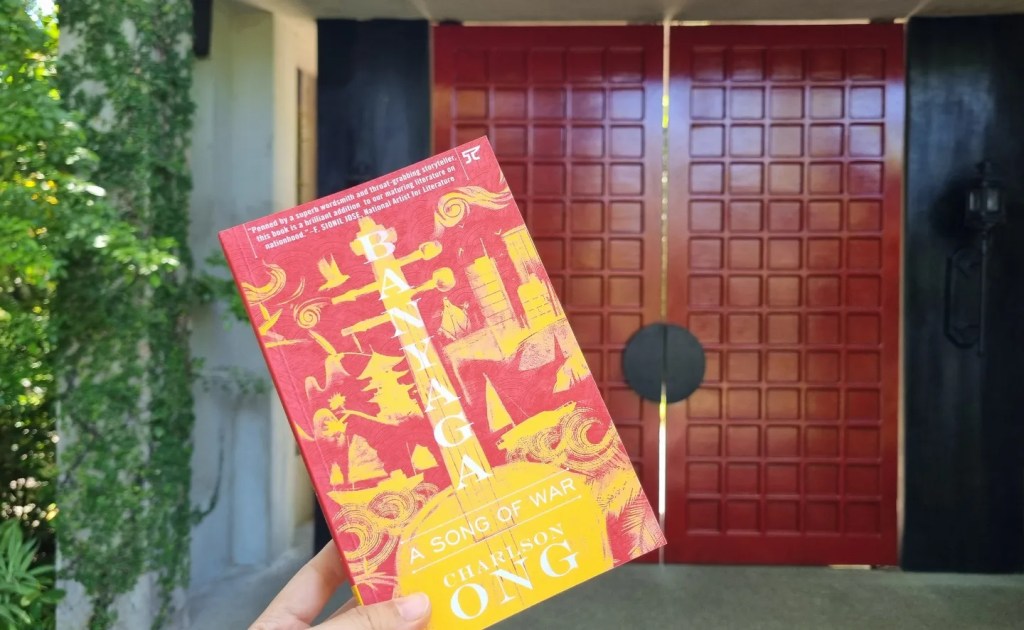
Banyaga: A Song of War weaves melodies, threads, saturated shades of scarlet, unattainable indigo, and moonlight yellow into the rich literary tapestry of our nation, and gives prominence to an underwritten perspective of Philippine history and literature — that of the Tsinoys, the Chinese Filipino.
The vivid imagery (beginning with Chinese boys caught in a brawl that results in a sworn brotherhood, on a ship heading for Manila) that remains consistent up to its plaintive ending in Manila Bay almost a century later; the fleshed-out personalities and exuberance of the characters; and the nonlinear narrative, brilliantly interlaced throughout the American occupation until the post-Martial Law era, tempts the mind’s eye to read this with a Wong Kar-Wai filter. With the acculturation of Chinese and Filipino traditions, and the subtle exposé on the workings of the government, economy, and political unrest as a backdrop, all of these lend to it a fullness of texture and quality that I have yet to encounter in any other Filipino novel published in the 2000s.
Banyaga, which means “foreigner” in our language, follows the lives of Ah Puy, Ah Sun, Ah Beng, and Ah Tin who hoped to escape poverty and political turmoil in China. Their dreams for better lives are soon trumped when they are rejected by relatives and family upon their arrival in Manila. As they are forced to fend for themselves and survive in a strange land that would become their only home, they will come to be known as Hilario Ong, Samuel Lee Basa, Antonio Limpoco y Palmero, and Fernando de Lolariaga. The different surnames suggest that the trajectory of their lives takes different turns, but an invisible thread would always bind the lives of the four sworn brothers and their families to each other and the course of Philippine history.
This novel has indelible scenes that will have you gasping in shock, push you on the edge of your seat, and break your heart repeatedly throughout the span of three hundred and seventy-three pages, but most of all, it will lead you to ponder on nationhood and leave you in awe of the heights that our nation’s literature has achieved.
“The chief glory of every people arises from its authors.”
Debatable to some, for sure. But I am inclined to agree with Samuel Johnson, and with Susan Sontag. Especially after having read The Three-Cornered Sun.








 The Book-Butterfly