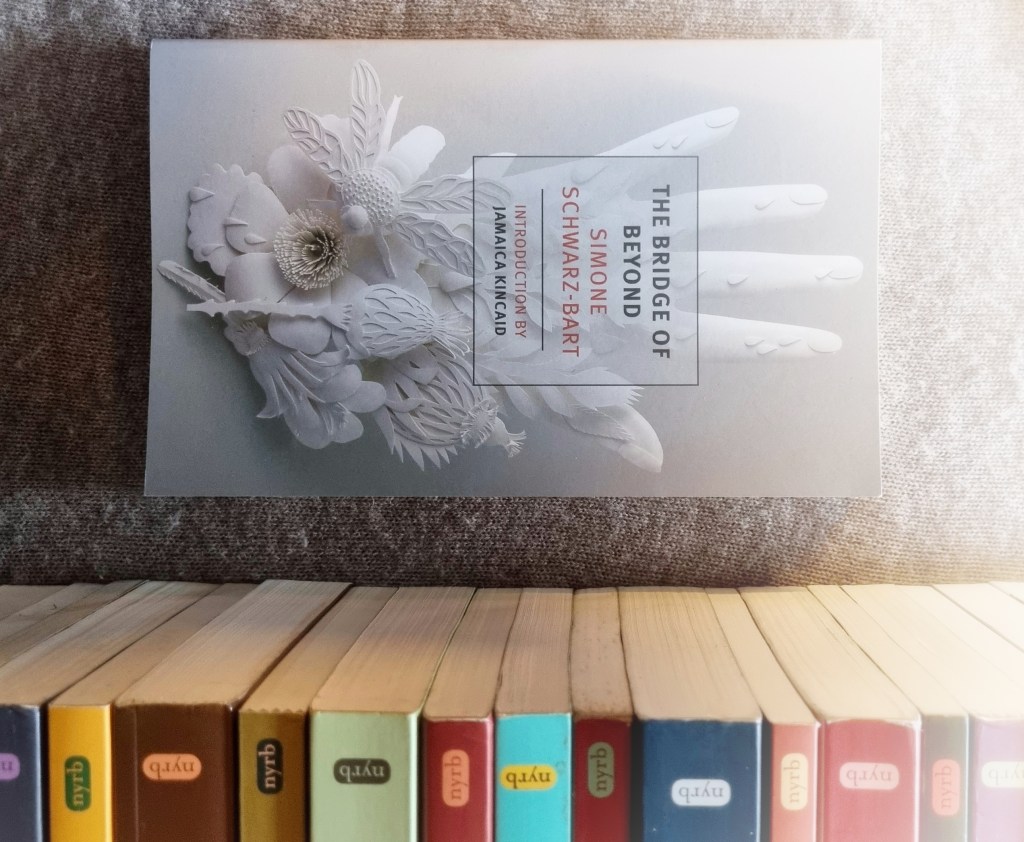
“Weren’t you just reading The Books of Jacob?” My mom asked when she saw me with this a day after I finished reading Olga Tokarczuk’s magnum opus.
“Recovery read,” I answered with a wink.
She shot me a questioning look.
“You know how runners do a short recovery run within 24 hours after a marathon?”
She could only laugh and shake her head.
It was the perfect easy run for this reader! In fact, I think every little detail of this book is perfect!
From the cover design, to the French flaps, to the first page that quotes Leonard Cohen:
Now, I’ve heard there was a secret chord / That David played, and it pleased the Lord / But you don’t really care for music, do you?
And truly, if you care for art and music, brilliant is an understatement of how this book is written. Think Apeirogon, think When We Cease to Understand the World but instead of physicists and mathematicians, musicians and artists — Bach, The Beatles, Brahms, Messiaen, Glenn Gould, Rothko, Mahler, Scheherazade… yes, Scheherazade!
Haven’t we already noticed that literature around the world is still undoubtedly under her spell, especially the Eastern Europeans and South Americans? Argentine Luis Sagasti’s musical offering puts us in the shoes of the bewitched Persian King Shahryar.
I will not be stingy with truth. And because the truth is often bound to be difficult and makes us squirm in our comfortable seats, the question is not whether you will like this. The question is whether you can swallow it — the nature of flawed leaders, of spiritual shepherds who are wolves to their own flock, of society, of human beings, of real characters.
This is what Olga Tokarczuk conveys to me right from the first of seven books in The Books of Jacob.
She thrusts us into 1752 Poland where there is a growing animosity towards the Jews and the longing for a messiah is intensified. But only in the second book do we meet the messianic figure: Jacob Frank who asks, “What do we want some sage for?” Jacob whose sexual perversities are now being slowly divulged to the reader. Jacob who ridicules his most earnest followers while they, in the goodness of their hearts, concoct half-truths and falsehoods about him to glorify him; because he is seemingly authentic in everything he does; and although repulsive, he is charming.
All these, eerily juxtaposed with current events in the Philippines: the FBI issuing a poster of church leader Apollo Quiboloy’s warrant of arrest for fraud, coercion, and sex trafficking; a dictator’s son who is a tax code offender leading the presidential polls; the former being an open endorser of the latter.
With an increasing throng of followers, this charismatic Jacob Frank preached the idea that the notion of sin no longer applies. There was no room for conventional morality in his philosophy. “We are to trample all the laws because they are no longer in effect…”
There is no more morality — a common refrain among leaders and their supporters today who justify wrongdoing and do not wish to face accountability!
I was wrong. Olga did not thrust us into events over two centuries ago with this opus. She brings us to the present. This is us. This is us. Because isn’t morality dead to us unless and until the injustice is done by those we dislike, and then we cry foul and demand morality and justice?
This colossus — a lyrical galaxy of darkness and light, weakness and strength, of comets and plagues set in some of the most exciting places I have actually been to, of beautiful passages about literature and how it somehow makes solid the ground beneath us despite this chaotic world, of history and its excruciating details — is not exactly about Jacob. It is about society and how we create the tapestry of history with our actions and our choices… and it seems like we never learn.
There is the romantic in me who would like to write an ode of admiration to this exceptional journalist for tackling a most pertinent matter and there is also the dormant journalist tempted to fangirl. However, the teacher of little children prevailed and simplified the lessons instead.
Who is my “Other”?
Those who do not hold the same beliefs. The most obvious right now are those who do not share the same political views.
How should we relate to Others?
There seems to be three approaches: War, isolation, and a third one learned through trade routes like the Silk Road — cooperation.
Why not war?
“It is hard to justify wars; I think everyone loses them, because it is a defeat for the human being. It exposes his inability to come to terms, to empathize with the Other, to be kind and reasonable…”
Why not isolation?
“The idea that prompted man to build great walls and vast moats, to surround himself with them and isolate himself from others, has in modern times been given the name of the doctrine of apartheid.”
What is the main content of the encounter with the Other?
Dialogue. Dialogical openness, perspective, and awareness. “The will to become acquainted.”
What should I equip myself with?
“…it is so important to have one’s own distinct identity, a sense of its strength, value and maturity. Only then can a man boldly confront another culture. Otherwise he will lurk in his hiding place, fearfully isolating himself from others.”
Why should we cooperate and why should we relate to the Other?
Because building bridges of understanding with Others “is not just an ethical duty but also an urgent task for our time in a world where everything is so fragile and where there is so much demagogy, disorientation, fanaticism and bad will.”
“The Self not only has to relate to the Other, but must assume responsibility for him and be prepared to bear the consequences for such a decision, such an attitude. Is there a Christian act of sacrifice in this? Yes — of sacrifice, renunciation and humility.”
What a pleasure to have spent the past few days eavesdropping on these conversations!
My introduction to Edward W. Said was not through my current reading project but through classical music years ago via the Daniel Barenboim connection when they co-wrote an illuminating book and founded the West-Eastern Divan Orchestra — Said a Palestinian intellectual and Barenboim an Israeli pianist and conductor, bringing together musicians from areas of conflict to show the world that it is possible to create peace among people from these nations, to harmonize, and produce beautiful music. And now, I am reintroduced to Said through the enlightening forewords he has written for many of the literary works I am reading from that part of the world.
As for dear Gabo, I still vividly remember the day my best friend presented me with my first Marquez in our teens and I gave him John Fowles’ The Magus in return. This act of his, which was not entirely innocent, led to a Latin American reading stage that brought me to magical literary adventures.
When asked whether the inability to love is very serious, Gabo replies, “I don’t think there’s any human misery greater than that. Not only for the person afflicted but for all those whose misfortune it is to come within his orbit.” Love is something to be learned, he adds, and even lets one of his fictional characters echo this.
Said on the hand, gave me more lines to note in my journal and reminded me why he was once an intellectual crush.
“I’ve never felt myself to belong to any establishment of any kind, any mainstream. I’m interested in mainstreams, I’m jealous of them, I sometimes, occasionally, envy people who belong to them—because I certainly don’t—but on the whole I think they’re the enemy. I feel that authorities, canons, dogmas, orthodoxies, establishments, are really what we’re up against. At least what I’m up against, most of the time. They deaden thought.”
“I think a lot of this business we were talking about earlier, about politics and culture being separate, is really laziness. There’s a critical establishment that says you’re supposed to only study this, and that’s because you don’t have the time or the energy to study other things. For me it’s a manifestation of laziness and idleness. And all of them, it seems to me, in the end, really don’t advance to anything.”
“And far from being right, I think it’s important to be critical.”
These conversations bring together two significant reading phases of my life.
What struck me this time was in realizing how much their musical tastes influenced their writings greatly. Chopin among others for Said, Bartok and Caribbean music for Gabo. Because he was a revolutionary says the former and the mixture of the two had to be explosive says the latter. Through this we see that they did not confine themselves to one form of art but saw art as something encompassing rather than something to be compartmentalized.
Said and Gabo are very much alive in these pages. These great minds that impacted and straddled two centuries while they lived; and even in death, continue to change the way we think, read, and perceive the world; their inspiration consistently outliving the last page of each of their books; saying it in their own distinct way but always reminding us to live as fully and as passionately as we can.
When a poet writes a memoir, the entire book is a poignant song. Exiled from his homeland after the Six Day War, Mourid Barghouti returns after thirty years and sings of his experience and his memories.
“And now I pass from my exile to their… homeland? My homeland? The West Bank and Gaza? The Occupied Territories? The Areas? Judea and Samaria? The Autonomous Government? Israel? Palestine? Is there any other country in the world that so perplexes you with its names?”
And yet, as Edward W. Said intimates in the foreword, the account is free of bitterness and recrimination.
“I know that it is the easiest thing to stare at the faults of others and that if you look for faults you see little else. Which is why—after each setback that befalls us—I look for our faults too; the faults of our song. I ask if my attachment to the homeland can reach a sophistication that is reflected in my song for it. Does a poet live in space or time? Our homeland is the shape of the time we spent in it.”
The pages teem with beautiful questions…
“Who has stolen our gentleness?”
“Are they really afraid of us or is it we who are afraid?”
“What should we remember and what should we forget?”
“Did I paint for strangers an ideal Palestine because I had lost it?”
…and express in simple ways the everyday sorrows of displacement.
“I have never been able to collect my own library. I have moved between houses and furnished apartments, and become used to the passing and the temporary. I have tamed myself to the feeling that the coffeepot is not mine.”
But in the vast desert of pain, there is room for love and joy…
“Love is the confusion of roles between the giver and the taker.”
“Joy needs training and experience. You have to take the first step.”
…and even vaster spaces for art.
“I said to myself that the heart of the matter was in a detailed knowledge of life, and of the human maturity that is the foundation for all artistic maturity. These are features that no work of art worthy of the name can do without, whatever the lived experience. What is important is the piercing insight and the special sensitivity with which we receive experience, not simply our presence at the event, which, important as it is, is not enough to create art.”
I Saw Ramallah — read, once again, to humanize what we tend to generalize.
The Language of Passion is an excellent education on writing and thinking.
The topics in this Nobel laureate’s book of essays and articles are broad — from politics and religion to art, literature, and spaces; and the scope of the material manifests the breadth of his mind.
“That two truths are ‘contradictory’ doesn’t mean they can’t exist side by side,” Llosa writes. This reminds me of another line I encountered in Maria Popova’s Figuring, “It seems to be difficult for anyone to take in the idea that two truths cannot conflict.”
Llosa was writing about both the Israeli and Palestinian right to a particular piece of land and Popova was referring to the conflict between religion and science.
This is the sort of contemplation that I am subscribing to at this point in life; and that I did not have to embrace all of his opinions while admiring the way he expressed his thoughts is, I believe, part of the immediate result of a Llosa education.
If you intend to read this, do not allow the abrupt and tidy ending of the love story in the first part to dissuade you from continuing. That’s not exactly how it ends. Make sure you persevere until the second to the last chapter to find the poetic piece of the puzzle that renders the last chapter almost unnecessary and makes the whole book worth reading.
And do not read this if you are in a hurry. It is writing that begs you to slow down, to savor elegant lines such as “…he was an upright shadow moving so slowly that in that peculiar underwater light his approach was almost imperceptible, inching forward like destiny”; it is writing that urges you to be there in an East African town of a British protectorate with Hassanali when he finds the half-conscious sunstricken Englishman, Martin Pearce, in 1899.
1899, only a year after our independence from another entitled European power who thought the world was intended for European colonization. “So I had to learn about that,” our narrator remarks, “and about imperialism and how deeply the narratives of our inferiority and the aptness of European overlordship had bedded down in what passed for knowledge in the world.”
As a Filipina, this book made me understand and applaud the Nobel Prize motivation — for Gurnah’s “uncompromising and compassionate penetration of the effects of colonialism and the fate of the refugee in the gulf between cultures and continents.”
As a woman, I felt the bitter aftertaste of the intergenerational injuries colonialists cause, not just to a place but to their women.
As a daughter and a lover, I recognized that honorable layer of filial duty and the sacrifices we make for love.
As a reader, I relished the passages that put weight on the value of stories: “She missed his noises, his voice, his bulk, his presence, but after that she realized how much more she missed his stories.”
“It is about how one story contains many and how they belong not to us but are part of the random currents of our time, and about how stories capture us and entangle us for all time.”
“It’s remarkable, isn’t it, that these people have got by for centuries without writing anything down… everything is memorized and passed on… It’s a staggering thought, that no African language had writing until the missionaries arrived,” says one English character in the book.
It is remarkable, and even more remarkable that Tanzania now has a Nobel Prize laureate in literature.
Desertion is a sorrowful title. But as it is written in my favorite chapter, “Sorrow has its gifts.”
The sound of sirens woke me up. Whose witty idea was it to celebrate Women’s Month with Fire Prevention Month in the Philippines? Woman is a fire you cannot prevent. Sirens are also women.
These were my tangled thoughts as I got up on the first day of March, a month I look forward to as a reading woman. It’s when I devote most of my reading time to women authors.
Rebecca had to be the first choice, because maybe my mind treats literature like medicine and it cyclically hankers for a more potent dose to achieve efficacy, and she lives up to this promise — this sort of writing that painfully confronts the hurts and pinpoints the ills but becomes the balm through impeccable information-giving and matchless storytelling, all administered with strength and grace.
The title is an acknowledgement to how the artist Georgia O’Keefe signed her letters for the people she loved, “from the faraway nearby.” A way to measure physical and psychic geography together, Rebecca observes. “We’re close, we say, to mean that we’re emotionally connected, that we are not separate… emotion has its geography, affection is what is nearby…” We can be distant from the person next to us but be hopelessly attached to another who is hundreds of miles away. Was it Ondaatje who asked, “Do you understand the sadness of geography?” It seems Rebecca understands and she holds your hand through this sadness.
But that is only one of the myriads of things meaningful to me that she weaves artfully into this narrative. The curious format of this book is a nod to the Arabian Nights. It was only recently when I remarked how Latin American and Eastern European literature are under Scheherazade’s spell, but this book makes me ask, “Who isn’t?”
“The fairy-tale heroines spin cobwebs, straw, nettles into whatever is necessary to survive. Scheherazade forestalls her death by telling a story that is like a thread that cannot be cut; she keeps spinning and spinning, incorporating new fragments, characters, incidents, into her unbroken, unbreakable narrative thread. Penelope at the other end of the treasury of stories prevents her wedding to any of her suitors by unweaving at night what she weaves by day… By spinning, weaving, and unraveling, these women master time itself, and though master is a masculine word, this mastery is feminine.”
“Stories are compasses and architecture; we navigate by them, we build our sanctuaries and our prisons out of them…” This is the line with which Rebecca opens this book.
And this is how she ends. “Who drinks your tears? Who has your wings? Who hears your story?”
“Who has your wings?” Who else can ask such a poignant question?
This mastery is, indeed, feminine. Happy Women’s Month!
A Field Guide to Getting Lost
January 25, 2022
Life is unpredictable, but nothing highlights this fact more than the pandemic. If we care to admit it, everyone feels a little lost in the midst of this all.
This beauty of a book is the fresh perspective on being lost that I did not know I needed, for Solnit invites you to be at home with being lost and to be comfortable with it. She encourages you to “leave the door open for the unknown” and calls it art.
“That thing the nature of which is totally unknown to you is usually what you need to find, and finding it is a matter of getting lost. The word ‘lost’ comes from the Old Norse ‘los,’ meaning the disbanding of an army, and this origin suggests soldiers falling out of formation to go home…”
The first two chapters took possession of me, the rest of it was simply a bonus. There are passages that are painful to read but in a cathartic way.
Sometimes, in our arrogance as readers, we approach a book as confident as Alexander on a Persian conquest; and in our confidence, we allow ourselves and others to believe that we have conquered it. Only to learn and be humbled, again and again, that the ones that matter, are those that conquer us.
Orwell’s Roses
March 11, 2022
When you turn to a book for solace and get chills instead.
Yes, this has got to be the most beautiful literary criticism of Nineteen Eighty-Four: It rethinks the man that was George Orwell, it guides us to reassess beauty, and it reviews Nineteen Eighty-Four in a light that is distinctly hers. But with Rebecca Solnit, you never know where she will take you next; it is only guaranteed to be a place of startling insight and perspective.
Written and published amid the Covid-19 pandemic, it surprisingly mentions and describes Putin as an admirer and rehabilitator of Stalin’s reputation; even calling to mind the Holodomor, also known as the Terror-Famine, recognized by 16 nations as a genocide carried out by the Soviet government that killed 3-5 million Ukrainians from 1932-1933… and it seems like George Orwell’s Nineteen Eighty-Four will not be the only prescient book in question here.
What is chilling is the reminder that, “To be corrupted by totalitarianism, one does not have to be in a totalitarian country.” Orwell set Nineteen Eighty-Four in England, “To emphasize that totalitarianism could triumph anywhere.”
And what buttresses totalitarianism? Lies. “Lies gradually erode the capacity to know and to connect… Lies are integral to totalitarianism… demands, in fact, the continuous alteration of the past, and in the long run probably demands a disbelief in the very existence of objective truth.”
“Who controls the past controls the future: who controls the present controls the past. The attack on truth and language makes the atrocities possible. If you can erase the witnesses, convince people of the merit of supporting a lie, if you can terrorize people into silence, obedience, lies, if you can make the task of determining what is true so impossible or dangerous they stop trying, you can perpetuate your crimes. The first victim of war is truth.”
And yet, despite these ominous warnings for which Orwell is known, Solnit asks us to reconsider the word “Orwellian” and look at the man who, in the spring of 1936, planted roses. Beautiful is far from the first word that comes to mind when confronted with his writings, but there is a definition of beauty, Solnit emphasizes, that does not have to do with prettiness. “Another kind of beauty, of a toughness that is life…” The beauty to which Orwell was most committed and for which he strove was “this beauty in which ethics and aesthetics are inseparable, this linguistic beauty of truth and of integrity as a kind of wholeness and connectedness, between language and what it describes, between one person and another, or between members of a community or society.”
What was beautiful to him was truth, clarity, honesty — and roses. “Orwell was passionate about the beauty and gestures and intentions, ideals and idealism when he encountered them, and it was to defend them that he spent much of his life facing their opposites.”
“Orwell’s work was about ugliness of various kinds, but what he found hideous serves as a negative image of what he found beautiful.”
There is, after all, solace through the roses telling us that stopping to smell them does not necessarily distract us from the seemingly more important things in life, but strengthens us instead. Through Rebecca Solnit, and through the man who made my birth year significant in literary history, we are spurred to recalibrate what we deem beautiful, to acknowledge our need for beauty, and to always strive to pursue it.
Hope in the Dark
July 4, 2022
If it were not Rebecca Solnit who wrote this, I would have dismissed the title as another one of those inspirational books that I do not gravitate towards so much. But having experienced four Solnits this year prior to this, which all proved to be books I needed at the exact time I read them, I seized this as soon as it arrived. And once again, she delivered.
I felt it was written for me, who, upon returning from an exhilarating trip, returned to my country with a new president whom I did not vote for. Solnit’s books are extremely political, but she wrote this to make the case for hope, especially for those who, on the surface, seemingly lost:
To point out that just because my side did not win the election, does not mean we are not victorious in many things. To challenge myself to live the same way with the leadership I did not choose as I would have had my candidate won, and to continue being a responsible citizen and human being — because being victorious and seemingly right is small comfort when, around the world, and around the country, there is still injustice and there are still people dying and living horribly.
“Hope doesn’t mean denying these realities. It means facing them and addressing them by remembering what else the twenty-first century has brought, including movements, heroes, and shifts in consciousness that address these things now.”
“The hope I’m interested in is about broad perspectives with specific possibilities, ones that invite or demand that we act. It’s also not a sunny everything-is-getting-better narrative, though it may be a counter to the everything-is-getting-worse narrative.”
Consider reading this if you, like me, paid your taxes dutifully and was called “self-righteous” when you pointed out that our new president failed to pay his; if you campaigned for your candidate without insulting anyone but the many enjoyed branding everyone on your side as toxic, even though poisonous ones were actually present on both sides if we care to admit (I have screenshots); if you were maligned and called names because of who you supported while the same people demanded respect but has been disrespecting your candidate for six years; if you, hopefully, like some of them, just wished for a better country. Consider reading this if you are frustrated and you think hope is lost, because it just made me realize that it isn’t.
This book reminded me that hope and action feed each other, and that every action and inaction have more impact than we know; to not merely demand change but to embody it.
Hope, above all, is action; and as long as we do our part and, if possible, do more than what’s required of us, there is hope.
Wanderlust
June 19, 2022
…with a title perfect for a trip, Solnit shared an Eskimo custom of offering an angry person release by walking the emotion out of his or her system by going in a line across the landscape; “The point at which the anger is conquered is marked with a stick, bearing witness to the strength or length of the rage.”
Old Uzbek language has one hundred words for different manners of crying, and special verbs for gestures like gazing imploringly into a lover’s face.
Elif Batuman writes about this in The Possessed, and I reacted to this information as a reader would and thought, “How rich Uzbek literature must be!”
So here I am. Few things are more appealing to this reader than a scarcely-translated and relatively scarcely-read novel by an author whose works are banned in his own country.
It is intense in both intellectual and emotional degrees, and probably not too easy for those who are unacquainted with the Arabian Nights fashion of telling stories within stories within stories. This is one of those jealous novels that demand your full attention, but also one of the most masterful I have read for my Silk Route Reading Project.
The characters are real figures from Uzbek history. It chronicles the arrest of the nation’s prominent writer, Abdulla Qodiriy, by the Soviet secret police in the 1930s. His abduction interrupted the work on what he himself believed would be his greatest masterpiece, a novel about 19th-century poet-queen Oyxon. Abdulla Qodiriy’s manuscripts were subsequently burned and his last novel remained unwritten, but this is where Hamid Ismailov spins an imagined tale of Abdulla Qodiriy who, despite being in prison and enduring its horrors, continues to write the novel in his mind.
In this book we have Hamid Ismailov telling a story about Abdulla Qodiriy who is telling a story about Queen Oyxon.
“Wasn’t the concoction of endless misfortunes that made up Oyxon’s life a reflection of the nation? …when and how had Oyxon’s tragic life-story turned into Abdulla’s own?” Concerning betrayals or intellectual persecution, perhaps Ismailov’s, too.
Yes, it is absolutely political, but how the Uzbek character is laid bare, their superstitions, their literary traditions, the exceptionally moving ending that had a cinematic quality which inspired a soundtrack in my mind, and most of all the tormenting pleasure of a writer’s thought process and how it is like a dance with jinns; these are the reasons why I think this is the perfect initiation to Uzbek literature — albeit complete with figurative hazing.
Expect no less from a people who has a hundred words for crying.
“What was beyond our grasp was neither the future nor the past, but the present itself.”
It is a mistake to suspect that this book will help one make sense of the world.
I fell victim to this assumption that I even intended this to be my first read of 2022 if not for delayed shipments caused by Typhoon Odette/Rai.
Read from cover to cover within 24 hours, partly because the web Labatut weaves is sheer genius and the subject of quantum mechanics is so fascinating, but also partly because of a panicked speed when what I sought to find — comfort and hope — was still nowhere to be found even as I approached the final pages.
“…it was mathematics — not nuclear weapons, computers, biological warfare or our climate Armageddon — which was changing our world to the point where, in a couple of decades at most, we would simply not be able to grasp what being human really meant. Not that we ever did… but things are getting worse… But it’s not just regular folks; even scientists no longer comprehend the world. Take quantum mechanics, the crown jewel of our species, the most accurate, far-ranging and beautiful of all our physical theories. It lies behind the supremacy of our smartphones, behind the Internet, behind the coming promise of godlike computing power. It has completely reshaped our world. We know how to use it, it works as if by some strange miracle, and yet there is not a human soul, alive or dead, who actually gets it. The mind cannot come to grips with its paradoxes and contradictions. It’s as if the theory had fallen to earth from another planet, and we simply scamper around it like apes, toying and playing with it, but with no true understanding.”
I fell in love with mathematics later in life and even though my dabbling in the subject is nowhere close to the mathematical heights mentioned in the book, I wondered at every morsel. But mathematics, as wondrous and beautiful as it is, has not always been wielded for the good and has often passed through the hands and minds of the eccentric and the disturbed.
Labatut draws us to this dark side. To say that this book is unsettling is an understatement. And reviewing it through my distilled notes highlights the irony and alarm:
Mary Shelley, recalled to have warned us through her monstrous masterpiece of “the risk of the blind advancement of science.”
Fritz Haber, first to obtain nitrogen, recipient of the 1918 Nobel Prize in Chemistry, accused by his wife of “perverting science by devising a method for exterminating human beings on an industrial scale.”
Albert Einstein, who sensed that following one of quantum mechanics’ pioneers Werner Heisenberg’s line of thinking would lead to a darkness that would infect the soul of physics.
Karl Schwarzschild, contributed greatly to the general theory of relativity, said to have possessed a “peculiar form of a fear that physics would be incapable of… finding an order in the universe.” “…the most frightful thing about mass at its most extreme degree of concentration was not the way it altered the form of space, or the strange effects it exerted on time: the true horror, he said, was that the singularity was a blind spot, fundamentally unknowable. Light could never escape from it, so our eyes were incapable of seeing it. Nor could our minds grasp it, because at the singularity the laws of general relativity simply broke down. Physics no longer had meaning… If matter were prone to birthing monsters of this kind, Schwarzschild asked with a trembling voice, were there correlations with the human psyche?”
“Don’t they understand that we are rising up only to fall?”
“We have reached the highest point of civilization. All that is left for us is to decay and fall.”
Alexander Grothendieck, leading figure in the creation of modern algebraic geometry, withdrew from the world not because he hated human beings but for the protection of mankind. “Grothendieck said that no one should suffer from his discovery, but he refused to explain what he meant when he spoke of ‘the shadow of a new horror.’”
Shinichi Mochizuki, awarded the Fields Medal, the highest honor that can be bestowed upon a mathematician, who, after publishing six hundred pages that contained a proof of an important conjecture in number theory, deleted his blog and announced that “in mathematics, certain things should remain hidden, ‘for the good of all of us.’”
Benjamin Labatut, you go to such great lengths if only to say, in this strange and brilliant way, that innocence is bliss?