Neal Ascherson: Black Sea

On a trip to Turkey in 2016, we landed at Sabiha Gökçen International Airport, which is on the Asian side of Turkey and closer to the Marmara Sea. The Istanbul Airport that opened in 2018 is on the European side, and just before landing on the meeting point of the world, one is gifted with a breathtaking view of the Black Sea.

I saw the Black Sea thrice from an airplane window on my most recent trip, and the irony dawned on me that this body of water that has sadly become the “largest mass of lifeless water in the world,” in fact, teems with so much history and so much… life!

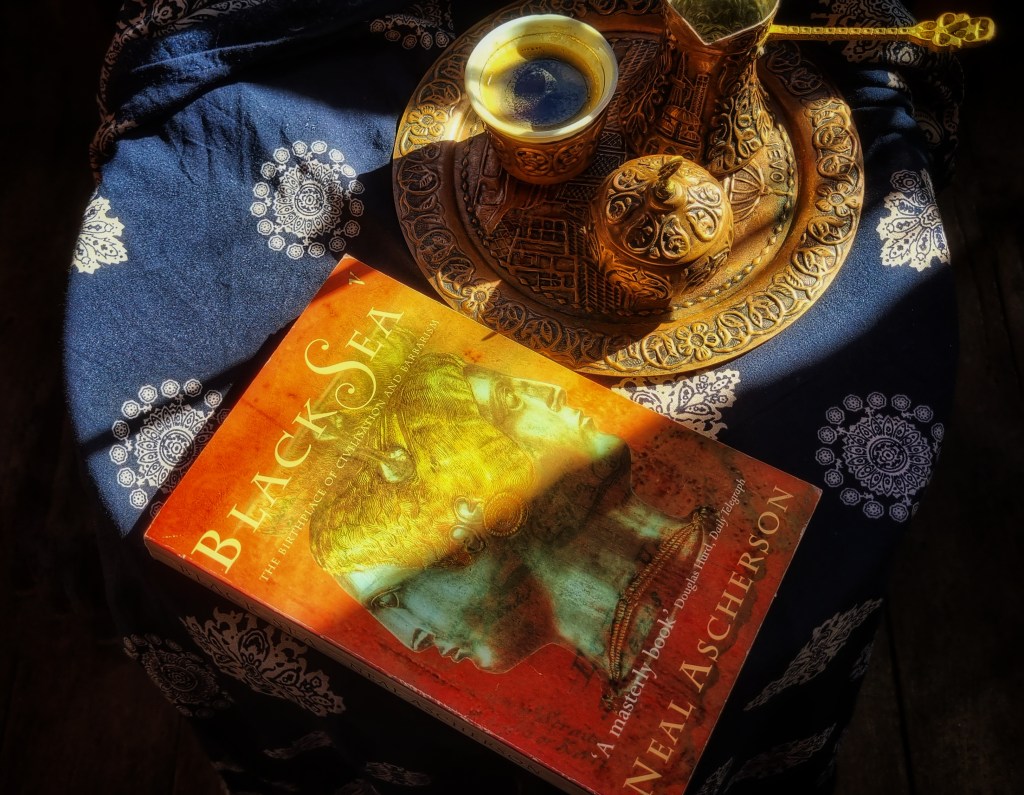
This book written by Neal Ascherson about this birthplace of civilization and barbarism accompanied me, although I only finished reading it on my way back home. I don’t think I’ve read a more poetic history book!

“Human settlement around the Black Sea has a delicate, complex geology accumulated over three thousand years. But a geologist would not call this process simple sedimentation, as if each new influx of settlers neatly overlaid the previous culture. Instead, the heat of history has melted and folded peoples into one another’s crevices, in unpredictable outcrops and striations.”

Reading it brought me back to the landscapes of Tokarczuk’s The Books of Jacob and to where I’ve just been, merging the lands of my dreams with those places that are the epicenters of current world events. Because somewhere in the midst of this all, is the history of the Black Sea.

From its first mention in literature in the Bronze Age (where Jason and the Argonauts sailed upstream the Bosphorus to the Black Sea); to the different Central Asian tribes and kingdoms; to chapters that made me understand better the Russian Revolution and Communism’s life, course, and death in that region; to the question of Crimea, Russia and Ukraine’s relationship and to many things in between, I am in awe of how Ascherson sustained a poetic voice!

In a way, it answers our suspicions about how, despite all the earlier discoveries of the East in almost all fields, the West is still seen as more superior and more “civilized”. It is an enlightening investigation on the definitions of civilization and barbarism that surprisingly touches on feminism and immigration, which is quite different from what most minds have been programmed to believe.

Here is a history book that does not merely record events and dates, but most importantly, relationships. For as the author compellingly reveals, the Black Sea is not just a place but a pattern of relationships, and nothing like the symbiosis of the Bosporus Kingdom has ever happened.

A beautiful thing about traveling and reading is to be able to measure ourselves against the expanse of time and history, with the intention of acquiring more perspective, if only to acquire more life.

June 25, 2022 – Uzbekistan Beyond Book Pages

My last few days in Uzbekistan were supposed to be spent in Termez, a place bordering Afghanistan where Alexander (considered not so great in these parts of the world) founded a town. But after learning about the tragic earthquake in Afghanistan, and for the peace of mind of those I love (not that I’ve given them so much of that), I decided to be practical (yes, I can be, sometimes) and come back to Tashkent to be closer to the airport. Termez will have to wait; and perhaps, it is a romantic idea to leave something to come back for.

It is risky to travel these days, and it is crazy how the fate of some dreams and travel plans hang in the balance between two words — Positive or Negative. And when I asked my niece who works in a bank to change some currency for me, she reported that the bank declined upon learning of my destination, “Kay duol sa na-ay gyera.” (It is close to areas of conflict.) She had to go out of her way to another money changer. If one looks at the map, the bank is not wrong.

But here I am. Because when something feels right, it feels right. I booked my ticket with so much faith, and the itinerary that has been ready since 2020 finally came in useful.

“But I thought you wanted to go to Iran?” friends asked. I am in what used to be part of Persia. “Stan” is a Persian suffix that means “place of”. This is the place of the Uzbeks that was once of Persia. When the Achaemenids expanded their empire, they sought not to Persianize whomsoever they conquered but allowed different peoples and cultures to thrive — as long as they paid tribute, of course. And since we know borders are all but manmade, I am in the region of which I have been reading and dreaming for a long time… and it is intoxicating, and beautiful, and enriching.

The books I have been reading did not end on their last pages. The best books never do. They only give the reader a deeper yearning to continue the journey and the learning beyond the pages. They give one an urgency to live.

June 24, 2022 – Goodnight, Khiva

As the veins of the Silk Route on land dwindled and acquiesced to naval routes, and explorers discovered treasures deemed more valuable than the fiber that changed the world, Khiva continued to treasure silk just as much as gold. Even up until 1924, the silk money of Khiva were hand-woven (and literally laundered when it required cleaning).

As I wistfully think about the ephemerality of places never to be seen, as they are, ever again; I also take joy in the experience of being changed by these places. I suppose it is unfair to ask them to stay the same while I am constantly being transformed?

And maybe this is why I travel, and read, and write… because how can one explore the world to its deepest, if one does not also attempt to explore the terrains of the self and the mind?

Good night, Khiva. Thank you for a thousand and one… lessons.

© 2022 MDR
Khiva, Uzbekistan

June 23, 2022 – Khiva, Uzbekistan

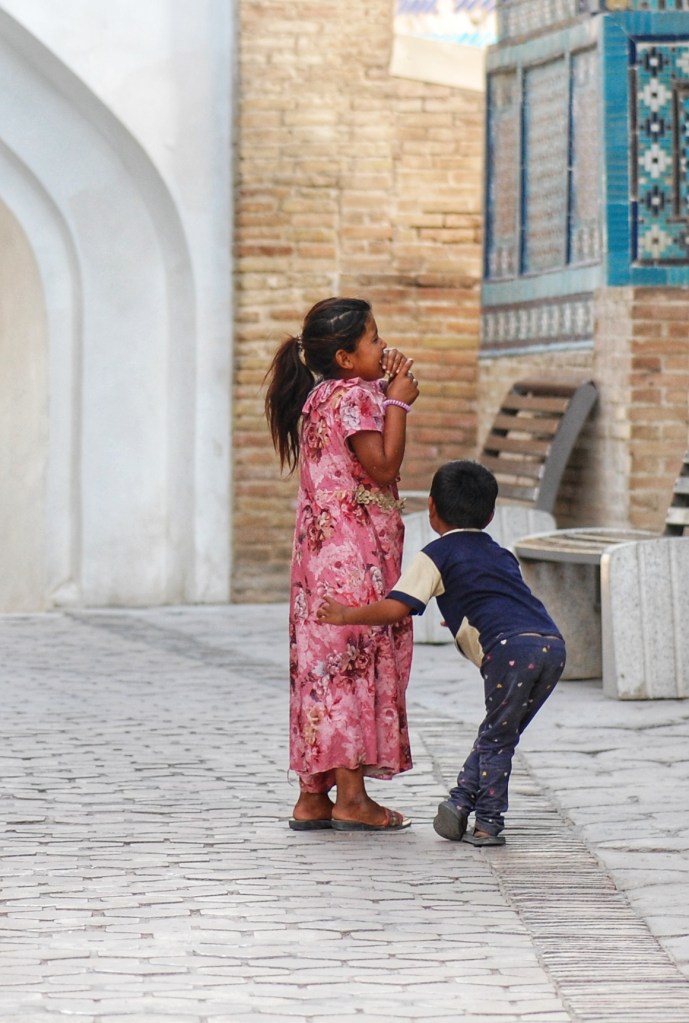
In the alley right below, a child sings in a language both strange and familiar to me. Strange because she sings in the Khorezmcha dialect, familiar because it is music.

A few meters away from her, women in traditional dress eclipse the child’s voice as they bargain with her mother, a scarf seller. These women are tourists from the other “Stan” nations. They flock the streets by sundown. (Western tourists tend to forego Khiva because it is out of the way. To get here from Bukhara, one has to drive for hours through an expanse of steppeland that seems to stretch to infinity, and the usual tourist would usually opt for another stamp on the passport from another Stan than come to Khiva. I am now closer to Turkmenistan than I am to Bukhara.)

But I also see Khiva changing right before my eyes. I see workers installing LED lights, replacing some crumbling bricks, and fixing the cracks of the old city, making it look new. And although they have the tourist’s best interest in mind, I feel a pinch in my heart. I know Khiva will not look the same in a few months, or weeks… and there is a bittersweetness in realizing that I came just in time — or perhaps, a few centuries late.

In the distance, the tallest minaret in Central Asia calls my attention, calls to prayer, calls time to stand still, and all falls silent.

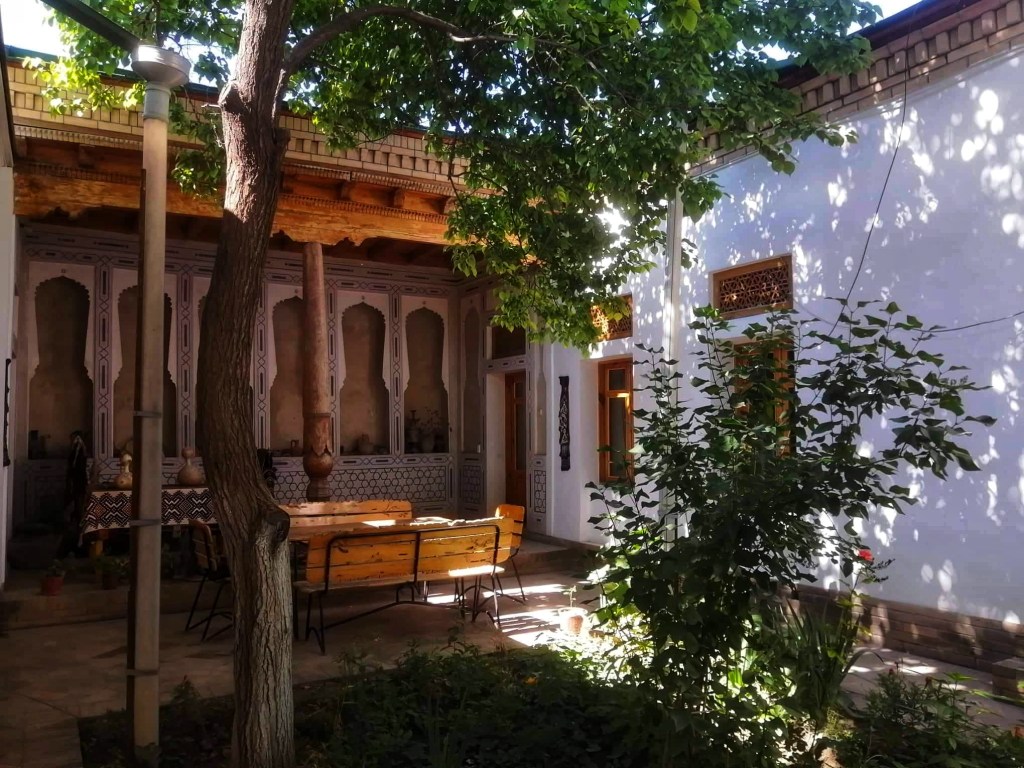
Does this balcony right outside my bedroom explain enough why I chose to stay in Khiva longer?

© 2022 MDR
Khiva, Uzbekistan

June 22, 2022 – Summer Solstice in Khiva

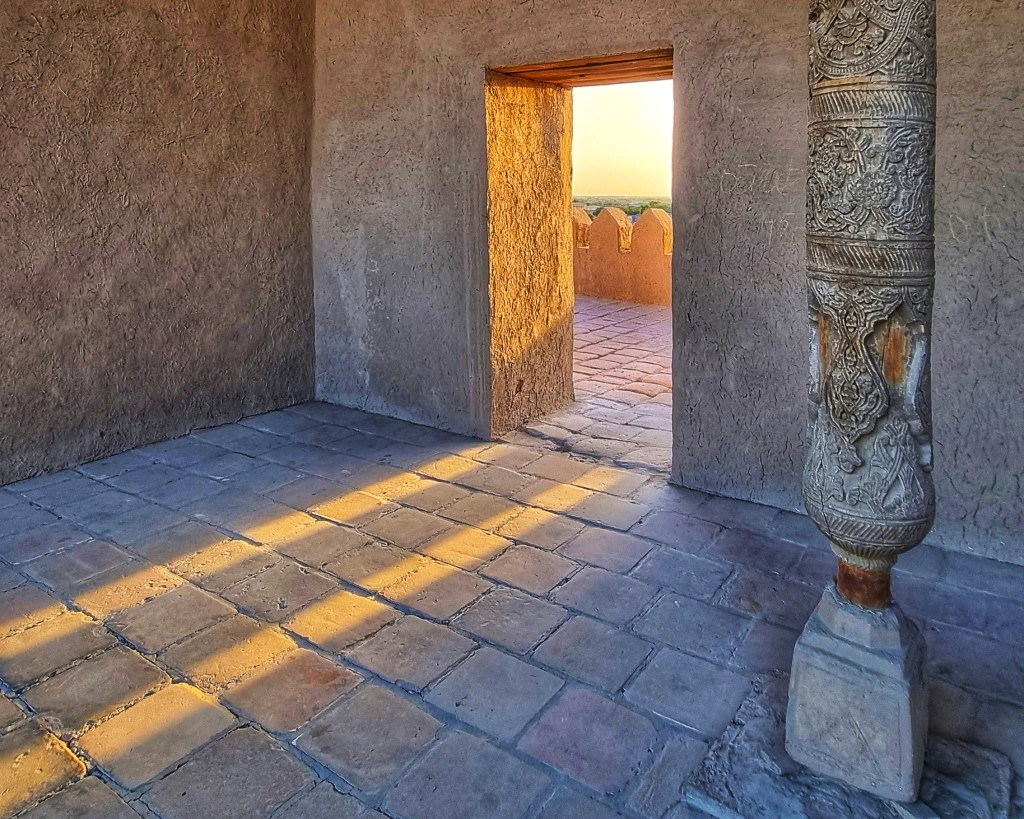
Resplendent, the summer solstice sunset gilds the citadel of Khiva.

Khiva, the former capital of Khwarazm.

Khwarazm, the region that gave us polymath Muhammad Ibn Musa al-Khwarizmi (780-850), who wrote the book Al-Jabr. From his name we have the word “algorithm,” and from Al-Jabr “algebra”.

The sun blazes differently here. And for knowledge, their wise men, too, seemed to burn so intensely.

June 21, 2022 – The Colors of Bukhara

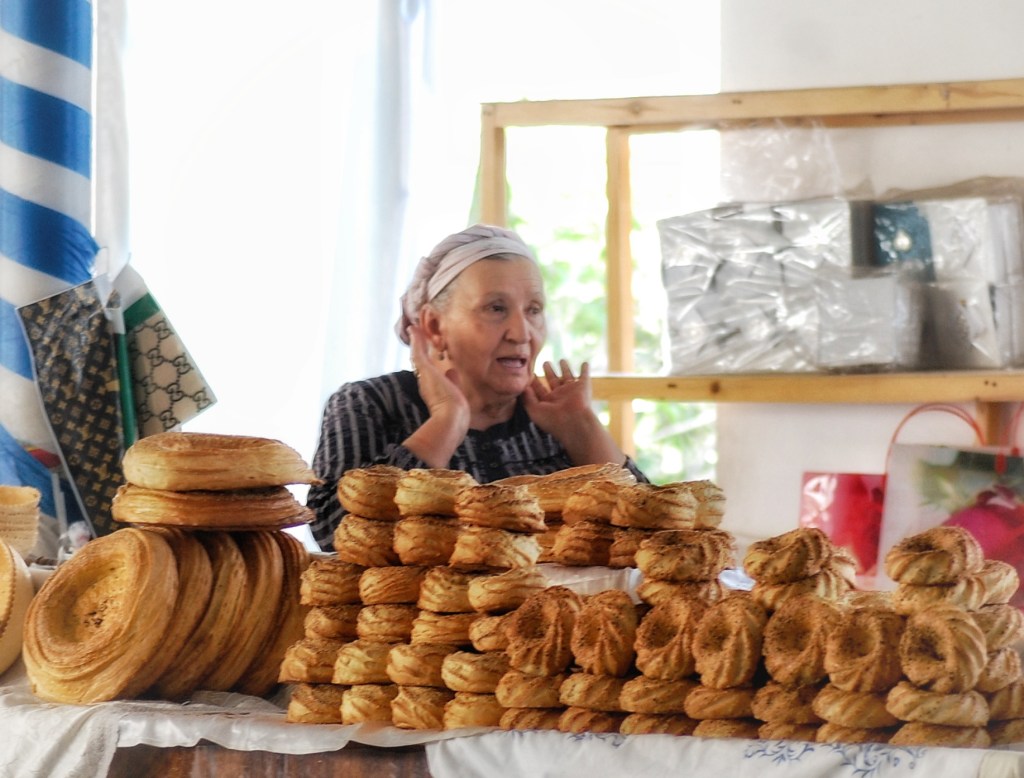
The temperature is significantly higher in Bukhara that you can feel your skin baked into the color of a lepyoshka as soon as you step out of the caravanserai. Yes, I am staying in a caravanserai! Isn’t that the most natural thing to do when traversing desert cities?

In contrast to Samarkand that can only be depicted in golden blues and vibrant shades of dreams, Bukhara wears the colors of the desert.

But that’s not to say that this important stop on the Silk Route is monochromatic. For as we know, the desert yields surprises; and thousands of years of history have stamped their mark and bled their hues on this oasis city.

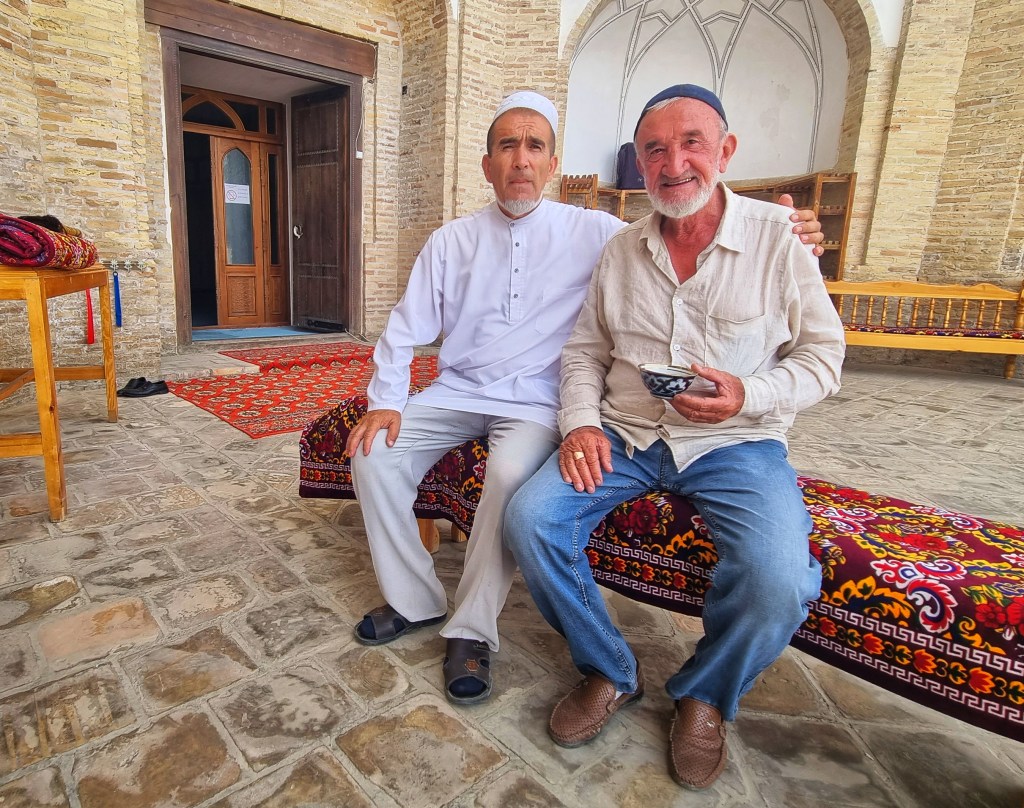
I made two friends today who know their history! One endearingly encouraged me to look it up on my phone because he says it’s all there, and the other is an imam who saw me taking pictures of the architecture while trying my best to be unobtrusive at a site sacred to Muslims. He must have appreciated this because he beckoned to me and invited me to take closer pictures of the mosque and its interior, and afterwards, for tea. It was the best tea I’ve had on this trip!

June 20, 2022 – Bukhara, Uzbekistan

© 2022 MDR
Ark of Bukhara, Uzbekistan

“I found in this library such books, about which I had not known and which I had never before seen in my life. I read them, and I came to know each scientist and each science. Before me lay the gates of inspiration into great depths of knowledge which I had not surmised existed.” — Ibn Sina (Avicenna)

Avicenna (980 – 1037) — philosopher, poet, astronomer, mathematician, physicist, the father of early modern medicine, among many other things — has been known to us as a Persian polymath. But he was, in fact, born in Uzbekistan. His early education began here in Bukhara.

The library in the Ark of Bukhara has not survived the many conquests that Bukhara has been through, although this enormous structure that dwarfs me continued to be a fortress from circa 500CE until it fell to the Red Army in 1920.

Sadly, there is no way for me to find the books of which Avicenna wrote, but the book wide open before me now is Bukhara… and I am savoring every line.

June 19, 2022 – Samarkand Mornings and Minarets

“A city so deeply imbued with poetry that even the doctors wrote their medical treatises in verse.” This line by Elif Batuman, who wrote briefly about the height of the Timurid Renaissance, came back to me so clearly as I took my last look at Samarkand.

I can only commit these soft mornings in Samarkand to memory, as another gem in the Silk Route beckons…

June 18, 2022 – Samarkand, Uzbekistan: Ulugh Beg

© 2022 MDR
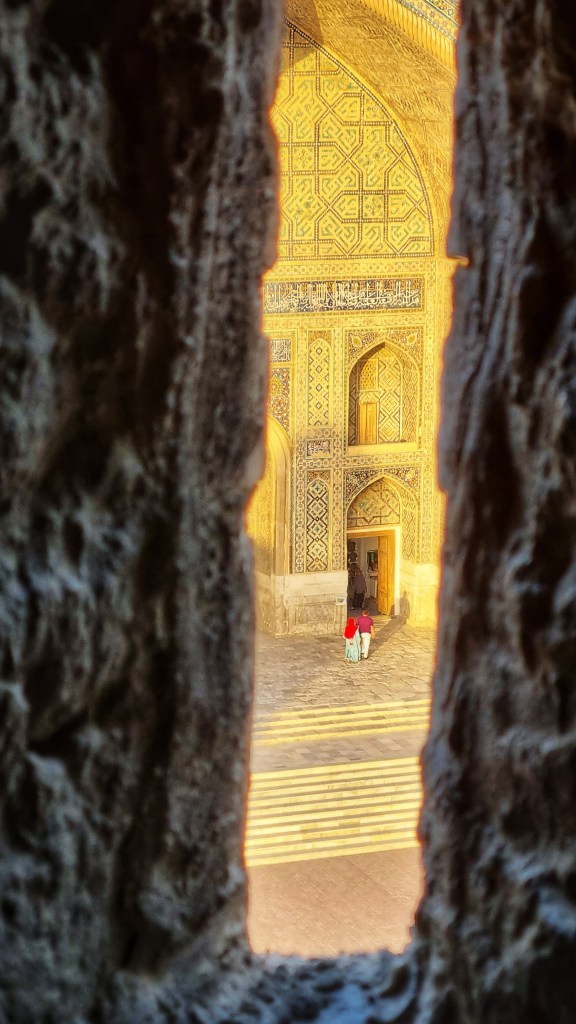
Ulugh Beg Madrasa, Registan, Samarkand

It seemed to have been written in the stars that the first place I would be drawn to in Samarkand is the remnant of an observatory that was the most well-known throughout the Islamic Golden Age and the largest in Central Asia, preceding Tycho Brahe’s Uraniborg and Taqi al-Din’s observatory in Constantinople by more than a hundred years.

The great mathematician and astronomer behind this observatory, whose computation of the length of the sidereal year was more accurate than that of Copernicus’s, is Ulugh Beg.

Although what remains of the observatory is the arc of a gigantic sextant (used to measure the transit altitudes of the stars and to produce the most comprehensive star catalogue in the period between Ptolemy and Tycho Brahe); the splendid madrasa that he built right at the heart of the city still stands.

He turned Samarkand into an intellectual center, inviting mathematicians and astronomers to study there — but no longer by force. He was, after all, a sultan of the Timurid Empire, the grandson of Tamerlane, and his tomb lies at the foot of his grandfather’s in the Amir Timur Mausoleum.
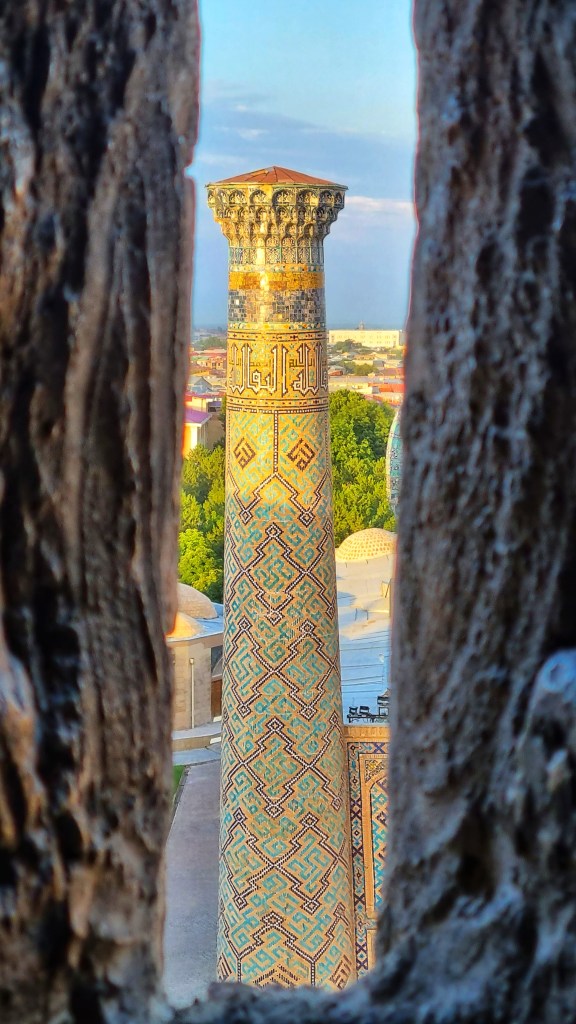
…to trace the constellations of Samarkand’s history and look at the stars that have burned the brightest… and bask in their afterglow… what a dream.

© 2022 MDR
Ulugh Beg Conservatory, Samarkand

June 17, 2022 – Samarkand, Uzbekistan: Tamerlane

When Soviet archaeologists exhumed this tomb in 1941, they allegedly found this inscription inside: “When I rise from the dead, the world shall tremble. Whoever opens my tomb shall unleash an invader more terrible than I.”

In a matter of hours, Hitler’s men invaded Russia resulting in millions of deaths. Stalin ordered the remains to be reinterred in 1942, and soon after, the Germans surrendered at Stalingrad. Coincidence or not, it is a remarkable story.

Two years ago, I listened to a series of podcasts about this man for whom this mausoleum was built. I found him frightening and intriguing! There aren’t enough books written about him, and eurocentric history merely dedicates one or two measly paragraphs to him!

This man, known in the West as Tamerlane, is Amir Timur, “iron” in their language. It was he who freed his people from the yoke of the Mongols and proceeded to establish the Timurid Empire in 1370 and conquered lands spanning parts of Russia, and north western India to Syria.

During his reign, he and his armies decimated 5 percent of the world’s population! On his Persian conquest, they massacred and constructed towers out of the bodies. He was as brutal as the Mongol Khans, but unlike them, he spared the intellectuals, the architects, the writers, the rug makers, the craftsmen, the artistic and the educated, and brought them to Samarkand. And thus began the flourishing of Timurid arts and architecture, well exhibited in this very mausoleum up to this day.

Where I am staying in Samarkand is a wall away from this mausoleum.

The moon was still up when I walked over this morning and the muezzin’s call to prayer accompanied my quiet footfalls.

I sat on the steps with a book thinking it would still be off limits at such an early hour, but the caretaker noticed me and offered to let me in and left me on my own!

Heart pounding and knees slightly trembling, I entered and thought I heard throat singing along with the muezzin’s call…

 © 2022 MDR
Amir Timur Mausoleum, Samarkand