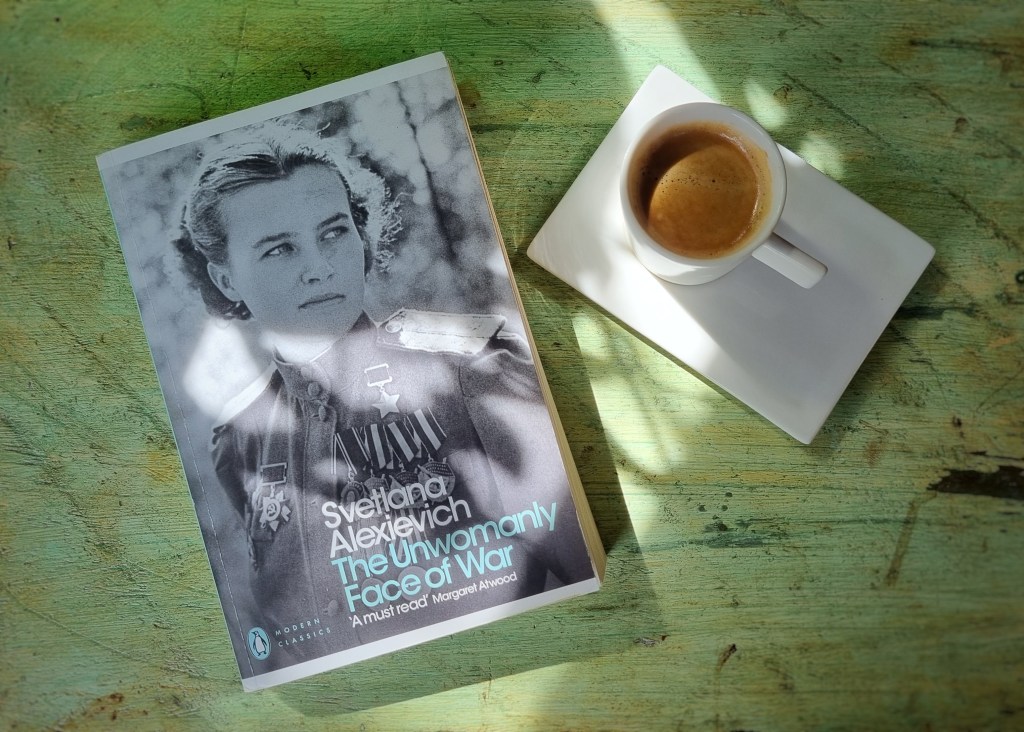
During WWII, women served in all branches of the military: 225,000 in the British, 450,000-500,000 in the American, and about a million in the Soviet army. The women in the Soviet army contributed to the German defeat, but little was known and little was said about them and the price they had to pay for victory.
Over the course of twenty six years, Svetlana Alexievich sought out many of these women and became the repository for their untold stories. This is part of the body of work that earns her a place as one of only seventeen women out of a hundred and fifteen Nobel Laureates in Literature.
Maybe it’s because Svetlana Alexievich says that she isn’t writing about war nor the history of a war, “but about human beings in a war… the history of feelings.” Maybe it’s because she is what she says she is, “A historian of the soul.” Maybe it’s because she believes, for good reason, that suffering is “a special kind of knowledge,” “the highest form of information,” that suffering has a direct connection with the mystery of life. (“All of Russian literature is about that. It has written more about suffering than about love. And these women tell me more about it…”) Maybe it’s because she makes this book of unburdening into an overwhelming choir of over two hundred voices singing a soulful rendition of an unsung threnody for the first time, that it answers my question as to why a piercing account of war can be so beautiful and so important.
Special thanks to Gabi for encouraging me to read this and for giving it to me as a birthday present last year. 🤍
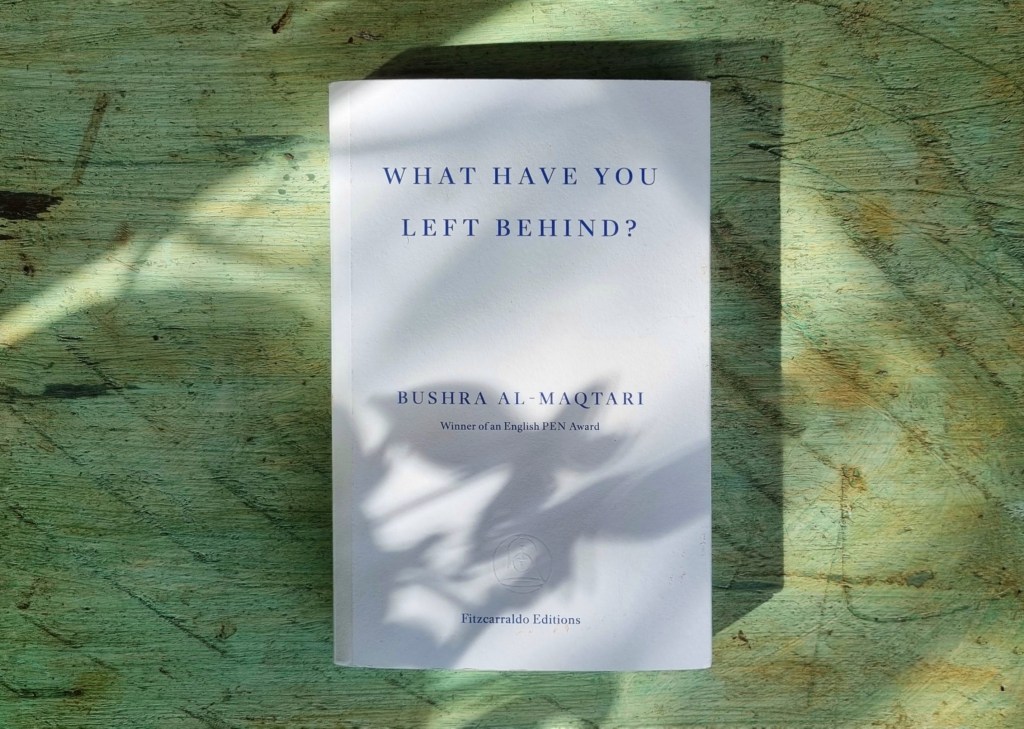
“Do not travel to Yemen due to terrorism, civil unrest, health risks, kidnapping, armed conflict, and landmines. Avoid all travel to Yemen.”
I was constantly met with these words when, during lockdown, I made itineraries for the places I hope to visit in the future. If you know me well enough, I’ll probably be one of the first people you’ll think of whenever you see photos of the architecture in the old city of Sana’a, that stone house in Wadi Dhar, and the otherworldly trees and landscape of Socotra.
The hostile travel advisories did not prevent me from coming up with an itinerary, but my rational side knows it would be safer to travel to Yemen through literature for the time being.
Unfortunately, authors writing about, and especially those from, Yemen are hard to come by. You can imagine my eager anticipation when Fitzcarraldo Editions announced the launch of this book!
Warning: Do not read this in public. Unless you’re okay with weeping in public.
Every page is drenched in heartache and death. It’s the kind of book that Scholastique Mukasonga would call “a paper grave”. A book to put my puny troubles into perspective.
But I think my task as reader is not to highlight how this book made me feel; it’s to sound the sirens and ask others to take time to look into what is happening in a country that hardly enters the fringes of our consciousness.
Inspired by the work of Belarusian journalist and 2015 Nobel Prize laureate in literature, Svetlana Alexievich, Bushra Al-Maqtari traveled across her own war-torn country for two years to document the lives and deaths of civilians caught in the crossfire of the civil war that erupted in 2014 and which persists up to this day. But unlike Alexievich, Al-Maqtari lived, and continues to live, through the war of which she writes.
This war has claimed hundreds of thousands of innocent lives, only to serve the greed for power of a few. The least we can do is listen, read, encourage others to do the same, and allow the power of fearless journalism and literature to achieve its goal.
Exceptionally written, it is an essential education and addition to a journalist’s shelf, or any human being’s shelf for that matter. It is a precious but painful work of journalism that makes me wonder at how difficult it must be to gather, to write, and to live these stories — especially as a woman.
The book is the result of one woman’s courageous initiative: “…to ward against forgetting, against feigning ignorance, against indifference,” to emphasize that the Yemeni people “are not voiceless, they are unheard.”
The best of Nawal El Saadawi’s books are nonfiction: They reveal the devastating truth that her works of fiction are, in fact, nonfiction.
A vital textbook for the study of women in the Arab world, The Hidden Face of Eve has a more academic structure compared to A Daughter of Isis, Walking through Fire, and her numerous memoirs that are deeply personal. But all her writings perfectly demonstrate how the personal is political, and there is not a hint of the tedium that we might encounter in textbooks.
The delicate preface alone is worth mulling over and digesting; and the book, thorough in the history and status of women in Arab society from pre-Islam days until the present, often enlightening or enraging, should be read in its entirety. Whether one agrees or disagrees with any of her views, no one will close this book without having learned anything substantial. Reading this showed me what a shallow understanding I have of the matter despite years of delving in books from Islamic nations.
Nawal does not launch into an angry tirade against religion, however, but against those who use religion “as an instrument in the hands of economic and political forces,” those who use religion to deprive women of knowledge and suppress the search for truth by intimidation and obscurantism, and those who misinterpret religion and utilize it as an instrument of oppression and exploitation. She challenges that religion, if authentic in the principles it stands for, “aims at truth, equality, justice, love, and a healthy wholesome life for all people, whether men or women.”
She criticizes feminism that is merely an instrument of a specific class, or a feminism that is fanatical and superficial, stressing that fanaticism of any form should be opposed, whether it be religion, political, or social. Interestingly, she even remarks on the “modern” woman, “who thinks that progress is manifested by a tendency to show more and more of her thighs,” but remains mentally and emotionally suppressed under the surface.
She therefore makes a stand for the education of the female child, the strengthening of the mind, a free mind, and a heightened level of consciousness, pointing out that a girl who has lost her personality through the throttling of her mind will lose the capacity “to think independently and to use her own mind,” and “will do what others have told her and will become a toy in their hands and a victim of their decisions.” Thus, “the emancipation of Arab women can only result from the struggle of the Arab women themselves, once they become an effective political force.” As we all know, this does not merely apply to Arab women. There is also the acknowledgement that “progress for women, and an improvement of their status, can never be attained unless the whole of society moves forward.”
Can you see why I wished to greet Women’s History Month by reading someone like Nawal El Saadawi? But because there is no one like Nawal El Saadawi, I read her.
“…with liberation they stand to lose nothing else but their chains…”
Mira, keep this close to Luis Sagasti’s A Musical Offering, close to Olga Tokarczuk’s Flights.
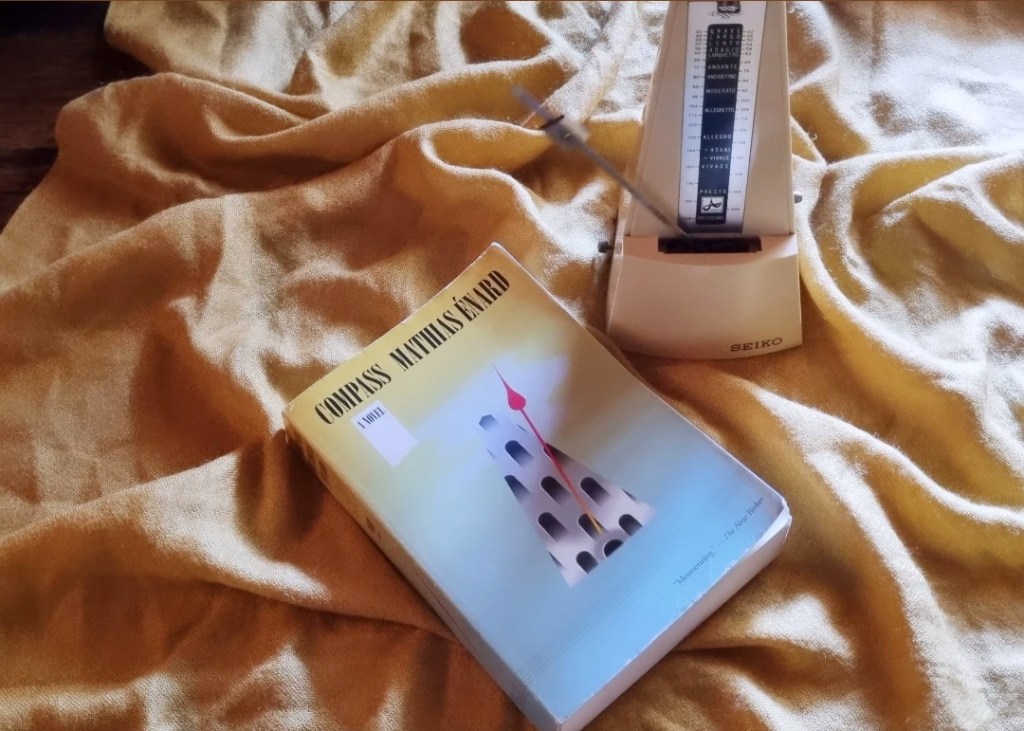
It is, after all, a musical offering — golden threads of western music’s entwining with the orient, of Liszt’s recitals in Constantinople, of how Nietzsche wanted to Mediterraneanize music, of the narrator’s replica of Beethoven’s compass that insisted on pointing east, but most of all because it reminds you beautifully that “music is a fine refuge against the imperfection of the world,” one that describes music as “time thought out, time circumscribed and transformed into sound… time domesticated, reproducible time, time shaped,” and cautions that “life is like a Mahler symphony, it never goes back, never retraces its steps…” but also that “this feeling of the passing of time is the definition of melancholy, an awareness of finitude from which there is no refuge.” Take note of how there is a metronome on the cover instead of a compass. Perhaps because a metronome goes back and forth between directions whilst keeping the music in time.
It is about flights. A hypnotic trip across east and west, tick tock, east, west, art, love, time, self, other, literature, until they have intermingled and are present in each other, an adventure with Being — of traveling to the lands of your dreams and to your favorite cities, about crossing the borders of genres, art forms, literary forms, and geographical borders, but also flights from sanity, and traversing through memory, history, and dreams, suggesting that “our dreams might be more knowledgable than we.” Flights of flavors, an exotic dish not everyone will love; disturbing at times, an acquired taste with a scent of opium.
But keep this book close to Luis Sagasti’s A Musical Offering, close to Olga Tokarczuk’s Flights, close to your heart. Only you know how much this book means to you. Don’t forget you were constantly wide-eyed with wonder when you read it and you agreed with the following lines. How much you were in need of reading that last sentence!
“Sometimes I feel as if night has fallen, that western darkness has invaded the Orient of enlightenment. The spirit and learning, the pleasures of the spirit and learning, of Khayyam’s and Pessoa’s wine, have not been able to stand up to the twentieth century; I feel that the global construction of the world is no longer carried out by the interchange of love and ideas, but by violence and manufactured objects… You have to have… energy to constantly reconstruct yourself, always look mourning and illness in the face, have the perseverance to continue searching through the sadness of the world to draw beauty or knowledge from it.”
Despite being only approximately two-thirds the length of The Balkan Trilogy, it took me longer to finish reading The Levant Trilogy.
Olivia Manning is not to blame, but rather the awry emotional state I was in when I read the latter. I even entertained the thought of setting it aside for a lighter read, but I was rewarded for pressing on. I’m glad I trusted the recommendation of friends who thought the trilogies are worth experiencing. As I approached the Levant’s third book, my pace finally picked up and I could hardly put it down again; and by the time I turned the last page, I was not ready to let Guy and Harriet Pringle go.
Among other things, I think the second trilogy is a surprising critique on imperialism and British presence in the Levant. (“Lord, the things we do to other people’s countries.”)
And as I re-viewed the six books mentally, it felt to me like the twenty years of writing between the first volume and the last is a peeling away of life’s layers of unrealistic romanticism; so that by the end, one is left with the stark nakedness of reality — of war, marriage, and life.
Is it a bleak depiction of life? Not entirely. Manning seemed to say that it all depends on how you play the cards you’re dealt.
Lüneburg Variation is a first novel, Chess Story was Zweig’s last; and one cannot really read Lüneburg Variation without recalling Chess Story. Both explore the same themes of Nazi savagery, moral complexity, and the maniacal passion for chess; but Maurensig paints it in darker shades.
Lüneburg Variation’s striking first line sets a sinister tone: “They say chess was born in bloodshed”; on the second page a murder is committed; on the seventh, a confession.
And then we meet the players behind the game and we are brought to a time when Austria was gripped by anti-Semitism, and how the world of chess, peopled by masters of Jewish descent, was purged from Jews to “recover its purity.”
For a book that’s only slightly longer than Zweig’s novella, it has a handful of indelible scenes, but what will stay with me is a particular chess lesson. After a protégé loses to his teacher, the master asks, “What if this has been caused by your inattention?”
But the attention of which the master spoke referred to something beyond the chessboard. That page made me close the book to ponder on those words that endorsed seeing rather than merely looking. I sipped at my postprandial coffee, and thought of life, and I thought of reading. How inattentive we can be to the world around us! How inattentive we can be as readers!
As I read on, the pieces came together and I was chilled by a realization. What if this was a question meant to haunt generations? Genocide, injustice, cruelty are things that can only be perpetrated by the indifference and inattention of many.
Life is like a book of short works by César Aira; you never know what you’re gonna get. But do try one and surprise yourself. Besides, who can resist book covers such as these? And how cool is that lenticular?
I have now accepted that a César Aira title is a blind date with a story or an essay. There might be some straightforward titles, but they are still no indication as to where his imagination will take you. How could I have known that A Brick Wall would be musings about cinema and childhood memories, or that the most musical one would not be the title story, or that Artforum isn’t exactly about art, or that my favorite line would come from one of the stories that didn’t appeal to me so much?
But then again, he writes in Athena Magazine, “Wasn’t that the definition of literature: the world turned upside down?”
The favorite line: “Elegance is a form of energy.”
The titles I recommend from The Musical Brain, and in this particular order: Picasso, In the Cafe, Poverty, and Acts of Charity.
As for Artforum, I don’t think any other author could be more eloquent about the maniacal acquisition of the printed word, a.k.a book-hoarding:
“One can say that they are only material objects, that other things bring true happiness. But would that be true? There always has to be something material, even love needs something to touch. And in my proceeds of that joyful day, the material was so entwined with the spiritual that it transcended itself, without ceasing to be material…they were paper and ink, and they were also ideas and reveries. They reproduced the dialectic of art itself… material made spirit is the luxurious border where reality communicates with utopia.”
“Would Chekhov have suffered writer’s block?” Maria wondered, as the hull of the sunflower seed snapped open between her lightly clamped teeth.
Had it not been for gravity and absentmindedness, it might have appeared like a final attempt of helpless rebellion as the kernel fled in its nakedness, first escaping through Maria’s lips and slipping straight into the narrow entrance of a cowl-necked blouse, lapsing between two mounds of mysterious bosomy matter, and finally shelving itself in the black hole of the navel.
There, cradled in the darkness was the sunflower seed, and it knew not what parallel or different fate it would have encountered had it slipped inside – on the other side, of that warm, heaving skin. At that moment, it knew not time nor space, it only knew of warmth, suspension, and a false feeling of relief.
Maria’s eyes swept the floor but found no trace of the seed, so she picked up another one when suddenly, an idea! A writing idea after weeks of creative standstill! She mock-kissed the second sunflower seed with glee and tossed it back on the table. “If Chekhov could eye an ashtray and tomorrow furnish a story called ‘The Ashtray,’ what tales I could conjure from a sunflower seed!”
With confident strokes of her pen she inked ‘The Sunflower Seed’ on the top of a blank sheet, and Maria wrote:
“Would Chekhov have suffered writer’s block?” Alejandra wondered, just as the sunflower seed snapped open between her semi-clenched teeth.
Of what seemed as a definitive act of impetuous rebellion, the seed fled in its nakedness, first escaping through Alejandra’s lips and slipping straight into the abyss of a cowl-necked blouse, lapsing between two mounds of mysterious bosomy matter, and at last shelved itself in a black hole which was the navel. There, cradled in the darkness was the sunflower kernel, and it knew not what parallel or different fate it would have encountered had it slipped inside – on the other side, of that warm, heaving skin. At that moment, it knew not time nor space, it only knew of warmth, suspension, and an ersatz feeling that resembled belongingness.
Maria continued to write vigorously and narrated how Alejandra’s husband discovered the mutinous seed in her bellybutton later that night and punished it by plopping it into his mouth with a teasing gleam in his eyes.
Pleased with the South American tone of absurdity in her story despite aiming for a Russian shade, and unaware that her tale was half fiction-half accidental truth, she put her pen down with a satisfying staccato. “Ah, the sound of a period!” she exclaimed. As she stood up, the sunflower seed fell to the floor, later to be identified as midnight snack by the little mouse that lived in between Maria’s walls.
The above story is not from the two books featured here. I wrote this in 2009 when reading a volume of Chekhov, who happens to be one of the most handsome of authors, ignited a spark of creative inspiration. Since then, I’ve found that the best short story compendiums do not inspire me to write reviews; they nudge me to pay more attention to the details of everyday life and to write my own short stories however inferior mine may be.
Ferit Edgü is more minimalist than Sait Faik but I find both their stories to be of a distinctive hue. There is something almost monochromatic about them: But akin to the most masterful black and white photographs, this quality does not reduce them to something less but raises and intensifies their expressiveness.
My best attempt to describe them would be to ask one to look into photographer Ara Guler’s black and white images; or better yet, grab that photo book, Ara Guler’s Istanbul with a foreword by Orhan Pamuk. Each photograph a story, each story an evocative photograph.
It is said that every Turk knows a Sait Faik line or story by heart. He is, after all, considered the Turkish counterpart of Anton Chekhov. Turkey’s most prestigious short story award, the Sait Faik Prize, is named after him — which Ferit Edgü received in 1979.
Needless to say, last month’s release of this Ferit Edgü collection resulted in yet another NYRB | Archipelago book-pairing at my end.
Now, excuse me as I attempt to write another short story. If that doesn’t work, I’ll be content with seeking beauty in the ordinary.
“And so the role of literature on this earth: It is that thing seeking beauty.” — Sait Faik
“The story of a marriage and of a war,” reveals the NYRB description. Thus it was with a sense of irony that I picked this up after learning that Emma Thompson and Kenneth Branagh met on the set of the 1987 BBC adaptation, married two years later, and divorced when Branagh had an affair with Helena Bonham Carter.
I have to admit that the silly curiosity in whether Guy and Harriet Pringle would meet a similar fate was partly what spurred me to read on. Lest this begins to sound like a gossip column, let me continue by writing that there is a certain ease in reading Olivia Manning.
That can hardly be said of other wartime books that have close to a thousand pages, and yet, here is The Balkan Trilogy; alive with the imperfections of being, the tragicomedy of the human condition, the uncertainties of love and life, and keen observations on history that kept me engaged up to the very end.
Manning is also an ideal literary guide for a place one rarely reads about. The last volume is set in Greece and the first two in Rumania. Despite my daring adventures in world literature, Rumania remains unfamiliar territory, but with her geospatial adeptness and descriptive prowess sustained by first-hand experiences, I was wholly transported to Bucharest’s golden domes, outdoor cafes, and societal hodgepodge, and baptized into the political currents of WWII through the stunning perspective of the Balkans.
My initiation to Manning’s work was School for Love. As if reading my thoughts, Rachel Cusk’s introduction addresses my reflection on why I was met with yet another orphan as a main protagonist: “A central metaphor for war, displacement, cataclysm, and the death of the old world in 1940s Europe.”
And yet, despite the solemn themes and the fight for a marriage in the face of disenchantment and war, the aforementioned ease stems from a writer who stops to smell the roses; someone who implies that doing so does not distract us from the more important things in life but nourishes us instead and gives our lives more meaning.
Sometimes we need a massive trilogy to be reminded that the only real fortune in this cruel world is to live and love.
“The beauty of a book, says the book dealer, lies in the fact that no other book can arouse the same feelings in you. That’s why you can’t compare good books.” — Burhan Sönmez, Labyrinth
When your desire to forget certain things mingles with a character’s desire to remember, and the words from the book and those unsaid in your heart cross paths, the sensation stays with you, the way your first sip of raki does — like drinking smooth, liquid embers as your insides become drenched with that distinctive Turkish melancholy.
One ends tragically, the other ambiguously, but the influential power of Istanbul that takes hold of writers is exquisitely manifested in this pair. Despite Istanbul being a bazaar of a thousand and one stories, Burhan Sönmez has his own approach to storytelling and his own approach to this alluring, Janus-faced city that readers who are just as enamored with it as I am will hold in esteem. As a certain character says, “Just as you can’t bathe in the same river twice, neither can you tell the same story twice in Istanbul.”
The interesting thing you’ll discover about these two books is that, despite being two entirely different novels by the same author, their titles are interchangeable. Both are about labyrinths, and both are about Istanbul; both can either be about the labyrinths of the mind and memory or the labyrinths of the city; and I find both to be best read successively.
The past — or the land of our birth — can be a burden from which we sometimes wish to be free, but who are we without it?



 The Book-Butterfly