Take care, dear Bella. Happiness is a very fragile thing…
Barbara Comyns is such a skillful writer who can string you along with hope despite a sense of foreboding right from the beginning. It is the same thing that oddly lures you deeper into the story until the previously unknown but anticipated event suddenly confronts and startles you.
It is a book too dark for a Sunday read, but perhaps it was written to reveal the madness that could ensue when women go against their intuition and trade their freedom for something else.
Kurdish authors — whether their Kurdish-ness belongs to the Iranian, Iraqi, Turkish, or Syrian side — all come from the same amorphous tradition of storytelling, and they have an artful way of wrapping their own originality around this. But they also come from another kind of tradition; that of loss.
Balsam Karam describes herself as, “a Kurdish writing in Swedish.” That is exactly why, even without checking what this novel is about, I immediately purchased a copy. There is a scarcity of Kurdish voices in literature, and this scarceness urges me to listen to each one.
Now I have found that this book is about mothers losing children; and children losing mothers; motherlands being uprooted of her children; and children being separated from their motherlands; written by a woman who is in the process of retrieving her voice when she thought she had lost it along with her firstborn; and all these meld into each other in a mosaic of poetry and prose.
Yes, it is fragmented and it is painful. That’s what loss feels like.
“The chief glory of every people arises from its authors.”
Debatable to some, for sure. But I am inclined to agree with Samuel Johnson, and with Susan Sontag. Especially after having read The Three-Cornered Sun.
While I have long discovered that I prefer the nonfiction writer in Nawal, her fiction remains to be in a class by itself. (That’s why I still continue collecting what I can of her books, fiction and nonfiction, especially now that I’ve discovered these excellent editions — in terms of publication quality and translation — from Saqi Books.)
Two Women in One is not straightforward storytelling. There’s a tinge of Clarice in the free indirect prose. Unsettling, like any piece by Nawal; claustrophobic, and therefore, effective.
It’s not a good place to start if one is new to Nawal. The angst of a young woman, wanting to be an artist but who’s forced into medical school, is potent here.
Conformity becomes suffocating to her, “Everything had the same color and shape to her. All bodies were similar, and all gestures and voices. She found herself running aimlessly… fleeing the deadly sameness within and without…” When she realizes that none of her life is her doing or her own choice, she unleashes a rebellious other woman in her. “Freedom is dangerous, but life without it is no life at all.”
But what I found most powerful in this work is the underlying message that unless Egypt is free, she cannot be free. “Egypt was not free. The chains were still there.” Because when all is said and done, how a nation treats their women, is always a measure of that nation. A woman’s personal freedom is often symbiotic and synonymous with national freedom.
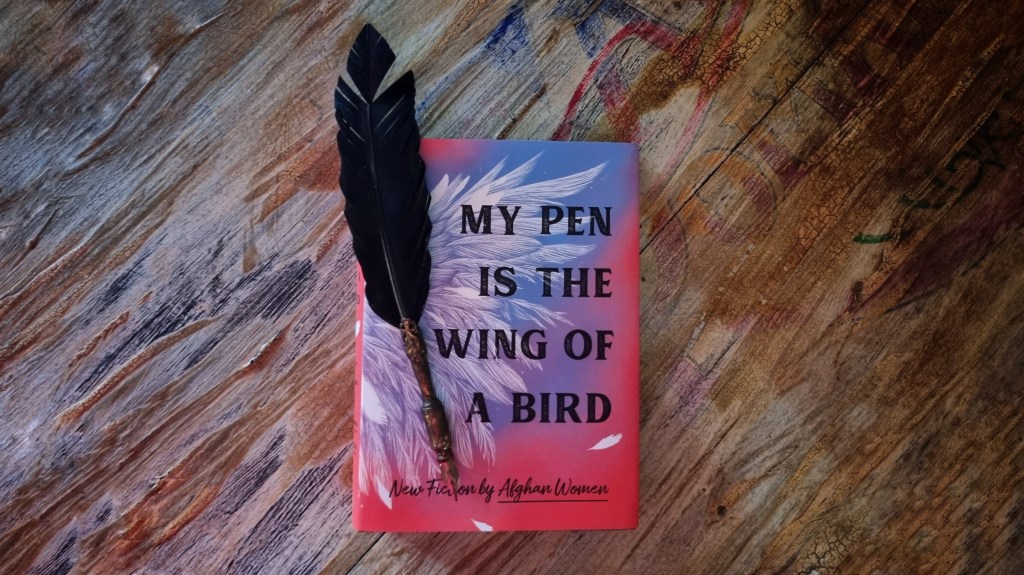
This book came into my possession on International Women’s Day. That day I was asked to speak at an event in celebration of Woman; and as one who never goes out without a book (in case of emergency), I slipped this in my bag on the way out. I was early at the venue so I took this out and flipped the title page. It read:
“My pen is the wing of a bird; it will tell you those thoughts we are not allowed to think, those dreams we are not allowed to dream.”
Batool Haidari, Untold Author, International Women’s Day 2021
The line was written on exactly the same day three years earlier. That’s when I knew I brought the right book with me.
The first open call inviting Afghan women to submit short fiction came in 2019. The creation of this anthology and the translation of the pieces from Afghanistan’s two principal languages, Dari and Pashto, pressed on through more than just power outages and internet service interruptions, but also a global pandemic lockdown and the Taliban takeover in 2021. The book that now sits on my shelf is a triumph.
As anyone might have guessed, there is little happiness here. But it makes us see that there is humanity, kindness, and so much more to Afghanistan’s stories than just war. As in any short story collection, some stories have more literary merit than others, but every single one deserves our attention if we wish to educate ourselves and see a more thorough picture of Afghanistan and the world we live in — especially when their humanitarian crisis continues even as the world’s attention is no longer on them.
“My pen is the wing of a bird; it will tell you those thoughts we are not allowed to think, those dreams we are not allowed to dream.”
This line made me realize the wide gulf between literature by women from places of conflict and the first world. In literature from the first world, this would refer to careless and obsessive romantic affairs, and the women who write about these things are lauded for their rawness and honesty. In literature from marginalized communities, the thoughts they are not allowed to think and the dreams they are not allowed to dream are education, work, the freedom to do the right thing, and the freedom to live. A dose of the latter is always a healthy reality check on the disparity present even within women’s literature.
Reading on Women’s Month is something I look forward to each year. There’s simply nothing like communing with some of the fiercest minds in literature for an entire month!
I’m glad to have kicked off with Hurricane Clarice and Hanne Ørstavik, but this month’s reading goals are not too unrealistic: One Sontag essay a day (although I will definitely squeeze in what I can). I cannot fully express how much her words feed me so profoundly.
“…literature was a criticism of one’s own reality, in the light of a better standard.” — From The World As India
“Literature can train, and exercise, our ability to weep for those who are not us or ours. Who would we be if we could not sympathize with those who are not us or ours? Who would we be if we could not forget ourselves, at least some of the time? Who would we be if we could not learn? Become something other than we are?” — From Literature is Freedom
“To have access to literature, world literature, was to escape the prison of national vanity, of philistinism, of compulsory provincialism… Literature was the passport to enter a larger life; that is, the zone of freedom. Literature was freedom. Especially in a time which the values of reading and inwardness are so strenuously challenged, literature is freedom.”— From Literature is Freedom
“And one of the resources we have for helping us to make sense of our lives, and make choices, and propose and accept standards for ourselves, is our experiences of singular authoritative voices, not our own, which make up that great body of work that educates the heart and the feelings and teaches us to be in the world, that embodies and defends the glories of language: namely, literature.” — From At the Same Time: The Novelist and Moral Reasoning
“The writer’s first job is not to have opinions but to tell the truth… and refuse to be an accomplice of lies and misinformation. Literature is the house of nuance and contrariness against the voices of simplification… the job of the writer is to make us see the world as it is, full of many different claims and parts and experiences.”— From The Conscience of Words
“A writer is first of all a reader.” — From The World As India
“The capacity to be overwhelmed by the beautiful is astonishingly sturdy and survives amidst the harshest distractions.” — From An Argument About Beauty
And I’ve written fourteen novels, and if there’s one thing my writing has to be, for me, it has to be truthful. What I write has to be truthful. I’ve wanted that to apply to my whole life too, in my relationships with other people, my relationship with myself.
My first experience with Hanne Ørstavik’s writing was in 2022 with her novel, Love, wherein she seemed to have invented a literary equivalent of the Shepard tone — that auditory illusion used in film soundtracks to create a palpable suspense and disquiet. With a narrative that demanded complete attention, it revealed a writer in full command of form and style.
Expecting another work of sparse and exacting Nordic prose, I was surprised to be met with vulnerability and painful honesty in Ti Amo. It cannot be more different than Love. Expertly calculated tension dominated Love, Ti Amo announces death candidly right from the beginning and nothing is veiled.
Love was fiction, Ti Amo is not, and I cannot somehow bring myself to judge a work by someone writing through her husband’s terminal illness. It is a book about life, death, and writing, and nothing describes this book better than the author’s own description of the marble pillars in Ravenna’s Basilica di San Vitale.
“In the San Vitale — the way the great marble blocks of the pillars possess a quieter beauty than the glittering mosaics. The mottled markings in the marble are just there, silent and displayed, defenseless, and what was hidden within the stone, the veins, the figures they trace, is exposed now for all time, laid bare, halted in once so sweeping, now dissected movements through the stone. And what we see is the cross section, the wound, and the beauty of what simply exists, neither devised nor constructed, merely disclosed.”
I thought wrong when I surmised it was written as closure. (As if grief had closure!) Of the wound and the beauty of what exists, it is simply, and not too simply, a disclosure.
“It was as if love were the desperate clumsy shape that living and dying take…”
“If it hurts, that’s the way in which things are alive.”
“But what kind of silence did she want to share with him?”
I love you. Yes, he said after a pause. Both sat quiet for an instant, waiting for the echo of what she said to die.
The Penguin Classics covers got it right. Surrealist Giorgio de Chirico’s art answers the dreamlike quality of Clarice Lispector’s writing. Not in the sense that reality is bent, but in the sense that the unconscious corridors and objects of the soul, heart, and mind are suspended, isolated, turned over, and perused in poetic abstractions that only she can get away with.
New Directions Publishing chose to be literal. With an apple. In the dark. And it’s an effective counterpoint to the metaphysical prose that the contemporary reader is more than willing to bite into. “After all a person is measured by his hunger… All I’ve got is hunger. And that unstable way of grasping an apple in the dark — without letting it fall.” But what is this hunger? And what is this apple?
The book is about Martim, a fugitive who finds his way to an outlying ranch run by two women. There is a storyline. There is suspense and there are surprise twists. Lispector readers know that these are things she does not always give us because she deems them secondary to the subliminal probing of how we love, how we desire, how we live, and how we exist. Clarice for whom writing and being are one and the same thing. But she is especially generous here. This longest novel of hers is not fixed and final. It’s a sentient thing wherein her words and the reader gestate. It is a book only a Clarice Lispector can write.
It’s one of my favorite reading months and I’m thrilled to have kicked it off with Hurricane Clarice. Happy Women’s Month to the women who hunger for life and endless learning!
The only thing I knew about Frederick the Great was that he once met Bach, and the Prussian king gave the composer a musical theme on which the sixteen pieces of Bach’s The Musical Offering are based.
Thanks to the author’s gossipy nature, I think I’m knowing more than I want to. Haha! Kidding aside, reading Nancy Mitford’s historical biographies is an attempt to brush up on European history and not neglect it completely while I am on this predominantly eastbound literary journey.
Mitford seems to be more reflective here and I’ve found it to have more depth than The Sun King, but as a musician I am slightly disappointed that little is said about the momentous encounter with Bach. This book, however, covers a great deal about Frederick’s fraught friendship with his most famous contemporary, Voltaire.
Being controversial herself, Mitford turns the spotlight on Europe’s controversial figures. But without being too academic, she seems to provide the right dose that I’m currently looking for. I like the fact that I don’t end up liking her subjects any better or liking them any less; I just end up learning a little bit more and having a less fuzzy idea of the Europe just before the French Revolution.
Someone recently asked me to recommend a book on world history. That’s the thing: There’s not just one book. One just has to read as much as they can. And that is what we shall do.
Ruta Sepetys cover designs are not the kind that would catch my attention in a bookstore. In fact, Ruta Sepetys was unknown to me until Fully Booked and Penguin Random House gifted our book club with six of her books.
Although the books will continue to be passed around Ex Libris members, I picked I Must Betray You for the reason that Romania does not often turn up in the books that come our way.
And what a surprise when reading this made me realize how much the Philippines and Romania have in common! At times I could easily interchange Ceaușescu with Marcos in my head and the story would still make sense:
Wealth didn’t accurately describe it. Excess, extravagance, greed, and gluttony, those words were more accurate. Countless estates across the country, hundreds of millions salted away in foreign bank accounts…
“I can’t bear it,” said Liliana. “We’ve been suffering for years, existing off scrawny chicken feet, with just one forty-watt light bulb per home. And they’ve been living like kings. Gourmet food, foreign goods, antiques, jewelry, fur coats, hundreds of pairs of shoes.”
As Sepetys writes for a younger audience, I can only wish I had more books like this growing up! I would have alternated them between the Nancy Drews and the Hardy Boys, and it would have deepened a younger person’s understanding of self and the world.
They steal our power by making us believe we don’t have any… But words and creative phrases — they have power, Cristian. Explore this power in your mind.