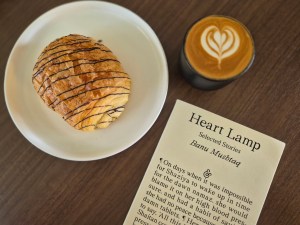
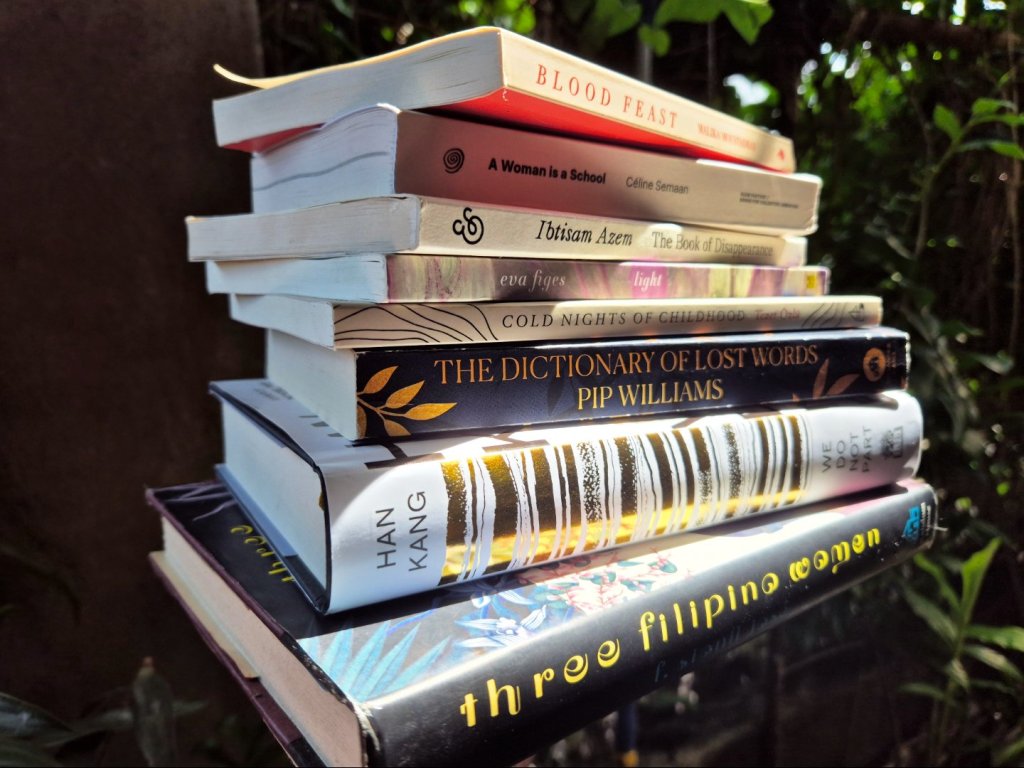
There has been a significant increase of Maghrebi literature in my reading repertoire, and the recent discovery of Malika Moustadraf is yet another strong force that pulls my literary compass in that direction.
She is Morocco’s answer to Egypt’s Nawal el Saadawi whose depictions of how women are viewed and treated are unflinching. But Malika has a distinct style that draws the reader right into a scene, into the midst and into the cracks of such a society, sometimes forcing us to look through the eyes of the scoundrels themselves. I daresay she is the more masterful fiction writer.
But fiction, as we know, is just a tool to reveal the rawest of truths, and Malika has succeeded in this. The tragedy is that she will no longer be writing. The few works that she leaves in her wake are glimpses of the undeniable literary powerhouse she would have become had she not passed away from a chronic illness at the age of thirty-seven in 2006.
One thing I’ve noticed in Maghrebi authors is the sensitivity and the softness of the men and the forcefulness of the women. Their literature can teach us many things, but among these is the truth that softness can be extremely masculine, and forcefulness immensely feminine.
This book was, indeed, a fitting way to start this reading month. Wishing you a rewarding Women’s Month!
“Only love and art can do this: only inside a book or in front of a painting can one truly be let into another’s perspective. It has always struck me as a paradox how in the solitary arts there is something intimately communal.”
An understated book that is a meditation and an education in art and life.
“I hope that when there is laughter, it’s laughter made wise by having known real grief — and when there is grief, it is made wise by having known real joy,” Kaveh Akbar writes in Martyr! Whether writing about art, architecture, Libya, or politics, Hisham Matar’s books are often so heartfelt — wholly made wise by having known sorrow and loss.
Fires, Marguerite Yourcenar
…because maybe, subconsciously, this month’s reading theme is about finding solace in the works of authors whose masterpieces have already left an impression on me, that I immediately dove into Yourcenar’s Fires without hesitation, having been incredibly moved by Memoirs of Hadrian in 2022.
She does admit, and warn, in the Preface that this book is, “the product of a love crisis” and that writing this was, in a way, “exorcising a very concrete love”; and yet it still surprised me that the elegance I encountered in Hadrian was replaced in Fires by a certain violence and ferociousness in the prose.
Antigone, Sappho, Clymenestra, and Achilles are just some of the main characters of the nine lyrical prose pieces, or stories, that Yourcenar amalgamates with her own experiences. I was left wondering if I understood the allusions correctly, or whether I understood anything at all.
One thing is certain, Fires is a masterclass on opening lines:
Phaedra’s piece begins with, “I hope this book will never be read.”
The Patroclus opening, “A heart is perhaps something unsavory. It’s on the order of anatomy tables and butcher’s stalls. I prefer your body.”
Lena’s? “Loving eyes closed is to love blindly. Loving eyes open is perhaps to love madly.”
“Love is a penalty. We are punished for not having been able to stay alone.” Clymenestra’s.
Face Shield Nation, Gideon Lasco
Articles that I looked forward to during the pandemic compiled in a book. Lasco was the voice of calm and reason at a time of confusion; evoking through his column the architectural definition of a column as a sturdy pillar of support. An essential time capsule of an era that we cannot afford to forget if we intend to learn from it. Read full entry here.
One Hundred Years of Solitude, Gabriel Garcia Marquez (a re-reading)
Growing up is realizing that Gabo is the real Melquiades who brought us magnets, magnifying lenses, astronomical observations, and mercurial storytelling. It was he who made imagination and literary possibilities flourish in the fertile and pristine Macondos of our minds, and who never really died. Read full entry here.
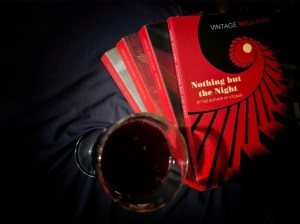
Nothing but the Night, John Williams
Maybe the first disappointment that assails the reader is the realization that, despite the slenderness of this volume, there is a heaviness in each page that restrains forward motion.
“Boring,” the lazy might judge hastily somewhere within the first three chapters. But one should not be too quick to criticize even though I myself could only read a couple of pages per sitting. For if one looks closer, and feels deeper, isn’t this genius, how John Williams conveys exactly what depression feels like?
“…there came to him that peculiar loneliness which is felt only in the monstrous impersonality of a multitude…”“What was the senseless circumstance which led him on and on, deeper and deeper into what seemed to him a maze labyrinth, devoid of pattern or meaning? …some unnameable power pushed him from one place to another, down paths he had no wish to travel, through doors he did not know and had no wish to know. All was dark and nameless and he walked in darkness.”
But then the reader is momentarily allowed to come up for air. I’m referring to the fourth chapter that is briefly set alight with a Proustian beauty! “That is the very best time of life, he thought: lost time.” And then John Williams proceeds to craft this fleeting tribute to the master searcher of lost time before he relinquishes the ethereal chapter to the fading light.
As the novel finally builds suspense, it spirals into a nihilistic darkness that ends with a violent and repulsive slap in the face.
Written in Burma when he was only twenty-two while recovering from injuries brought about by a plane crash over the Himalayas during WWII, he wrote this first novel at a particularly dark time when there was nothing else but the night.
The John Williams here is not the John Williams that gave us Stoner and Augustus. The John Williams here is the John Williams that would eventually give us Stoner and Augustus.
The Black Book, Orhan Pamuk
This reader has been through Pamuk’s longest novels and still felt the density of the mystery and prose in this book’s mere four hundred pages.
It explores the writing process and the precariousness of identity. It is also about how much the books we read, the stories we hear, the movies we watch, the everyday objects in our lives, and our city’s history shape the multiplicities of our being.
I enjoyed that twist at the end and relished the familiarity of Istanbul as a breathing character in a Pamuk novel. But maybe, just maybe, The Black Book is not for the Pamuk newbie, and not for those who are in a hurry.
The Golden Road, Willliam Dalrymple
It is not only the Silk Roads that are rising again, as Peter Frankopan proclaims in a forceful last line that gave me goosebumps. Rising, too, are buried or forgotten histories that have now resurfaced to challenge centuries of unquestioned narratives.
Frankopan’s The Silk Roads was an eye-opener, but The Golden Road takes this non-Eurocentric view of ancient and early medieval history to an intriguing direction by revealing India as a catalyst that transformed the world. Read full review here.
“Does one truly forget with time, as they say? It’s not true. Time polishes memory…”
For an era and a place teeming with history, there isn’t enough literary fiction set in Al-Andalus.
Prior to Hoopoe Fiction’s republication of Radwa Ashour’s Granada: The Complete Trilogy, I had only read Tariq Ali’s Shadows of the Pomegranate Tree, and I remember being immensely affected by it but finding it too short.
Ashour’s trilogy, now available in a single volume, answers that yearning and enables readers to linger a little bit longer, with its 465 pages, in the tragic century following the defeat of the last Muslim state in Iberia; the fall of Granada that extinguished seven hundred years of Muslim rule in Spain.
The story traces five generations of one family and those they loved while giving the reader a glimpse of how an entire people navigated betrayal, subjugation, persecution, and the undoing of their culture and traditions. Abu Jaafar, the patriarch, a learned man in the bookbinding trade who dies of sorrow after witnessing the burnings of Arabic books and texts at the behest of the Spanish Inquisition, and Salima, the granddaughter who reminds me of Hypatia, are some of this novel’s most enduring characters.
Some plot lines are slightly itinerant, and this reader wonders whether what seems like inadequacies are merely little black holes of translation. Reading this is rewarding, nonetheless, and it is a step closer to that ultimate novel set in Al-Andalus that I hope to read in this lifetime. Although heartbreaking, this book contains lovely imagery and questions that cling and will not easily let go — just like the question of why these historical episodes from the 1500s feel awfully recent and familiar.
But we need books like this to polish our memory of history and to make our worldview flourish. As Marina Warner points out in the foreword, “In Arabic, the root of the verb for watering, rawa, happens to be the same for storytelling: a storyteller is a rawi. As the comparative literature scholar and Arabist Philip Kennedy comments, ‘Rawwii is well-watered; there are lots of versions of the root, including riwaaya which now means a story (or novel).’ Narration is irrigation, irrigation is narration.”
What a lovely thought, that to be well-watered and nourished is to be well-read, or well-storied.
“But the thing is, she didn’t die. No, she went on.”
Black Butterflies by Priscilla Morris
A book set during the Siege of Sarajevo hits differently when it is recommended by someone whose family was directly affected by the Bosnian War. It heightens the truth in a work of historical fiction.
It was an easy pick as my first book of the year, despite the promise of grim events. I did not wait for the hard copy to fall into my hands. The e-book was immediately downloaded when I learned that its main characters were an artist, a writer, and a bookstore owner who lent his books during the siege because he believed it was a time when people needed stories the most; and I could not put the book down as soon as I learned that “black butterflies” were the scorched pages from the burning of the national library — “burnt fragments of poetry and art catching in people’s hair.”
The friend who told me that I should read this was not wrong. It is a poignant story about how art triumphs and can oftentimes be the thing that saves us. But at the same time, this book is a sobering and relevant reminder, amidst the season’s celebrations, that similar things are happening in other parts of the world; histories are being erased; libraries are being bombed and burned; entire nations are going through the most violent traumas; and the heritage of entire peoples are being turned to debris.
Books like this convey what hate can do, but books like this also proclaim what art can do. To be one less person in this world who hates — may this be the lesson that the books and the art we consume always teach us.
“He had put the Times Atlas of World History under the paper on which he was noting my answers… The boy likes leafing through it when the shells fall.”
Death in the Museum of Modern Art by Alma Lazarevska
These evocative short stories by Bosnian writer, Alma Lazarevska, complement Black Butterflies. It does not go into detail about the history of the besieged city in which her characters are set. Nothing about what caused the war or about the opposing factions, nothing about a nation’s history. Rather, the history of a day, the history of a feeling, and the intimacy of a thought. Lazarevska leaves the greater scheme of things to the historians and paints ordinary life and “the space of their painful interweaving” as the city is being starved and bombed.
This was recommended to me by another friend after I posted about Black Butterflies. I wouldn’t have predicted earlier on that the first two books I’d read in 2025 would be set in the Balkans, and yet, here we are. Are the Balkans calling (louder this time)?
In one of the stories, an Austrian writer is referred to, “Whose books are an excellent weapon against shallow sentiment.” That line stuck with me and it aptly applies to this masterful work.
Thank you, Anna and Vishy for these splendid recommendations!
“Boris tells me what he’s seen on television. Lots of politics in the Ukraine, in Russia, and in America. I don’t pay too close attention. Politics are important, of course, but at the end of the day, if you want to eat mashed potatoes it’s up to you to put manure on the potato plants. The important thing is that there’s no war.”
Alina Bronksy’s wit has been on my radar for quite some time but it took one Sunday that badly begged for light reading to make me read her.
Having parents who are advancing in years, I find myself increasingly drawn to elderly protagonists. And so it was a joy to discover Baba Dunja. Her spunk, her kindness, her practicality, and her comic observations make her one of the most endearing characters one will encounter in books.
But don’t think it’s all light-hearted fun. Alina Bronsky, being a Russian-born German writer, seems to have married dark Russian humor with good old Teutonic political satire.
Even though the government appears to be apathetic about this town near Chernobyl, and despite warnings of radiation levels, Baba Dunja and her cast of amusing friends and neighbors are undeterred by the discrimination against its residents and consider Tschernowo home. And I think that’s what this book is all about — the idea and process of home that we choose and make for ourselves, no matter what.
“Wojnicz had noticed that every discussion, whether about democracy, the fifth dimension, the role of religion, socialism, Europe, or modern art, eventually led to women.”
Reading Olga with UP Symphony rehearsing Shostakovich as background.
Mischief. More literary mischief from Olga.
That the first death in the book happens to be of a woman whom our dear Wojnicz mistakes for a servant, when she is in fact the guesthouse proprietor’s wife, is not negligible.
And then, mushrooms. Then the puns in the names: January and August, two characters named after months, months named after a two-faced Roman god and a Roman Caesar; Dr. Semperweiss, because, always white; and it’s not a mere coincidence how the owner of the Guesthouse for Gentlemen where Wojnicz lodges is named Wilhelm “Willi” Opitz (see Opitz syndrome, especially in males); the Tuntschi, definitely a nod to the Sennentuntschi of Alpine folklore involving an ill-treated doll that retaliates; and Empusium, after Empusa, the female shape-shifter of Greek mythology.
The Empusium is Thomas Mann’s The Magic Mountain reframed, they say. Friends who have known me way back from my Thomas Mann reading phase know the story of how I developed a fever while reading the Magic Mountain. (They tried to assuage my sickness by saying that it’s the best state in which to read Thomas Mann. Hah!) Strangely enough, I also got sick a day after I started reading The Empusium. Whether that’s part of Olga’s mischief, I cannot say for sure, but, “The story has a spirit of sickness,” says my mom ominously.
While Mann’s mountain was an allegory for a sick Europe, Olga’s mountain is glaringly sick with misogyny. In the author’s note, Olga divulges that the chauvinistic passages were paraphrased from the words of history’s famous men, and she names all of them. Why do you think it’s labeled as a “horror story”?
The books I’ve read on two consecutive weekends; of Libya and Tunisia; and it so happens that they are neighbors on the world map.
In the Country of Men has been languishing on my shelf for over a decade, and Matar’s appearance on this year’s Booker Prize longlist reminded me of his silent presence in my library. On the other hand, This Tilting World was recently acquired after Fellous’s work caught my attention in an anthology.
Aside from the geographic proximity of their respective settings, these two books surprisingly have more in common: In the Country of Men often feels painfully autobiographical, while This Tilting World admits to being utterly personal. They are simultaneously love letter and farewell letter to their homelands; they explore questions of nationalism, and both present a character’s fraught, and yet loving, relationship with a father and a country; and the writing seems to be an attempt at making sense of the loss of innocence, of the violently shattered idyll of their childhood and hometowns.
However, these are books which, I feel, have unfulfilled potential: In the Country of Men left me wishing for characters with more integrity, This Tilting World left me in want of a more cohesive opus for Fellous’s luscious and elegant prose.
But both contain their own beauty and remain valuable records of Libya’s and Tunisia’s recent history. The books are, therefore, still worth reading.
In response to what the mother in In the Country of Men recounted, (…part of the punishment was to leave me with no books. “Don’t give her any more ammunition,” your grandfather had said…) we say: the more “ammunition” the better! It’s the only way we can make sense of this tilting world.
After immersing myself in a variety of literature from the region, and after reading nine of her books, singing praises at the time I read them, then ultimately realizing that I prefer her two nonfiction works to the seven novels, it eventually felt like I had outgrown Elif Shafak.
Nawal el Saadawi, Sema Kaygusuz, Farnoosh Moshiri, Dunya Mikhail, Adania Shibli, and other lesser known women authors that I encountered through this reading project, made Shafak’s fiction feel diluted and elementary…
…until I learned that There are Rivers in the Sky involves Mesopotamia, The Epic of Gilgamesh, and one of the books that fueled my obsession with the Fertile Crescent, Sir Austen Henry Layard’s Nineveh and its Remains.
Needless to say, I purchased the e-edition of There are Rivers in the Sky on the day it launched, and veered away from this month’s plan to read Women in Translation. Apparently, Shafak still manages to lure me with her chosen topics and setting.
And I’m glad I read it. I’m glad I did not deceive myself into believing that my literary taste has become too sophisticated for Elif Shafak. Because after all, maybe she does not water it down. Maybe what she does is a deliberate simplification, so that her books become stepping stones to forgotten stories, accessible pathways to pressing matters that we don’t even stop to think about, and springboards that launch readers into deeper inquiry about issues that are not discussed enough.
In There are Rivers in the Sky, Shafak still transcends her pretty book covers and continues to be an activist for those who do not have a voice — in this case, buried history, looted artifacts, dying rivers, and the dwindling Yazidis and the continual decimation of their people and their stories.
Reading this has taught me many lessons, and it is not without its beautiful lines: “…the world is changing faster than minds can grasp… all these smartly turned out people with their polished boots and affected airs, you look at them and you think they must know everything, educated and cultured as they are, but… when times are confusing, everybody is a little lost. No one is inwardly confident as they present to be. Hence the reason we must read… books… provide us with light amidst the fog.”
That’s why we need to read women. What does that have to do with it? It has everything to do with it.
Give me a back cover blurb without telling me the book is by Piñeiro and I would notbe very interested. The descriptions of her novels are unattractive to me, especially if they are about flies and women killing their husbands’ lovers.
But tell me a book is written by Piñeiro and I would read it without even asking what it’s about, even if it seems to be about flies.
Because if you just trust Piñeiro’s storytelling prowess and allow her to take you on a satisfying ride, you eventually learn that when it comes to the word “fly,” there is the noun, and there is the verb, and she’s ultimately writing about freedom.
Predictably unpredictable. She does it again. But this time, more heartwarming than one would expect, and more blatantly feminist.
“That’s the thing about love, it likes to leave its mark.” — Nathalie Handal
This collection of writings by Arab women turned out to have more erotic passages than I expected, and the conservative reader who cannot appreciate this as an act of defiance against authoritarian patriarchal societies might prefer to stay away.
I value this book as a reminder, as the introduction mentions, of how women were writing in Arabic centuries before women began writing in English; and as a reminder of the treasure troves of Arabic literature that hardly make it into our consciousness simply because they are not on the Western radar.
Poems by Arab women throughout the ages pepper this collection alongside contemporary essays and excerpts from novels, including those by Palestinian authors, Adania Shibli, Suad Amiry, and Naomi Shihab Nye. The translations are no less significant as it has works by Man Booker International Prize awardee, Marilyn Booth, and Ernaux translator, Sophie Lewis.
More than a treasury of sensuality, I see this book as a celebration of women who strive to steer the gaze away from centuries of male perspective, and a celebration of women in translation, but who are translating forceful statements beyond mere words.
What I think will stay with me, however, is a line from Tunisian-French author, Colette Fellous — an imagery of two lovers’ bodies, likened to a closing book.