A light rain was falling, a fine spray, unlike what rain is in the tropics. Within a couple of hours the deep purple of evening entered through that same window and transformed the spray into delicate snowflakes that vanished even before you could touch them; inconspicuous magic in the micro details when one season gives way to another.
It was toward the end of the trip when I took this photo of my traveling companions on the windowsill. Absent from the stack, but verily lodged in my consciousness, are Euripedes’ Medea and Percival Everett’s For Her Dark Skin.
I went to Georgia accompanied by seven books, and after jaunts to Tbilisi’s charming bookshops, a modest number of three Georgian masterpieces were read on the train and during long drives, then added to the pile.
The eclectic curation is an education in itself as it includes a Greek tragedy, a rather feminist and modern retelling of the tragedy, a wonderful and informative chronicle of Georgia’s unique wine culture, journalistic reports and stories from the early years of post-Soviet Georgia, the greatest love story of the Caucasus, literary criticism, a portrait of young Stalin that is also a portrait of a nation, a painful recollection of the Georgian-Abkhazian armed conflict in the 90s, epic poetry, and Tolstoyan short stories.
Once again, people wondered whether I had gone to another destination just to read. But I know they’re only kidding.
For who isn’t aware that reading and traveling are not separate experiences? They are halves of a whole that lend clarity and depth to each other.
In our travels, what we notice, perceive, and experience — and what we contribute to meaningful interactions, or how we overflow — largely depend on what is already inside us. “Nothing flows out of a jar except that already inside it,” writes the preeminent Georgian author, Shota Rustaveli in The Knight in the Panther’s Skin.
In life, reading and traveling are merely expressions of how one chooses to take their fill.
A quick and enjoyable re-reading of my initiation to the flavors of Latin American magic realism — in anticipation of Salma Hayek’s production of the upcoming series adaptation.
Recommended by my best friend in our early teens, this is the book that led to highschool years enlivened and colored by the novels of Isabel Allende and Gabriel Garcia Marquez and the poetry of Pablo Neruda and Octavio Paz. This is also the book that made the kitchen a more magical place for me.
Reading this with older eyes shows me how much I’ve grown, how much I’ve outgrown, and also how much I did not understand back then: It seems to be oozing with more sensuality now. The romantic passages are no longer what strike me the most. When John Brown encourages Tita to express herself through writing and thereby carving her path to freedom, I realize that nothing Pedro ever did could top that and I was rooting for the wrong man all along. Now I’m no longer concerned about whether the adaptation is faithful to the love story, I’m more concerned about how faithful it is to the kitchen magic.
“My grandmother had a very interesting theory; she said that each of us is born with a box of matches inside us but we can’t strike them all by ourselves… Each person has to discover what will set off those explosions in order to live, since the combustion that occurs when one of them is ignited is what nourishes the soul. That fire, in short, is its food. If one doesn’t find out what will set off these explosions, the box of matches dampens, and not a single match will ever be lighted.”
What makes me buy a book for its cover design? My favorite city’s unparalleled skyline!
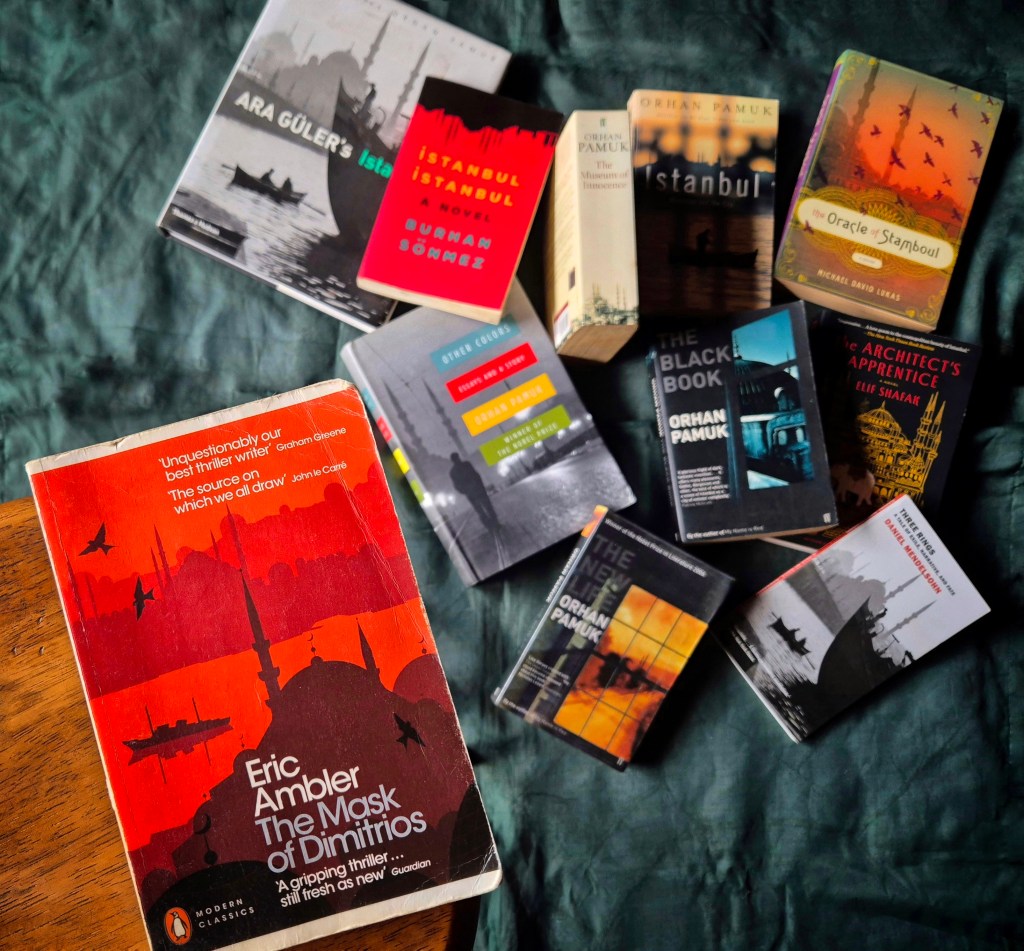
That is why I read Eric Ambler even though thrillers and spy novels are not my usual genre of choice… especially those written circa 1939.
It was the lure of Istanbul that pulled me into the orbit of Charles Latimer, a detective novelist vacationing in Turkey in the 1930s. There he meets a Turkish colonel who broaches the subject of Dimitrios, a murdered criminal whose body was found floating in the Bosphorus. Intrigued by the dead man’s notoriety, Latimer does his own investigating. What he uncovers is a web of international intrigue that leads him to Smyrna, Athens, Sofia, Geneva, and finally, Paris.
But I began to suspect that this book was not a regular thriller when Charles Latimer inspected the body of Dimitrios in the morgue and saw him, “Not as a corpse in a mortuary, but as a man, not as an isolate, a phenomenon, but as a unit in a disintegrating social system.” It is also worthy of note how Dimitrios, who had become the epitome of evil in Latimer’s mind, turned out to be, “A picture of distinguished respectability,” when he was alive.
“But it was useless to try to explain him in terms of Good and Evil. They were no more than baroque abstractions. Good Business and Bad Business were the elements of the new theology. Dimitrios was not evil. He was logical and consistent; as logical and consistent in the European jungle as the poison gas called Lewisite and the shattered bodies of children killed in the bombardment of an open town. The logic of Michelangelo’s David, Beethoven’s quartets and Einstein’s physics had been replaced by that of the Stock Exchange Year Book and Hitler’s Mein Kampf.”
The Mask of Dimitrios does not read like a thriller. It is unlike those formulaic bestsellers that cater to superficial and momentary sensations. Those who seek such will be disappointed. It is rather a perceptive insight into that rapidly splintering era sandwiched between two World Wars.
What makes it terrifying is the way he seemed to be describing the world today.
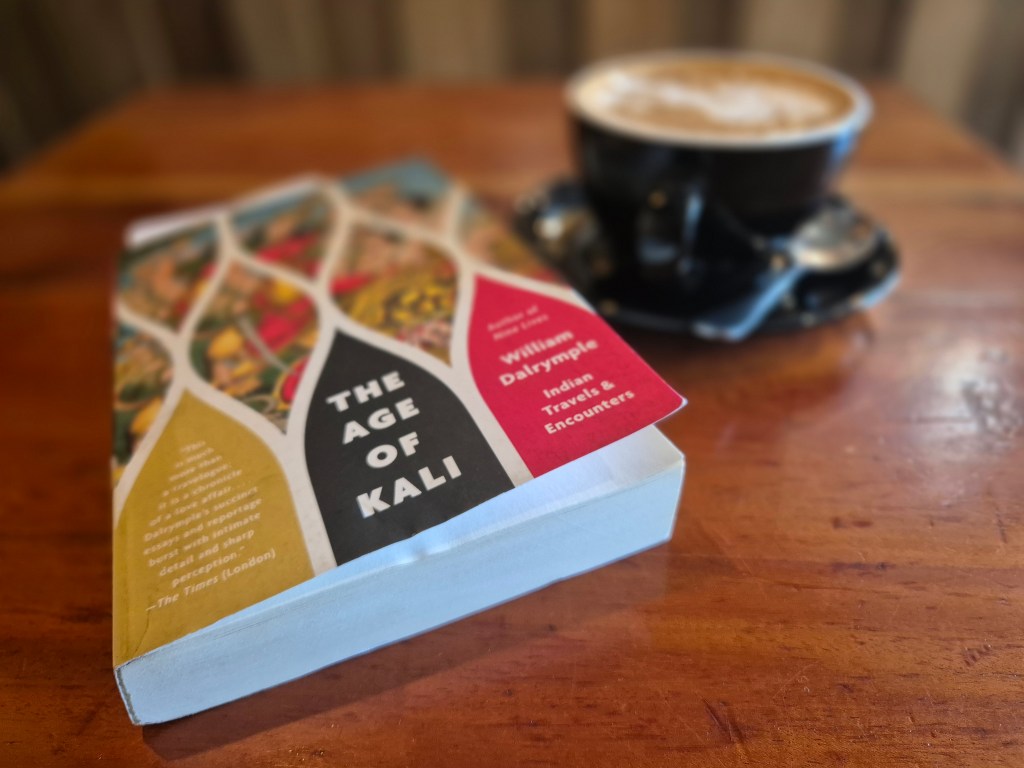
In Hindu cosmology, world time is divided into four great epochs called the Yuga Cycle: Satya Yuga, Treta Yuga, Dwapara Yuga, and the Kali Yuga. As the cycle progresses through the four stages, the length of each yuga decreases, but social and moral decay multiplies. We are believed to be in the Kali Yuga, the age of conflict, sin, and disintegration.
This sets the tone for the book, so that a few pages in, I felt relieved that I did not read this before, or during, my trip to India.
“This book covers so many sensitive areas that it is bound to raise a few cries of protest and dissent, particularly from Indians understandably touchy about criticism from abroad; but it is a work of love. Its subject is an area of the world I revere like no other, and in which I have chosen to spend most of my time since I was free to make that choice,” writes Dalrymple in the introduction.
But as I read on, I began to regret not reading this before, or during, my trip to India! Unlike the three other Dalrymple books in the Vintage Departures edition, this is less travelogue than a compilation of articles and essays about the Indian subcontinent, from north to south and east to west, which are more political in nature.
Published in 1998, it includes interviews with Pakistan’s Benazir Bhutto and Imran Khan, and figures from opposing sides of caste wars and political parties. It is, therefore, a crash course on a part of the world that, despite its significant advances, is still reeling from the British Raj, the Partition, and religious discrimination. As an outsider and common reader, I have yet to encounter a more readable and insightful work that encapsulates caste and gender prejudice, corruption in government, the justice system and the economic obstacles of the subcontinent in a single book.
Dalrymple rarely waxes poetic here, but this book stamps his authority in the field of journalism. As I read this amidst horrifying world events and the filing of certificates of candidacies by movie stars, social media influencers, and crooks here in the Philippines, I can easily believe that we are, indeed, in the Age of Kali.
“Wojnicz had noticed that every discussion, whether about democracy, the fifth dimension, the role of religion, socialism, Europe, or modern art, eventually led to women.”
Reading Olga with UP Symphony rehearsing Shostakovich as background.
Mischief. More literary mischief from Olga.
That the first death in the book happens to be of a woman whom our dear Wojnicz mistakes for a servant, when she is in fact the guesthouse proprietor’s wife, is not negligible.
And then, mushrooms. Then the puns in the names: January and August, two characters named after months, months named after a two-faced Roman god and a Roman Caesar; Dr. Semperweiss, because, always white; and it’s not a mere coincidence how the owner of the Guesthouse for Gentlemen where Wojnicz lodges is named Wilhelm “Willi” Opitz (see Opitz syndrome, especially in males); the Tuntschi, definitely a nod to the Sennentuntschi of Alpine folklore involving an ill-treated doll that retaliates; and Empusium, after Empusa, the female shape-shifter of Greek mythology.
The Empusium is Thomas Mann’s The Magic Mountain reframed, they say. Friends who have known me way back from my Thomas Mann reading phase know the story of how I developed a fever while reading the Magic Mountain. (They tried to assuage my sickness by saying that it’s the best state in which to read Thomas Mann. Hah!) Strangely enough, I also got sick a day after I started reading The Empusium. Whether that’s part of Olga’s mischief, I cannot say for sure, but, “The story has a spirit of sickness,” says my mom ominously.
While Mann’s mountain was an allegory for a sick Europe, Olga’s mountain is glaringly sick with misogyny. In the author’s note, Olga divulges that the chauvinistic passages were paraphrased from the words of history’s famous men, and she names all of them. Why do you think it’s labeled as a “horror story”?
“Today the West often views Islam as a civilization very different from and indeed innately hostile to Christianity. Only when you travel in Christianity’s Eastern homelands do you realize how closely the two religions are really linked. For the former grew directly out of the latter and still, to this day, embodies many aspects and practices of the early Christian world now lost in Christianity’s modern incarnation… Certainly if John Moschos were to come back today it is likely that he would find much more that was familiar in the practices of a modern Muslim Sufi than he would with those of, say, a contemporary American Evangelical. Yet this simple truth has been lost by our tendency to think of Christianity as a Western religion rather than the Oriental faith it actually is. Moreover the modern demonization of Islam in the West, and the recent growth of Muslim fundamentalism (itself in many ways a reaction to the West’s repeated humiliation of the muslim world), have led to an atmosphere where few are aware of, or indeed wish to be aware of, the profound kinship of Christianity and Islam.” — William Dalrymple, From the Holy Mountain
Hagia Sophia, followed by mosaics, lots of them: These are the things that initially come to mind whenever I encounter the word “Byzantine,” and I suspect I am not alone in this. And because it is art that outlives the rise and fall of empires, there is almost nothing else we can clearly visualize about Byzantine beyond its art, architecture, and its leading players in history.
“The sacred and aristocratic nature of Byzantine art means that we have very little idea of what the early Byzantine peasant or shopkeeper looked like; we have even less idea of what he thought, what he longed for, what he loved or what he hated,” writes William Dalrymple.
But once upon a time, circa 580 AD, a monk called John Moschos traveled with Sophronius the Sophist across the empire including the three greatest Byzantine metropolises — Constantinople, Antioch, Alexandria — and wrote about it. In a book called Spiritual Meadow, Moschos detailed what he saw, whom he met, the heresies he witnessed, and stories about common folk, “the sort who normally slip through the net cast by the historian.”
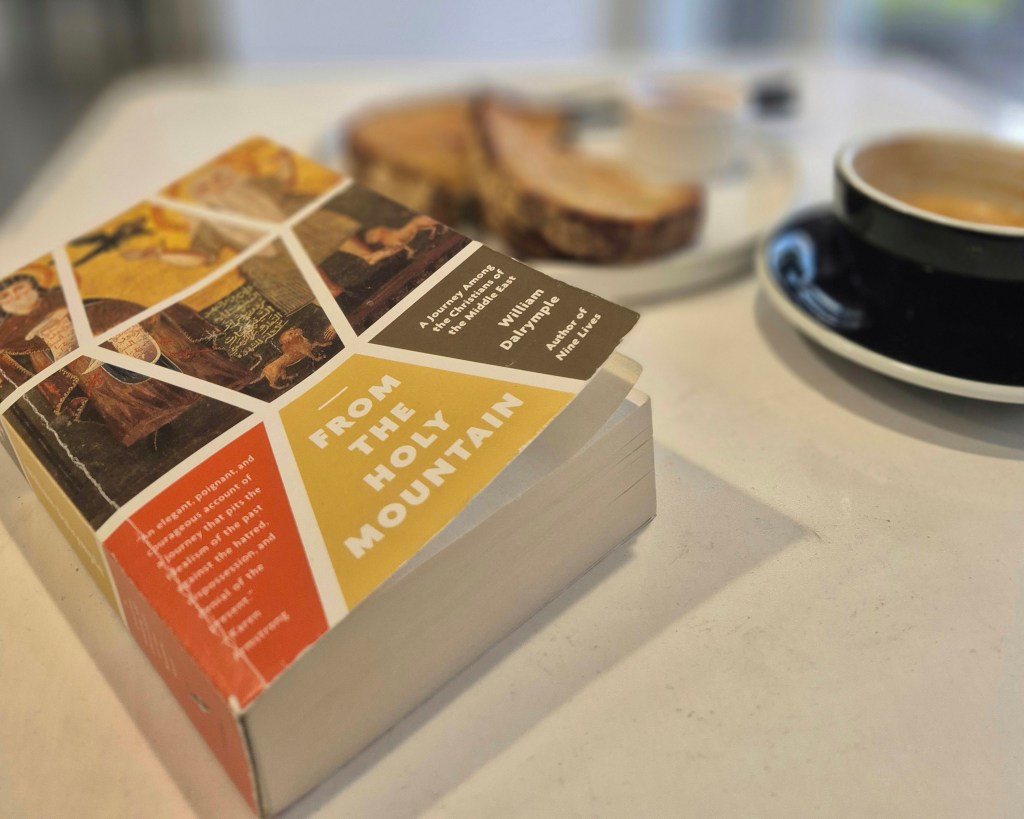
It was this book that Dalrymple used as a guide to travel through the eastern Mediterranean world in 1994, a world that is now predominantly Islamic, but a world that once was predominantly Christian (not in deed, of course, but by religious affiliation) for hundreds of years, from the age of Constantine to the dawn of Islam in the 7th century.
This journey among the dwindling population of Eastern Christians begins in the Monastery of Iviron in Mount Athos, an autonomous region in Greece that is under the ecclesiastical jurisdiction of the Ecumenical Patriarch of Constantinople. To this day, women are prohibited from entering the monastic community. It is, therefore, a place I cannot travel to even if I wanted to.
And this is the service Dalrymple does for his readers: To visit places inaccessible to us, to experience cultures and traditions unheard of and never to be seen again, “to do what no future generation of travelers would be able to do: to see wherever possible what Moschos and Sophronius had seen, to sleep in the same monasteries, to pray under the same frescoes and mosaics, to discover what was left, and to witness what was in effect the last ebbing twilight of Byzantium,” and then tell the tale. (A sad validation of this slightly conceited claim is the wistful realization that most of the Syrian Byzantine sites mentioned in this book became casualties of war several years after its publication.)
The stunning architecture that William Dalrymple describes with an eye for detail and a penchant for lyricism; the coming across of endangered languages such as Turoyo, the modern Aramaic spoken in the Tur Abdin region in southeastern Turkey and northern Syria, “where Jesus could expect to be understood if he came back tomorrow”; the discovery of a musical mystery, an ancient form of plainsong in Syria that could possibly be the direct antecedent of the Gregorian chant; the Eastern roots of Celtic illuminating art and how the trajectory of Renaissance art owes it to John of Damascus, an Arab Christian monk; the author’s observation that “Muslims appear to have derived their techniques of worship from existing Christian practice” and that “Islam and the Eastern Christians have retained the original early convention; it is the Western Christians who have broken with sacred tradition”; perspectives on the Armenian genocide, the Kurdish conflict, the Lebanese Civil War, and the Israeli–Palestinian situation at the time; the realization that Byzantine Palestine was dominated by Christians and for eight hundred years the Jewish community was a minority; accounts of Muslims praying in Eastern churches, “the Eastern Christians and the Muslims have lived side by side for nearly one and a half millennia, and have been able to do so due to a degree of mutual tolerance and shared customs unimaginable in the solidly Christian West”; and most remarkably, the awareness that, oftentimes, people are not as hostile and as divided as governments and ideologies want us to believe; these are a few of the things that will have readers brimming by the time they get to the last page.
This is essential Dalrymple right here — a book that will leave one richer for having read it.
Thank you, dear Anna, for this most wonderful recommendation! 🤍
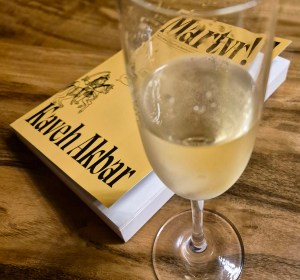
“…Your project reminds me of all the great Persian mirror art… Some centuries ago all these Safavid explorers from Isfahan go to Europe—France, Italy, Belgium—and they see all these gargantuan mirrors all over. Ornate, massive mirrors everywhere in palaces, in the great halls. Building-sized mirrors. They come back and they tell the Shah about them and of course he wants a bunch for himself. So he tells his explorers, his diplomats, to go back to Europe and bring him mirrors, giant mirrors, buy them for any price. And so they do, but of course as they bring these massive mirrors back across the world, they shatter, they fracture into a billion little mirror pieces. Instead of great panes of mirrors, the shah’s architects in Isfahan had all this massively expensive broken mirror glass to work with. And so they begin making these incredible mosaics, shrines, prayer niches… I think about this a lot, Cyrus. These centuries of Persians trying to copy the European vanity, really their self-reflection. How it arrived to us in shards. How we had to look at ourselves in these broken fragments, and how these mirror tiles found themselves in all these mosques, the tilework, these ornate mosaics. How those spaces made the fractured glimpses of ourselves near sacred… it means, in my humble opinion, we got to cubism hundreds of years before Braque or Picasso or any European. That maybe we’ve been training for a long time in sitting in the complicated multiplicities of ourselves, of our natures.” — Kaveh Akbar, Martyr!
Currently reading Kaveh Akbar’s Martyr! and this passage reminded me of the 16th century Sheesh Mahal (“Mirror Palace”) in Rajasthan, and the photos I still have not uploaded from the India trip.
I have not read historical evidence, but I was told Sheesh Mahal’s mirrors were transported from Belgium by Elephants.
The books I’ve read on two consecutive weekends; of Libya and Tunisia; and it so happens that they are neighbors on the world map.
In the Country of Men has been languishing on my shelf for over a decade, and Matar’s appearance on this year’s Booker Prize longlist reminded me of his silent presence in my library. On the other hand, This Tilting World was recently acquired after Fellous’s work caught my attention in an anthology.
Aside from the geographic proximity of their respective settings, these two books surprisingly have more in common: In the Country of Men often feels painfully autobiographical, while This Tilting World admits to being utterly personal. They are simultaneously love letter and farewell letter to their homelands; they explore questions of nationalism, and both present a character’s fraught, and yet loving, relationship with a father and a country; and the writing seems to be an attempt at making sense of the loss of innocence, of the violently shattered idyll of their childhood and hometowns.
However, these are books which, I feel, have unfulfilled potential: In the Country of Men left me wishing for characters with more integrity, This Tilting World left me in want of a more cohesive opus for Fellous’s luscious and elegant prose.
But both contain their own beauty and remain valuable records of Libya’s and Tunisia’s recent history. The books are, therefore, still worth reading.
In response to what the mother in In the Country of Men recounted, (…part of the punishment was to leave me with no books. “Don’t give her any more ammunition,” your grandfather had said…) we say: the more “ammunition” the better! It’s the only way we can make sense of this tilting world.
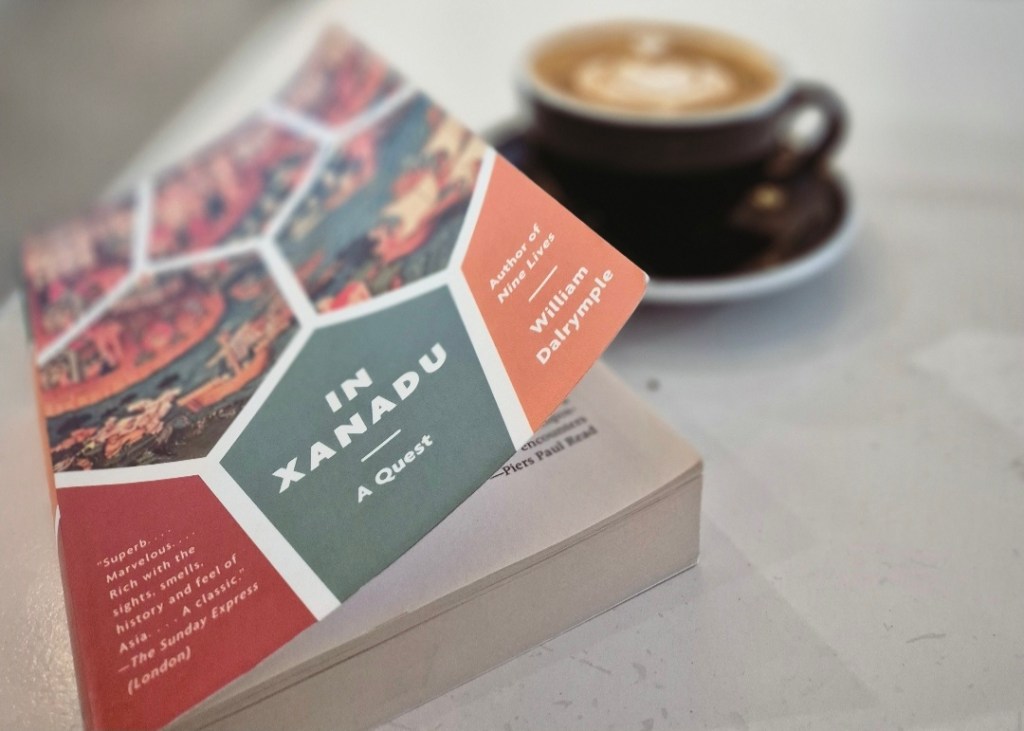
Trace Marco Polo’s 700-year-old passage from Jerusalem to the ruins of Kublai Khan’s summer palace in Xanadu? “Insane!” most people would say, as this journey runs along war-torn lands and the route bestudded with disputed territories.
But that is exactly what twenty-one-year-old William Dalrymple set out to do in 1986 under a travel scholarship. Thankfully, he lived to tell the tale and published this book, his first, in 1989.
The first several pages impressively encapsulates both the divisiveness and the beauty within Jerusalem: “If history repeats itself anywhere, it does so in Jerusalem. […] For two thousand years Jerusalem has brought out the least attractive qualities in every race that has lived here. The Holy City has had more atrocities committed in it, more consistently, than any other town in the world. Sacred to three religions, the city has witnessed the worst intolerance and self-righteousness of all of them. […] It is only when you get here and have a moment to sit, and think, and look back, that you come to realize… how beautiful Jerusalem still is.” With a few hundred pages left after reading such lines, and a dreamy itinerary that includes Cyprus, Syria, Eastern Turkey, Iran, Afghanistan, Pakistan, India, Kashgar — a city in the Xinjiang Uyghur Autonomous Region, Peking, and Xanadu in Inner Mongolia, a reader could only look forward to the adventure.
The Dalrymple of In Xanadu, however, is a far cry from the more perceptive and compassionate Dalrymple who affected me deeply in the pages of Nine Lives last June. It is understandable, considering the twenty-year publication gap between the two books. (In Xanadu, 1989; Nine Lives, 2009.)
The author admits, in the introduction of the 25th anniversary edition of In Xanadu, how he still feels “deeply ambiguous” about his first book. “For In Xanadu records the impressions, prejudices and enthusiasms of a very young, naïve and deeply Anglocentric undergraduate. Indeed my 21 year old self – bumptious, cocky and self-confident, quick to judge and embarrassingly slow to hesitate before stereotyping entire nations – is a person I now feel mildly disapproving of: like some smugly self-important but charming nephew who you can’t quite disown, but feel like giving a good tight slap to, or at least cutting down to size, for his own good.”
He was but a boy whose judgments were not too tolerant and whose remarks were yet impervious to today’s hyper political correctness. In spite of that, this is probably Dalrymple in his funniest and most candid. If Nine Lives found me crying inside a room of a Jaipur haveli, In Xanadu found me chuckling in public several times. For all his faults of youth, I think we can still count on him being a more reliable and entertaining narrator than Marco Polo.
As a fan, I find it encouraging to be able to track, through his books, how much his travels, his experiences, and his eagerness to learn and inform has transfigured him into the literary hero that he is today. It is comforting to be able to observe how our traveling intellectual icons grow. That way we are reminded that they are human and their writings are those we can grow with. Either that, or we’ll come to realize that we’ve somehow grown, too.
By reading In Xanadu, one is assured that the reading journey with Dalrymple can only get better from here. Who else is looking forward to getting their hands on The Golden Road?
After immersing myself in a variety of literature from the region, and after reading nine of her books, singing praises at the time I read them, then ultimately realizing that I prefer her two nonfiction works to the seven novels, it eventually felt like I had outgrown Elif Shafak.
Nawal el Saadawi, Sema Kaygusuz, Farnoosh Moshiri, Dunya Mikhail, Adania Shibli, and other lesser known women authors that I encountered through this reading project, made Shafak’s fiction feel diluted and elementary…
…until I learned that There are Rivers in the Sky involves Mesopotamia, The Epic of Gilgamesh, and one of the books that fueled my obsession with the Fertile Crescent, Sir Austen Henry Layard’s Nineveh and its Remains.
Needless to say, I purchased the e-edition of There are Rivers in the Sky on the day it launched, and veered away from this month’s plan to read Women in Translation. Apparently, Shafak still manages to lure me with her chosen topics and setting.
And I’m glad I read it. I’m glad I did not deceive myself into believing that my literary taste has become too sophisticated for Elif Shafak. Because after all, maybe she does not water it down. Maybe what she does is a deliberate simplification, so that her books become stepping stones to forgotten stories, accessible pathways to pressing matters that we don’t even stop to think about, and springboards that launch readers into deeper inquiry about issues that are not discussed enough.
In There are Rivers in the Sky, Shafak still transcends her pretty book covers and continues to be an activist for those who do not have a voice — in this case, buried history, looted artifacts, dying rivers, and the dwindling Yazidis and the continual decimation of their people and their stories.
Reading this has taught me many lessons, and it is not without its beautiful lines: “…the world is changing faster than minds can grasp… all these smartly turned out people with their polished boots and affected airs, you look at them and you think they must know everything, educated and cultured as they are, but… when times are confusing, everybody is a little lost. No one is inwardly confident as they present to be. Hence the reason we must read… books… provide us with light amidst the fog.”







 The Book-Butterfly