Reading in August


Our ecological crisis is also a ‘crisis of forgetfulness’… we have forgotten how sacred the nature of creation is,” Iraqi-British writer, Dalia Al-Dujaili, reminds us in Babylon, Albion

Although I read this in a perfect setting on a weekend getaway — amidst soothing sounds of nature, enveloped by clean air, and surrounded by mountains blanketed by mist — this ‘crisis of forgetfulness’ where the greed of many has replaced the sanctity of nature manifests in international and national news, and in the floodwaters that lap on my own doorstep back home. 

Readers who find the lyrical wisdom of Aimee Nezhukumatathil refreshing will surely love this wholesome rumination into identity, migration, land, rivers, borders, national and personal myths, familial and arboreal roots, and humanity’s natural heritage. While these somber topics usually weigh down on the reader, Al-Dujaili imparts a hopeful outlook while encouraging us to make our very own existence into a form of praise, and challenging us to scrutinize how we carry identity. Needless to say, Babylon, Albion was a profoundly beautiful way to end August.


August is Women in Translation Month and Buwan ng Wika (National Language Month). To celebrate the latter: Munting Aklat ng Baybayin by Ian Alfonso. No better way than through learning more about our pre-colonial script! To celebrate the former: Iman Mersal’s Traces of Enayat and Lydia Sandgren’s Collected Works.
“The best investigative reporting is storytelling,” says journalist Jane Mayer. Traces of Enayat is proof of this as Iman Mersal takes the reader on a quest to find traces of Enayat, an Egyptian writer who took her own life in 1963. Mersal affectingly expresses the attachment and resonance we find in the authors we encounter and whose works derail us from an otherwise uneventful trajectory. It also begs the question: How many Enayats has the world lost into oblivion?
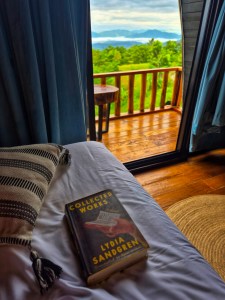
As for Collected Works, seven pages shy of six hundred, this novel quietly draws you into its world. It acquaints you with its setting and its characters without haste. It knows how to linger. It lingers on one’s thoughts on literature and art, on a character’s indecision to call someone or not, whether to read a book or not. It often lingers on everyday scenes where words turn into still life paintings and everyday portraits. But these scenes and characters exist in the shadow of Cecilia’s disappearance. Almost fifteen years after she vanished without a trace, her daughter, Rakel, believes it is her missing mother she is reading about in a novel, and measured suspense and mystery begin to replace the monotony of their lives. I would recommend this to the unhurried reader. Ultimately, Collected Works is a meditation on what one’s life amounts to. 

As for reading life in August? This is what it amounted to. It felt very much like a defiance of my country’s frustrating political climate.

April in Books

April was manic. It called for two short story collections in sympathy of a fractured attention span.


Silk, Silver, Spices, Slaves, Lio Mangubat First, prepare a cup of tablea tsokolateKapeng barako will do, but because cacao seeds arrived in the Philippines earlier than coffee through the Galleon Trade, I’ll opt for the former to pair with this book. When the chocolate brew is ready, steep yourself in the richness of both history and drink. Read full entry here.


Covert Joy, Clarice Lispector

There’s nothing here that a Clarice fan hasn’t read. And it’s arguably redundant to have this book when these twenty stories have already appeared in that hefty volume of The Complete Stories. But can you resist an edition that has one of your favorite Lispector stories as the titular story of a collection? No.

Because the thing is, reading Clarice is an experience; re-reading her is a veneration. And if I may say so, a none too covert joy. 

“Sometimes I’d sit in the hammock, swinging with the book open on my lap… I was no longer a girl with a book: I was a woman with her lover.”


The Dissenters, Youssef Rakha

“…it is Time that happens to people. We talk about having and saving and wasting it as if it is ours to work with, but really it is we who are time’s property.”

Egypt’s modern history is a story of revolutions, but its revolutions are especially ones that are true to the word’s literal meaning — a return, a cycle, a recurrence. How can one analyze over seventy years of a nation’s tumultuous history from its first president up to the current one? Through a woman’s life, answers Youssef Rakha. “Woman after woman using men’s failures and her body to write the ultimate description de l’Égypte.”


Canone Inverso, Paolo Maurensig

Ironic how I have acquired and read Maurensig’s three chess novels but have only read the novel about music now; but how delightful to discover that Bach’s Chaconne is what decorates the endpaper of this edition and learn that the piece plays a role in the story! As a work of literature, Canone Inverso may not be something one would call a masterpiece, but I cannot deny how this story gripped me from beginning to end. It’s a splendid book to entertain a reading musician!

It is only post-novel that I’m finding out that there is a movie for which Ennio Morricone composed the soundtrack! (And Sophie is played by Mélanie Thierry, who is the girl in the window that inspires the pianist in Legend of 1900, but in Canone Inverso she is the pianist!) All the while I read this, I was really thinking about how it would make a cinematic feat through the vision of an insightful director. I could already hear the dramatic soundtrack and imagine the cinematography, the light coming through the windows as dusk falls on the heurigen of Grinzing, and virtuosic music piercing the air…


To the Wedding, John Berger

What shall we do before eternity?

Take our time.

Not all blurbs are to be believed. But when it’s Michael Ondaatje who writes, “Wherever I live in the world, I know I will have this book with me,” and when a friend whose literary taste is most similar to yours recommends it, you just believe. But prepare to have your heart broken.

How was it possible to write a complexly poignant novel with fragmented vignettes? How does one distinguish between poetry and prose? This book deftly blurs the lines.


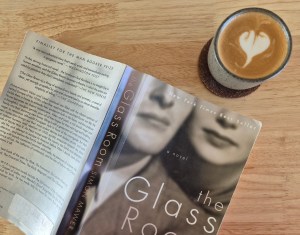
The Glass Room, Simon Mawer

The Glass Room, but not the ‘room’ of English, expresses the author. Rather, the Teutonic ‘raum’ with a broader sense of space. The novel correspondingly hints at architecture while maintaining a broader sense of architecture by concerning itself beyond the architect and the building, and taking into account the lives that inhabit a particular space. Similarly, it is an acknowledgment of how one cannot write about the Modernist shift in architecture without conveying how it is an entire geopolitical and cultural movement. Read full entry here.


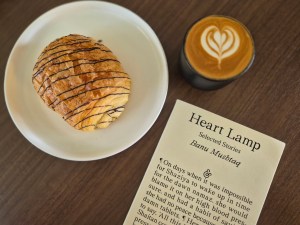
Heart LampBanu Mushtaq

How do you extinguish the light in a woman’s heart?

With these short stories Banu Mushtaq seems to count the ways.

Addendum: Through a Booker discussion with Ex Libris friends a day before the awards were announced, I understood that the winner of the International Booker Prize should define 2025. As touched as I was with this book, I did not think it would fit the criterion. And yet it emerged as the winner: The first book originally published in Kannada (the official language of the author’s state of Karnataka in southern India) and the first collection of short stories to win the award.

Through this I am reminded: Woman is always relevant, and that stories of everyday life are still worth telling.


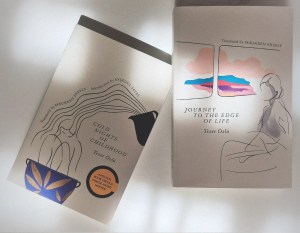
 Journey to the Edge of Life, Tezer Ozlu

“It is the boundless realm of literature that has set me on this road, through words and beyond them…”

Yes, yes, and yes.


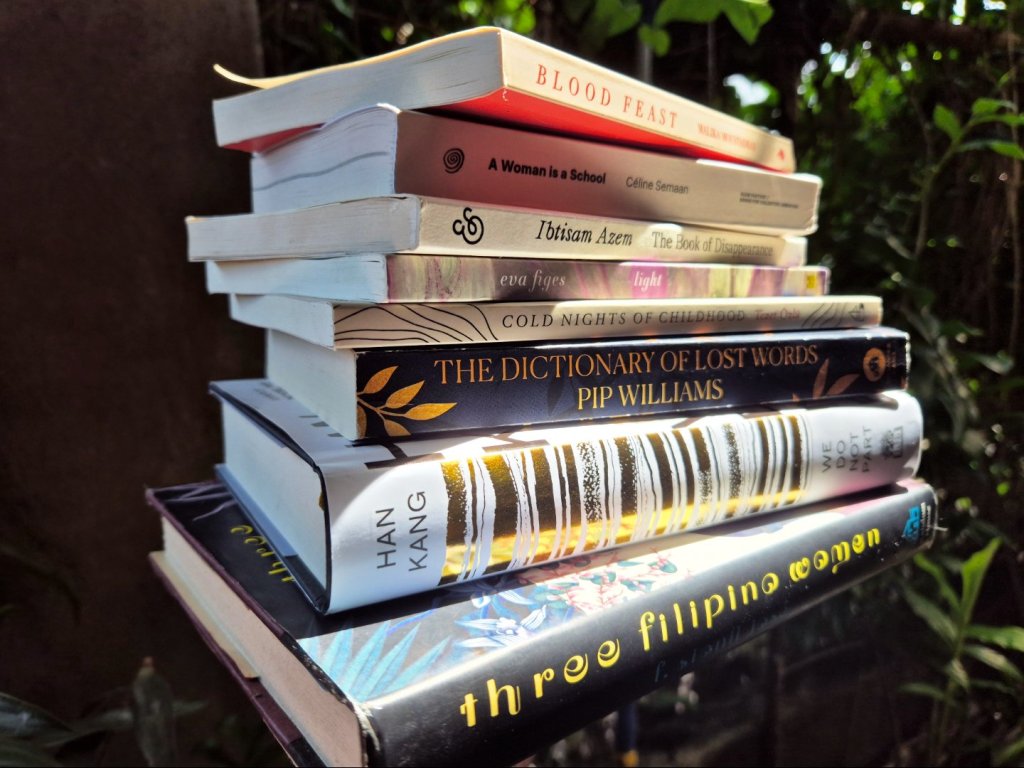
Women’s Month Summary


Blood Feast, Malika Moustadraf

Malika Moustadraf is Morocco’s answer to Egypt’s Nawal el Saadawi whose depictions of how women are viewed and treated are unflinching. But Malika has a distinct style that draws the reader right into a scene, into the midst and into the cracks of such a society, sometimes forcing us to look through the eyes of the scoundrels themselves. I daresay she is the more masterful fiction writer. Fiction, as we know, is just a tool to reveal the rawest of truths. Read full entry here.


A Woman is a School, Celine Semaan

Even though this one did not exceed my expectations, it has its merits. I love how she writes of art as “the ultimate act of giving.” It may be enlightening to someone younger who is reading about the effects of colonialism for the first time, but readers may find more substantial memoirs and more informative books on Lebanon and Lebanese culture, and better books that encourage attentiveness to social justice.


The Dictionary of Lost Words, Pip Williams

An exceedingly apt book for Women’s Month that would also make a splendid companion read to Simon Winchester’s The Professor and the Madman. It is this one that left my heart with a tender aching.

“Never forget that… Words are our tools of resurrection.”


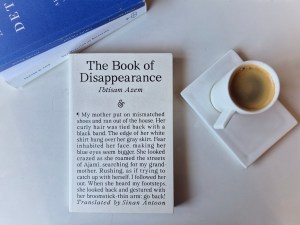
The Book of Disappearance, Ibtisam Azem

In another Palestinian masterpiece, Adania Shibli’s Minor Detail, the entire book is a bullet in motion that hits you with a staggering force on the very last page. There is an abrupt and brutal finality. There is no closure in Ibtisam Azem’s The Book of Disappearance. It ends without a concluding cadence and leaves the reader suspended in an unsettling limbo. But that does not imply that this book pales in comparison. Perhaps we are given a nanoscopic glimpse of what it feels like to be Palestinian. Read full entry here.


We Do Not Part, Han Kang

“Extermination was the goal. Exterminate what? The reds.” But Jeju’s inhabitants were not all reds, and yet it was easier for the military to operate by decimating the population. For nearly fifty years after the massacre, it was a crime punishable by law for a South Korean to mention the event. A huge percentage of the thousands that perished were innocent.

“Collateral damage.” That’s what they call it. Now where have I heard that term recently? Read full entry here.


Cold Nights of Childhood, Tezer Ozlu

Bursts of beauty in the prose amidst a stream of surreal disclosures from a woman grappling with mental illness and electroshock therapy. But it is ultimately a sad and disturbing portrayal of a particular societal context and its effect on the psyche, framed affectionately by Aysegul Savas’ introduction and Maureen Freely’s translator’s note. Read full entry here.


Light: Monet at Giverny, Eva Figes

An impressionist painting in book form with the most elegant feminism I have ever read.

“I’m sitting at the restaurant reading. Some books take me to worlds far greater and more tender than real life.” This line was lifted from Tezer Ozlu. She could have been referring to this book. Amidst the cacophony of social media and political rants, my mind is thankful to have been transported and softened by such a beautiful, beautiful book!


Three Filipino Women, F. Sionil Jose

This reader’s Women’s Month has usually been reserved for reading women authors, but an exception had to be made for this. Curious as to how a man would paint a portrait of the Filipino woman, I soon realized that this is more portrait of Philippine politics than it is of the Filipino woman. It is a dismal but virtuosic depiction. Three women: A politician, a prostitute, and a student activist. Maybe parable, maybe allegory, maybe both. Beyond death, F. Sionil Jose reminds me, once again, that he was the closest thing the Filipinos had to a Nobel laureate in literature.


Ibtisam Azem: The Book of Disappearance

“What if all Palestinians vanished from their homeland overnight?”

This is the line that greets the reader on its French flap. Longlisted for the 2025 International Booker Prize, one would think that the question, and the novel, are a response to the Gaza War. Although uncannily timely, it was written in 2014.

In this story, all Palestinians disappear. There is fear, relief, and even joy. “This problem disappeared on its own. It is a divine miracle,” remarked one Israeli. Ariel, a journalist and liberal Zionist, tries to figure out what really happened and looks for traces by reading his missing friend Alaa’s letters to a dead grandmother. 

The book is semi-epistolary as it alternates between Ariel’s articles and Alaa’s letters. In a clever contrast, Ariel’s articles look toward the uncertain future, while Alaa’s letters look into the past. “Perhaps I am writing out of fear. Against forgetfulness. I write to remember and to remind, so memories are not erased. Memory is my last lifeline.”

The articles and the poignant letters reveal the disparity of their personal histories: One looks at the same city as the Jaffa his people had lost; while one looks at it as Tel Aviv, with its Bauhaus architecture, the dream that came true. 

In another Palestinian masterpiece, Adania Shibli’s Minor Detail, the entire book is a bullet in motion that hits you with a staggering force on the very last page. There is an abrupt and brutal finality.

There is no closure in Ibtisam Azem’s The Book of Disappearance. It ends without a concluding cadence and leaves the reader suspended in an unsettling limbo. But that does not imply that this book pales in comparison. Perhaps we are given a nanoscopic glimpse of what it feels like to be Palestinian.

Zulfu Livaneli: Serenade For Nadia

“Only those whose stories are told can exist.”

Serenade for Nadia brings to light seldom-discussed tragedies of Turkish history: The 1942 Struma disaster, wherein hundreds of Jews fleeing the Axis nations in Europe perished when their refugee ship was torpedoed in the Black Sea; the Armenian Genocide; and the plight of the Crimean Turks who were oppressed and slaughtered by the Soviet government for being seen as Nazi collaborators.

This novel, however, is set in modern-day Istanbul where Maya Duran works at Istanbul University while single-handedly raising a teenage son. Her life is turned upside down when she is assigned to assist a visiting octogenarian, Maximillian Wagner, a German-born professor from Harvard. Little by little, the untold stories of her family and her nation come back to haunt her and beg to be uncovered and told. If a reader pays close attention, it will not be difficult to see that Maya’s character is also an accusing finger pointed at prevailing misogynistic attitudes in Turkey.

Aside from music playing a big role, this reader is extremely impressed by the number of intricate social issues that appear organically in this novel. Because Turkish history and culture are so rich, and its government and society are often paradoxical, it takes a good writer to pack all of this in a novel without making it feel contrived. Zulfu Livaneli succeeds in this, and one can understand why Orhan Pamuk himself hailed him as, “An essential force in Turkey’s musical, cultural, and political scene.”

Having read Disquiet in 2023, this is my second Livaneli. Although I admired Disquiet for its eye-opening qualities, I had qualms with the translation. If I have any qualms with Serenade For Nadia, it is only that this book should come with tissues. Tears are guaranteed.

Radwa Ashour: Granada – The Complete Trilogy

“Does one truly forget with time, as they say? It’s not true. Time polishes memory…”


For an era and a place teeming with history, there isn’t enough literary fiction set in Al-Andalus.

Prior to Hoopoe Fiction’s republication of Radwa Ashour’s Granada: The Complete Trilogy, I had only read Tariq Ali’s Shadows of the Pomegranate Tree, and I remember being immensely affected by it but finding it too short.

Ashour’s trilogy, now available in a single volume, answers that yearning and enables readers to linger a little bit longer, with its 465 pages, in the tragic century following the defeat of the last Muslim state in Iberia; the fall of Granada that extinguished seven hundred years of Muslim rule in Spain.

The story traces five generations of one family and those they loved while giving the reader a glimpse of how an entire people navigated betrayal, subjugation, persecution, and the undoing of their culture and traditions. Abu Jaafar, the patriarch, a learned man in the bookbinding trade who dies of sorrow after witnessing the burnings of Arabic books and texts at the behest of the Spanish Inquisition, and Salima, the granddaughter who reminds me of Hypatia, are some of this novel’s most enduring characters. 

Some plot lines are slightly itinerant, and this reader wonders whether what seems like inadequacies are merely little black holes of translation. Reading this is rewarding, nonetheless, and it is a step closer to that ultimate novel set in Al-Andalus that I hope to read in this lifetime. Although heartbreaking, this book contains lovely imagery and questions that cling and will not easily let go — just like the question of why these historical episodes from the 1500s feel awfully recent and familiar.

But we need books like this to polish our memory of history and to make our worldview flourish. As Marina Warner points out in the foreword, “In Arabic, the root of the verb for watering, rawa, happens to be the same for storytelling: a storyteller is a rawi. As the comparative literature scholar and Arabist Philip Kennedy comments, ‘Rawwii is well-watered; there are lots of versions of the root, including riwaaya which now means a story (or novel).’ Narration is irrigation, irrigation is narration.”

What a lovely thought, that to be well-watered and nourished is to be well-read, or well-storied.

Edward W. Said: The Question of Palestine

Significant Palestinian literature, to this reader, seems to indirectly and collectively ask the Other this particular question: We acknowledge your pain, do you acknowledge ours?

The frustration and the trouble stem from the fact that the answer has often been “no”.

Although worded differently and more succinctly, this book asks the same question, alongside all the other important questions concerning Palestine and Israel. It is Israeli-Palestinian Conflict 101 for those who cannot decide on what to think or say about the whole thing.

Without the dramatic and emotional pronouncements of novels, Edward Said organizes rational thinking, facts, and hopeful solutions with the most concise, coherent, and decisive voice I have ever heard on the Palestinian predicament. All that, while being understanding and un-dismissive of Jewish history and concerns.

This book is evidence that it is not so hard to understand the question of Palestine — but only if one is willing to understand and undo years of hearing only one side. It is also the perfect antidote to well-intentioned and shallow sloganeering. Never have I been so impelled to give a book a standing ovation.

But this book does not need my commentary. It only needs to be read.

Celebrating 40 in Georgia

To celebrate my 40th in Iran, that was the dream. It was supposed to be Iran.

But life often has a knack of improvising on my dreams. Flights to Iran were suspended as I was about to book tickets; and it wouldn’t have been good for my parents’ hearts had I forced it at this volatile time in history.

Iran chose to remain elusive. Then I was reminded of a line from Ali & Nino: “Surely love is the same in Georgia as in Iran.” Georgia, or Gurjistan, was one of the Persian “stans,” after all, and was under Persian suzerainty for centuries. And surely, if love is, as they say, the same in Georgia as in Iran, then perhaps celebrating 40 in Georgia wouldn’t be too different either? (“But there are protests,” they said. “At least there are no missiles,” I answered.)

The time had come for Georgia to be lived, aside from being read — for the literature of the Caucasus to be finally given the chance to lend depth and texture to my travels, and to the narrative of my experience.

Little did I know that the flight route from Doha to Tbilisi would fly over Shiraz and Isfahan. As if on cue, there was a sudden otherworldly sunset display through the airplane window just as we flew over Isfahan. Instead of Isfahan’s Eternal Flames, I was given the sun. And through the clouds, I saw traces of Isfahan down below; appearing to reassure me that it would be there waiting until the right time came along.

Then a full moon ushered me to Georgia. And I soon learned that Georgia, for a nation so tiny, is a generous country — not just in their wine servings, but in beauty and unforgettable experiences. (Maybe therein lies the advantage of smaller countries: beauty is concentrated, undiluted, and undiffused.) All at once, Georgia felt right.

Hopefully, someday, Iran will feel right, too. But at this particular point in life, Georgia is exactly what I needed. The trip was a gift that I’ll always be grateful for — a melding of deeply beautiful things and non-things, as if traveling knew no other way to be.

I’ve been asked what being forty feels like. With books (and maybe an occasional glass of wine haha) by my side, forty feels right. 🤍

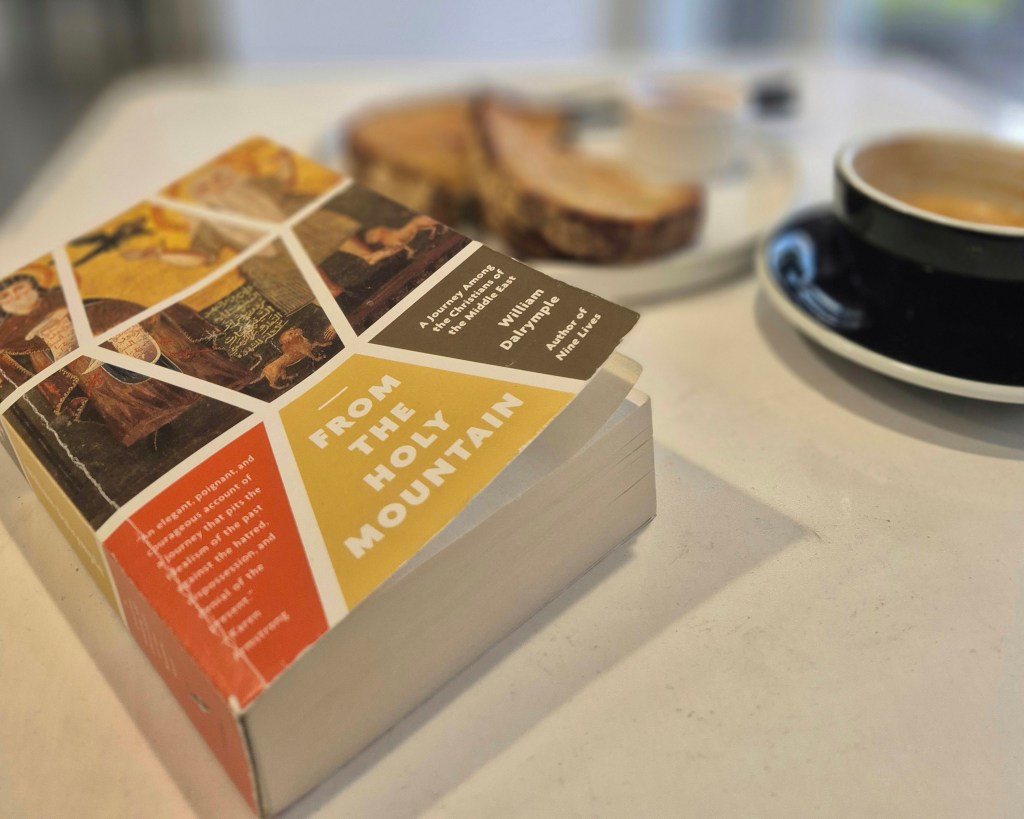
William Dalrymple: From the Holy Mountain

“Today the West often views Islam as a civilization very different from and indeed innately hostile to Christianity. Only when you travel in Christianity’s Eastern homelands do you realize how closely the two religions are really linked. For the former grew directly out of the latter and still, to this day, embodies many aspects and practices of the early Christian world now lost in Christianity’s modern incarnation… Certainly if John Moschos were to come back today it is likely that he would find much more that was familiar in the practices of a modern Muslim Sufi than he would with those of, say, a contemporary American Evangelical. Yet this simple truth has been lost by our tendency to think of Christianity as a Western religion rather than the Oriental faith it actually is. Moreover the modern demonization of Islam in the West, and the recent growth of Muslim fundamentalism (itself in many ways a reaction to the West’s repeated humiliation of the muslim world), have led to an atmosphere where few are aware of, or indeed wish to be aware of, the profound kinship of Christianity and Islam.” — William Dalrymple, From the Holy Mountain


Hagia Sophia, followed by mosaics, lots of them: These are the things that initially come to mind whenever I encounter the word “Byzantine,” and I suspect I am not alone in this. And because it is art that outlives the rise and fall of empires, there is almost nothing else we can clearly visualize about Byzantine beyond its art, architecture, and its leading players in history.

“The sacred and aristocratic nature of Byzantine art means that we have very little idea of what the early Byzantine peasant or shopkeeper looked like; we have even less idea of what he thought, what he longed for, what he loved or what he hated,” writes William Dalrymple. 

But once upon a time, circa 580 AD, a monk called John Moschos traveled with Sophronius the Sophist across the empire including the three greatest Byzantine metropolises — Constantinople, Antioch, Alexandria — and wrote about it. In a book called Spiritual Meadow, Moschos detailed what he saw, whom he met, the heresies he witnessed, and stories about common folk, “the sort who normally slip through the net cast by the historian.” 

It was this book that Dalrymple used as a guide to travel through the eastern Mediterranean world in 1994, a world that is now predominantly Islamic, but a world that once was predominantly Christian (not in deed, of course, but by religious affiliation) for hundreds of years, from the age of Constantine to the dawn of Islam in the 7th century.

This journey among the dwindling population of Eastern Christians begins in the Monastery of Iviron in Mount Athos, an autonomous region in Greece that is under the ecclesiastical jurisdiction of the Ecumenical Patriarch of Constantinople. To this day, women are prohibited from entering the monastic community. It is, therefore, a place I cannot travel to even if I wanted to. 

And this is the service Dalrymple does for his readers: To visit places inaccessible to us, to experience cultures and traditions unheard of and never to be seen again, “to do what no future generation of travelers would be able to do: to see wherever possible what Moschos and Sophronius had seen, to sleep in the same monasteries, to pray under the same frescoes and mosaics, to discover what was left, and to witness what was in effect the last ebbing twilight of Byzantium,” and then tell the tale.  (A sad validation of this slightly conceited claim is the wistful realization that most of the Syrian Byzantine sites mentioned in this book became casualties of war several years after its publication.)

The stunning architecture that William Dalrymple describes with an eye for detail and a penchant for lyricism; the coming across of endangered languages such as Turoyo, the modern Aramaic spoken in the Tur Abdin region in southeastern Turkey and northern Syria, “where Jesus could expect to be understood if he came back tomorrow”; the discovery of a musical mystery, an ancient form of plainsong in Syria that could possibly be the direct antecedent of the Gregorian chant; the Eastern roots of Celtic illuminating art and how the trajectory of Renaissance art owes it to John of Damascus, an Arab Christian monk; the author’s observation that “Muslims appear to have derived their techniques of worship from existing Christian practice” and that “Islam and the Eastern Christians have retained the original early convention; it is the Western Christians who have broken with sacred tradition”; perspectives on the Armenian genocide, the Kurdish conflict, the Lebanese Civil War, and the Israeli–Palestinian situation at the time; the realization that Byzantine Palestine was dominated by Christians and for eight hundred years the Jewish community was a minority; accounts of Muslims praying in Eastern churches, “the Eastern Christians and the Muslims have lived side by side for nearly one and a half millennia, and have been able to do so due to a degree of mutual tolerance and shared customs unimaginable in the solidly Christian West”; and most remarkably, the awareness that, oftentimes, people are not as hostile and as divided as governments and ideologies want us to believe; these are a few of the things that will have readers brimming by the time they get to the last page.

This is essential Dalrymple right here — a book that will leave one richer for having read it.


Thank you, dear Anna, for this most wonderful recommendation! 🤍

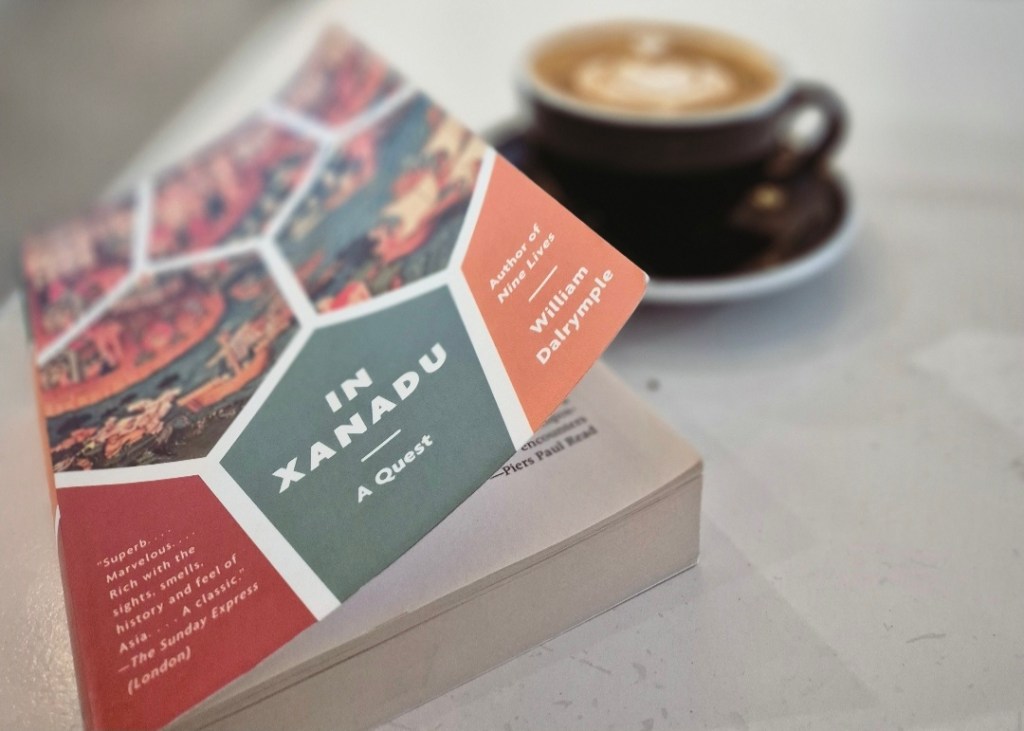
 William Dalrymple: In Xanadu – A Quest   

Trace Marco Polo’s 700-year-old passage from Jerusalem to the ruins of Kublai Khan’s summer palace in Xanadu? “Insane!” most people would say, as this journey runs along war-torn lands and the route bestudded with disputed territories.

But that is exactly what twenty-one-year-old William Dalrymple set out to do in 1986 under a travel scholarship. Thankfully, he lived to tell the tale and published this book, his first, in 1989.

The first several pages impressively encapsulates both the divisiveness and the beauty within Jerusalem: “If history repeats itself anywhere, it does so in Jerusalem. […] For two thousand years Jerusalem has brought out the least attractive qualities in every race that has lived here. The Holy City has had more atrocities committed in it, more consistently, than any other town in the world. Sacred to three religions, the city has witnessed the worst intolerance and self-righteousness of all of them. […] It is only when you get here and have a moment to sit, and think, and look back, that you come to realize… how beautiful Jerusalem still is.” With a few hundred pages left after reading such lines, and a dreamy itinerary that includes Cyprus, Syria, Eastern Turkey, Iran, Afghanistan, Pakistan, India, Kashgar — a city in the Xinjiang Uyghur Autonomous Region, Peking, and Xanadu in Inner Mongolia, a reader could only look forward to the adventure. 

The Dalrymple of In Xanadu, however, is a far cry from the more perceptive and compassionate Dalrymple who affected me deeply in the pages of Nine Lives last June. It is understandable, considering the twenty-year publication gap between the two books. (In Xanadu, 1989; Nine Lives, 2009.)

The author admits, in the introduction of the 25th anniversary edition of In Xanadu, how he still feels “deeply ambiguous” about his first book. “For In Xanadu records the impressions, prejudices and enthusiasms of a very young, naïve and deeply Anglocentric undergraduate. Indeed my 21 year old self – bumptious, cocky and self-confident, quick to judge and embarrassingly slow to hesitate before stereotyping entire nations – is a person I now feel mildly disapproving of: like some smugly self-important but charming nephew who you can’t quite disown, but feel like giving a good tight slap to, or at least cutting down to size, for his own good.”

He was but a boy whose judgments were not too tolerant and whose remarks were yet impervious to today’s hyper political correctness. In spite of that, this is probably Dalrymple in his funniest and most candid. If Nine Lives found me crying inside a room of a Jaipur haveli, In Xanadu found me chuckling in public several times.  For all his faults of youth, I think we can still count on him being a more reliable and entertaining narrator than Marco Polo. 

As a fan, I find it encouraging to be able to track, through his books, how much his travels, his experiences, and his eagerness to learn and inform has transfigured him into the literary hero that he is today. It is comforting to be able to observe how our traveling intellectual icons grow. That way we are reminded that they are human and their writings are those we can grow with. Either that, or we’ll come to realize that we’ve somehow grown, too.

By reading In Xanadu, one is assured that the reading journey with Dalrymple can only get better from here. Who else is looking forward to getting their hands on The Golden Road?