The temperature is significantly higher in Bukhara that you can feel your skin baked into the color of a lepyoshka as soon as you step out of the caravanserai. Yes, I am staying in a caravanserai! Isn’t that the most natural thing to do when traversing desert cities?
In contrast to Samarkand that can only be depicted in golden blues and vibrant shades of dreams, Bukhara wears the colors of the desert.
But that’s not to say that this important stop on the Silk Route is monochromatic. For as we know, the desert yields surprises; and thousands of years of history have stamped their mark and bled their hues on this oasis city.
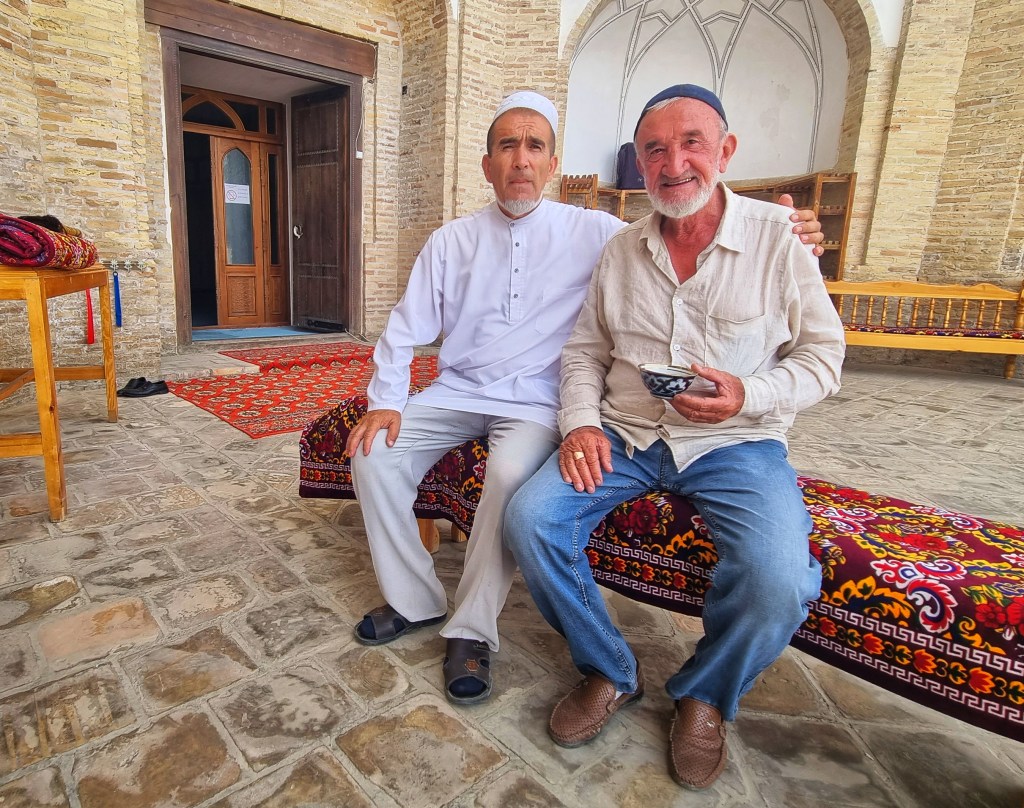
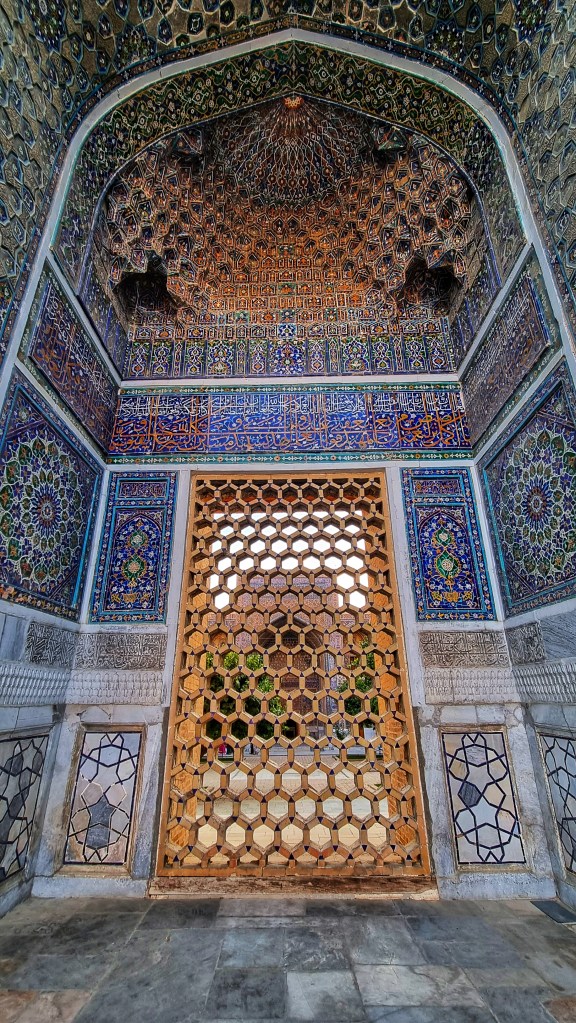
I made two friends today who know their history! One endearingly encouraged me to look it up on my phone because he says it’s all there, and the other is an imam who saw me taking pictures of the architecture while trying my best to be unobtrusive at a site sacred to Muslims. He must have appreciated this because he beckoned to me and invited me to take closer pictures of the mosque and its interior, and afterwards, for tea. It was the best tea I’ve had on this trip!
“I found in this library such books, about which I had not known and which I had never before seen in my life. I read them, and I came to know each scientist and each science. Before me lay the gates of inspiration into great depths of knowledge which I had not surmised existed.” — Ibn Sina (Avicenna)
Avicenna (980 – 1037) — philosopher, poet, astronomer, mathematician, physicist, the father of early modern medicine, among many other things — has been known to us as a Persian polymath. But he was, in fact, born in Uzbekistan. His early education began here in Bukhara.
The library in the Ark of Bukhara has not survived the many conquests that Bukhara has been through, although this enormous structure that dwarfs me continued to be a fortress from circa 500CE until it fell to the Red Army in 1920.
Sadly, there is no way for me to find the books of which Avicenna wrote, but the book wide open before me now is Bukhara… and I am savoring every line.
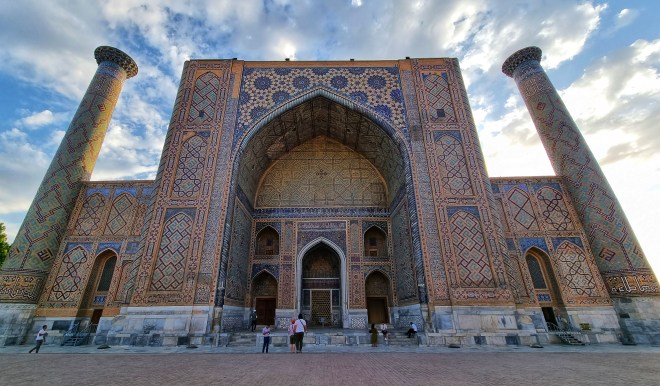
It seemed to have been written in the stars that the first place I would be drawn to in Samarkand is the remnant of an observatory that was the most well-known throughout the Islamic Golden Age and the largest in Central Asia, preceding Tycho Brahe’s Uraniborg and Taqi al-Din’s observatory in Constantinople by more than a hundred years.
The great mathematician and astronomer behind this observatory, whose computation of the length of the sidereal year was more accurate than that of Copernicus’s, is Ulugh Beg.
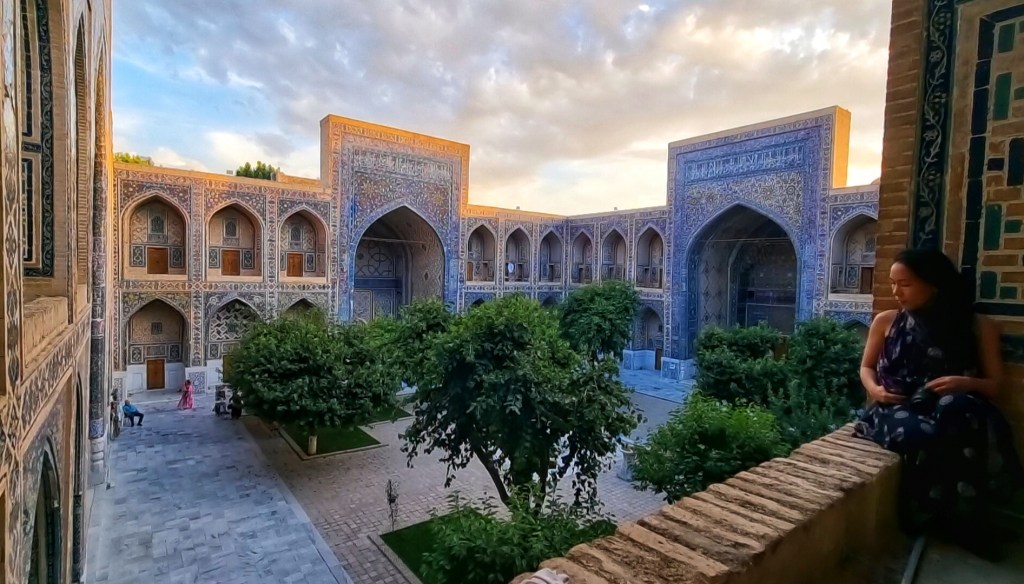
Although what remains of the observatory is the arc of a gigantic sextant (used to measure the transit altitudes of the stars and to produce the most comprehensive star catalogue in the period between Ptolemy and Tycho Brahe); the splendid madrasa that he built right at the heart of the city still stands.
He turned Samarkand into an intellectual center, inviting mathematicians and astronomers to study there — but no longer by force. He was, after all, a sultan of the Timurid Empire, the grandson of Tamerlane, and his tomb lies at the foot of his grandfather’s in the Amir Timur Mausoleum.
When Soviet archaeologists exhumed this tomb in 1941, they allegedly found this inscription inside: “When I rise from the dead, the world shall tremble. Whoever opens my tomb shall unleash an invader more terrible than I.”
In a matter of hours, Hitler’s men invaded Russia resulting in millions of deaths. Stalin ordered the remains to be reinterred in 1942, and soon after, the Germans surrendered at Stalingrad. Coincidence or not, it is a remarkable story.
Two years ago, I listened to a series of podcasts about this man for whom this mausoleum was built. I found him frightening and intriguing! There aren’t enough books written about him, and eurocentric history merely dedicates one or two measly paragraphs to him!
This man, known in the West as Tamerlane, is Amir Timur, “iron” in their language. It was he who freed his people from the yoke of the Mongols and proceeded to establish the Timurid Empire in 1370 and conquered lands spanning parts of Russia, and north western India to Syria.
During his reign, he and his armies decimated 5 percent of the world’s population! On his Persian conquest, they massacred and constructed towers out of the bodies. He was as brutal as the Mongol Khans, but unlike them, he spared the intellectuals, the architects, the writers, the rug makers, the craftsmen, the artistic and the educated, and brought them to Samarkand. And thus began the flourishing of Timurid arts and architecture, well exhibited in this very mausoleum up to this day.
Where I am staying in Samarkand is a wall away from this mausoleum.
The moon was still up when I walked over this morning and the muezzin’s call to prayer accompanied my quiet footfalls.
I sat on the steps with a book thinking it would still be off limits at such an early hour, but the caretaker noticed me and offered to let me in and left me on my own!
Heart pounding and knees slightly trembling, I entered and thought I heard throat singing along with the muezzin’s call…
What is it about the rhythmic and harmonic counterpoints between a lone stringed instrument, a drum, and throat singing that fire up the blood and make you want to conquer the world? This must have been the music that ran through the veins of the formidable khans and Tamerlane. As if my heart was not already drumming wildly, the perfect soundtrack for how I felt greeted me through the train speakers — music so visceral, so empowering and liberating.
It was a day that started with a huge bowl of yogurt and honey, crisped walnuts that I did not expect to be so flavorful, plump dried apricots, raisins that had retained their blue, all these topped with crumbled cottage cheese; and a cup of coffee to further fuel an excitement that I had not felt in a long time.
I left for the train station amidst a glorious Tashkent sunrise while half of me was still in disbelief that I was finally going to a land that had achieved mythical status in my mind, a land I thought I would only be able to visit through books.
But today I walked into a poem. I found myself welcomed to a courtyard with a garden framed in abundant grapevines. My wonder must have been apparent that the owner of the guest house started pointing at each fruit-bearing tree and incanted, “Fig, apricot, orange, apple, quince, plum, persimmon, pear, peach, walnut, cherry, mulberry…”
“Mulberry? What the silkworms eat?” I asked.
“Yes.” She rummaged through the renowned leaves of silk history and held out gems of a deep magenta towards me.
As the mulberries burst into color and flavor in my mouth, I realized how perfectly symbolic this initiation was to a place that was once known to the Greeks as Maracanda — metropolis of the Sogdians, the wealthiest and most successful merchants of the silk roads.
What a most beautiful thing to finally be able to write in my journal, that today I arrived in Samarkand, the heart of the Silk Route.
In which city did Alexander Solzhenitsyn miraculously heal from a stomach tumor that he chose the place to be the setting of Cancer Ward? Where did Mikhail Bulgakov’s widow hide the manuscript of Master and Margarita before it was published? To where did Anna Akhmatova evacuate during the Leningrad siege? For which city did Vronsky refuse an assignment significant to his military career in favor of Anna Karenina? In which city is the oldest Quran kept? Tashkent.
It has played important roles in literary history, and literary history seems to be woven along the threads of daily life here. Three of Tashkent’s Metro Stations that I was able to pass through today are dedicated to writers: Alisher Navoi, the greatest writer in Chagatai history; Abdulla Qodiriy, the nonfictional character of the novel, The Devil’s Dance, which I read earlier this year, and writer of what is considered the first Uzbek novel; and Alexander Pushkin!
Abdulla Qodiriy (1894–1938), author of the first Uzbek novel, translator of Russian literature into the Uzbek language, and nonfictional protagonist of Hamid Ismailov’s The Devil’s Dance.
“‘You begin to liquidate a people,’ Hübl said, ‘by taking away its memory. You destroy its books, its culture, its history. And then others write other books for it, give another culture to it, invent another history for it. Then the people slowly begins to forget what it is and what it was.’”
It was this quote from the book making the rounds on social media recently that led me to re-read The Book of Laughter and Forgetting, but then I found more to retrieve from the margins of memory.
“…but the past is filled with life, and its countenance is irritating, repellent, wounding, to the point that we want to destroy or repaint it… we fight for access to the labs where we can retouch photos and rewrite biographies and history.”
“They wanted to efface hundreds of thousands of lives from memory and leave nothing but an unstained age of unstained idyll.”
“…erased from the country’s memory, like mistakes in a schoolchild’s homework.”
“The constitution did indeed guarantee freedom of speech, but the laws punished anything that could be considered an attack on state security. One never knew when the state would start screaming that this word or that was an attempt on its security.”
Fortunately and unfortunately, Kundera reminds us that we are not alone in this plight, and there are still those who remember.
“The struggle of man against power is the struggle of memory against forgetting.”
It’s funny how this book made more sense when I read it as a younger person — the passages about music and literature I glorified, the obscenities I took as metaphors and almost everything else as literary symbols. Now that I’m older, it all seems absurd.
And it is absurd because of how real it has become.
Along with my old yellowed notes tucked between its pages lie the pretentiousness of a young reader and the confounding of an older one.
“You don’t have to burn books to destroy a culture. Just get people to stop reading them.” — Ray Bradbury, Fahrenheit 451
“…in history as in human life, regret can never restore a lost moment, and 1,000 years will not buy back what was lost in a single hour.”
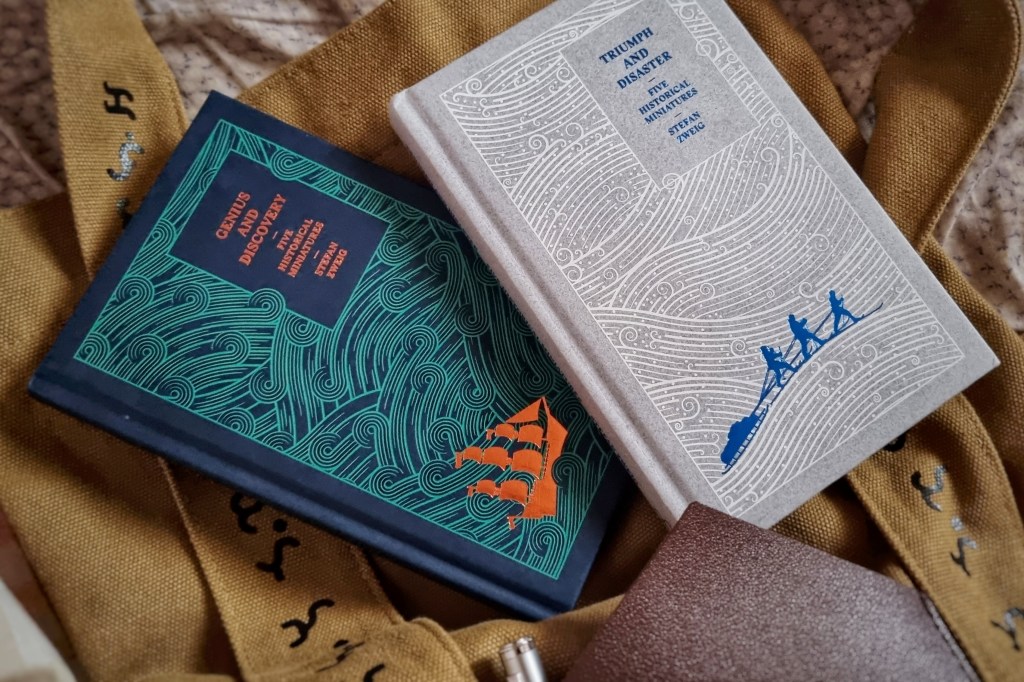
The day of the Philippine Elections has finally come! And no queue at the polling precinct is too long if you have the right books with you!
Five historical miniatures in each of these lovely books from Pushkin Press by distinguished Austrian writer, Stefan Zweig. There is nonetheless nothing “miniature” about the writing! In fact, they magnify some of history’s crucial moments and characters in such glorious and vibrant ways, you can only wish Zweig wrote more of these!
It was this line that leapt off the pages from the foreword of both books: “…a single Yes, a single No, a Too Soon or a Too Late makes that hour irrevocable for hundreds of generations while deciding the life of a single man or woman, of a nation…”
A single vote.
Dear Philippines, tomorrow we find out how we did.
Imagine a Serbian little boy being taken away from his mother as “blood tribute,” an Ottoman practice of forcibly recruiting soldiers from Balkan Christian subjects. Imagine the screams and the cries as the mother follows them to the Drina River, until the janissaries and the child embark on a ferry where they are parted forever.
This is the agony with which the book begins, and it made me wonder if I should shelve it for later. It felt too heavy to be read amid the volatile climate of the Philippine elections. But the writing made me want to read more, and I do not regret doing so.
This boy rose through the military ranks and became known as Mehmed Paša Sokolović, and in his later years, Grand Vizier of the Ottoman Empire. But the painful memory of separation never left him: “…he thought that he might be able to free himself from this discomfort if he could do away with that ferry on the distant Drina, around which so much misery… gathered and increased incessantly, and bridge the steep banks and the evil water between them, join the two ends of the road which was broken by the Drina and thus link safely and forever Bosnia and the East, the place of his origin and the places of his life. Thus it was he who first, in a single moment behind closed eyelids, saw the firm graceful silhouette of the great stone bridge which was to be built there.” Thus began the construction of the bridge over the Drina, at the part of the river where he last saw his mother.
The main character in this novel is the bridge. This bridge that has withstood over four hundred years of tumultuous history.
— — —
Elif Shafak was a reading staple between November 2020 to January 2022 when I was steeped in my reading project to cover and uncover as many writings from places affected by the Silk Route; so when a friend learned that Elif Shafak had said that The Bridge on the Drina caused something in her to shift forever, this was enthusiastically recommended to me.
Of the nine books by Shafak that I read, the first one was The Architect’s Apprentice, set in sixteenth century Istanbul about a fictional apprentice working with the legendary Ottoman court architect, Sinan. The one commissioned to design the bridge on the Drina, the Mehmed Paša Sokolović Bridge, is none other than Mimar Sinan.
— — —
But authors are stories in themselves, and Ivo Andrić’s life is literally one for the books. Born to a poor family in Bosnia, he grew up playing on the very bridge he would later immortalize and earn him the Nobel Prize for Literature in 1961. The years in between include two World Wars and an extraordinarily rich and eventful life.
The introduction to this edition claims, “No better introduction to the study of Balkan and Ottoman history exists… no anthropologist has ever reported the process of cultural change so sensitively; no historian has entered so effectively into the minds of the persons with whom he sought to deal…” I can only agree!
Andrić arranges the perplexing layers of this region’s history from the 16th to the 20th century into an impassioned song that constantly returns to its main theme — the bridge.
“…The life and existence of every great, beautiful and useful building, as well as its relation to the place where it has been built, often bears within itself complex and mysterious drama and history… Therefore the story of the foundation and the destiny of the bridge is at the same time the story of the life of the town and of its people…”
“Life…renews itself despite everything and the bridge does not change with the years or with the centuries or with the most painful turns in human affairs. All these pass over it, even as the unquiet waters pass beneath its smooth and perfect arches.”
There is an excess of lessons to be learned from this work, and much to be said about the exceptional writing, but what made me read on was the pervading refrain of the enduring power of art and architecture, and the comforting thought that no matter the course of history, life always renews itself.
“…that was Cleopatra, she was Queen of a great country. She was an enemy to Rome; but she was a brave woman, and she loved her country as much as any Roman might love his; she gave her life so that she might not have to look upon its defeat.”
This passage is an example of the compassion with which John Williams treats his characters.
My copy of Augustus being secondhand, it was a lovely surprise to find this pressed beauty tucked between the pages featuring Cleopatra.











 The Book-Butterfly