Despite being only approximately two-thirds the length of The Balkan Trilogy, it took me longer to finish reading The Levant Trilogy.
Olivia Manning is not to blame, but rather the awry emotional state I was in when I read the latter. I even entertained the thought of setting it aside for a lighter read, but I was rewarded for pressing on. I’m glad I trusted the recommendation of friends who thought the trilogies are worth experiencing. As I approached the Levant’s third book, my pace finally picked up and I could hardly put it down again; and by the time I turned the last page, I was not ready to let Guy and Harriet Pringle go.
Among other things, I think the second trilogy is a surprising critique on imperialism and British presence in the Levant. (“Lord, the things we do to other people’s countries.”)
And as I re-viewed the six books mentally, it felt to me like the twenty years of writing between the first volume and the last is a peeling away of life’s layers of unrealistic romanticism; so that by the end, one is left with the stark nakedness of reality — of war, marriage, and life.
Is it a bleak depiction of life? Not entirely. Manning seemed to say that it all depends on how you play the cards you’re dealt.
Lüneburg Variation is a first novel, Chess Story was Zweig’s last; and one cannot really read Lüneburg Variation without recalling Chess Story. Both explore the same themes of Nazi savagery, moral complexity, and the maniacal passion for chess; but Maurensig paints it in darker shades.
Lüneburg Variation’s striking first line sets a sinister tone: “They say chess was born in bloodshed”; on the second page a murder is committed; on the seventh, a confession.
And then we meet the players behind the game and we are brought to a time when Austria was gripped by anti-Semitism, and how the world of chess, peopled by masters of Jewish descent, was purged from Jews to “recover its purity.”
For a book that’s only slightly longer than Zweig’s novella, it has a handful of indelible scenes, but what will stay with me is a particular chess lesson. After a protégé loses to his teacher, the master asks, “What if this has been caused by your inattention?”
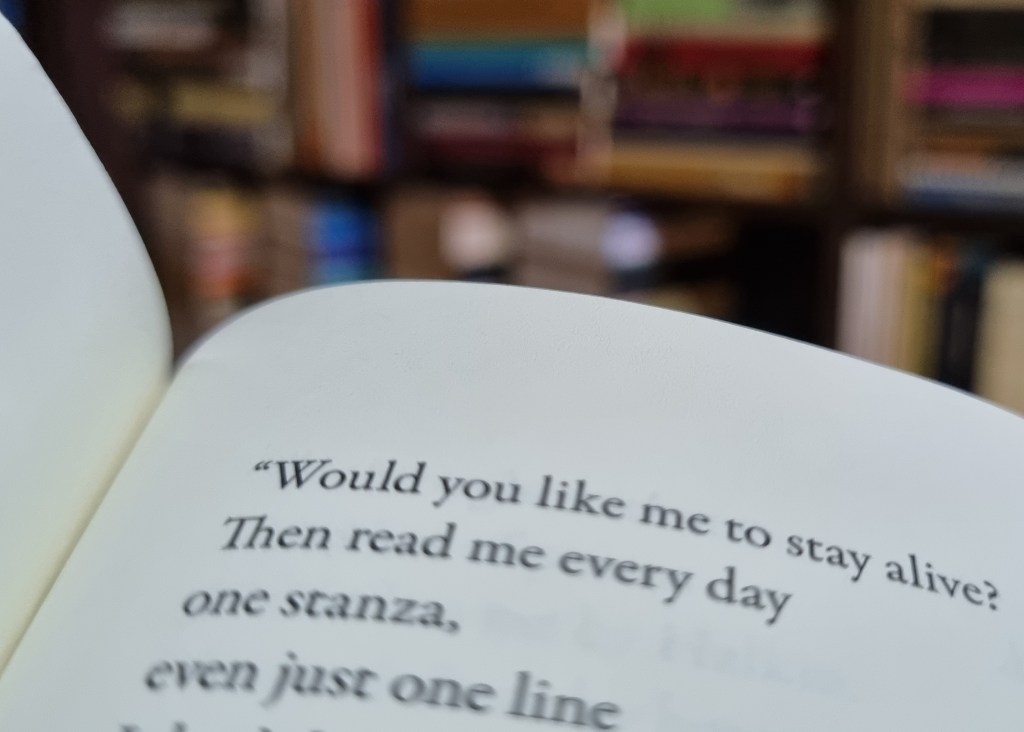
But the attention of which the master spoke referred to something beyond the chessboard. That page made me close the book to ponder on those words that endorsed seeing rather than merely looking. I sipped at my postprandial coffee, and thought of life, and I thought of reading. How inattentive we can be to the world around us! How inattentive we can be as readers!
As I read on, the pieces came together and I was chilled by a realization. What if this was a question meant to haunt generations? Genocide, injustice, cruelty are things that can only be perpetrated by the indifference and inattention of many.
Life is like a book of short works by César Aira; you never know what you’re gonna get. But do try one and surprise yourself. Besides, who can resist book covers such as these? And how cool is that lenticular?
I have now accepted that a César Aira title is a blind date with a story or an essay. There might be some straightforward titles, but they are still no indication as to where his imagination will take you. How could I have known that A Brick Wall would be musings about cinema and childhood memories, or that the most musical one would not be the title story, or that Artforum isn’t exactly about art, or that my favorite line would come from one of the stories that didn’t appeal to me so much?
But then again, he writes in Athena Magazine, “Wasn’t that the definition of literature: the world turned upside down?”
The favorite line: “Elegance is a form of energy.”
The titles I recommend from The Musical Brain, and in this particular order: Picasso, In the Cafe, Poverty, and Acts of Charity.
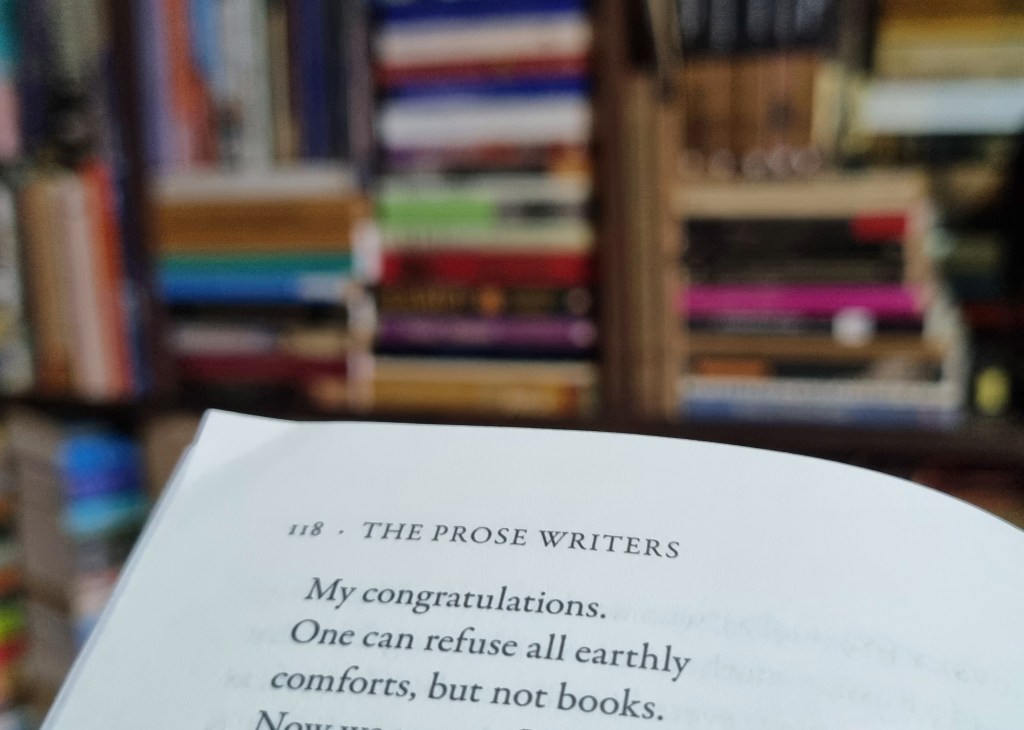
As for Artforum, I don’t think any other author could be more eloquent about the maniacal acquisition of the printed word, a.k.a book-hoarding:
“One can say that they are only material objects, that other things bring true happiness. But would that be true? There always has to be something material, even love needs something to touch. And in my proceeds of that joyful day, the material was so entwined with the spiritual that it transcended itself, without ceasing to be material…they were paper and ink, and they were also ideas and reveries. They reproduced the dialectic of art itself… material made spirit is the luxurious border where reality communicates with utopia.”
“Would Chekhov have suffered writer’s block?” Maria wondered, as the hull of the sunflower seed snapped open between her lightly clamped teeth.
Had it not been for gravity and absentmindedness, it might have appeared like a final attempt of helpless rebellion as the kernel fled in its nakedness, first escaping through Maria’s lips and slipping straight into the narrow entrance of a cowl-necked blouse, lapsing between two mounds of mysterious bosomy matter, and finally shelving itself in the black hole of the navel.
There, cradled in the darkness was the sunflower seed, and it knew not what parallel or different fate it would have encountered had it slipped inside – on the other side, of that warm, heaving skin. At that moment, it knew not time nor space, it only knew of warmth, suspension, and a false feeling of relief.
Maria’s eyes swept the floor but found no trace of the seed, so she picked up another one when suddenly, an idea! A writing idea after weeks of creative standstill! She mock-kissed the second sunflower seed with glee and tossed it back on the table. “If Chekhov could eye an ashtray and tomorrow furnish a story called ‘The Ashtray,’ what tales I could conjure from a sunflower seed!”
With confident strokes of her pen she inked ‘The Sunflower Seed’ on the top of a blank sheet, and Maria wrote:
“Would Chekhov have suffered writer’s block?” Alejandra wondered, just as the sunflower seed snapped open between her semi-clenched teeth.
Of what seemed as a definitive act of impetuous rebellion, the seed fled in its nakedness, first escaping through Alejandra’s lips and slipping straight into the abyss of a cowl-necked blouse, lapsing between two mounds of mysterious bosomy matter, and at last shelved itself in a black hole which was the navel. There, cradled in the darkness was the sunflower kernel, and it knew not what parallel or different fate it would have encountered had it slipped inside – on the other side, of that warm, heaving skin. At that moment, it knew not time nor space, it only knew of warmth, suspension, and an ersatz feeling that resembled belongingness.
Maria continued to write vigorously and narrated how Alejandra’s husband discovered the mutinous seed in her bellybutton later that night and punished it by plopping it into his mouth with a teasing gleam in his eyes.
Pleased with the South American tone of absurdity in her story despite aiming for a Russian shade, and unaware that her tale was half fiction-half accidental truth, she put her pen down with a satisfying staccato. “Ah, the sound of a period!” she exclaimed. As she stood up, the sunflower seed fell to the floor, later to be identified as midnight snack by the little mouse that lived in between Maria’s walls.
The above story is not from the two books featured here. I wrote this in 2009 when reading a volume of Chekhov, who happens to be one of the most handsome of authors, ignited a spark of creative inspiration. Since then, I’ve found that the best short story compendiums do not inspire me to write reviews; they nudge me to pay more attention to the details of everyday life and to write my own short stories however inferior mine may be.
Ferit Edgü is more minimalist than Sait Faik but I find both their stories to be of a distinctive hue. There is something almost monochromatic about them: But akin to the most masterful black and white photographs, this quality does not reduce them to something less but raises and intensifies their expressiveness.
My best attempt to describe them would be to ask one to look into photographer Ara Guler’s black and white images; or better yet, grab that photo book, Ara Guler’s Istanbul with a foreword by Orhan Pamuk. Each photograph a story, each story an evocative photograph.
It is said that every Turk knows a Sait Faik line or story by heart. He is, after all, considered the Turkish counterpart of Anton Chekhov. Turkey’s most prestigious short story award, the Sait Faik Prize, is named after him — which Ferit Edgü received in 1979.
Needless to say, last month’s release of this Ferit Edgü collection resulted in yet another NYRB | Archipelago book-pairing at my end.
Now, excuse me as I attempt to write another short story. If that doesn’t work, I’ll be content with seeking beauty in the ordinary.
“And so the role of literature on this earth: It is that thing seeking beauty.” — Sait Faik
“The story of a marriage and of a war,” reveals the NYRB description. Thus it was with a sense of irony that I picked this up after learning that Emma Thompson and Kenneth Branagh met on the set of the 1987 BBC adaptation, married two years later, and divorced when Branagh had an affair with Helena Bonham Carter.
I have to admit that the silly curiosity in whether Guy and Harriet Pringle would meet a similar fate was partly what spurred me to read on. Lest this begins to sound like a gossip column, let me continue by writing that there is a certain ease in reading Olivia Manning.
That can hardly be said of other wartime books that have close to a thousand pages, and yet, here is The Balkan Trilogy; alive with the imperfections of being, the tragicomedy of the human condition, the uncertainties of love and life, and keen observations on history that kept me engaged up to the very end.
Manning is also an ideal literary guide for a place one rarely reads about. The last volume is set in Greece and the first two in Rumania. Despite my daring adventures in world literature, Rumania remains unfamiliar territory, but with her geospatial adeptness and descriptive prowess sustained by first-hand experiences, I was wholly transported to Bucharest’s golden domes, outdoor cafes, and societal hodgepodge, and baptized into the political currents of WWII through the stunning perspective of the Balkans.
My initiation to Manning’s work was School for Love. As if reading my thoughts, Rachel Cusk’s introduction addresses my reflection on why I was met with yet another orphan as a main protagonist: “A central metaphor for war, displacement, cataclysm, and the death of the old world in 1940s Europe.”
And yet, despite the solemn themes and the fight for a marriage in the face of disenchantment and war, the aforementioned ease stems from a writer who stops to smell the roses; someone who implies that doing so does not distract us from the more important things in life but nourishes us instead and gives our lives more meaning.
Sometimes we need a massive trilogy to be reminded that the only real fortune in this cruel world is to live and love.
“The beauty of a book, says the book dealer, lies in the fact that no other book can arouse the same feelings in you. That’s why you can’t compare good books.” — Burhan Sönmez, Labyrinth
When your desire to forget certain things mingles with a character’s desire to remember, and the words from the book and those unsaid in your heart cross paths, the sensation stays with you, the way your first sip of raki does — like drinking smooth, liquid embers as your insides become drenched with that distinctive Turkish melancholy.
One ends tragically, the other ambiguously, but the influential power of Istanbul that takes hold of writers is exquisitely manifested in this pair. Despite Istanbul being a bazaar of a thousand and one stories, Burhan Sönmez has his own approach to storytelling and his own approach to this alluring, Janus-faced city that readers who are just as enamored with it as I am will hold in esteem. As a certain character says, “Just as you can’t bathe in the same river twice, neither can you tell the same story twice in Istanbul.”
The interesting thing you’ll discover about these two books is that, despite being two entirely different novels by the same author, their titles are interchangeable. Both are about labyrinths, and both are about Istanbul; both can either be about the labyrinths of the mind and memory or the labyrinths of the city; and I find both to be best read successively.
The past — or the land of our birth — can be a burden from which we sometimes wish to be free, but who are we without it?
“Fifty shrewd and moving glimpses into the lives of Soviet writers, composers, and artists caught between the demands of art and politics.”
Fifty portraits in words by this man born in Ukraine when it was part of the Russian Empire, this man with Jewish origins who extraordinarily survived the Shoah, and who walked among Akhmatova, Pasternak, Prokofiev, and Shostakovich and many others “who lived / in times that were hard to bear.”
Fifty poignant poems, written “so that those who did not know will know” and read by this reader as “what happened long ago / becomes current again.”
Fifty intimate portraits that initially seem to be of individual people but soon become apparent as an exceptional, panoramic depiction of an era of art choked by tyranny.
Little did I know that it would become one of my most treasured volumes of Russian literature. I love how clueless we sometimes are of a book’s value until we read it and become acquainted with its soul.
Oh, what would it have been like to be Teffi, born into a remarkable time that made personal encounters with Tolstoy, Rasputin, Gorky, and Lenin possible, and to have made a name for herself as a writer in an androcentric literary world?
These delightful autobiographical essays answer that question. From childhood recollections, what her multipurpose desk was like, how her pseudonym came to be, to encounters with history’s formidable men, Teffi writes with a poetic simplicity that makes for light reading while never lacking depth.
“I adore oranges. They are round and golden, like the sun, and beneath their peel are thousands of tiny pockets bursting with sweet, fragrant juice. An orange is a joy. An orange is a thing of beauty.
And suddenly I thought of Ganka. She didn’t know about oranges. Warm tenderness and pity filled my heart.”
Stealing from the crate of oranges, she managed to give one to Ganka, who, in return, “Bit off a piece together with the peel, then suddenly opened her mouth wide, made a horrible face, spat everything out and hurled the orange far into the bushes.”
“I had become a thief in order to give her the best thing I knew in all the world. And she hadn’t understood, and she spat it out.”
And dear Teffi who apparently knew what it’s like to give one’s best and have it discarded just like that, called this short piece “Love”.
“In the old days pomegranates stood for a woman’s breasts and when a lover spoke words of love to his beloved he would liken her breasts to pomegranate fruit. Do you know what we mean today when we say ‘pomegranate’? A pomegranate is a hand grenade. See how far pomegranate has fallen from the throne of love and become a part of war?”
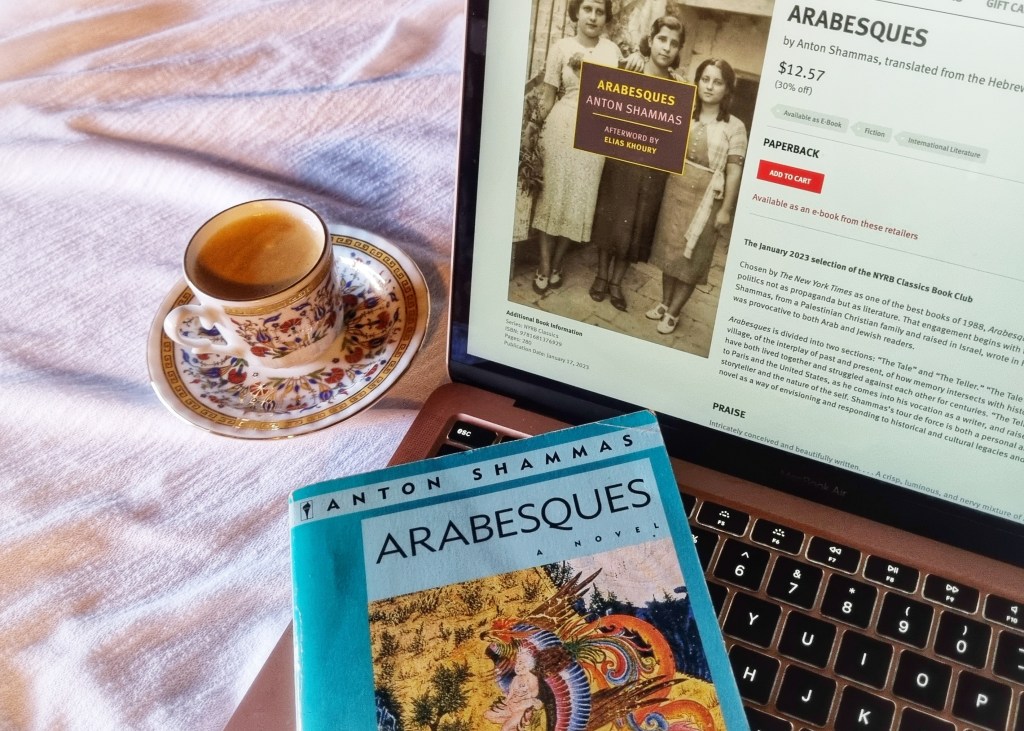
NYRB’s launching of Anton Shammas’ Arabesques with an afterword by Elias Khoury prompted this reading. I am thrilled to finally see Khoury’s name on an NYRB cover, but still baffled as to why this virtuoso of form, poetic prose, historical and political insight continues to be unbelievably underrated!
One probably cannot read his books consecutively because of all the trauma they contain, and how he presents a different form of the novel each time could disorient those who prefer the familiar; but on my fourth novel by Khoury, I remain amazed…
…especially when I disliked the main character for his views on marital infidelity right from the beginning, and I found more repulsive revelations in other characters; and yet, the hypnotic storytelling with beautiful lines about words and meaning just pulled me in. Strong female characters emerged, the plight of foreign domestic workers in Lebanon was addressed (an especially meaningful aspect as I’ve noticed how Lebanese authors from Alameddine, al-Shaykh, to Khoury have often included Filipina domestic help in their depiction of the Beiruti socio-scape), Lebanon’s history came through in well-executed layers, with two brothers on different sides of the civil war clashing ideologies were dissected, but as broken pieces of the mirror began to come together for the reader, the characters’ lives fell apart.
Khoury is less abstract here. These are all symptoms of the same sickness, he says. “He’d told her that his soul hurt and that there was no pain worse than that of the soul.” This is what war does to lives, he says. This is what war does to identity. This is what war does to love. This is how war never ends if it lives inside us.
On a lighter note, Archipelago Books hit the bull’s eye with that Wassily Kandinsky cover art!
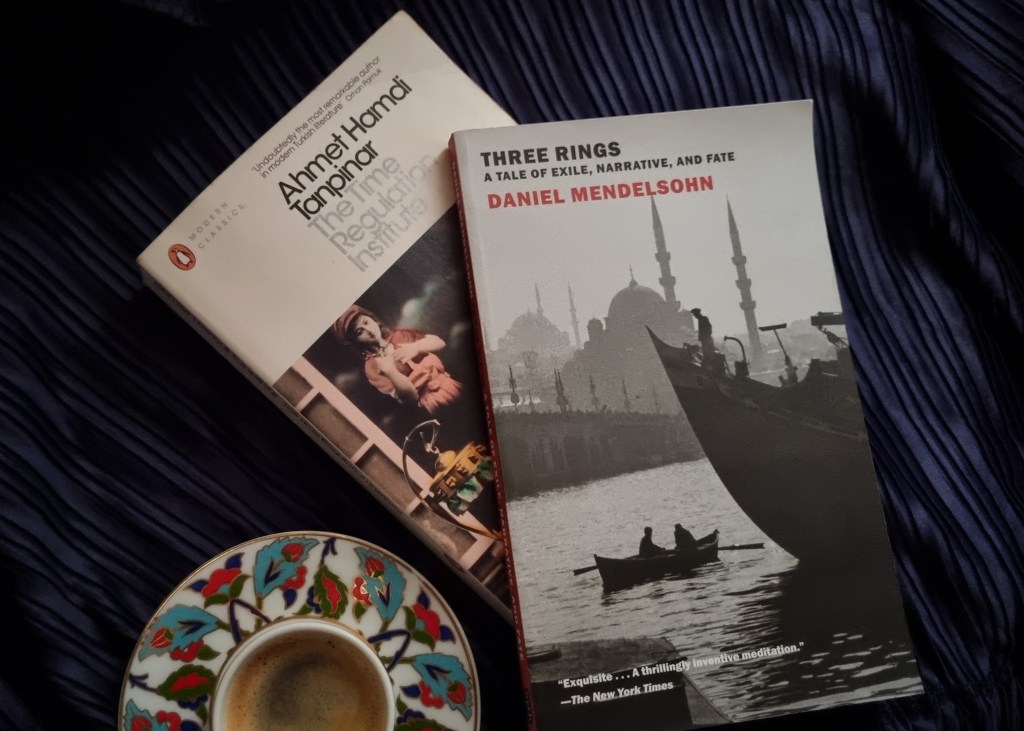
One was acquired because of the unmistakeable image of my favorite city that bewitched me as I browsed through NYRB’s contemporary collection; and the other because there are only two Turkish modern classics in the Penguin collection and I’ve already read and loved the other one!
What is a classic? In Amit Chaudhuri’s rephrasing of J.M. Coetzee, it is that which speaks to you when you are ready to hear it. I was not too sure about being ready, but if Pamuk thinks Tanpinar is the most remarkable author in modern Turkish literature, you trust him… even if it means limping through four hundred pages of winding narrative for an entire week.
But as reading fate would have it, Mendelsohn’s book turned out to be the crutch that got me through my inadequacies as a reader and the compass that prevented me from losing my way through Tanpinar’s meandering tale.
Aside from being so much more, Three Rings sheds light on ring composition in masterpieces by Homer, Proust, Sebald, and other literary forebears. Because of this, it made me recognize this exact literary form in The Time Regulation Institute and taught me to luxuriate in the beauty of narrative digression instead of getting lost.
As if harmonizing intentionally, Tanpinar evokes the eastern concept of time as a non-linear progression as Mendelsohn intimates this non-linearity in literature and life.
Time Regulation Institute is primarily a satire on the young Turkish Republic during Atatürk’s cultural revolution, which included enforcing Western time and imposing a fine on those who continued to observe Islamic time. While Atatürk is lauded in the West as a hero for modernizing a dying and retrogressive Ottoman Empire, Tanpinar artfully warns readers about how new freedoms are accompanied by new tyrannies — a seldom heeded but always relevant, and necessary, warning.
“The political pursuit of freedom can lead to its eradication on a grand scale — or rather it opens the door to countless curtailments… never have I known a concept so inextricable from its antithesis, and indeed entirely crushed under its weight… I must confess I’ve always found freedom an elusive concept… if we truly felt passionately about it, then wouldn’t we have…never let it out of our sight?”