“…in history as in human life, regret can never restore a lost moment, and 1,000 years will not buy back what was lost in a single hour.”
The day of the Philippine Elections has finally come! And no queue at the polling precinct is too long if you have the right books with you!
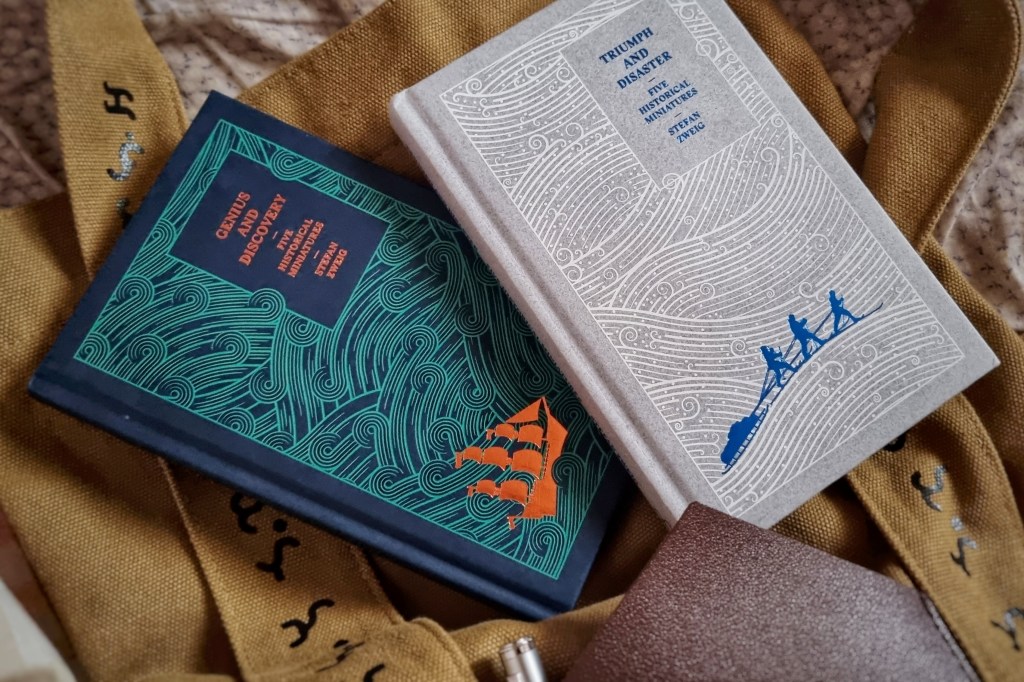
Five historical miniatures in each of these lovely books from Pushkin Press by distinguished Austrian writer, Stefan Zweig. There is nonetheless nothing “miniature” about the writing! In fact, they magnify some of history’s crucial moments and characters in such glorious and vibrant ways, you can only wish Zweig wrote more of these!
It was this line that leapt off the pages from the foreword of both books: “…a single Yes, a single No, a Too Soon or a Too Late makes that hour irrevocable for hundreds of generations while deciding the life of a single man or woman, of a nation…”
A single vote.
Dear Philippines, tomorrow we find out how we did.
Imagine a Serbian little boy being taken away from his mother as “blood tribute,” an Ottoman practice of forcibly recruiting soldiers from Balkan Christian subjects. Imagine the screams and the cries as the mother follows them to the Drina River, until the janissaries and the child embark on a ferry where they are parted forever.
This is the agony with which the book begins, and it made me wonder if I should shelve it for later. It felt too heavy to be read amid the volatile climate of the Philippine elections. But the writing made me want to read more, and I do not regret doing so.
This boy rose through the military ranks and became known as Mehmed Paša Sokolović, and in his later years, Grand Vizier of the Ottoman Empire. But the painful memory of separation never left him: “…he thought that he might be able to free himself from this discomfort if he could do away with that ferry on the distant Drina, around which so much misery… gathered and increased incessantly, and bridge the steep banks and the evil water between them, join the two ends of the road which was broken by the Drina and thus link safely and forever Bosnia and the East, the place of his origin and the places of his life. Thus it was he who first, in a single moment behind closed eyelids, saw the firm graceful silhouette of the great stone bridge which was to be built there.” Thus began the construction of the bridge over the Drina, at the part of the river where he last saw his mother.
The main character in this novel is the bridge. This bridge that has withstood over four hundred years of tumultuous history.
— — —
Elif Shafak was a reading staple between November 2020 to January 2022 when I was steeped in my reading project to cover and uncover as many writings from places affected by the Silk Route; so when a friend learned that Elif Shafak had said that The Bridge on the Drina caused something in her to shift forever, this was enthusiastically recommended to me.
Of the nine books by Shafak that I read, the first one was The Architect’s Apprentice, set in sixteenth century Istanbul about a fictional apprentice working with the legendary Ottoman court architect, Sinan. The one commissioned to design the bridge on the Drina, the Mehmed Paša Sokolović Bridge, is none other than Mimar Sinan.
— — —
But authors are stories in themselves, and Ivo Andrić’s life is literally one for the books. Born to a poor family in Bosnia, he grew up playing on the very bridge he would later immortalize and earn him the Nobel Prize for Literature in 1961. The years in between include two World Wars and an extraordinarily rich and eventful life.
The introduction to this edition claims, “No better introduction to the study of Balkan and Ottoman history exists… no anthropologist has ever reported the process of cultural change so sensitively; no historian has entered so effectively into the minds of the persons with whom he sought to deal…” I can only agree!
Andrić arranges the perplexing layers of this region’s history from the 16th to the 20th century into an impassioned song that constantly returns to its main theme — the bridge.
“…The life and existence of every great, beautiful and useful building, as well as its relation to the place where it has been built, often bears within itself complex and mysterious drama and history… Therefore the story of the foundation and the destiny of the bridge is at the same time the story of the life of the town and of its people…”
“Life…renews itself despite everything and the bridge does not change with the years or with the centuries or with the most painful turns in human affairs. All these pass over it, even as the unquiet waters pass beneath its smooth and perfect arches.”
There is an excess of lessons to be learned from this work, and much to be said about the exceptional writing, but what made me read on was the pervading refrain of the enduring power of art and architecture, and the comforting thought that no matter the course of history, life always renews itself.
“…that was Cleopatra, she was Queen of a great country. She was an enemy to Rome; but she was a brave woman, and she loved her country as much as any Roman might love his; she gave her life so that she might not have to look upon its defeat.”
This passage is an example of the compassion with which John Williams treats his characters.
My copy of Augustus being secondhand, it was a lovely surprise to find this pressed beauty tucked between the pages featuring Cleopatra.
“Father, has it been worth it? Your authority, this Rome that you have saved, this Rome that you have built? Has it been worth all that you have had to do?”
To have made palpable not only history, but the scope of human nature and the heart’s confidentialities; to have justly raised some of history’s forgotten women from the footnotes of the annals; to have retrieved a legendary man from his pedestal so he could tread in our minds as a mere mortal; to have given pensive credence to a line from that famous Quartet by Durrell in that the real ruins of Europe are its great men; there is but one word for the man, this book, the writing — august.
I have not read a more majestic novel!
As much as I want to reiterate the praises heaped upon this work and repeat the passages that moved me, I wish to put emphasis on what makes it meaningful to me as a woman — the noteworthy backstory, underscored by John McGahern in this edition, about the catalyst that gave us this book. In a conversation with writer Morton Hunt, John Williams learned the story of Augustus’ daughter Julia, whom the emperor deeply loved, but whom he sent into exile because she had broken the laws on adultery that he himself had enacted. The fascination with the fact that the only child of the first emperor of the Roman Empire had been overlooked in the histories led Williams to an immersion into the Roman world, which resulted in this work in which Julia is the heart.
It is this heart that grants us a compassionate portrait of Augustus. With this work published in 1971, and with that subtle power distinctly his, John Williams penned a revolutionary and enlightening approach on how to treat history’s women alongside the men — not to raise them unreasonably into women who played bigger roles in history than they actually did, but to remind us that they existed, they lived, and that they mattered.
Greeting this month with Memoirs of Hadrian and ending it with Augustus feels like a paradox at a time in my country when “history” is crafted to suit narratives and facts are doubted because they are purportedly written by the victors.
Friends, Romans, countrymen… in this, our history differs, because we have history written not by the victors but by the victims, and by those who became victims by speaking the truth. If we have the courage to question our history, we need also the courage to question our motives, and most of all, ask ourselves what kind of people our convictions empower.
“…nor did I determine to change the world so that my wealth and power might be enhanced… it was more instinct than knowledge, however, that made me understand that if it is one’s destiny to change the world, it is his necessity first to change himself.”
As subtle but as vital as breath, the passage of ideas and wonder surges with life through these pages and straight to the reader.
Marguerite Yourcenar carves and immortalizes the many aspects of the great Roman emperor that was Hadrian, but unlike any work of history, she resuscitates his heart and offers it to us, pulsating and bleeding, as only Marguerite Yourcenar can.
Written in the form of a letter to his successor, Marcus Aurelius, whose Meditations endure up to this day, Memoirs of Hadrian is the introspection of a man at the end of his days, stripped away of life’s pretensions and left only with his truths. I suspect that this, too, shall endure.
“I have known men infinitely nobler and more perfect than myself…There is but one thing in which I feel superior to most men: I am freer…For my part I have sought liberty more than power, and power only because it can leadto freedom.”
It is partly an ode to Hadrian the traveler, the only emperor in the empire’s history to have traveled to almost every part of its vast realm. Of traveling, he writes, “It disrupts all habit and endlessly jolts each prejudice.”
An ode to a man who could accept with calm the vicissitudes of Rome Eternal after his time (“If ever the barbarians gain possession of the world they will be forced to adopt some of our methods; they will end resembling us”) but could not understand a resignation to ignorance; and thus promoted Greek philosophy and culture and patronized the arts, literature, music, architecture.
A man who perceived that knowledge and literature were as important as food to a civilization, and libraries, dispensaries to the soul: “The founding of libraries was like constructing more public granaries, amassing reserves against a spiritual winter which by certain signs, in spite of myself, I see ahead.”
An ode to Hadrian the builder who believed in the richness of an architecture more varied than Vitruvius’ four orders would allow (“Our great stone blocks, like our tones in music, are amenable to endless regrouping”) and thus amassed inspiration even from faraway Ctesiphon, Babylon, and Egypt, drew the plans himself, and put emphasis on building from vernacular materials.
“To build is to collaborate with the earth, to put a human mark upon a landscape, modifying it forever thereby…To reconstruct is to collaborate with time gone by, penetrating or modifying its spirit, and carrying it toward a longer future… My cities were born of encounters… Each building stone was the strange concretion of a will, a memory, and sometimes a challenge. Each structure was the chart of a dream… I have wanted to live as much as possible in the midst of this music of forms.”
“In the evenings the art of building gave way to that of music, which is architecture, too, though invisible.”
And so it is also an ode to a man who applied the laws of art and governance interchangeably: “Strength was the basis, discipline without which there is no beauty, and firmness without which there is no justice. Justice was the balance of the parts, that whole so harmoniously composed which no excess should be permitted to endanger. Strength and justice together were but one instrument, well tuned… all forms of dire poverty and brutality were things to forbid as insults to the fair body of mankind, every injustice a false note to avoid in the harmony of the spheres.”
It is an ode to the man who first ventured to call Rome “eternal”; who counted desperately on the eternity of stone, as we are able to continue to witness through Hadrian’s Wall, Hadrian’s Villa, Castel Sant’Angelo, the Pantheon; a man who believed that, “Anything made by man which aspires to eternity must adapt.” And therefore it is an ode to a man who looked for and looked to eternity — and thus, he loved.
Above all, it is an ode to a man who loved. For what is eternity without it?
“The woman is you,” remarked those who saw me with this book.
I can only hope to be half as courageous.
But who is she? “To read is to pray,” she taught. “To write is to trust.” Her words had claws, they said, but at the same time they recognized that her silence were double the weight of her words.
She believed in these: That sometimes, illiteracy was fear; that truth conquered fear; that denial was difficult in the face of truth; that the best told lies can prove short-sighted before the long truths of eternity; and that there was no escape for those who took refuge in their ignorance. And of pride? “Love had nothing to do with it.”
Who was she again? Throughout the story we only know her as the woman who read too much. All the women in the book were not given names. Set during the Qajar Dynasty in the 1800s when literacy among women in Persia was not encouraged, and the details of their lives were largely invisible and unrecorded — as it had been for centuries, and as it had been for most parts of the world; this clever literary trick by Bahiyyih Nakhjavani is most likely a curtsy to Virginia Woolf who wrote, “For most of history, anonymous was a woman.”
“No marker on her grave then? None.” Her death is something readers will know right from the beginning. Her story is written in such a peculiar way that it moves forward while moving backwards simultaneously, proving that the best of these Iranian women writers are masters not only in subtlety but also in form, and one can only try not to blink and miss allusions or be helplessly lost.
“History is filled with screams that are ignored.” The reading woman is executed for what she stands, for opposing unreasonable orthodoxy, “for stating the obvious rather than for deviating from the truth,” condemned for showing other women “how to inscribe their lives on the pages of history… giving them the tools by which to be autonomous.” Her death only fanned the flames of the emancipation of women, especially the emancipation of the mind.
Nakhjavani surprises us in the afterword by revealing that the woman who read too much; who, after all, had a name, was a real woman. Tahirih Qurratu’l-Ayn, the symbolic mother of literacy in Iran.
I glance around my library as I write and wonder at the sudden awareness that, on my shelves organized by geography, the Iran section is the only one where women authors outnumber the men. What better way to honor her!
Here in the midst of “look how far we’ve come” and “miles to go before we sleep,” reading this makes me ponder on the women who came before us; back to Enheduanna (2286-2251 BCE), a woman, the first known author, and to the endless library of history we long to fill… and read.
We’ve always had the rights of the mind at our disposal. We need only take up courage to use them.
“The world changed when definitions of womankind were altered.”
I will not be stingy with truth. And because the truth is often bound to be difficult and makes us squirm in our comfortable seats, the question is not whether you will like this. The question is whether you can swallow it — the nature of flawed leaders, of spiritual shepherds who are wolves to their own flock, of society, of human beings, of real characters.
This is what Olga Tokarczuk conveys to me right from the first of seven books in The Books of Jacob.
She thrusts us into 1752 Poland where there is a growing animosity towards the Jews and the longing for a messiah is intensified. But only in the second book do we meet the messianic figure: Jacob Frank who asks, “What do we want some sage for?” Jacob whose sexual perversities are now being slowly divulged to the reader. Jacob who ridicules his most earnest followers while they, in the goodness of their hearts, concoct half-truths and falsehoods about him to glorify him; because he is seemingly authentic in everything he does; and although repulsive, he is charming.
All these, eerily juxtaposed with current events in the Philippines: the FBI issuing a poster of church leader Apollo Quiboloy’s warrant of arrest for fraud, coercion, and sex trafficking; a dictator’s son who is a tax code offender leading the presidential polls; the former being an open endorser of the latter.
With an increasing throng of followers, this charismatic Jacob Frank preached the idea that the notion of sin no longer applies. There was no room for conventional morality in his philosophy. “We are to trample all the laws because they are no longer in effect…”
There is no more morality — a common refrain among leaders and their supporters today who justify wrongdoing and do not wish to face accountability!
I was wrong. Olga did not thrust us into events over two centuries ago with this opus. She brings us to the present. This is us. This is us. Because isn’t morality dead to us unless and until the injustice is done by those we dislike, and then we cry foul and demand morality and justice?
This colossus — a lyrical galaxy of darkness and light, weakness and strength, of comets and plagues set in some of the most exciting places I have actually been to, of beautiful passages about literature and how it somehow makes solid the ground beneath us despite this chaotic world, of history and its excruciating details — is not exactly about Jacob. It is about society and how we create the tapestry of history with our actions and our choices… and it seems like we never learn.
“What was beyond our grasp was neither the future nor the past, but the present itself.”
It is a mistake to suspect that this book will help one make sense of the world.
I fell victim to this assumption that I even intended this to be my first read of 2022 if not for delayed shipments caused by Typhoon Odette/Rai.
Read from cover to cover within 24 hours, partly because the web Labatut weaves is sheer genius and the subject of quantum mechanics is so fascinating, but also partly because of a panicked speed when what I sought to find — comfort and hope — was still nowhere to be found even as I approached the final pages.
“…it was mathematics — not nuclear weapons, computers, biological warfare or our climate Armageddon — which was changing our world to the point where, in a couple of decades at most, we would simply not be able to grasp what being human really meant. Not that we ever did… but things are getting worse… But it’s not just regular folks; even scientists no longer comprehend the world. Take quantum mechanics, the crown jewel of our species, the most accurate, far-ranging and beautiful of all our physical theories. It lies behind the supremacy of our smartphones, behind the Internet, behind the coming promise of godlike computing power. It has completely reshaped our world. We know how to use it, it works as if by some strange miracle, and yet there is not a human soul, alive or dead, who actually gets it. The mind cannot come to grips with its paradoxes and contradictions. It’s as if the theory had fallen to earth from another planet, and we simply scamper around it like apes, toying and playing with it, but with no true understanding.”
I fell in love with mathematics later in life and even though my dabbling in the subject is nowhere close to the mathematical heights mentioned in the book, I wondered at every morsel. But mathematics, as wondrous and beautiful as it is, has not always been wielded for the good and has often passed through the hands and minds of the eccentric and the disturbed.
Labatut draws us to this dark side. To say that this book is unsettling is an understatement. And reviewing it through my distilled notes highlights the irony and alarm:
Mary Shelley, recalled to have warned us through her monstrous masterpiece of “the risk of the blind advancement of science.”
Fritz Haber, first to obtain nitrogen, recipient of the 1918 Nobel Prize in Chemistry, accused by his wife of “perverting science by devising a method for exterminating human beings on an industrial scale.”
Albert Einstein, who sensed that following one of quantum mechanics’ pioneers Werner Heisenberg’s line of thinking would lead to a darkness that would infect the soul of physics.
Karl Schwarzschild, contributed greatly to the general theory of relativity, said to have possessed a “peculiar form of a fear that physics would be incapable of… finding an order in the universe.” “…the most frightful thing about mass at its most extreme degree of concentration was not the way it altered the form of space, or the strange effects it exerted on time: the true horror, he said, was that the singularity was a blind spot, fundamentally unknowable. Light could never escape from it, so our eyes were incapable of seeing it. Nor could our minds grasp it, because at the singularity the laws of general relativity simply broke down. Physics no longer had meaning… If matter were prone to birthing monsters of this kind, Schwarzschild asked with a trembling voice, were there correlations with the human psyche?”
“Don’t they understand that we are rising up only to fall?”
“We have reached the highest point of civilization. All that is left for us is to decay and fall.”
Alexander Grothendieck, leading figure in the creation of modern algebraic geometry, withdrew from the world not because he hated human beings but for the protection of mankind. “Grothendieck said that no one should suffer from his discovery, but he refused to explain what he meant when he spoke of ‘the shadow of a new horror.’”
Shinichi Mochizuki, awarded the Fields Medal, the highest honor that can be bestowed upon a mathematician, who, after publishing six hundred pages that contained a proof of an important conjecture in number theory, deleted his blog and announced that “in mathematics, certain things should remain hidden, ‘for the good of all of us.’”
Benjamin Labatut, you go to such great lengths if only to say, in this strange and brilliant way, that innocence is bliss?
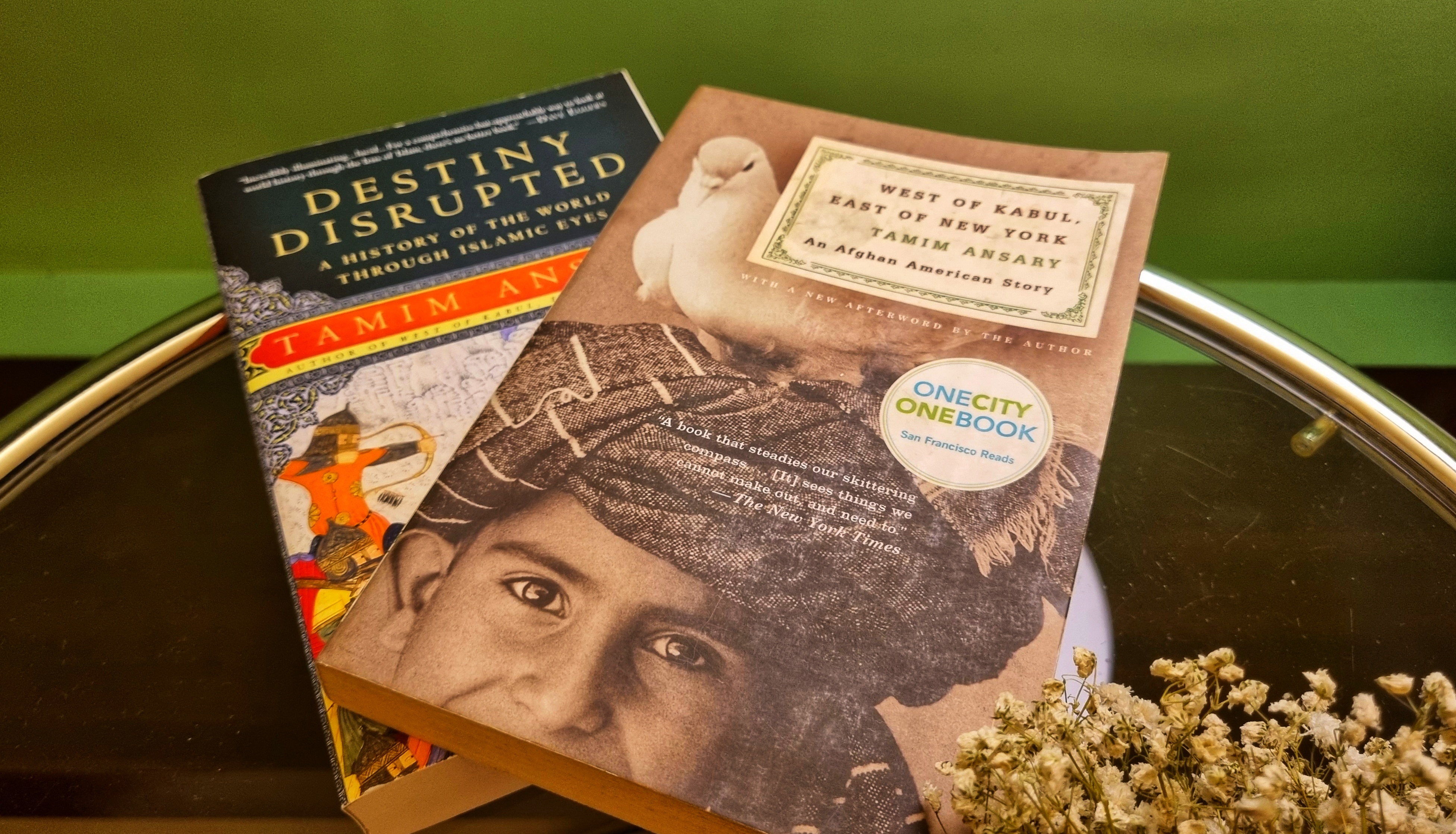
I finished reading this book the day an article from the New York Times came into my inbox: “Afghanistan Has Become the World’s Largest Humanitarian Crisis.”
A passage from page 59 immediately came to mind: “We just shared the towering profundity of our loss, tasting that resignation to fate that came to us from our Afghan soil, for even as children, we knew that loss would deepen us. That’s what it means to be an Afghan.”
Published after 9/11 when it was Osama bin Laden and the Taliban that put Afghanistan on the map of the majority of Western consciousness, and during a time when the world was angry and calling for the bombing of Afghanistan as retribution, Ansary felt an urgency to let the world know that the Taliban and Bin Laden are not Afghanistan.
“It’s not only that the Afghan people had nothing to do with this atrocity. They were the first victims of the perpetrators… Some say, Why don’t the Afghans rise up and overthrow the Taliban? The answer is, They’re starved, exhausted, hurt, incapacitated, suffering… There are millions of widows. And the Taliban has been burying these widows in mass graves. The soil is littered with land mines, the farms were all destroyed by the Soviets.”
“We come now to the question of bombing Afghanistan back to the Stone Age. Trouble is, that’s been done. The Soviets took care of it already.”
Make the Afghans suffer? They’re already suffering. Level their houses? Done. Turn their schools into piles of rubble? Done. Eradicate their hospitals? Done. Destroy their infrastructure? Cut them off from medicine and health care? Too late. Someone already did that.”
And yet, this memoir gave room to a heart-warming aspect of Ansary’s writing. From his childhood in Kabul and Lashkargah to adulthood in the United States, there was still space for life, love, friendship, and even for travel.
Unfortunately, 20 years after this book’s publication, the dam is breaking in Afghanistan once more.
“History is like a river, except people can only live in lakes, so they dam the current and build villages by still waters — but the dam always breaks.”


 The Book-Butterfly