Hamid Ismailov

“We are a nomadic people. Today we pitch our yurts on one mountain pasture, tomorrow on another. Some people see their sense, their history, their fellow men as urban, and preserve all this in schools and madrasas, books and manuals. But we get on our horses and carry everything on our persons, and we have to keep it like this, on the move, in our minds and hearts.” — Hamid Ismailov, Manaschi

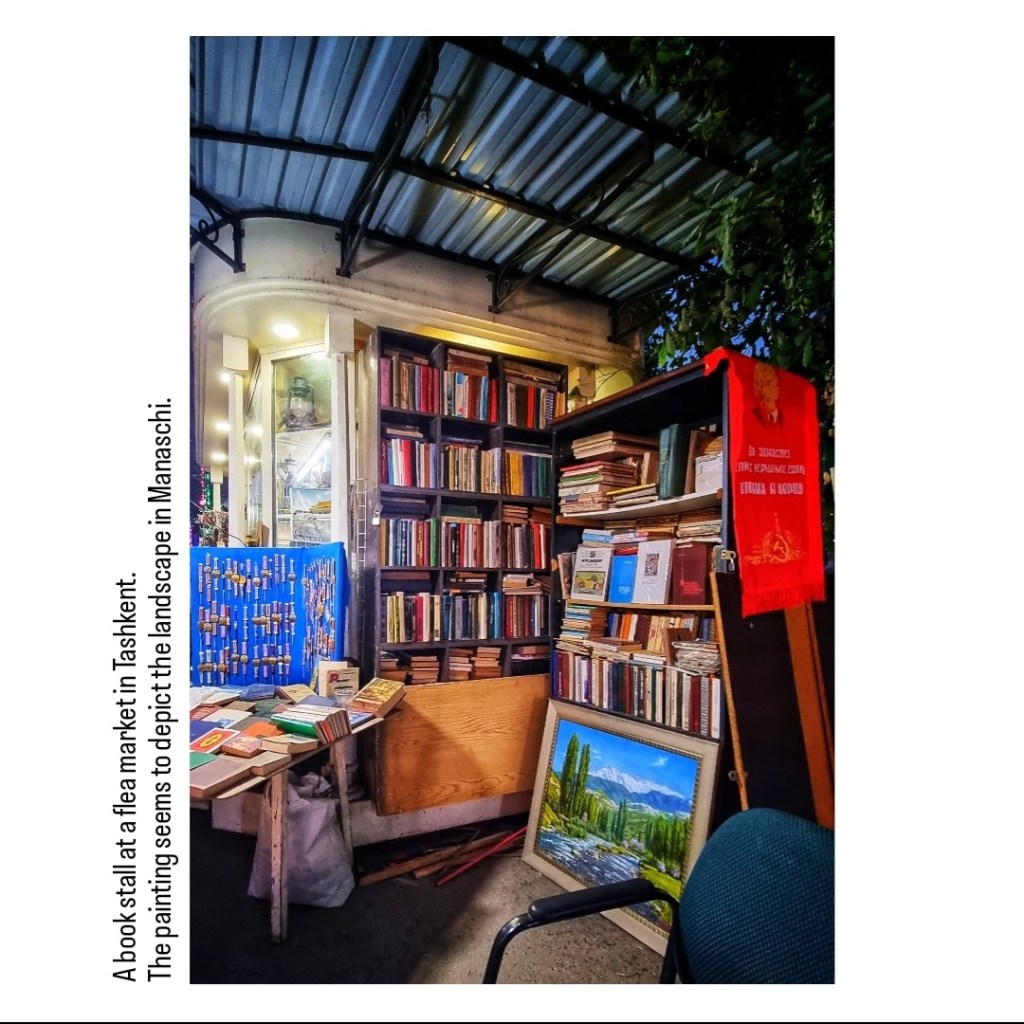
Sometime in between the first and the second volume of this Central Asian triptych, I travelled to Uzbekistan where Ismailov’s books cannot set foot because they are banned, and had a glimpse of the place that wrote the author.

Devil’s Dance is an intense initiation to Uzbek Literature. Of Strangers and Bees playfully meanders across the boundaries of time, literature, and geography. Manaschi is a geopolitically relevant finale that equals the force of Devil’s Dance.

But whether one speaks of the persecution of Uzbek writers throughout different regimes and implies that the writing process is akin to a dance with jinns;

the other of exile, elusive homelands, the value of community, man’s capacity for good and evil, or the search for truth and self through wanderers and bees;

and another of the trouble with imposed artificial borders, ethnic conflicts, the complexity of identity, or mystical bardic traditions;

all three uniquely celebrate the rich storytelling heritage of Central Asia — a heritage so crucial that a protagonist from the second volume boldly claims it to have shaped the shorelines of the great ocean that is Russian literature.

I love how this trilogy is a confluence of literary traditions rather than a defiance of the Western form. It manifests the power of stories, written, uttered, or observed; the power of stories when lived, as we become our stories and our stories become us; and the power of stories to take us beyond pathways of silk, even to places where only the rustle of words can go.

“It was a good thing the world had Uzbek literature.” — Hamid Ismailov, Of Strangers and Bees


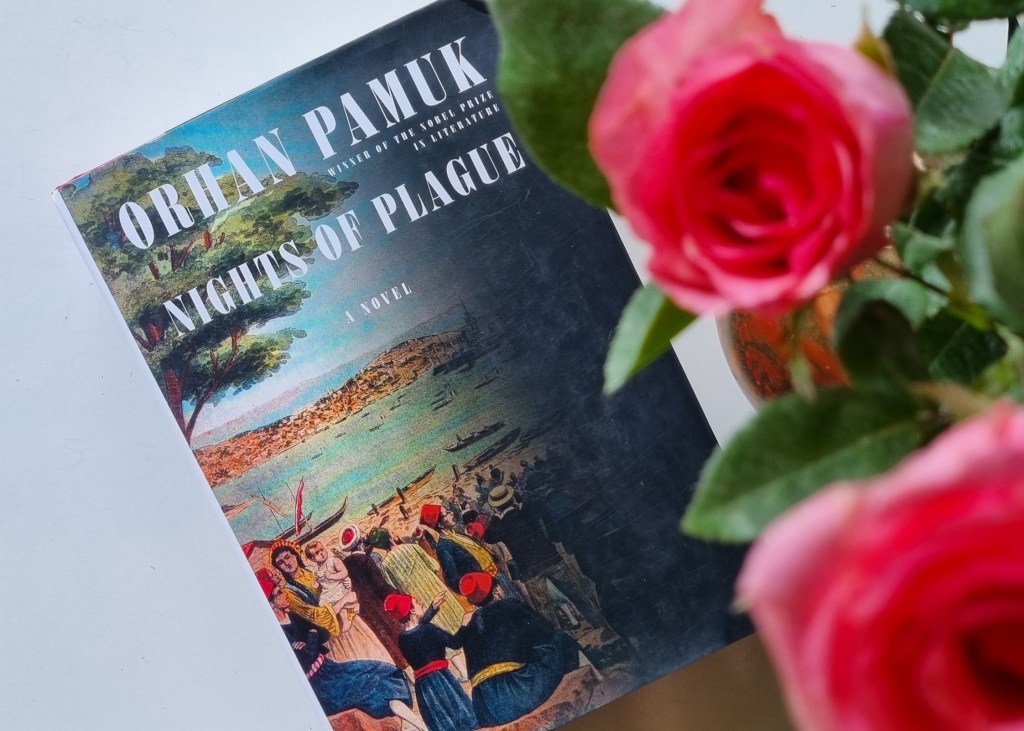
Orhan Pamuk: Nights of Plague

Orhan Pamuk’s longest novel to date unravels with a pace that tends to linger, to wit: it is not for readers who are in a hurry. For that reason, I found it strangely refreshing. Strange because it is a plague narrative that is not meant to be refreshing, refreshing because of the reading experience it provided; defiant of the modern reader’s preference for a literary quick fix, and defiant of our silly reading goals that have more to do with the number of books rather than the languid relishing in an author’s descriptive prowess.

Perhaps I simply feel at home in the expression of an author whose mind is a museum of melancholy, but I am now sensing that part of the allure is in how his books are written for their own sake — written because he felt they needed to be written rather than written for their salability. Isn’t that pure art?

Set in 1901, in the fictional island of Mingheria, “on the route between Istanbul and Alexandria,” it is a curious deviation from a usual Pamuk novel that stays within reach of Istanbul. While Snow is set farther in eastern Turkey, an invented island between Crete and Cyprus is still a surprising backdrop for seasoned Pamuk readers; but only until we realize that the creation of Mingheria allows for a certain leverage and freedom for political criticism. Methinks Mingheria speaks more about Turkey than it does about an imaginary island nation in 1901. 

This novel can teach a thing or two about running a nation during a plague; about epidemiology; how to deal with resistance from different sectors against quarantine measures; how plagues do not distinguish between Christian or Muslim; how failed attempts at containing a plague can fan the flames of a revolution; how revolutions can be exploited; the similarities between solving a murder and stopping an epidemic; and living or loving through the sickness and political ferment. It is about plagues, revolutions, nationalism, the administrative and language reforms that ensue, the fickleness of governments, about the accidents of history, how history is made, and how history is written.

It echoes Camus’ The Plague in the way that the narrator’s significance is revealed only at the end and also for the chilling reminder that plagues reappear throughout history “for the bane and enlightenment of men”.

Unfortunately, man easily forgets, and unwittingly asks to be reminded ever so often.

Ben Hopkins: Cathedral

Through previous readings, this reader has encountered provocative theories that suggest that it was religious reformation that freed human thought from church dogma thus giving rise to individualism, which subsequently paved the way for the Renaissance; and also theories of the aftermath of the Black Death setting the scene for capitalism by overthrowing social systems including feudalism.

The Protestant Reformation erupted in the 1500s, the Black Death in the 1300s. Ben Hopkins’ novel of six hundred and twenty four pages begins in the 1200s, but through its characters, we already witness the gradual ascent of mercantile capitalism and individualism challenging the hegemony of the Catholic Church.

But thankfully, these big words and the sophisticated ideas that are attached to them are not heaped too heavily on the reader’s shoulders. The author seems to have employed his filmmaking expertise by creating a well-paced and entertaining book with a handful of dramatic imagery and contrasting characters across the broad spectrum of society, but which also carries so much understanding of the religious and socioeconomic landscape of a particular European period.

In the midst of it all, the Cathedral — or more accurately, the construction of the Cathedral — that remains unfinished and continues to be built even by the end of this novel. This novel that begins in 1229 and ends in 1351. This Cathedral that symbolizes a number of things. 

In this story there is clearly the aspect of the historical, or the architectural, but which should always lead one to contemplate on the personal — the edifices that we build for ourselves. And because we already know how certain it is that we can carry nothing out, what do we leave behind?

To quote a cherished character who passed away by the the shores of Constantinople, “A man can die anywhere. It’s all the same. The only important thing is how he lives.”

Sabahattin Ali: Madonna in a Fur Coat

“And what a pity that is: a dash of curiosity is all it takes to stumble upon treasures we never expected.”

This is true for people, and it is true for books including this one.

“For wasn’t there sufficient pleasure to be had in silent patience… When we walked side by side, did I not feel his humanity most profoundly? Only now did I begin to understand why it was not always through words that people sought each other out and came to understand each other, and why some poets went to such lengths to seek out companions who could, like them, contemplate the beauties of nature in silence. Though I did not know what I was learning from this silent man walking alongside me, I was certain that I was learning far more than I would have done from a teacher in years.”

In this little treasure of a book, there are traces of Before Sunrise in the manner of dialogue and hints of Stoner in the life of the main character that, had it not been written decades prior, I would have believed it to be inspired by both. And yet, it could very well be the other way around. That reading Madonna in a Fur Coat brought these special titles to mind should already say enough of its merits.

But we write about what we have read to simmer in the experience. To cling to the characters a little bit more as if to comfort them even though, in truth, it is us who seek comfort. To investigate their strengths and their flaws and hold them up against our own and consider if we would be as strong or as weak, whether we could love as much, love enough, or truly love at all. To write about how this particular book gently chides us for our superficial encounters and interactions, and how it nudges us to search into the loneliness of other people as much as our own. To untangle our thoughts and give them enough time to be rewired with whatever wisdom we just gleaned, because we know it is not exactly in the writing but in the thinking, and then in the living.

Containers for the Human Music

It is little known outside Ex Libris Philippines that this book club was founded by music and architecture majors during their university years at UP Diliman. 

On a trip to the capital last month, the music section of Ex Libris was able to convene whilst the architecture section was excellently acknowledged through the venue — The Library Cafe at the Ramon Magsaysay Center, an architectural icon in the Philippines named after our seventh president. 

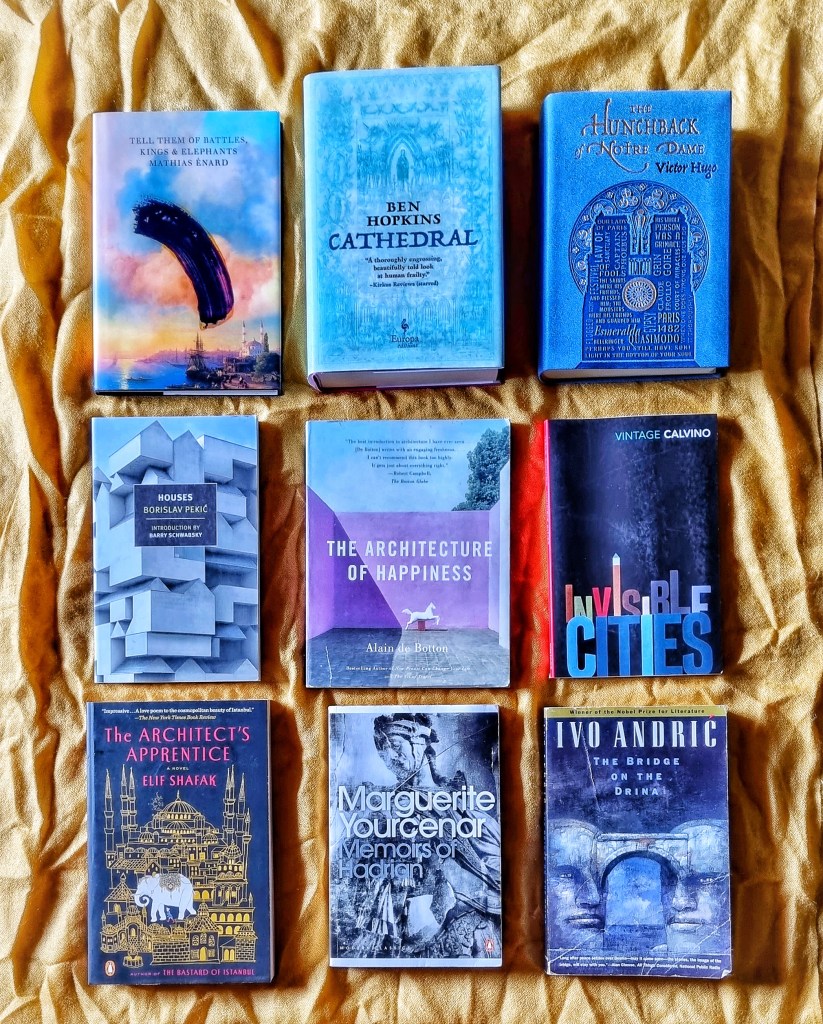
I took this photo on our way in and it made me reflect on how architecture, literature, and music are the same spirit taking distinct forms and harnessing different planes of space in our lives. 

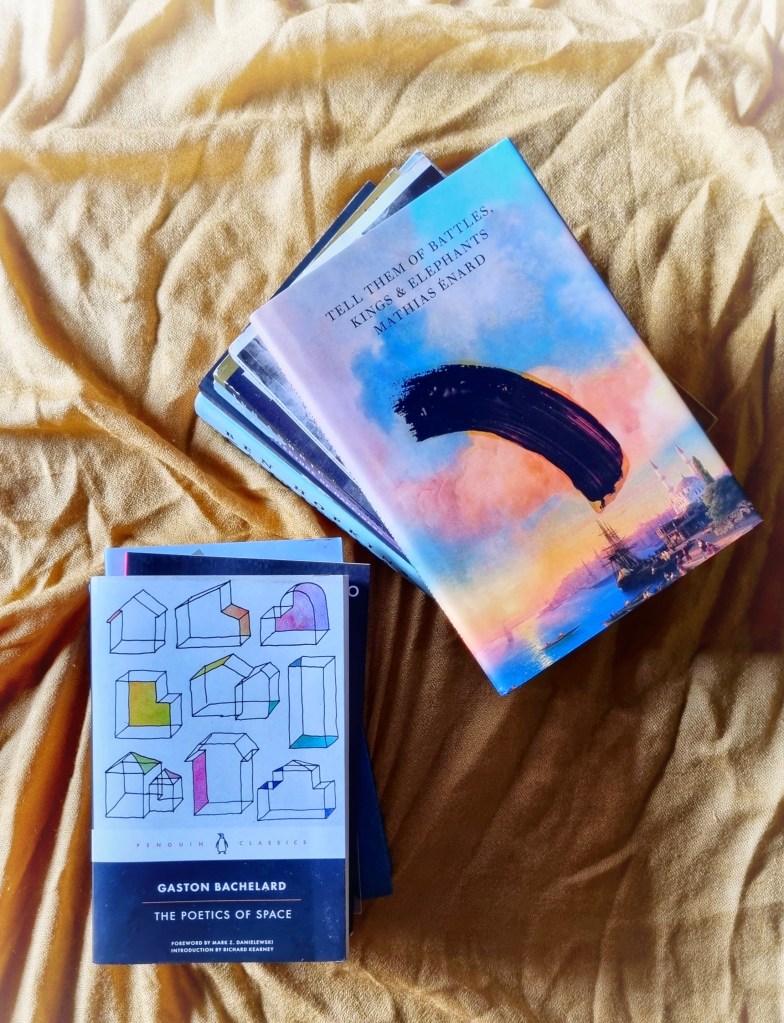
Although, through the years, I have come across books in which literature and architecture occupy the same space, and it is nothing short of fascinating when they do: Victor Hugo’s Hunchback of Notre Dame, Italo Calvino’s Invisible Cities, Marguerite Yourcenar’s Memoirs of Hadrian, Boris Pekić’s Houses, Ivo Andrić’s Bridge on the Drina, Alain de Botton’s Architecture of Happiness, Gaston Bachelard’s Poetics of Space, Mathias Énard’s Tell Them of Battles, Kings & Elephants, Elif Shafak’s Architect’s Apprentice, and my current read, Ben Hopkins’ Cathedral. And as we can see, when these two meet, sumptuous covers are a given.

In an interview on his book, Apeirogon, Colum McCann likened novelists to architects who create a structure aspiring that it will house the best of human endeavor and hope for it to endure, and for people to enter and be changed by it… so that it becomes “a container for the human music”. 

The idea and the verity of books as containers for the human music… Isn’t that beautiful?

Miljenko Jergovic: Sarajevo Marlboro & Ivo Andric: Omer Pasha Latas

She knew there would be pain in these books. But don’t people in the warmest climes imbibe hot drinks to temper the body’s response to heat? By that logic, here she is; steeped in the rich wordscape and sorrowful history of the Balkans.

The first days of November find this reader still silenced by life. A point in which literature remains among the few things left that can coax words out of her.

Sarajevo Marlboro and Omer Pasha Latas fell into her possession around the same time. That both books come from two of her favorite publishers, that the earth tones of their elegant covers match her autumnal soul, that both authors are exemplary, that their stories juxtapose on the same geographical region, were reasons enough to read them together.

Jergović’s extraordinary vignettes is a dip into a sea of humanity and tragedy in the midst of the Yugoslav wars. Andrić, born a century before these wars, whose words seem to flow as naturally as a limpid stream in the Bosnian countryside, write of a different time under the Ottoman rule, but of eerily similar sufferings.

Sarajevo Marlboro, traces of life retrieved from the rubble, fragments that suggest that the real casualties of war are the living; Omer Pasha Latas, unfinished at the time of Andrić’s death. But none of these books leave this reader dissatisfied. It is strangely easy to be drawn into the hypnotic quality of the details.

Both books intimate our need for context and our need for stories if only to make sense of life and divine its purpose; they whisper about the lies of those in power and of fabricated histories; but both beautifully manifest the ephemerality of life.

Andrić’s last word: “Music”. Jergović’s last paragraph: “You can never list or recall the private libraries that have burned down in Sarajevo… But the fate of the Sarajevo University Library, its famous city hall, whose books took a whole night and day to go up in flames, will be remembered as the fire to end all fires, a last mythical celebration of ash and dust. It happened, after a whistle and an explosion… Gently stroke your books, dear stranger, and remember they are dust.”

Dust: Like everything else we deem precious in this world. So while she can, this reader will stroke her books. They don’t always hold the answers, but they hold her, and hold the dusty, broken pieces of herself together.

Julian Barnes: The Noise of Time

How do reading friends try to lift your spirits? One brought me to Solidaridad, the legendary bookshop founded by the late National Artist for Literature, F. Sionil Jose, and forbade me to exit the shop empty-handed.

“It’s on me,” they’ll say, and treat books like a drink in which you’ll drown your pains.

Thousands to choose from, and yet I clung to this one as soon as I saw it. I was unaware that 2011 Man Booker Prize-winning author, Julian Barnes, wrote a novel about Shostakovich! For an idea of how fond I am of Shostakovich’s music: I performed his Piano Concerto No. 2 on my first solo recital and named a pet fish “Shosta” after him — never mind that this pet fish leapt outside of the fishbowl to his doom and died a very dramatic Russian death.

But I digress… needless to say, I took The Noise of Time home with me and finished reading it on the day the 2022 Man Booker Prize winner is expected to be announced.


It is surprisingly an apt read for a time when many Russian musicians and artists are being cancelled worldwide for not publicly denouncing Putin and the war against Ukraine.

This book suggests that it is not always as easy as it seems to make a public stand.

Shostakovich, who enjoyed international success after his first symphony, dealt with a blow when his opera Lady Macbeth of Mtsensk (a title familiar to NYRB editions enthusiasts) was condemned by the Soviet government in 1948, endangering his life, family, and career. Although the aforementioned work was a success after its premiere in 1934, Barnes highlights the capriciousness of the Soviet state: “What the party had said yesterday was often in direct contradiction of what the party was saying today.” As if under similar laws of energy, Soviet power evolved and mutated from one form to another.

How Shostakovich had never joined the Party initially, but had allowed himself to be seen as supportive of the Party, and how his subsequent decisions played out, appear to be a question between cowardice or courage. But wasn’t this too much to ask from a man who simply wanted to compose music?

What becomes of art when it is suppressed or governed under tyranny — “art made tongue-tied by authority”?

This book has some beautiful answers:

“Art belongs to everybody and nobody. Art belongs to all time and no time. Art belongs to those who create it and those who savor it. Art no more belongs to the People and the Party than it once belonged to the aristocracy and the patron. Art is the whisper of history, heard above the noise of time.”

“Because music, in the end, belonged to music. That was all you could say or wish for.”

But if those lines still cannot convince one of the purity and the incorruptibility of great art, the second movement of Shostakovich’s Piano Concerto No. 2 just might.

Tarjei Vesaas: The Hills Reply

“Because when I read, I don’t really read; I pop a beautiful sentence into my mouth and suck it like a fruit drop, or sip it like a liquer until the thought dissolves in me like alcohol, infusing brain and heart and coursing on through the veins to the root of each blood vessel.” This is how Bohumil Hrabal’s Haňta reads — or how he doesn’t really read.

This is how I read, or how I did not really read, The Hills Reply by Tarjei Vesaas. I do not think there is any other way to read, or to not really read, this book.

What is this book? I can say, “A collection of sixteen short pieces of literature.” Or I can also say, “A lyrical poem, two hundred and seventy five pages long.”

But I’d rather say: A Lispector attuned to nature. An impressionistic artwork so keenly aware of the elements, of the light in different times of the day, and of its sounds and its silences. A swan song of sheer beauty that leaves you quiet and asks your heart, for the time being, to dwell inside its pages… a heart so full, so open, it breaks.

Tove Jansson: Sculptor’s Daughter

My father’s sculpture with The Sculptor’s Daughter.

This book was a birthday present I received years ago; given to me perhaps because I, too, am a sculptor’s daughter.

If not for the wintry setting, my childhood would not have strayed too far from Tove Jansson’s. Ice and snow aside, I immediately recognized the environment of an artist’s household! A world of creativity and wonder in which the gravest insult one can muster is, “You are not an artist!” Haha!

I know what it’s like to be made aware of chiaroscuro, composition, shapes, and shades, and to perceive the world with this awareness so early in life; and to realize only as an adult that this is rather unconventional.

Sculptor’s Daughter is the first book she wrote for adults, and although written in her senior years, Tove Jansson is once again a child speaking with simplicity and a disarming, childlike wisdom. She makes indelible images of amusing experiences, encounters, and juvenile feelings, and often leaves traces of artistic ideals.

While this may not fall under the category of books I would readily recommend to anyone, I would suggest it for days when a reader wishes to revisit a particular place called Childhood.

“The smaller you are, the bigger Christmas is.”

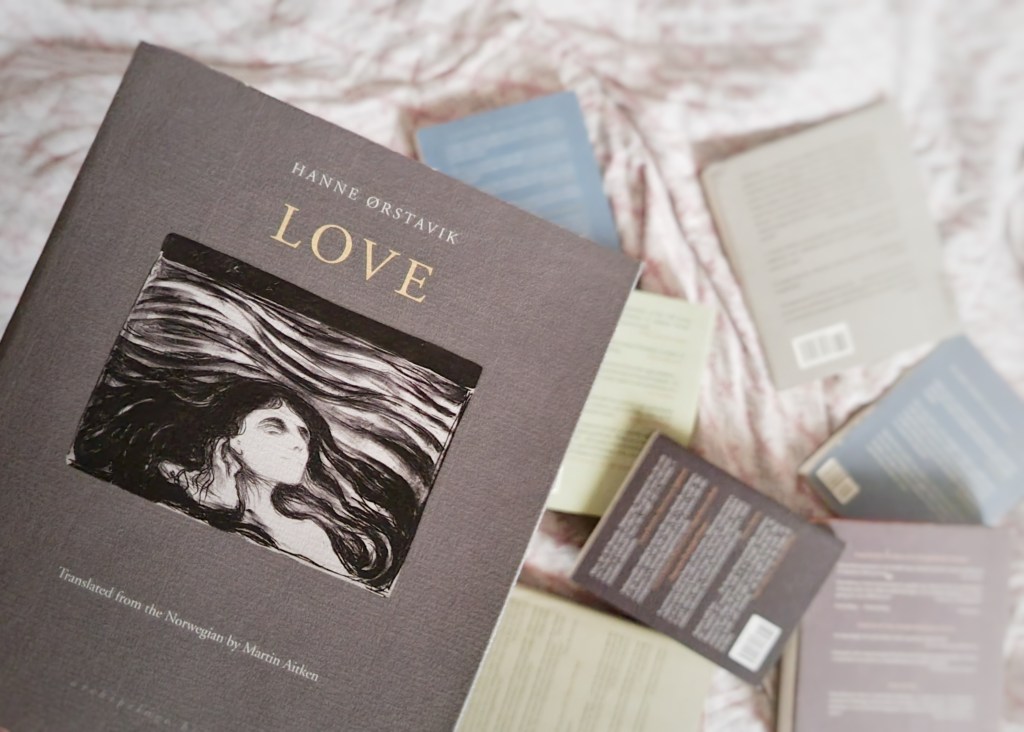
Hanne Ørstavik: Love

This. Is. Art.

This is art that will haunt you for a while.

It brings to mind the Shepard Tone, an auditory illusion used in film soundtracks to create a palpable disquiet. It occurs when layers of the same scale sequence are played at the same time; the highest layer decrescendos, the middle pitch maintains a consistent volume, and the bottom frequency increases in loudness. Played simultaneously, it manipulates the brain into believing that it is hearing an infinitely ascending tension.

In what appears to be the most original writing style I have encountered in a while, Hanne Ørstavik seems to have invented a literary equivalent of the Shepard Tone, camouflaged in a narrative that demands complete attention.

A village in northern Norway. A mother and son. The frost and the night are tangible.

And love?

Love is left out in the cold.