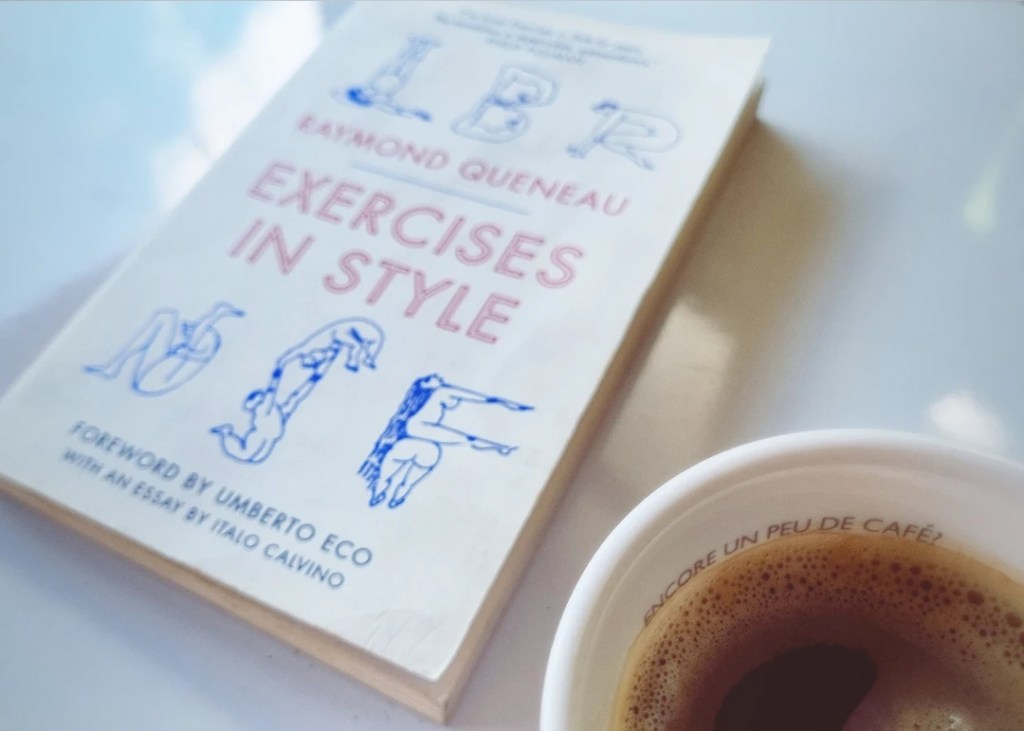
No, this isn’t the Kama Sutra: But it can be, if you enjoy the art of making love with words and trying out different positions with them.
A more conservative comparison: If classical music has Beethoven’s Diabelli Variations, literature has Queneau’s Exercises in Style.
The truth: I had no idea who Queneau was. I’ve come across NYRBs with his name on them, but I only grabbed this book because I’ve enjoyed the works of both Umberto Eco and Italo Calvino. (It must mean something when two outstanding Italians endorse the work of a Frenchman!) The former wrote the foreword and this edition features an essay by the latter, with a prescient first line directed to me, “Who is Raymond Queneau?”
Well, now I know Raymond Queneau: The first man who has managed to make me chuckle all the way while reading an entire book! This was just delightful! It is a retelling of the same short story in different styles that simply renders some books on writing and reading irrelevant — while making the reader laugh.
To those who love to read and write a bit, or write a lot: If this isn’t on your shelf yet, there’s an empty spot where Exercises in Style is supposed be. 😘
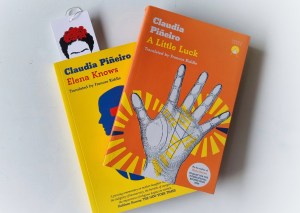
Elena Knows (April 2023) | A Little Luck (November 2023)
The phrase “a little luck” appears nine times in A Little Luck, just as “Elena knows” appears nineteen times in Elena Knows.
Does it matter? Not really. Maybe noticing those details says more of me as a reader than Claudia Piñeiro as a writer. One thing is certain; she does not repeat herself because she is running out of ways to say things. She is consistently unpredictable.
Elena Knows, which I read much earlier, is exceptionally written and translated. The choice to highlight a specific incapacitating disease that isn’t limited to women — to effectively confront every reader with what it feels like to lose bodily autonomy — is, I believe, the most impressive allegory that should be uncovered from under the many brilliant qualities of the novel. There are other apt adjectives for Elena Knows, but beautiful is not one of them.
But for the soulful strains of Piazzolla that wove through A Little Luck’s narrative; for how a woman damaged found the first steps to healing through literature; for how I thought it would all be about pain only to discover that it was principally about happiness; and for the sheer deftness of Piñeiro’s writing — this one is beautiful.
Just as unputdownable, just as suspenseful, just as affecting… and this time, beautiful.
“That’s why we need to read women. What does that have to do with it? It has everything to do with it.“
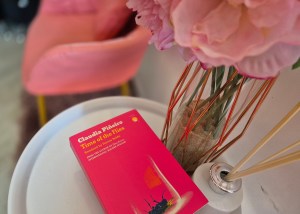
Time of the Flies, Claudia Piñeiro (August 2024)
Give me a back cover blurb without telling me the book is by Piñeiro and I would notbe very interested. The descriptions of her novels are unattractive to me, especially if they are about flies and women killing their husbands’ lovers.
But tell me a book is written by Piñeiro and I would read it without even asking what it’s about, even if it seems to be about flies.
Because if you just trust Piñeiro’s storytelling prowess and allow her to take you on a satisfying ride, you eventually learn that when it comes to the word “fly,” there is the noun, and there is the verb, and she’s ultimately writing about freedom.
Predictably unpredictable. She does it again. But this time, more heartwarming than one would expect, and more blatantly feminist.
“If I were moved by any kind of power at all, it would be the power of revealing absolutely everything about who we are.”
The Distance Between Us, Renato Cisneros (May 2023)
It’s been so long ago that I have started to question whether Florentina Ariza ever truly loved Fermina Daza. And why is it that what remains most vivid in my mind is how Dr. Urbino’s tasseled slippers made Fermina weep after his death?
“The thing you remember most is what has most deeply affected you,” writes Renato Cisneros. Have I always been affected by loss, or afraid of the space of another’s absence?
I apologize. I have fully digressed right from the beginning! Is it even possible to digress right from the beginning?
But what makes the writing and the translation of The Distance Between Us so satisfying is that it is reminiscent of my first encounters with the Latin American greats! (Not the magic realism aspect for there is none of that here, but in the way the writer involves the reader intimately by making the characters palpable, using subtle tricks of psychoanalysis to dig within as far as they can so that one can gaze even into the unconscious.) But perhaps, most of all, for the moving premise of a son writing a book in an attempt to reduce the distance between him and his deceased father, a controversial figure in Peru’s turbulent history: A poignant endeavor to understand who the father really was in order for the son to fully understand himself. To acknowledge the faults of the father so as not to perpetuate them. To break the cycle and confront, rather than escape as his father and forebears have done, “Ignoring and later burying the thornier details of their pasts, they turned their backs on the intrigues of their shared history, embarking on a course of permanent disorientation…”
And yet, “Just as a father is never prepared to bury his son, a son is never prepared to dig up his father.” His undertaking brought to light his father’s amorous affairs; classified information that led him to acknowledge, though he loved him, that his father was a villain, but also that villains are made of wounds; the discovery that his parents were never legally married; and then to write about their love, to legitimize it — “This novel is my parents’ lost marriage certificate.”
Forget my likening Charco Press books to espresso shots. This strong blend of the personal and the political compelled me to spend hours and days between its pages. “Authenticity” is such an abused term nowadays that I sometimes wonder if the overuse has marked the word with a tinge of insincerity. Then comes along a book like this that keeps such doubts at bay. A work devoid of the inauthenticities of biographies and brimming with the honesty that confronts us in fiction.
Was I wrong to wish that the son of a dictator who is now our current president could be more like this son? But I digress, again.
Chic French flaps that double as bookmarks, attractive colors, dimensions that fit in any handbag, and cover designs that could easily pass as pieces from the Museum of Modern Art: Charco Press indulges the busy contemporary reader.
It’s a section of my shelf that has lately become, perhaps unfairly, my go-to for a literary quick fix; where I’d proceed to grab a book without giving it too much thought — the way you would your car keys, the way I would a doppio from an espresso bar — on my way out to an appointment.
Small doses that pack a punch, style-wise, thought-wise, or both, delivering that stimulating and undiluted shot without demanding too much time and space. Yes, there are blends more intense or smoother than others. Some are darker roasts, and some have notes of an exotic flavor that make you gaze twice, sometimes longingly, inside an already empty demitasse. Some have a thick and bittersweet crema that cling to your lips, tongue, and insides long after you’ve downed the shot. But whatever the Charco Press barista has in store, it’s sure to come from a spread of South American blends that jolt our sleepy minds awake.
A Musical Offering, Luis Sagasti (February 2022)
Now, I’ve heard there was a secret chord / That David played, and it pleased the Lord / But you don’t really care for music, do you?
How can you not love a book that quotes Leonard Cohen on the first page? And truly, if you care for art and music, exquisite is an understatement of how this book is written. With an enchanting thread, Sagasti strings The Goldberg Variations, Bach, The Beatles, Brahms, Messiaen, Glenn Gould, Rothko, Mahler, Scheherazade… yes, Scheherazade! Because literature is still undoubtedly under her spell. Sagasti’s musical offering puts us in the shoes of the bewitched Persian King Shahryar, and this musician can only dream of a thousand nights more…
Fireflies, Luis Sagasti (May 2022)
Scheherazade in A Musical Offering, Penelope in Fireflies. I see what you did there, Mr. Sagasti! The mother weaver of stories of the East, and the mother un-weaver of storytelling of the West. Spun and spanned. And spangled. “Now I’m drunk, with universe.” Your books are beautiful reprieves. Write some more, please. We will need more of your magic.
“Without the slightest doubt, art is the answer. What we can’t be sure about is the question.“
The President’s Room, Ricardo Romero (February 2023)
The only part I felt I understood was the author’s note, but which I liked, because it speaks of the incendiary power of literature. At the end of this story of a nameless suburb in a nameless country where every house has a room reserved for the president, I had more questions than answers. But perhaps that is the point. To question, especially the things that people do not bother to question.
Two Sherpas, Sebastián Martinez Daniell (April 2023)
One of the many things I learned during a trip to Nepal was that it had never been colonized. Two Sherpas made me re-think this view when I realized how imperialism, with its enduring effects, encroaches on the mind and the sentiments of a people.
Unlike other books set in the Himalayas, the action takes place internally, inside the minds of two sherpas, one old, one young, as they look on an Englishman who has fallen from a ridge. The world looks different from up there, and there is much to glean from their perspective.
Trout, Belly Up, Rodrigo Fuentes (April 2023)
How simply evocative, these seven interrelated short stories! Subtle in depicting different social classes, but forthright in expressing that suffering is a shared experience, inextricable from the human condition.
A Perfect Cemetery, Federico Falco (November 2023)
It’s like walking into a museum of modern art and then stopping at five evocative pieces that touch or disturb something incomprehensible inside of you, and you leave the museum feeling full… of questions.
The Forgery, Ave Barrera (August 2024)
It’s probably best to read Balzac’s The Unknown Masterpiece prior to The Forgery. Had I not read it in 2022, I would not have recognized the numerous references. I regard The Unknown Masterpiece as an important record of the transition from the Romantic to the Modern period. This one, however, follows a painter in a series of unfortunate events inside the labyrinth of Mexican surrealism. I can see Modern Art lovers enjoying this book. Ave Barrera leaves you satisfyingly scratching your head. Does that make sense? But who’s talking about making sense?
“You want us to form a friendship built on disregarding the past, on ignorance and forgetting. Like all rulers, you want to burn your secrets so nobody can look at them after you die… We are not on the same path.”
How fittingly this line can be addressed to our current leader, and how I’d love to take some of Bachtyar Ali’s allegories to take a jab at the state of our politics!
But I doubt if railing against authorities was the main intent of this novel. Bachtyar Ali, injured in 1983 during a protest against Saddam Hussein’s Ba’ath Party and author of the first Kurdish novel to be translated in English, surely knows about unjust leaders and speaking out against them.
This story of a peshmerga fighter who is released after being detained in a desert prison for twenty one years and goes on a quest to find the son he left behind is told with the magical realism of A Thousand and One Nights, but with a more discernible moral aim, which also weaves in its tale the sufferings and the violent history of the Iraqi Kurds.
The Last Pomegranate Tree, with its moments of breathtaking lyricism, seems to me more of a profound contemplation on freedom, on what it means to be really free, and on what it is we should seek and hold on to when all seems lost.
“Only one thing has been left to us, the one thing they can’t reach: our hearts, our inner worlds.”
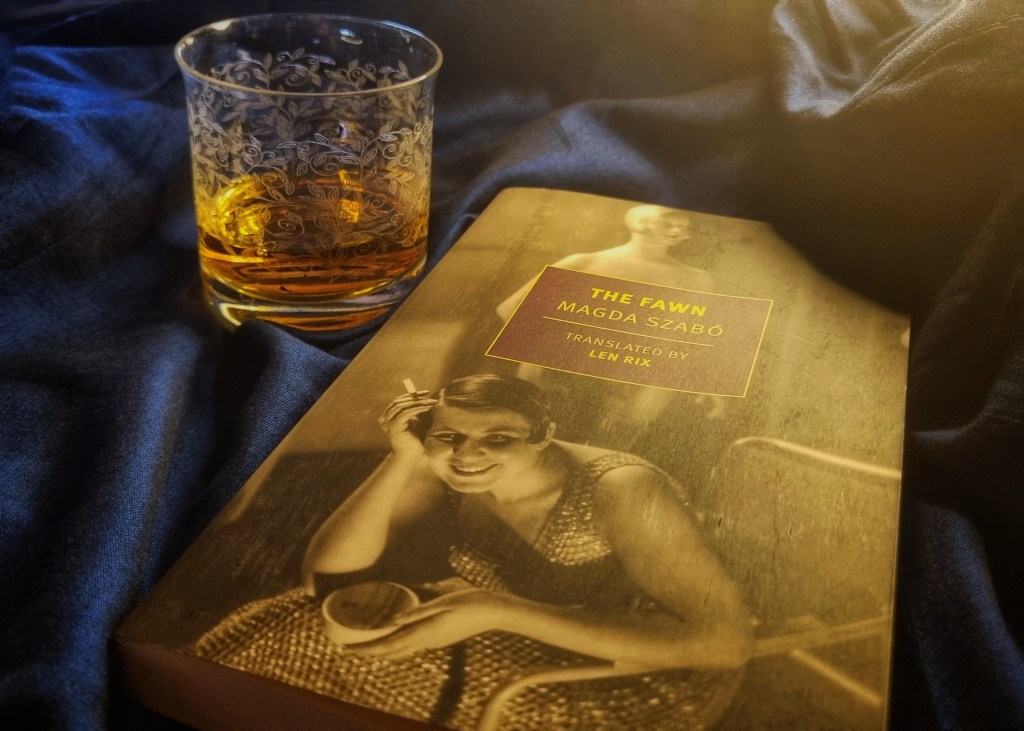
“I wanted to be with you sooner…” This first line, a faint melody, I imagine played by a solitary piano. This unwavering, melancholic undertone, suggesting that Eszter Encsy is addressing someone who is no longer in her life.
There is a calm, almost cold, but delicate aching to be accepted and understood. Recollections of childhood come across as confessions and explanations… including that time she did not mean to kill the fawn.
But how did that seemingly dispensable incident earn the title of the book? Perhaps the fawn is meant to symbolize the fragility of youth, and how easily it can be broken.
Magda Szabó, who died with a book in her hand, has bequeathed to the world novels that aim straight for the soul. She wrote of women; women who do not have to be faultless. She did not demand heroics from them or for them to be worthy of admiration or to be idealized. She only asked that they live — live intensely, and learn.
And yet, I did not expect her to go to the extent of Eszter. The moral puzzles are not vague here, it is made quite clear what kind of person we have as a central figure right from the beginning: “I could never have undertaken to be a good girl and never to tell lies…” “I lie so easily I could have made a career out of it…” “I was also laughing at the monster I really am…” “I wasn’t a very nice person and I wasn’t very friendly…”
We immediately get the picture. Appalled, we double-check the synopsis, even though Szabó readers know that her synopses hardly describe what one encounters between the pages. But we read on. Because Szabó is brilliant. Because we suspect that a gut punch or two awaits round the bend. Because oftentimes, nothing is what it initially seems. Because she writes of those difficult spaces between people that most of us are too inattentive, too timid, or too unimaginative to explore. Because we know that behind all her stories is a carefully woven leitmotif of a history she mourns. Because Szabó is always subtly reminding us of consequences, of how we cannot extricate our personal histories from that of our nation. Because she is eternally thought-provoking, and therefore, rewarding.
…and because those elegiac strains from that lonesome piano will linger long after you’ve turned the last page.
The long-awaited arrival of these two books thwarted an existing reading itinerary. His Palace of Dreams that warn against authorities who take away even the freedom of dreams was enough to make me want to read more after that first Ismail Kadare experience in 2021.
Why the inaugural winner of the International Booker Prize is not as widely read as other foreign authors in this part of the world puzzles me, especially when his stories continue to be remarkably resonant. When his allegories of tyrannies and his parables about the threats of imperialism are redolent of current events, I think we should all be reading a Kadare or two.
Curious as to how it would resemble or differ from The Bridge on the Drina, a novel by another Balkan literary giant, Ivo Andrić, I was eager to cross The Three-Arched Bridge. While I love Andrić’s rich and lengthier novel, Kadare’s has the surprising texture of a fable that makes it easier to read despite the dark subject matter.
It is 1377, Byzantium is in decline, and the new Turkish state is a looming threat to the Balkans. A bridge is being built somewhere in the peninsula and Gjon the Monk decides to tell its story, “To stop them spreading truths and untruths about this bridge in the eleven languages of the peninsula… to record the lie we saw and the truth we did not see and to put down both the daily events that are as ordinary as stones and also the major horrors, which are about as many in number as the arches of the bridge.”
The construction of the bridge encounters various obstacles and seems to be cursed. The setbacks lead to the recalling of an old Illyrian legend where immurement as sacrifice for the completion of a castle was necessary. In due course, an immurement is committed for the success of the bridge: A chilling metaphor for the new worlds and ideals founded on blood and, perhaps, a disturbing reminder of what is often sacrificed in the name of progress.
The writing left a significant impression on me, once again, that I jumped straight into the fray of The Siege wherein I felt amazed to have been held in thrall by the intricacies of fifteenth century military strategies. The “necessary” presence of architects, engineers, poets, chroniclers, astrologers, and the harem on the battlefield adds to the madness of war. Warfare might have evolved greatly since then, but man hasn’t. The Kadare straightforward with his prose is suddenly generous with details and delightfully ridicules war and testosterone, bringing to mind a line from Svetlana Alexievich who wrote, “War smells of men.”
What it has in common with The Three-Arched Bridge is that both books are seen through the eyes of chroniclers, opening a window to how history is written and made. The Siege unfolds through the impressions of Mevla Çelebi for the Ottoman camp (which probably alludes to real-life Ottoman traveller and writer, Evliya Çelebi), and an unnamed observer in the besieged Christian citadel.
In another twist of creativity that makes this my favorite among the three Kadares I’ve read so far, the narrative is focused on the besiegers, and with this brilliant move we are made privy to the thoughts and intents of those who intend to conquer or wipe out an entire people — “We could take their language,” or their religion: “You can’t call a country conquered until you have conquered its heaven… everything that has to do with the soul.”
Trust Kadare to embed a powerful message in an easily overlooked passage, a lesson in what a people must guard and defend — Everything that has to do with the soul.
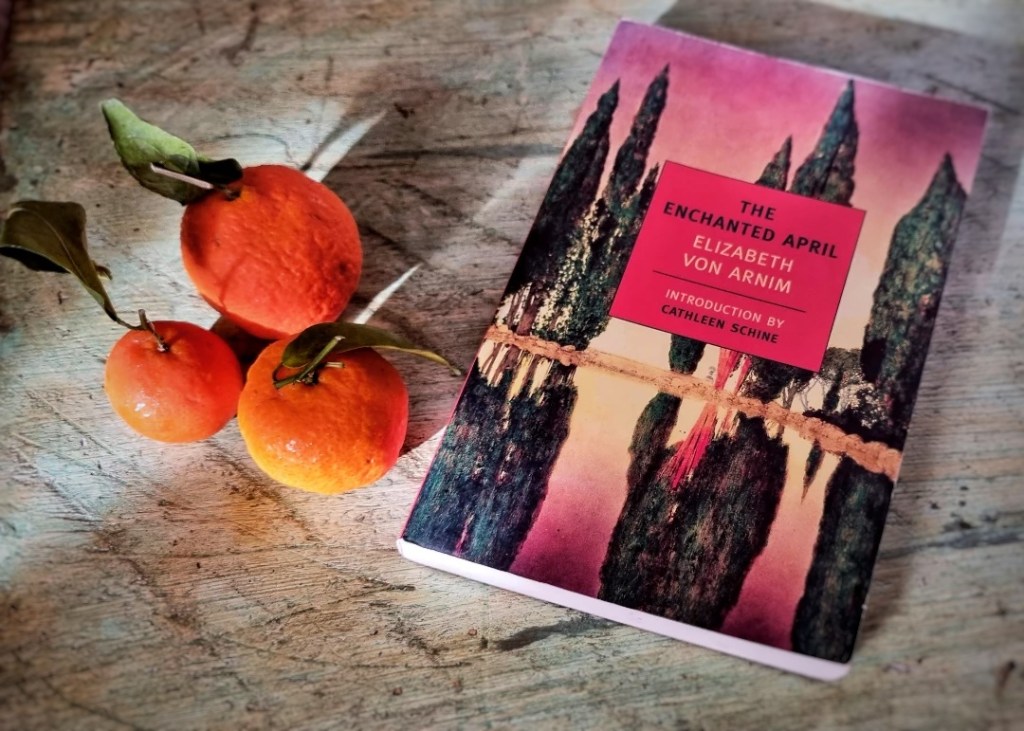
Reading this at a time when happiness eludes me and only a Turkish word can describe the sadness I feel, a time when the world is in disarray and the cynic in me is more pronounced than I want it to be, it is easier to argue that true beauty, real freedom from the male world’s sway, and lasting transformation surely take more than suggested by this book — but I am also a believer in the wisdom of surrendering to the restorative power of spending a month in a villa in Italy, flowers, rest, and the sea. Oh, I’d take these any day!
It is a truth universally acknowledged that one should not carp about novels like this. You simply open your heart to it, cease overthinking, and allow it to happen — the way you’re supposed to with sunshine, a little frivolity once in a while, and happiness.
So if this book were set to poetry, it would be this poem by Lydia McGrew:
When joy alights like a bird on a fence post arrested in fragile flight, do not frighten her away.
When she comes in the clutch of the heart at the scent of the evening air instinct with life and memory, in the grey-blue of the sky at twilight, in the sweep of the pine tree to the sky,
Do not say, There are depths to be plumbed, There are knots to be worried at. I have no time for this.
Nor listen to the more insidious voice that lectures, Death and disease roam the streets. Pitiless murder with bloody sword unsheathed stalks all the ways of the world, and beauty and innocence fall before him. What right have I to be happy?
Rather stand still, And say,
It is a gift.
And with that, I wish us all an enchanted April, and the wisdom and grace to submit to happiness when it beckons. 🤍
“To me, it has always seemed that each individual has such a moment. It is a fixed point in eternity, varying with each person, which they reach, sooner or later, in their trajectory through time. It is this moment which most perfectly expresses them, and to which essentially they belong, in which they live most fully. Both before and after, some awareness of this lies within them, so that in varying degrees of consciousness, they are seeking that moment in order to be fulfilled, or to find again in that fulfillment and setting, the persons who shared it with them.”
“A lifetime or a moment is all the same; a whole cycle lived richly, or thinly, one day. Each can prove to have been the meaning of a life. We cannot know, from where we stand. But if we seek, and are aware we have missed the moment we seek, our own absolute moment in time, then we live out our lives unfulfilled. In the words of an eastern proverb: we die with our eyes open — we cannot rest; even in death we are still looking for it.”
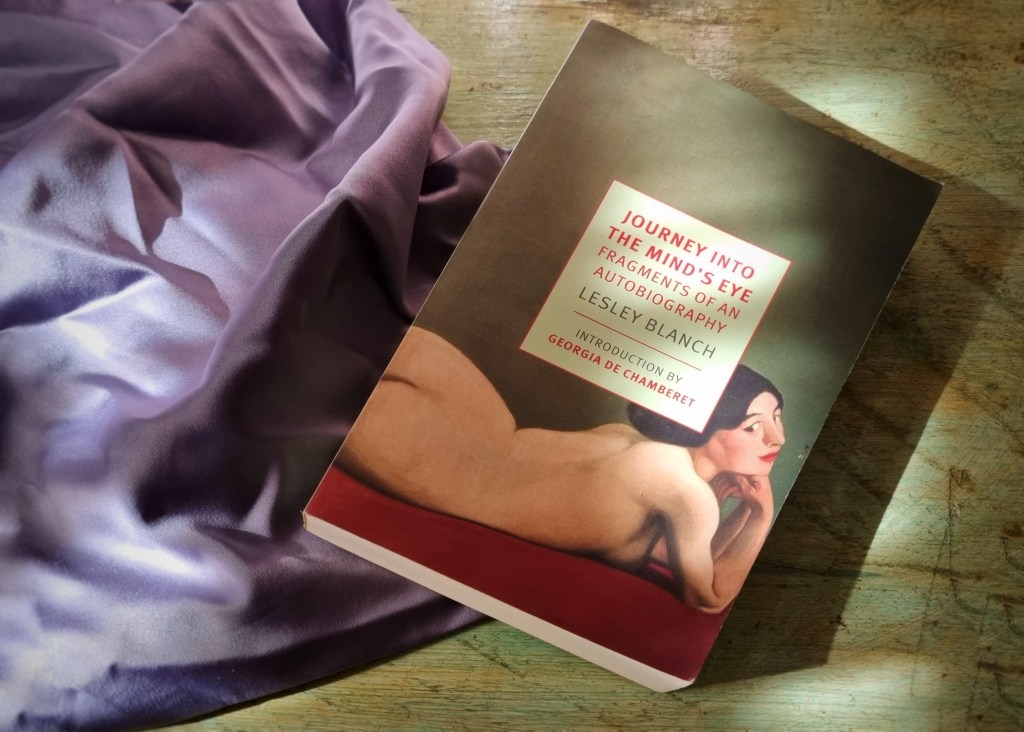
Never mind that her longings for a lost love and mine mingled as I luxuriated in the pages of this book. Never mind that some details will raise the eyebrows of conventional social constructs. (“Overweening conventions! They have us in a stranglehold from the cradle to the coffin,” writes Lesley Blanch.) Never mind the question of whether the Traveler corrupted her life or enhanced it; I have two opinions as contrasting as East and West. What is certain is that this woman ended up living by her own rules and did not lead a lackluster life.
But to have bookshelves spilling over because of a geographic fascination and to have the books arranged by region; to have literary tastes swayed topographically; to explore entire worlds by turning pages; to spend hours on long bus rides poring over books; to have “everything I saw, or read, ate, or thought tinctured by my infatuation”; to travel and be particular about the precise lighting in which to see certain places because they look more beautiful in morning, noon, or afternoon light; to find areas of conflict irresistible and be chided for having “such violent desires”; to journey into the mind’s eye or into the heart of another; to see traveling as an act of “following a strain of fugitive music” — I’ve never felt this aspect of myself more probed and understood, that I wish I came across this book much sooner.
There are allusions to be unveiled in the captivating writing, and there are lessons to be gleaned from the interaction between cultures, but the line I’ll take to heart is, “Don’t be so finite,” said the Traveler.
Lesley Blanch lived to be a hundred and three, unapologetically, and infinitely.
“And Arundhati Roy wrote a ravishing novel, The God of Small Things, that catapulted her into international stardom, perhaps so that when she stood to oppose dams and corporations and corruption and the destruction of the local, people would notice… Perhaps they opposed the ravaging of the earth so that poetry too would survive in the world.”
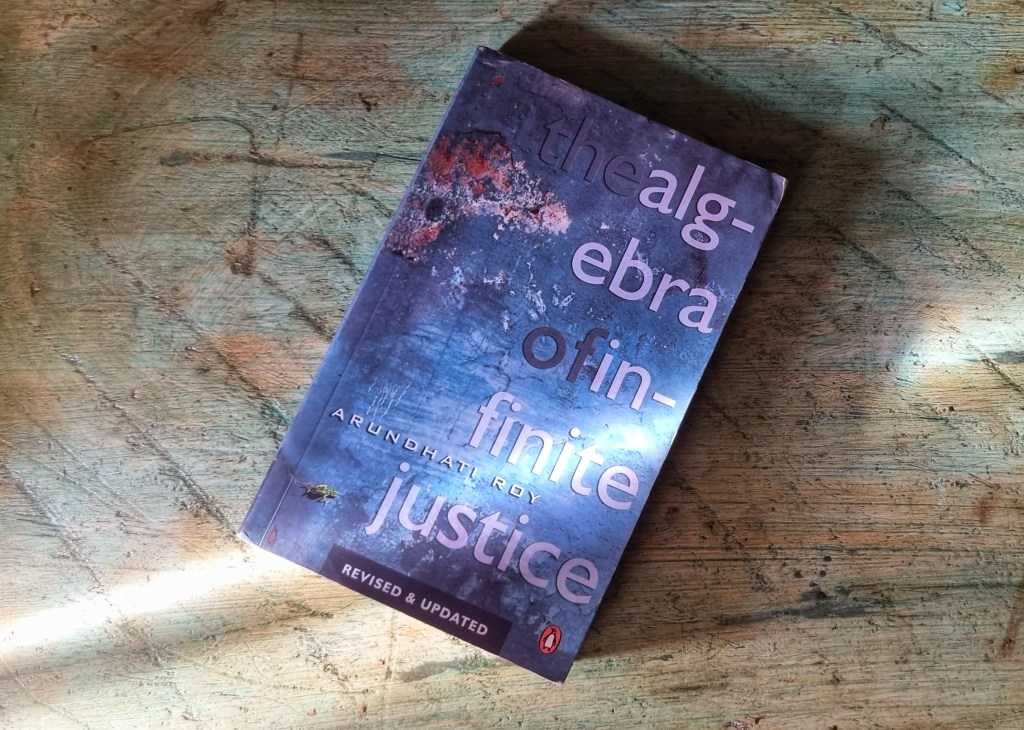
This beautiful passage is from Rebecca Solnit’s Hope in the Dark, and The Algebra of Infinite Justice is Arundhati Roy’s book of essays that opposes dams and corporations and corruption and the destruction of the local.
People did take notice, and many of them attacked her and accused her of all sorts of things for it. She was also criticized for not providing enough solutions by those who lost sight of the fact that before we can arrive at solutions, we have to take the first step and pinpoint the problems and ask the uncomfortable questions. This, she does. Courageously.
She asks about the necessity of nuclear weapons acquired in the name of “deterrence”, knowing that it is a matter that concerns humankind. “The nuclear bomb is the most anti-democratic, anti-national, anti-human, outright evil thing that man has ever made. If you are religious, then remember that this bomb is Man’s challenge to God. It’s worded quite simply: ‘We have the power to destroy everything that You have created.’ If you’re not religious, then look at it this way. This world of ours is 4,600 million years old. It could end in an afternoon.” On a relative scale, the same can be said of guns.
She aims questions at those who rail against the first world, but “actually pays to receive their gift-wrapped garbage”; she asks if corporate globalization is a mutant variety of colonialism; asks whether the building of dams are not “a brazen means of taking water, land and irrigation away from the poor and gifting it to the rich”; asks who and what has been sacrificed in the altar of “National Progress”; asks how Progress can be measured if we are not even aware of who has paid for it, referring to the millions of people and entire ecosystems displaced or extinguished by dams (a matter Filipino readers should not brush off — even our very own Gideon Lasco has called awareness to the environmental and sociocultural impacts of the Kaliwa Dam Project in the Philippines).
She asks everyone to be accountable: “Isn’t it true that there have been fearful episodes in human history where prudence and discretion would have just been euphemisms for pussilanimity? When caution was actually cowardice?”
“Fascism itself can only be turned away if all those who are outraged by it show a commitment to social justice that equals the intensity of their indignation. Are we ready… to rally not just on the streets, but at work and in schools and our homes, in every decision we take, and every choice we make?”
But I am most grateful for what resides with the difficult questions in that elegant mind of hers: “There is beauty yet in this brutal, damaged world of ours. Hidden, fierce, immense. Beauty that is uniquely ours and beauty that we have received with grace from others, enhanced, reinvented and made our own. We have to seek it out, nurture it, love it.”
“All we can do is to change its course by encouraging what we love instead of destroying what we don’t.”
“The only dream worth having… is to dream that you will live while you’re alive and die only when you’re dead…”
“Which means exactly what?”
“To love. To be loved. To never forget your own insignificance. To never get used to the unspeakable violence and vulgar disparity of life around you. To seek joy in the saddest places. To pursue beauty to its lair. To never simplify what is complicated or complicate what is simple. To respect strength, never power. Above all, to watch. To try and understand. To never look away. And never, never forget.
In truth, these are as difficult as the questions, but who says these are not solutions?
“Finally, I would like to say, I intended to write… not just in Turkish, but in the language of all who lament for the dead. And I intended to write it with the language of figs…”
The 1920 Treaty of Sèvres that was signed between the Allies of WWI and the Ottoman Empire is not explained here. There is nothing here that mentions how it marked the beginning of the partitioning of the empire, how Armenia was subsequently recognized as an independent state and a referendum was scheduled to decide the fate of the dream of a Kurdistan, but nothing of how the referendum never took place. No details of what exactly happened when the Kurds within Turkish borders clashed with Turkish nationalism; nothing of the decisions, events, or indecisions that led to the extermination of more than half of the Kurdish population in Turkey by 1938.
Throughout the book an unnamed and unidentified narrator addresses a woman muted by grief and coaxes her, not to speech, but to remembrance — a remembrance not of a specific event but of her spiritual and personal history, and the ancient mythology of her people; and I believe here lies the genius of this novel. Without explicitly saying that this book is about identity, Sema Kaygusuz makes this book wholly about identity.
Out of the silence roars a powerful voice that resists all attempts at wiping out Kurdish identity. I have come to understand that this book is, above anything else, a rallying cry for the Kurdish people: For them to never forget who they are. To never give in to the silencing, and to never allow grief to estrange them from who they really are.
What is between these pages is something that we won’t find in the chronologies of history. What is written here is more profound. In this novel that reads more like a lengthy poem, Kaygusuz achieves the impossible task of giving shape to grief and silence, and intimating a manner of history that can only be expressed through obmutescence or poetry.
“Finally, I would like to say, I intended to write not just in Turkish, but in the language of all who lament for the dead. And I intended to write it with the language of figs… the fig tree whose fruit has, over the course of the history of civilization, seduced and destroyed, poisoned and healed, struck panic in those captivated by its pleasure, and been served like jewels at the tables of kings, pharaohs, and sultans — in order that I might set aside its vitalizing force, its enviable adventure, in writing. What I mean to say is that, over the course of this novel, I am not only my grandmother who survived the massacre: I am also her granddaughter, I am Hizir, and I am a fig, with its countless tiny seeds. Each of us has written the others into being.” — from the Afterword of Every Fire You Tend by Sema Kaygusuz
Thank you for knowing exactly what I’d love to read and for lending me your copy, Gabi. Always grateful. 🤍







 The Book-Butterfly