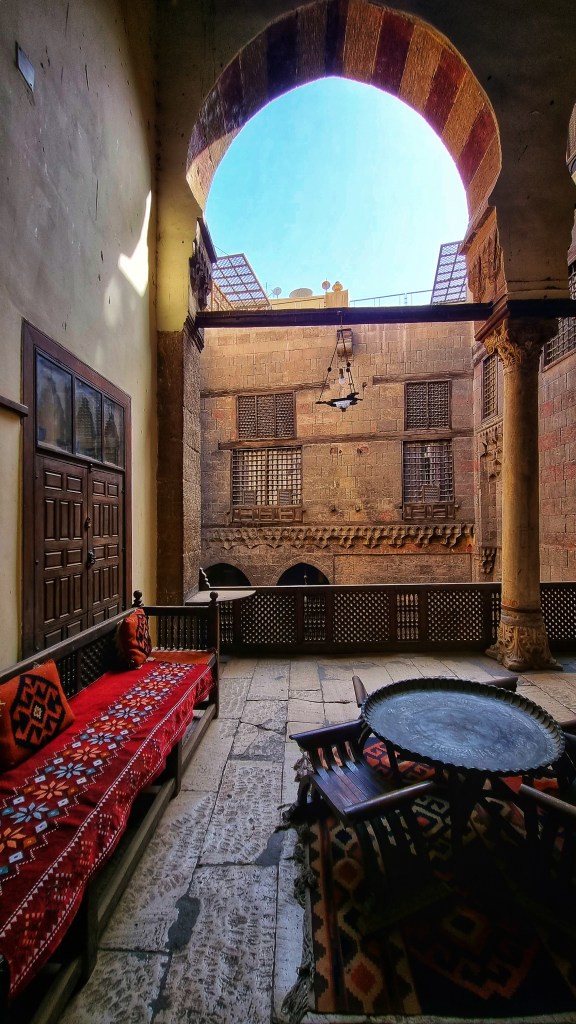
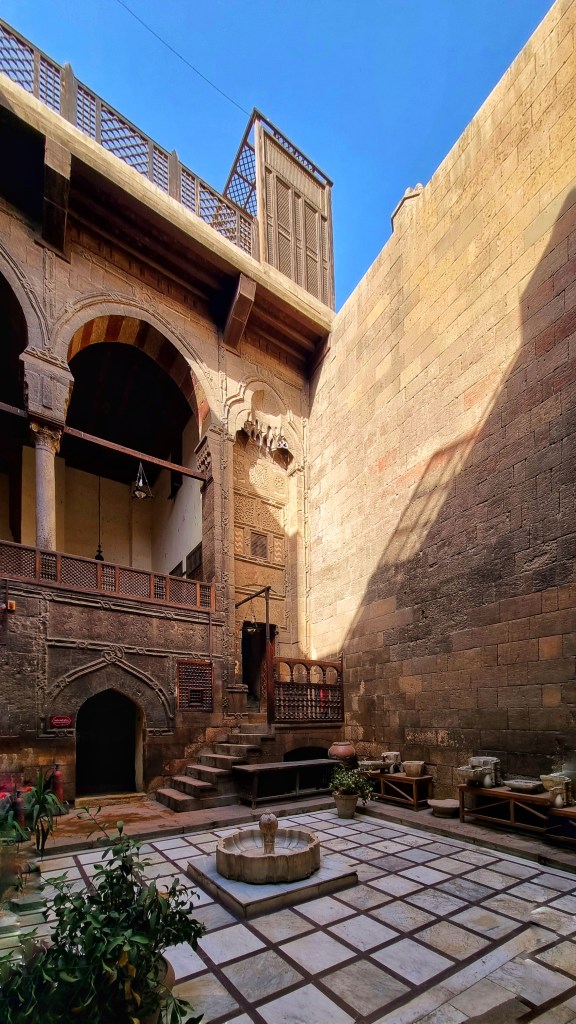
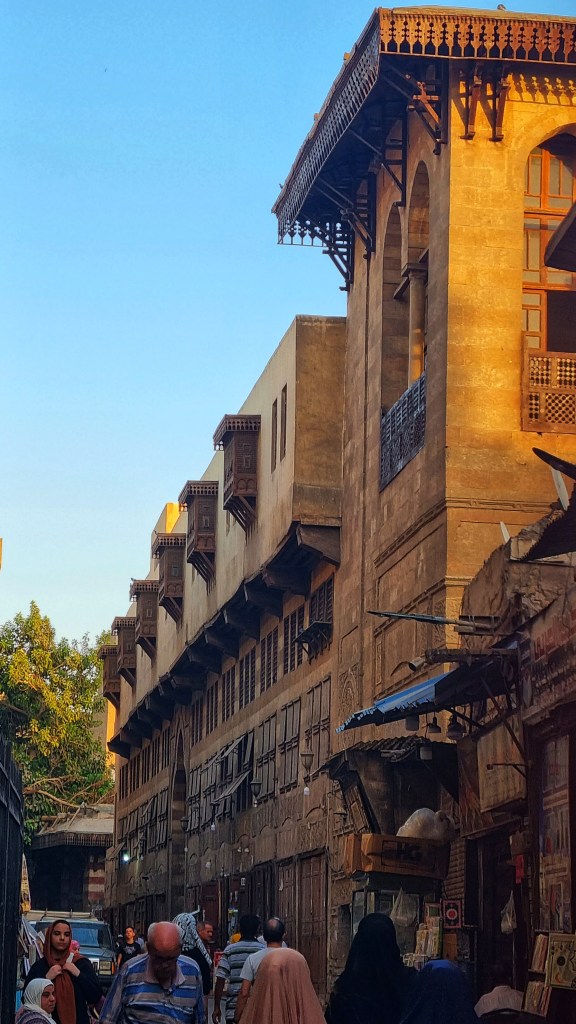
Old Cairo’s dust and cacophony remind me of Kathmandu. But instead of Hindu temples or Buddhist stupas, mosques and minarets. Instead of Newari tiki jhyas, Arabic mashrabiyas.
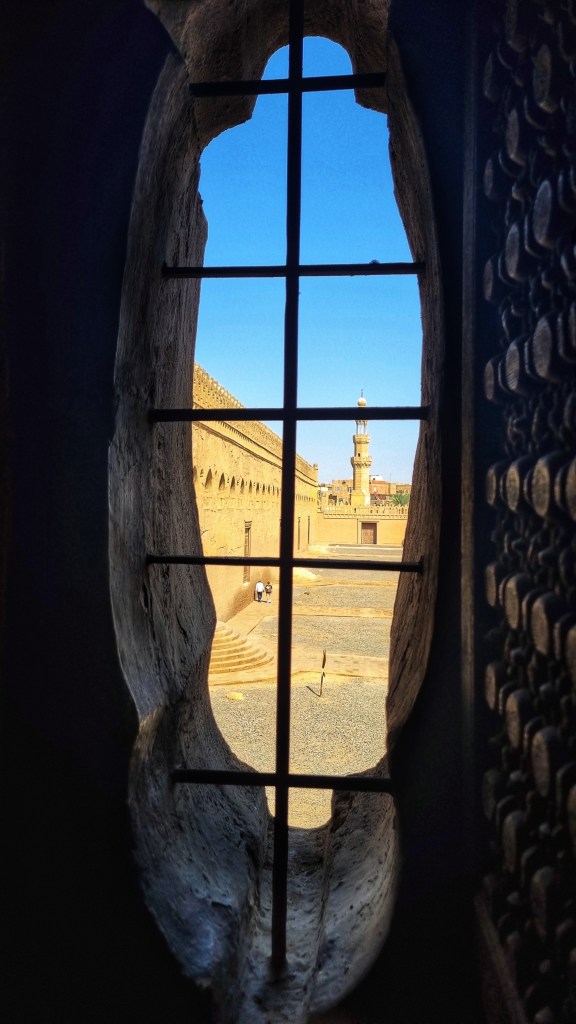
These windows with intricate latticework are some of my favorite features of traditional Islamic and Newari architecture. They seem to me embodiments of how a thing of beauty and tradition can become a refuge or a prison, and it is for you to decide. Moreover, these similarities in architectural identities make me wonder at the extent and influence of the Silk Route.
But what’s beautiful about these places of endless excitement is when you explore beyond the chaos and pass through their exterior, and find pockets of poetry and enchanting silence. I usually find what I’m looking for behind these latticed windows.
The Pyramids of Giza seen from the Citadel of Saladin.
Several friends wondered why I hadn’t gone crawling straight to the pyramids as soon as I arrived.
That’s because the Cairo presented to me by beloved authors goes beyond travel packages, tour groups, and cookie-cutter experiences; and so I was aware that there was another Cairo I wanted to savor apart from the pyramids and pharaonic Egypt.
But even though it would take me over two incredible weeks after landing in Egypt to get close to the Pyramids of Giza, my first glimpse of the pyramids took place on my second day as I was exploring the Citadel of Saladin. Saladin, or Salah ad-Din Yusuf ibn Ayyub (1137 – 1193), founder of the Ayyubid dynasty — one of my favorite historical characters.
This strategic fortress with a commanding view of Cairo that he built on the Mokattam Hills was the seat of government in Egypt from the time of his rule up until the 19th century.
Within the fortress walls are magnificent architectural exemplars of Ayubbid, Mamluk, and Ottoman architecture that bear proof of the major Islamic eras that Egypt underwent.
To the untrained eye, Old Cairo’s mosques and minarets look similar, but I have learned that there are differences between Umayyad, Abbasid, Fatimid, Ayyubid, Mamluk, and Ottoman architecture that manifest the vastness of the umbrella term that is Islamic Architecture.
Khan al-Khalili at Khan al-Khalili.A Mahfouz mural framed by chicken cages.
The Cairo that was introduced to me as a reader was not the Cairo of travel posters. The same way that the Istanbul I know is the Istanbul seen through the soul of Orhan Pamuk, the Cairo I know is the Old Cairo of Naguib Mahfouz.
If you’ve read works of both Nobel laureates, you can attest that the constant main characters of their novels are the cities of their birth.
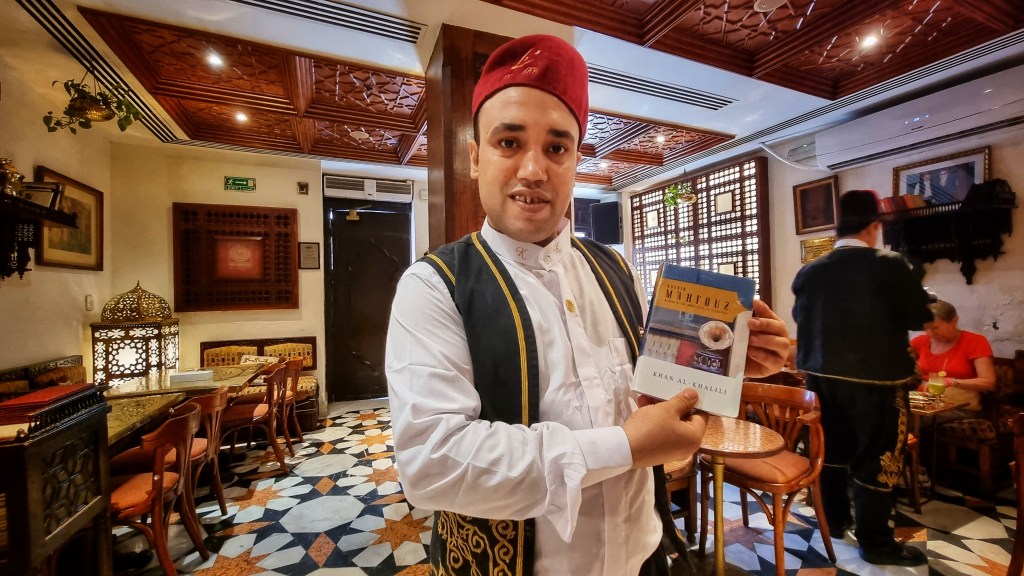
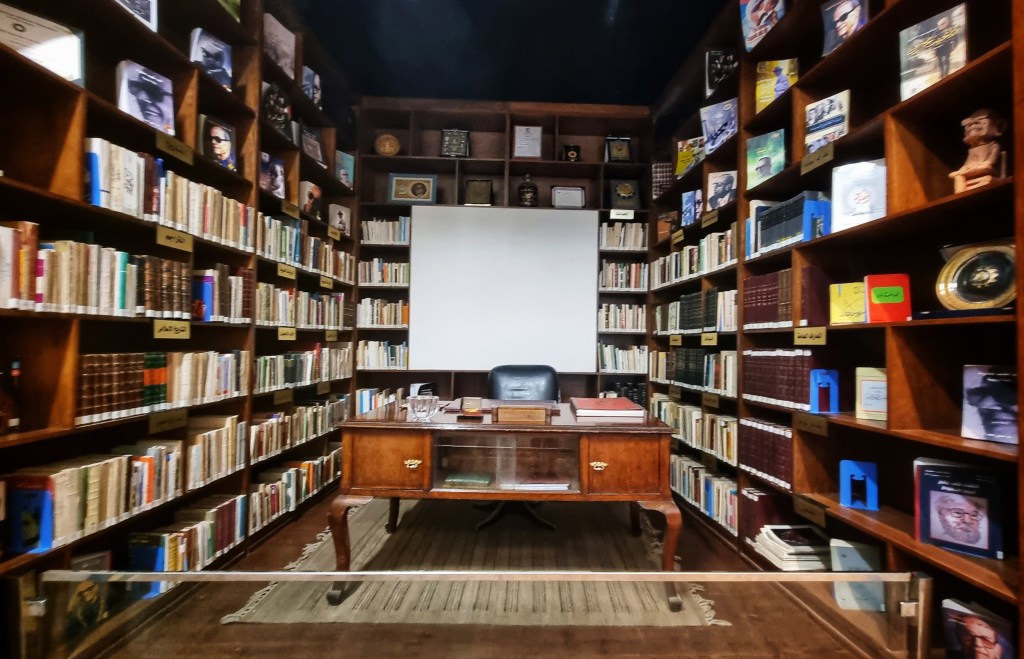
And just as I crossed to the European side of Istanbul to visit Pamuk’s museum, the first thing I did after only a few hours of sleep post-MNL-DIA-CAI flights was to visit the Naguib Mahfouz House Museum and the Naguib Mahfouz Coffee Shop (a coffee house Mahfouz used to frequent so that when he was awarded the Nobel, the owner renamed it in his honor).
A special display of the author’s books.
On Google Maps, the distance between the two establishments is near. But I turned out to be like an Israelite who fled Egypt and wandered for 40 years traversing a distance that can be done in 9 hours and 5 minutes by car, if you consult Google Maps.
The confused directions came from locals who mistook the coffee shop for the museum and vice versa, and this had me going in circles. It took me a while to finally realize what was going on. But it was as if Mahfouz planned the excursion himself. He did not want me to have it easy. I had to experience his Cairo before arriving there — the Cairo of chaos, of spices, of squawking chickens, of tantalizing fragrances and unpleasant smells, of shouting vendors, dirt, heat, of wonderfully claustrophobic alleys, of uncomfortable stares but also friendly and curious smiles. What I saw today was not the sugarcoated Cairo, and definitely not the whitewashed Cairo. It was the Cairo I came a long way to experience.
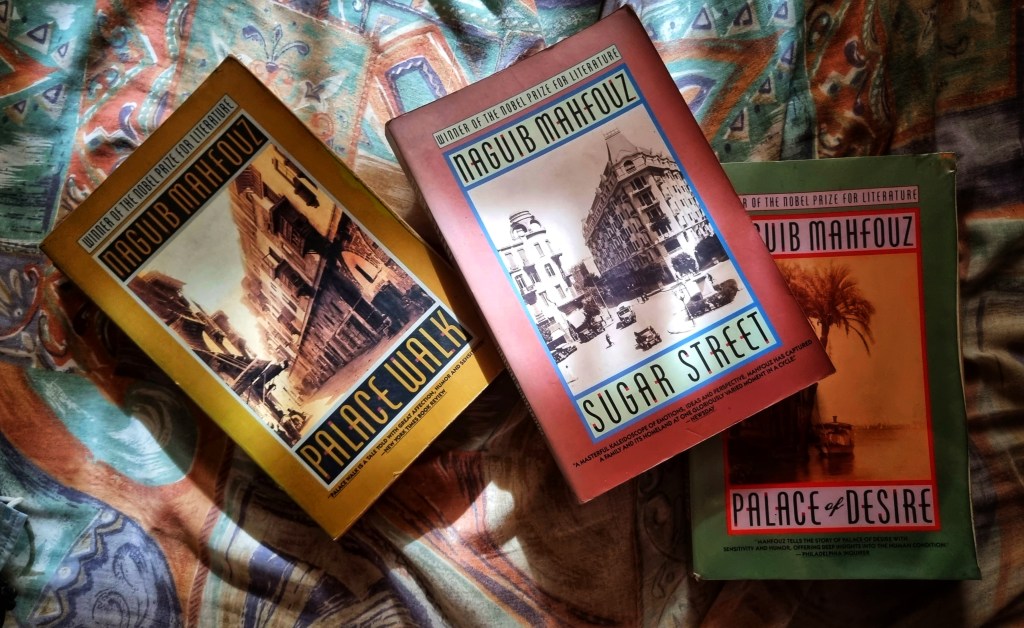
There are better editions with attractive new covers now. Mine still carry the designs of the first American edition of the English translation, but I love how the first volume depicts the antique mashrabiyas of Old Cairo. These projecting windows with intricate latticework are some of my favorite features of traditional Islamic architecture. They seem to me exemplars of how a thing of beauty and tradition can become a refuge or a prison.
And yet, not even these mashrabiyas could shield Ahmad Abd al-Jawad and his family from life, love, death, and a changing world.
It is often said that the Cairo Trilogy is a family saga spanning three generations, from the period of the Egyptian revolt against British colonizers in 1919 to the final days of the Second World War. But it is more than a family saga: It is an astute record of a society, a city, a nation, and a world in transition.
I admit that I found good reason to put the first volume down. I was constantly infuriated by how women were perceived and treated by the male characters, by how men justified their immorality and hypocrisy and got off scot-free while women were punished severely for the most innocent blunders, and by how women themselves accepted this as the natural order of things. Those passages were deeply frustrating.
But Mahfouz’s exquisite storytelling carried me through. He does not so much describe Cairo as transport me there — into the volatile political scene of an Egypt yearning for independence, through its wondrous or disreputable backstreets and alleys, and especially into the women’s cloistered lives so I could hear the questions brewing in their hearts, and eventually to the reflection of society’s gradual development through the change in attitude toward women and their education.
In this trilogy, imperial tyranny juxtaposes with tyranny in the family, but through it all, an incredible compassion and empathy emanates from Mahfouz who humanizes everyone, even the tyrants.
Before I knew it I was at the final page of the last volume, not quite ready to let go, and contemplating on the fact that I had just read one of the finest works of literature ever written.
Cleopatra’s era is closer to the invention of the iPhone than it is to the construction of the pyramids of Giza. A podcast episode that I listened to years ago pointed this out. The fact still blows my mind. When they are mere numbers written on a page, the breadth of history’s timeline cannot be fully grasped until such a comparison is made; but to make those epochs come alive is a task for the novelist.
Khufu’s Wisdom is set in Ancient Egypt’s Fourth Dynasty (circa 2625 – 2500 BCE). Khufu, also known as Cheops, whose sarcophagus rests in the Great Pyramid of Giza, is the pharaoh to whom Egypt’s biggest pyramid is commonly attributed when people are not busy attributing it to aliens. Rhadopis of Nubia in the Sixth Dynasty (circa 2350 – 2710 BCE), gravitates around a courtesan and King Merenra’s short-lived reign. Thebes at War, set between the Seventeenth to Eighteenth Dynasty (1630-1292 BCE), reimagines the interval when Egypt was ruled by the Hyksos or “foreign kings”.
I have read several works by Naguib Mahfouz before taking on this trilogy but have found this to be the easiest to read and the most entertaining thus far! Yes, the language is grand and often pompous — it has to match its pharaonic subjects! Yes, some details can be politically incorrect by today’s standards — the publication years of each volume are as follows: 1939, 1943, and 1944! But reading this made me feel like a very young girl again; one who cannot help but be swept away with abandon into wondrous tales of the past. How I was able to imagine the stories as grand cinematic adaptations in my head is proof of Mahfouz’s skill as a storyteller!
Although the stories are easy to read, they are not as simple as they seem on the surface:
Khufu’s Wisdom is a classic contemplation on fate and duty, and about the difficult submission to both. My favorite passage comes from a secondary character who asks the protagonist, a skilled warrior, “And now, tell me, are you reading anything useful? …the virtuous mind never dismisses wisdom even for a day, just as the healthy stomach does not renounce food for a day… The virtue of the science of war is that it trains the soldier to serve his homeland and his sovereign with might, though his soul does not benefit at all. And the soldier who is ignorant of wisdom is like the faithful beast — nothing more… if the soul isn’t nourished by wisdom then it sinks to the level of the lesser creatures.”
It was in Rhadopis of Nubia where I felt the political undertones deepen. While it also questions the role of beauty and art, there are questions posed to corruption in theocracies and the tricky relationship between king and clergy. In the hall of Rhadopis, politicians and all manner of men gathered to be entranced, even though it was believed to be a most dangerous thing to set eyes upon her. Her tragic tale left me wondering whether she inspired Salman Rushdie’s Enchantress of Florence and whether she is, as I continue to reckon Rushdie’s enchantress, an allegory for Power.
Thebes at War is the most dramatic out of all the three and a most fitting finale for the trilogy. It is where one will find this line, “Weeping is no use, gentlemen. The past will disappear into ancient times and obliteration so long as you are content to do nothing but mourn it.”
Mahfouz is a man who did more than mourn Egypt’s past. He has built literary edifices forged from existing architectural wonders and archaeological findings, constructed modern allegories out of ancient lives and times, and transformed them into timeless political missives — knowing that there will always be those who are doomed to forget and repeat the follies of history.
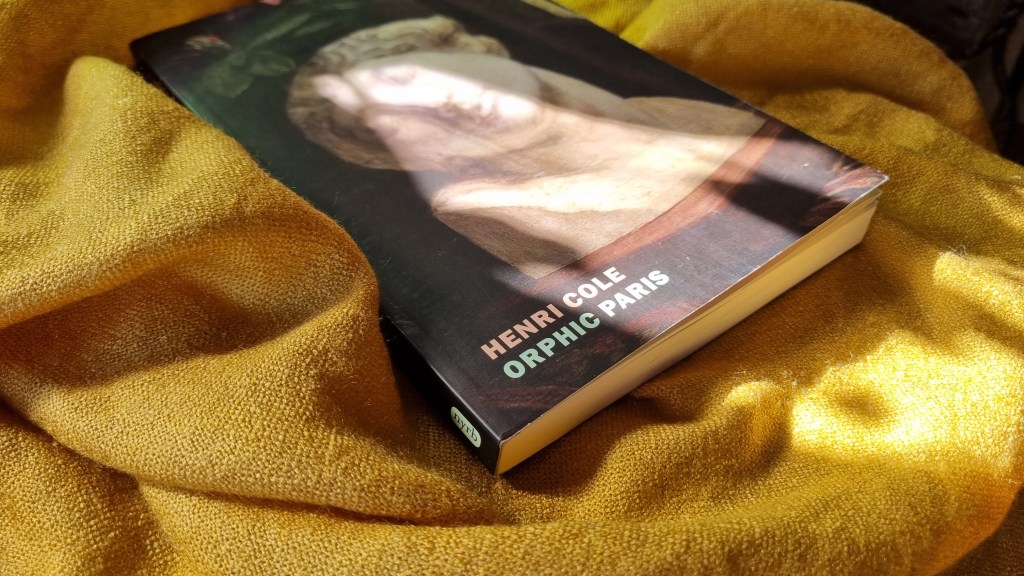
Portraits: Of a young Rebecca Solnit finding, and fending for, herself; of the nature of dictatorships and revolutions by Ryszard Kapuściński; of Eastern Turkey under the veil of its dramatic landscapes by Zülfü Livaneli; of Paris and the poet through the vantage point of Henri Cole; of the unfortunate visage of Skylark by Dezső Kosztoláni. These are some of the extraordinary faces I met on this month of May.
It is not nearly celebrated enough, says Solnit: “The sheer pleasure of meeting new voices and ideas and possibilities, having the world become more coherent in some subtle or enormous way, extending or filling in your map of the universe…this beauty in finding pattern and meaning,” this thing called Reading.
Even so, here we are. The readers (ironically, the ones least concerned about faces), the ones who, by turning each page, celebrate best these encounters, these awakenings, these flights.
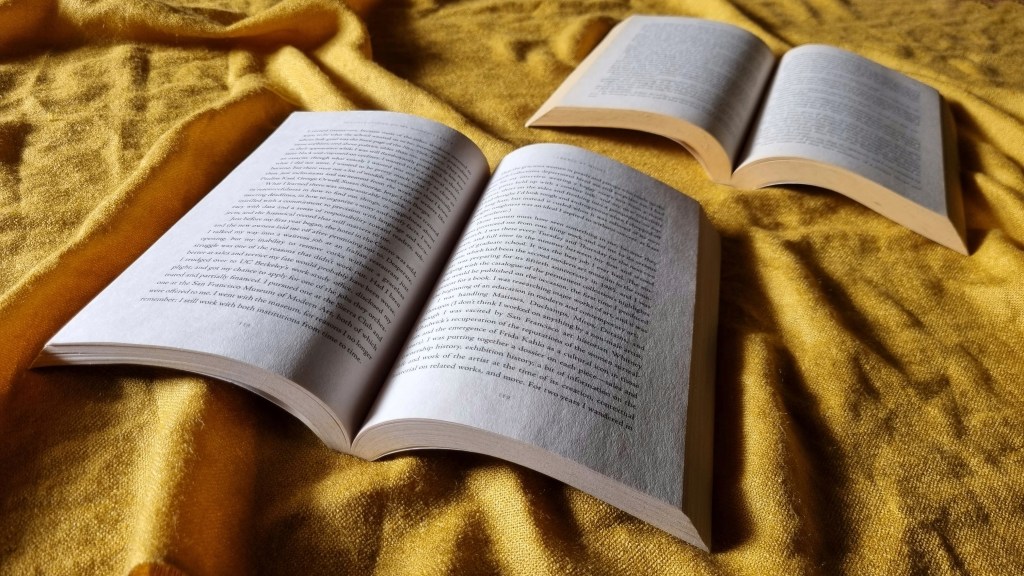
“At least I had books. Closed, a book is a rectangle, thin as a letter or thick and solid like a box or a brick. Open, it is two arcs of paper that, seen from the top or bottom when the book is wide open, look like the wide V of birds in flight.” — Rebecca Solnit, Recollections of My Nonexistence“I’ve always believed that poetry exists in part to reveal the soul’s capacity for compassion, sacrifice, and endurance. For some of us, this satisfies a basic human need, like air or water, but a poem must also have music, imagery, and form. Because there is a kind of nakedness or authenticity in poetry that is associated with truth, on many days I haven’t got the guts for it, and I fail. But when I succeed, there is nothing in life — except love — that equally verifies my existence.” — Henri Cole, Orphic Paris
“Maybe I’d been captivated by a story. Yes, I’d been captivated by a story, by a culture, by a history; can a person be smitten by a story? Clearly it does happen…”
Indeed. That is why this book found me. Friends probably know by now that I am drawn to the stories, the cultures, and the histories encompassing what used to be called the Fertile Crescent and the lands that have carried the veins of the Silk Route.
Kurdistan is no exception. Accessible literary works from or about this region is so scarce that I value every volume I can get my hands on. While I have yet to experience books set in Iranian and Syrian Kurdistan, which I imagine must be breathtaking, I have been fortunate to have read about Iraqi Kurdistan [The Beekeeper of Sinjar by Dunya Mikhail (Serpent’s Tail), The Last Pomegranate Tree by Bachtyar Ali (Archipelago Books)] and Turkish Kurdistan [The Wounded Age and Eastern Tales by Ferit Edgü (NYRB), Every Fire You Tend by Sema Kaygusuz (Tilted Axis Press), and Disquiet by Zülfü Livaneli (Other Press)].
The Beekeeper of Sinjar, The Last Pomegranate Tree, The Wounded Age and Eastern Tales, and Every Fire You Tend are all beautifully written books that have led me to believe that the sorrows of this place are too profound, they can only be expressed through metaphors, silence, or poetry.
Disquiet tells the story of Ibrahim, a journalist based in Istanbul, who is drawn back to his hometown of Mardin to investigate the death of Hussein, a childhood friend. As Ibrahim digs deeper, he becomes enmeshed in Hussein’s past, haunting stories of Yezidi Syrian refugees fleeing ISIS, and recollections of his city’s more harmonious days: “Those were the festive days when Assyrians, Muslims, Zoroastrians, including Parsis, mingled in the marketplace and at school and celebrated one another’s holy days… But now the atmosphere was closed, the city had been darkened by the shadow of a sterner, angrier Islam… Now as I walk the streets they seem darker… this was a city living in fear, caught in the middle of conflicts between ISIS, the PKK, and the state security forces.”
Among the aforementioned books, Disquiet has the most direct prose; and therefore, a good introduction to this region that also allows a worthy glimpse into the Yezidi faith and the painful plight of its adherents. I suspect that what I think are weak spots in the novel owe to the translation but which thankfully do not distract the foreign reader from the eye-openers; from the call to be disquieted about the atrocities; the reminder that Turkey is not a single entity and that even Turks from the westernmost cities cannot always identify with the languages, beliefs, traditions, and cultures of the Mesopotamian lands of eastern Turkey.
And for some reason, I love how the narrator still refers to this grand swathe of land as Mesopotamia — the birthplace of literature.
“I asked him why, if there are faiths in every corner of the world, those that emerged from the Middle East had spread throughout the world. Did we commit the most sins, were we in more need of salvation than anyone else?
I detected a faint smile beneath his grizzly mustache. The answer to this is kalam, he said, the word. In this world nothing affects people as much as the word. The Middle East is where the word reached its zenith — no other region’s poetry, legends, or fairy tales are as powerful, none other have this much power to influence the human heart. That’s why the poets here are classified as magicians.” — Zülfü Livaneli, Disquiet
“To me, it has always seemed that each individual has such a moment. It is a fixed point in eternity, varying with each person, which they reach, sooner or later, in their trajectory through time. It is this moment which most perfectly expresses them, and to which essentially they belong, in which they live most fully. Both before and after, some awareness of this lies within them, so that in varying degrees of consciousness, they are seeking that moment in order to be fulfilled, or to find again in that fulfillment and setting, the persons who shared it with them.”
“A lifetime or a moment is all the same; a whole cycle lived richly, or thinly, one day. Each can prove to have been the meaning of a life. We cannot know, from where we stand. But if we seek, and are aware we have missed the moment we seek, our own absolute moment in time, then we live out our lives unfulfilled. In the words of an eastern proverb: we die with our eyes open — we cannot rest; even in death we are still looking for it.”
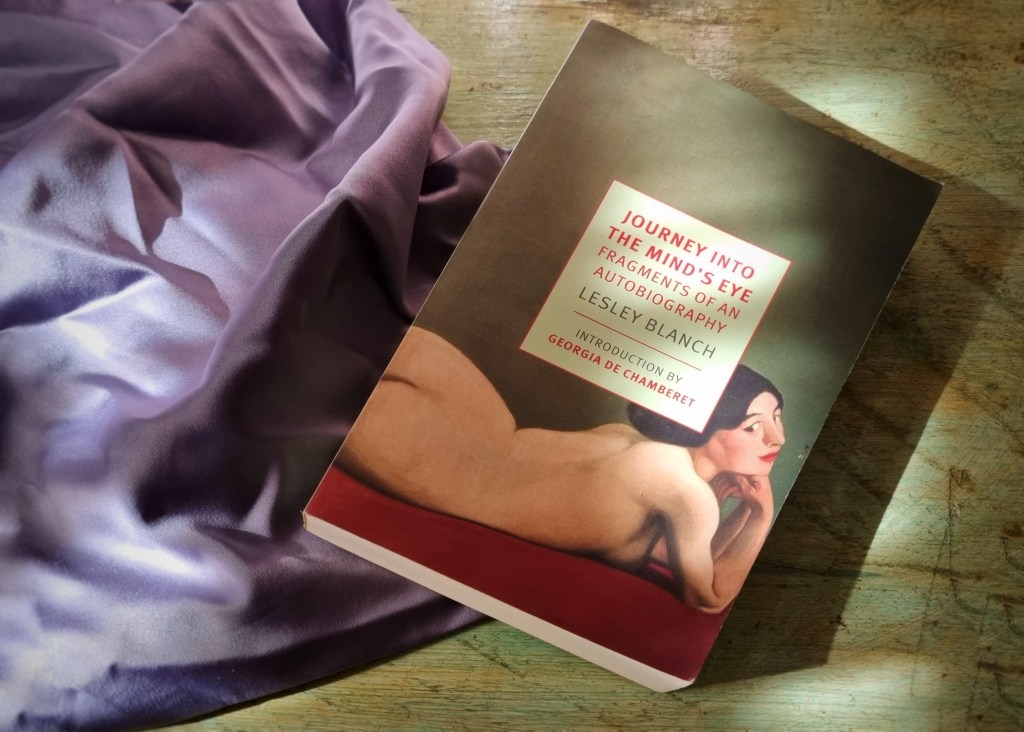
Never mind that her longings for a lost love and mine mingled as I luxuriated in the pages of this book. Never mind that some details will raise the eyebrows of conventional social constructs. (“Overweening conventions! They have us in a stranglehold from the cradle to the coffin,” writes Lesley Blanch.) Never mind the question of whether the Traveler corrupted her life or enhanced it; I have two opinions as contrasting as East and West. What is certain is that this woman ended up living by her own rules and did not lead a lackluster life.
But to have bookshelves spilling over because of a geographic fascination and to have the books arranged by region; to have literary tastes swayed topographically; to explore entire worlds by turning pages; to spend hours on long bus rides poring over books; to have “everything I saw, or read, ate, or thought tinctured by my infatuation”; to travel and be particular about the precise lighting in which to see certain places because they look more beautiful in morning, noon, or afternoon light; to find areas of conflict irresistible and be chided for having “such violent desires”; to journey into the mind’s eye or into the heart of another; to see traveling as an act of “following a strain of fugitive music” — I’ve never felt this aspect of myself more probed and understood, that I wish I came across this book much sooner.
There are allusions to be unveiled in the captivating writing, and there are lessons to be gleaned from the interaction between cultures, but the line I’ll take to heart is, “Don’t be so finite,” said the Traveler.
Lesley Blanch lived to be a hundred and three, unapologetically, and infinitely.
“The beauty of a book, says the book dealer, lies in the fact that no other book can arouse the same feelings in you. That’s why you can’t compare good books.” — Burhan Sönmez, Labyrinth
When your desire to forget certain things mingles with a character’s desire to remember, and the words from the book and those unsaid in your heart cross paths, the sensation stays with you, the way your first sip of raki does — like drinking smooth, liquid embers as your insides become drenched with that distinctive Turkish melancholy.
One ends tragically, the other ambiguously, but the influential power of Istanbul that takes hold of writers is exquisitely manifested in this pair. Despite Istanbul being a bazaar of a thousand and one stories, Burhan Sönmez has his own approach to storytelling and his own approach to this alluring, Janus-faced city that readers who are just as enamored with it as I am will hold in esteem. As a certain character says, “Just as you can’t bathe in the same river twice, neither can you tell the same story twice in Istanbul.”
The interesting thing you’ll discover about these two books is that, despite being two entirely different novels by the same author, their titles are interchangeable. Both are about labyrinths, and both are about Istanbul; both can either be about the labyrinths of the mind and memory or the labyrinths of the city; and I find both to be best read successively.
The past — or the land of our birth — can be a burden from which we sometimes wish to be free, but who are we without it?
Through previous readings, this reader has encountered provocative theories that suggest that it was religious reformation that freed human thought from church dogma thus giving rise to individualism, which subsequently paved the way for the Renaissance; and also theories of the aftermath of the Black Death setting the scene for capitalism by overthrowing social systems including feudalism.
The Protestant Reformation erupted in the 1500s, the Black Death in the 1300s. Ben Hopkins’ novel of six hundred and twenty four pages begins in the 1200s, but through its characters, we already witness the gradual ascent of mercantile capitalism and individualism challenging the hegemony of the Catholic Church.
But thankfully, these big words and the sophisticated ideas that are attached to them are not heaped too heavily on the reader’s shoulders. The author seems to have employed his filmmaking expertise by creating a well-paced and entertaining book with a handful of dramatic imagery and contrasting characters across the broad spectrum of society, but which also carries so much understanding of the religious and socioeconomic landscape of a particular European period.
In the midst of it all, the Cathedral — or more accurately, the construction of the Cathedral — that remains unfinished and continues to be built even by the end of this novel. This novel that begins in 1229 and ends in 1351. This Cathedral that symbolizes a number of things.
In this story there is clearly the aspect of the historical, or the architectural, but which should always lead one to contemplate on the personal — the edifices that we build for ourselves. And because we already know how certain it is that we can carry nothing out, what do we leave behind?
To quote a cherished character who passed away by the the shores of Constantinople, “A man can die anywhere. It’s all the same. The only important thing is how he lives.”














 The Book-Butterfly