“I’m sitting in the restaurant reading. Some books take me to worlds far greater and more tender than real life.”
Amidst a stream of surreal disclosures from a woman grappling with mental illness and electroshock therapy, bursts of beauty in the prose.
“I want to wander down these streets and avenues, drinking everything I see, making new discoveries, watching these people who remain strangers to me, all around me, this unquenchable life that I so long to take into my heart. Could it be that there are others who find whole worlds in a single moment, who marvel in the miracle of existence, whose thoughts can purge into the depths of unfettered time and rapture? I don’t know. A single moment can hold an eternity.”
But it is ultimately a sad and disturbing portrait of a particular societal context and its effect on the psyche, framed affectionately by Aysegul Savas’ introduction and Maureen Freely’s translator’s note.
Reading this brought to mind Leonora Carrington’s Down Below, and reading this reminded me that sometimes the point of literature is not to read only about women’s lives that appeal to the reader, but to have one’s eyes opened to different kinds of suffering if only to achieve a better understanding of the world we live in.
It’s a book I can only recommend to a select few, but I know the Turkish section of my shelf is richer for compassionately clasping it to its bosom.
“Only love and art can do this: only inside a book or in front of a painting can one truly be let into another’s perspective. It has always struck me as a paradox how in the solitary arts there is something intimately communal.”
An understated book that is a meditation and an education in art and life.
“I hope that when there is laughter, it’s laughter made wise by having known real grief — and when there is grief, it is made wise by having known real joy,” Kaveh Akbar writes in Martyr! Whether writing about art, architecture, Libya, or politics, Hisham Matar’s books are often so heartfelt — wholly made wise by having known sorrow and loss.
Fires, Marguerite Yourcenar
…because maybe, subconsciously, this month’s reading theme is about finding solace in the works of authors whose masterpieces have already left an impression on me, that I immediately dove into Yourcenar’s Fires without hesitation, having been incredibly moved by Memoirs of Hadrian in 2022.
She does admit, and warn, in the Preface that this book is, “the product of a love crisis” and that writing this was, in a way, “exorcising a very concrete love”; and yet it still surprised me that the elegance I encountered in Hadrian was replaced in Fires by a certain violence and ferociousness in the prose.
Antigone, Sappho, Clymenestra, and Achilles are just some of the main characters of the nine lyrical prose pieces, or stories, that Yourcenar amalgamates with her own experiences. I was left wondering if I understood the allusions correctly, or whether I understood anything at all.
One thing is certain, Fires is a masterclass on opening lines:
Phaedra’s piece begins with, “I hope this book will never be read.”
The Patroclus opening, “A heart is perhaps something unsavory. It’s on the order of anatomy tables and butcher’s stalls. I prefer your body.”
Lena’s? “Loving eyes closed is to love blindly. Loving eyes open is perhaps to love madly.”
“Love is a penalty. We are punished for not having been able to stay alone.” Clymenestra’s.
Face Shield Nation, Gideon Lasco
Articles that I looked forward to during the pandemic compiled in a book. Lasco was the voice of calm and reason at a time of confusion; evoking through his column the architectural definition of a column as a sturdy pillar of support. An essential time capsule of an era that we cannot afford to forget if we intend to learn from it. Read full entry here.
One Hundred Years of Solitude, Gabriel Garcia Marquez (a re-reading)
Growing up is realizing that Gabo is the real Melquiades who brought us magnets, magnifying lenses, astronomical observations, and mercurial storytelling. It was he who made imagination and literary possibilities flourish in the fertile and pristine Macondos of our minds, and who never really died. Read full entry here.
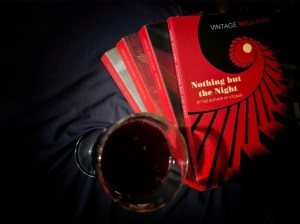
Nothing but the Night, John Williams
Maybe the first disappointment that assails the reader is the realization that, despite the slenderness of this volume, there is a heaviness in each page that restrains forward motion.
“Boring,” the lazy might judge hastily somewhere within the first three chapters. But one should not be too quick to criticize even though I myself could only read a couple of pages per sitting. For if one looks closer, and feels deeper, isn’t this genius, how John Williams conveys exactly what depression feels like?
“…there came to him that peculiar loneliness which is felt only in the monstrous impersonality of a multitude…”“What was the senseless circumstance which led him on and on, deeper and deeper into what seemed to him a maze labyrinth, devoid of pattern or meaning? …some unnameable power pushed him from one place to another, down paths he had no wish to travel, through doors he did not know and had no wish to know. All was dark and nameless and he walked in darkness.”
But then the reader is momentarily allowed to come up for air. I’m referring to the fourth chapter that is briefly set alight with a Proustian beauty! “That is the very best time of life, he thought: lost time.” And then John Williams proceeds to craft this fleeting tribute to the master searcher of lost time before he relinquishes the ethereal chapter to the fading light.
As the novel finally builds suspense, it spirals into a nihilistic darkness that ends with a violent and repulsive slap in the face.
Written in Burma when he was only twenty-two while recovering from injuries brought about by a plane crash over the Himalayas during WWII, he wrote this first novel at a particularly dark time when there was nothing else but the night.
The John Williams here is not the John Williams that gave us Stoner and Augustus. The John Williams here is the John Williams that would eventually give us Stoner and Augustus.
The Black Book, Orhan Pamuk
This reader has been through Pamuk’s longest novels and still felt the density of the mystery and prose in this book’s mere four hundred pages.
It explores the writing process and the precariousness of identity. It is also about how much the books we read, the stories we hear, the movies we watch, the everyday objects in our lives, and our city’s history shape the multiplicities of our being.
I enjoyed that twist at the end and relished the familiarity of Istanbul as a breathing character in a Pamuk novel. But maybe, just maybe, The Black Book is not for the Pamuk newbie, and not for those who are in a hurry.
The Golden Road, Willliam Dalrymple
It is not only the Silk Roads that are rising again, as Peter Frankopan proclaims in a forceful last line that gave me goosebumps. Rising, too, are buried or forgotten histories that have now resurfaced to challenge centuries of unquestioned narratives.
Frankopan’s The Silk Roads was an eye-opener, but The Golden Road takes this non-Eurocentric view of ancient and early medieval history to an intriguing direction by revealing India as a catalyst that transformed the world. Read full review here.
Serenade for Nadia brings to light seldom-discussed tragedies of Turkish history: The 1942 Struma disaster, wherein hundreds of Jews fleeing the Axis nations in Europe perished when their refugee ship was torpedoed in the Black Sea; the Armenian Genocide; and the plight of the Crimean Turks who were oppressed and slaughtered by the Soviet government for being seen as Nazi collaborators.
This novel, however, is set in modern-day Istanbul where Maya Duran works at Istanbul University while single-handedly raising a teenage son. Her life is turned upside down when she is assigned to assist a visiting octogenarian, Maximillian Wagner, a German-born professor from Harvard. Little by little, the untold stories of her family and her nation come back to haunt her and beg to be uncovered and told. If a reader pays close attention, it will not be difficult to see that Maya’s character is also an accusing finger pointed at prevailing misogynistic attitudes in Turkey.
Aside from music playing a big role, this reader is extremely impressed by the number of intricate social issues that appear organically in this novel. Because Turkish history and culture are so rich, and its government and society are often paradoxical, it takes a good writer to pack all of this in a novel without making it feel contrived. Zulfu Livaneli succeeds in this, and one can understand why Orhan Pamuk himself hailed him as, “An essential force in Turkey’s musical, cultural, and political scene.”
Having read Disquiet in 2023, this is my second Livaneli. Although I admired Disquiet for its eye-opening qualities, I had qualms with the translation. If I have any qualms with Serenade For Nadia, it is only that this book should come with tissues. Tears are guaranteed.
After immersing myself in a variety of literature from the region, and after reading nine of her books, singing praises at the time I read them, then ultimately realizing that I prefer her two nonfiction works to the seven novels, it eventually felt like I had outgrown Elif Shafak.
Nawal el Saadawi, Sema Kaygusuz, Farnoosh Moshiri, Dunya Mikhail, Adania Shibli, and other lesser known women authors that I encountered through this reading project, made Shafak’s fiction feel diluted and elementary…
…until I learned that There are Rivers in the Sky involves Mesopotamia, The Epic of Gilgamesh, and one of the books that fueled my obsession with the Fertile Crescent, Sir Austen Henry Layard’s Nineveh and its Remains.
Needless to say, I purchased the e-edition of There are Rivers in the Sky on the day it launched, and veered away from this month’s plan to read Women in Translation. Apparently, Shafak still manages to lure me with her chosen topics and setting.
And I’m glad I read it. I’m glad I did not deceive myself into believing that my literary taste has become too sophisticated for Elif Shafak. Because after all, maybe she does not water it down. Maybe what she does is a deliberate simplification, so that her books become stepping stones to forgotten stories, accessible pathways to pressing matters that we don’t even stop to think about, and springboards that launch readers into deeper inquiry about issues that are not discussed enough.
In There are Rivers in the Sky, Shafak still transcends her pretty book covers and continues to be an activist for those who do not have a voice — in this case, buried history, looted artifacts, dying rivers, and the dwindling Yazidis and the continual decimation of their people and their stories.
Reading this has taught me many lessons, and it is not without its beautiful lines: “…the world is changing faster than minds can grasp… all these smartly turned out people with their polished boots and affected airs, you look at them and you think they must know everything, educated and cultured as they are, but… when times are confusing, everybody is a little lost. No one is inwardly confident as they present to be. Hence the reason we must read… books… provide us with light amidst the fog.”
Portraits: Of a young Rebecca Solnit finding, and fending for, herself; of the nature of dictatorships and revolutions by Ryszard Kapuściński; of Eastern Turkey under the veil of its dramatic landscapes by Zülfü Livaneli; of Paris and the poet through the vantage point of Henri Cole; of the unfortunate visage of Skylark by Dezső Kosztoláni. These are some of the extraordinary faces I met on this month of May.
It is not nearly celebrated enough, says Solnit: “The sheer pleasure of meeting new voices and ideas and possibilities, having the world become more coherent in some subtle or enormous way, extending or filling in your map of the universe…this beauty in finding pattern and meaning,” this thing called Reading.
Even so, here we are. The readers (ironically, the ones least concerned about faces), the ones who, by turning each page, celebrate best these encounters, these awakenings, these flights.
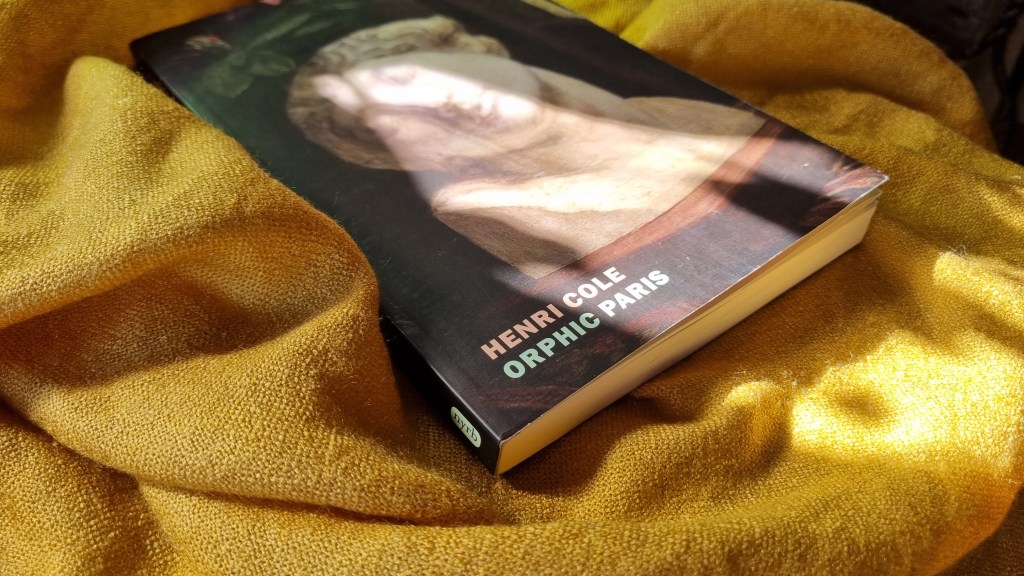
“At least I had books. Closed, a book is a rectangle, thin as a letter or thick and solid like a box or a brick. Open, it is two arcs of paper that, seen from the top or bottom when the book is wide open, look like the wide V of birds in flight.” — Rebecca Solnit, Recollections of My Nonexistence“I’ve always believed that poetry exists in part to reveal the soul’s capacity for compassion, sacrifice, and endurance. For some of us, this satisfies a basic human need, like air or water, but a poem must also have music, imagery, and form. Because there is a kind of nakedness or authenticity in poetry that is associated with truth, on many days I haven’t got the guts for it, and I fail. But when I succeed, there is nothing in life — except love — that equally verifies my existence.” — Henri Cole, Orphic Paris
“Maybe I’d been captivated by a story. Yes, I’d been captivated by a story, by a culture, by a history; can a person be smitten by a story? Clearly it does happen…”
Indeed. That is why this book found me. Friends probably know by now that I am drawn to the stories, the cultures, and the histories encompassing what used to be called the Fertile Crescent and the lands that have carried the veins of the Silk Route.
Kurdistan is no exception. Accessible literary works from or about this region is so scarce that I value every volume I can get my hands on. While I have yet to experience books set in Iranian and Syrian Kurdistan, which I imagine must be breathtaking, I have been fortunate to have read about Iraqi Kurdistan [The Beekeeper of Sinjar by Dunya Mikhail (Serpent’s Tail), The Last Pomegranate Tree by Bachtyar Ali (Archipelago Books)] and Turkish Kurdistan [The Wounded Age and Eastern Tales by Ferit Edgü (NYRB), Every Fire You Tend by Sema Kaygusuz (Tilted Axis Press), and Disquiet by Zülfü Livaneli (Other Press)].
The Beekeeper of Sinjar, The Last Pomegranate Tree, The Wounded Age and Eastern Tales, and Every Fire You Tend are all beautifully written books that have led me to believe that the sorrows of this place are too profound, they can only be expressed through metaphors, silence, or poetry.
Disquiet tells the story of Ibrahim, a journalist based in Istanbul, who is drawn back to his hometown of Mardin to investigate the death of Hussein, a childhood friend. As Ibrahim digs deeper, he becomes enmeshed in Hussein’s past, haunting stories of Yezidi Syrian refugees fleeing ISIS, and recollections of his city’s more harmonious days: “Those were the festive days when Assyrians, Muslims, Zoroastrians, including Parsis, mingled in the marketplace and at school and celebrated one another’s holy days… But now the atmosphere was closed, the city had been darkened by the shadow of a sterner, angrier Islam… Now as I walk the streets they seem darker… this was a city living in fear, caught in the middle of conflicts between ISIS, the PKK, and the state security forces.”
Among the aforementioned books, Disquiet has the most direct prose; and therefore, a good introduction to this region that also allows a worthy glimpse into the Yezidi faith and the painful plight of its adherents. I suspect that what I think are weak spots in the novel owe to the translation but which thankfully do not distract the foreign reader from the eye-openers; from the call to be disquieted about the atrocities; the reminder that Turkey is not a single entity and that even Turks from the westernmost cities cannot always identify with the languages, beliefs, traditions, and cultures of the Mesopotamian lands of eastern Turkey.
And for some reason, I love how the narrator still refers to this grand swathe of land as Mesopotamia — the birthplace of literature.
“I asked him why, if there are faiths in every corner of the world, those that emerged from the Middle East had spread throughout the world. Did we commit the most sins, were we in more need of salvation than anyone else?
I detected a faint smile beneath his grizzly mustache. The answer to this is kalam, he said, the word. In this world nothing affects people as much as the word. The Middle East is where the word reached its zenith — no other region’s poetry, legends, or fairy tales are as powerful, none other have this much power to influence the human heart. That’s why the poets here are classified as magicians.” — Zülfü Livaneli, Disquiet
“Finally, I would like to say, I intended to write… not just in Turkish, but in the language of all who lament for the dead. And I intended to write it with the language of figs…”
The 1920 Treaty of Sèvres that was signed between the Allies of WWI and the Ottoman Empire is not explained here. There is nothing here that mentions how it marked the beginning of the partitioning of the empire, how Armenia was subsequently recognized as an independent state and a referendum was scheduled to decide the fate of the dream of a Kurdistan, but nothing of how the referendum never took place. No details of what exactly happened when the Kurds within Turkish borders clashed with Turkish nationalism; nothing of the decisions, events, or indecisions that led to the extermination of more than half of the Kurdish population in Turkey by 1938.
Throughout the book an unnamed and unidentified narrator addresses a woman muted by grief and coaxes her, not to speech, but to remembrance — a remembrance not of a specific event but of her spiritual and personal history, and the ancient mythology of her people; and I believe here lies the genius of this novel. Without explicitly saying that this book is about identity, Sema Kaygusuz makes this book wholly about identity.
Out of the silence roars a powerful voice that resists all attempts at wiping out Kurdish identity. I have come to understand that this book is, above anything else, a rallying cry for the Kurdish people: For them to never forget who they are. To never give in to the silencing, and to never allow grief to estrange them from who they really are.
What is between these pages is something that we won’t find in the chronologies of history. What is written here is more profound. In this novel that reads more like a lengthy poem, Kaygusuz achieves the impossible task of giving shape to grief and silence, and intimating a manner of history that can only be expressed through obmutescence or poetry.
“Finally, I would like to say, I intended to write not just in Turkish, but in the language of all who lament for the dead. And I intended to write it with the language of figs… the fig tree whose fruit has, over the course of the history of civilization, seduced and destroyed, poisoned and healed, struck panic in those captivated by its pleasure, and been served like jewels at the tables of kings, pharaohs, and sultans — in order that I might set aside its vitalizing force, its enviable adventure, in writing. What I mean to say is that, over the course of this novel, I am not only my grandmother who survived the massacre: I am also her granddaughter, I am Hizir, and I am a fig, with its countless tiny seeds. Each of us has written the others into being.” — from the Afterword of Every Fire You Tend by Sema Kaygusuz
Thank you for knowing exactly what I’d love to read and for lending me your copy, Gabi. Always grateful. 🤍
“Would Chekhov have suffered writer’s block?” Maria wondered, as the hull of the sunflower seed snapped open between her lightly clamped teeth.
Had it not been for gravity and absentmindedness, it might have appeared like a final attempt of helpless rebellion as the kernel fled in its nakedness, first escaping through Maria’s lips and slipping straight into the narrow entrance of a cowl-necked blouse, lapsing between two mounds of mysterious bosomy matter, and finally shelving itself in the black hole of the navel.
There, cradled in the darkness was the sunflower seed, and it knew not what parallel or different fate it would have encountered had it slipped inside – on the other side, of that warm, heaving skin. At that moment, it knew not time nor space, it only knew of warmth, suspension, and a false feeling of relief.
Maria’s eyes swept the floor but found no trace of the seed, so she picked up another one when suddenly, an idea! A writing idea after weeks of creative standstill! She mock-kissed the second sunflower seed with glee and tossed it back on the table. “If Chekhov could eye an ashtray and tomorrow furnish a story called ‘The Ashtray,’ what tales I could conjure from a sunflower seed!”
With confident strokes of her pen she inked ‘The Sunflower Seed’ on the top of a blank sheet, and Maria wrote:
“Would Chekhov have suffered writer’s block?” Alejandra wondered, just as the sunflower seed snapped open between her semi-clenched teeth.
Of what seemed as a definitive act of impetuous rebellion, the seed fled in its nakedness, first escaping through Alejandra’s lips and slipping straight into the abyss of a cowl-necked blouse, lapsing between two mounds of mysterious bosomy matter, and at last shelved itself in a black hole which was the navel. There, cradled in the darkness was the sunflower kernel, and it knew not what parallel or different fate it would have encountered had it slipped inside – on the other side, of that warm, heaving skin. At that moment, it knew not time nor space, it only knew of warmth, suspension, and an ersatz feeling that resembled belongingness.
Maria continued to write vigorously and narrated how Alejandra’s husband discovered the mutinous seed in her bellybutton later that night and punished it by plopping it into his mouth with a teasing gleam in his eyes.
Pleased with the South American tone of absurdity in her story despite aiming for a Russian shade, and unaware that her tale was half fiction-half accidental truth, she put her pen down with a satisfying staccato. “Ah, the sound of a period!” she exclaimed. As she stood up, the sunflower seed fell to the floor, later to be identified as midnight snack by the little mouse that lived in between Maria’s walls.
The above story is not from the two books featured here. I wrote this in 2009 when reading a volume of Chekhov, who happens to be one of the most handsome of authors, ignited a spark of creative inspiration. Since then, I’ve found that the best short story compendiums do not inspire me to write reviews; they nudge me to pay more attention to the details of everyday life and to write my own short stories however inferior mine may be.
Ferit Edgü is more minimalist than Sait Faik but I find both their stories to be of a distinctive hue. There is something almost monochromatic about them: But akin to the most masterful black and white photographs, this quality does not reduce them to something less but raises and intensifies their expressiveness.
My best attempt to describe them would be to ask one to look into photographer Ara Guler’s black and white images; or better yet, grab that photo book, Ara Guler’s Istanbul with a foreword by Orhan Pamuk. Each photograph a story, each story an evocative photograph.
It is said that every Turk knows a Sait Faik line or story by heart. He is, after all, considered the Turkish counterpart of Anton Chekhov. Turkey’s most prestigious short story award, the Sait Faik Prize, is named after him — which Ferit Edgü received in 1979.
Needless to say, last month’s release of this Ferit Edgü collection resulted in yet another NYRB | Archipelago book-pairing at my end.
Now, excuse me as I attempt to write another short story. If that doesn’t work, I’ll be content with seeking beauty in the ordinary.
“And so the role of literature on this earth: It is that thing seeking beauty.” — Sait Faik
“The beauty of a book, says the book dealer, lies in the fact that no other book can arouse the same feelings in you. That’s why you can’t compare good books.” — Burhan Sönmez, Labyrinth
When your desire to forget certain things mingles with a character’s desire to remember, and the words from the book and those unsaid in your heart cross paths, the sensation stays with you, the way your first sip of raki does — like drinking smooth, liquid embers as your insides become drenched with that distinctive Turkish melancholy.
One ends tragically, the other ambiguously, but the influential power of Istanbul that takes hold of writers is exquisitely manifested in this pair. Despite Istanbul being a bazaar of a thousand and one stories, Burhan Sönmez has his own approach to storytelling and his own approach to this alluring, Janus-faced city that readers who are just as enamored with it as I am will hold in esteem. As a certain character says, “Just as you can’t bathe in the same river twice, neither can you tell the same story twice in Istanbul.”
The interesting thing you’ll discover about these two books is that, despite being two entirely different novels by the same author, their titles are interchangeable. Both are about labyrinths, and both are about Istanbul; both can either be about the labyrinths of the mind and memory or the labyrinths of the city; and I find both to be best read successively.
The past — or the land of our birth — can be a burden from which we sometimes wish to be free, but who are we without it?
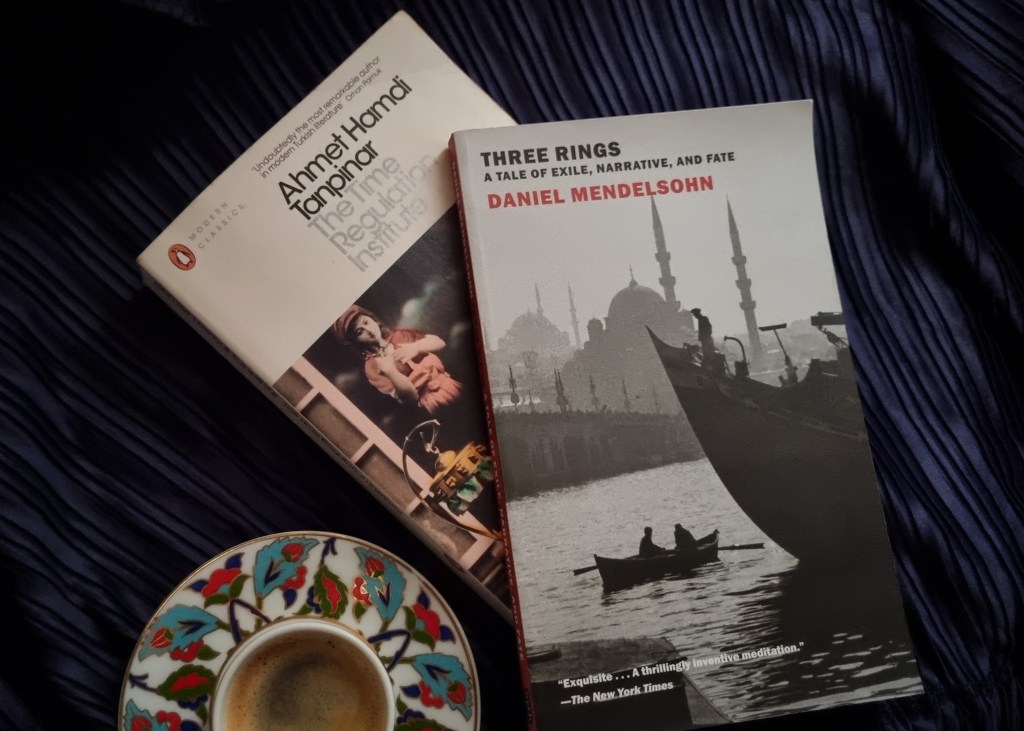
One was acquired because of the unmistakeable image of my favorite city that bewitched me as I browsed through NYRB’s contemporary collection; and the other because there are only two Turkish modern classics in the Penguin collection and I’ve already read and loved the other one!
What is a classic? In Amit Chaudhuri’s rephrasing of J.M. Coetzee, it is that which speaks to you when you are ready to hear it. I was not too sure about being ready, but if Pamuk thinks Tanpinar is the most remarkable author in modern Turkish literature, you trust him… even if it means limping through four hundred pages of winding narrative for an entire week.
But as reading fate would have it, Mendelsohn’s book turned out to be the crutch that got me through my inadequacies as a reader and the compass that prevented me from losing my way through Tanpinar’s meandering tale.
Aside from being so much more, Three Rings sheds light on ring composition in masterpieces by Homer, Proust, Sebald, and other literary forebears. Because of this, it made me recognize this exact literary form in The Time Regulation Institute and taught me to luxuriate in the beauty of narrative digression instead of getting lost.
As if harmonizing intentionally, Tanpinar evokes the eastern concept of time as a non-linear progression as Mendelsohn intimates this non-linearity in literature and life.
Time Regulation Institute is primarily a satire on the young Turkish Republic during Atatürk’s cultural revolution, which included enforcing Western time and imposing a fine on those who continued to observe Islamic time. While Atatürk is lauded in the West as a hero for modernizing a dying and retrogressive Ottoman Empire, Tanpinar artfully warns readers about how new freedoms are accompanied by new tyrannies — a seldom heeded but always relevant, and necessary, warning.
“The political pursuit of freedom can lead to its eradication on a grand scale — or rather it opens the door to countless curtailments… never have I known a concept so inextricable from its antithesis, and indeed entirely crushed under its weight… I must confess I’ve always found freedom an elusive concept… if we truly felt passionately about it, then wouldn’t we have…never let it out of our sight?”






 The Book-Butterfly