Zülfü Livaneli: Disquiet

“Maybe I’d been captivated by a story. Yes, I’d been captivated by a story, by a culture, by a history; can a person be smitten by a story? Clearly it does happen…”

Indeed. That is why this book found me. Friends probably know by now that I am drawn to the stories, the cultures, and the histories encompassing what used to be called the Fertile Crescent and the lands that have carried the veins of the Silk Route.

Kurdistan is no exception. Accessible literary works from or about this region is so scarce that I value every volume I can get my hands on. While I have yet to experience books set in Iranian and Syrian Kurdistan, which I imagine must be breathtaking, I have been fortunate to have read about Iraqi Kurdistan [The Beekeeper of Sinjar by Dunya Mikhail (Serpent’s Tail), The Last Pomegranate Tree by Bachtyar Ali (Archipelago Books)] and Turkish Kurdistan [The Wounded Age and Eastern Tales by Ferit Edgü (NYRB), Every Fire You Tend by Sema Kaygusuz (Tilted Axis Press), and Disquiet by Zülfü Livaneli (Other Press)].

The Beekeeper of Sinjar, The Last Pomegranate Tree, The Wounded Age and Eastern Tales, and Every Fire You Tend are all beautifully written books that have led me to believe that the sorrows of this place are too profound, they can only be expressed through metaphors, silence, or poetry.

Disquiet tells the story of Ibrahim, a journalist based in Istanbul, who is drawn back to his hometown of Mardin to investigate the death of Hussein, a childhood friend. As Ibrahim digs deeper, he becomes enmeshed in Hussein’s past, haunting stories of Yezidi Syrian refugees fleeing ISIS, and recollections of his city’s more harmonious days: “Those were the festive days when Assyrians, Muslims, Zoroastrians, including Parsis, mingled in the marketplace and at school and celebrated one another’s holy days… But now the atmosphere was closed, the city had been darkened by the shadow of a sterner, angrier Islam… Now as I walk the streets they seem darker… this was a city living in fear, caught in the middle of conflicts between ISIS, the PKK, and the state security forces.”

Among the aforementioned books, Disquiet has the most direct prose; and therefore, a good introduction to this region that also allows a worthy glimpse into the Yezidi faith and the painful plight of its adherents. I suspect that what I think are weak spots in the novel owe to the translation but which thankfully do not distract the foreign reader from the eye-openers; from the call to be disquieted about the atrocities; the reminder that Turkey is not a single entity and that even Turks from the westernmost cities cannot always identify with the languages, beliefs, traditions, and cultures of the Mesopotamian lands of eastern Turkey.

And for some reason, I love how the narrator still refers to this grand swathe of land as Mesopotamia — the birthplace of literature. 

“I asked him why, if there are faiths in every corner of the world, those that emerged from the Middle East had spread throughout the world. Did we commit the most sins, were we in more need of salvation than anyone else?

I detected a faint smile beneath his grizzly mustache. The answer to this is kalam, he said, the word. In this world nothing affects people as much as the word. The Middle East is where the word reached its zenith — no other region’s poetry, legends, or fairy tales are as powerful, none other have this much power to influence the human heart. That’s why the poets here are classified as magicians.” — Zülfü Livaneli, Disquiet

Bachtyar Ali: The Last Pomegranate Tree

“You want us to form a friendship built on disregarding the past, on ignorance and forgetting. Like all rulers, you want to burn your secrets so nobody can look at them after you die… We are not on the same path.”

How fittingly this line can be addressed to our current leader, and how I’d love to take some of Bachtyar Ali’s allegories to take a jab at the state of our politics!

But I doubt if railing against authorities was the main intent of this novel. Bachtyar Ali, injured in 1983 during a protest against Saddam Hussein’s Ba’ath Party and author of the first Kurdish novel to be translated in English, surely knows about unjust leaders and speaking out against them. 

This story of a peshmerga fighter who is released after being detained in a desert prison for twenty one years and goes on a quest to find the son he left behind is told with the magical realism of A Thousand and One Nights, but with a more discernible moral aim, which also weaves in its tale the sufferings and the violent history of the Iraqi Kurds.

The Last Pomegranate Tree, with its moments of breathtaking lyricism, seems to me more of a profound contemplation on freedom, on what it means to be really free, and on what it is we should seek and hold on to when all seems lost.


“Only one thing has been left to us, the one thing they can’t reach: our hearts, our inner worlds.”

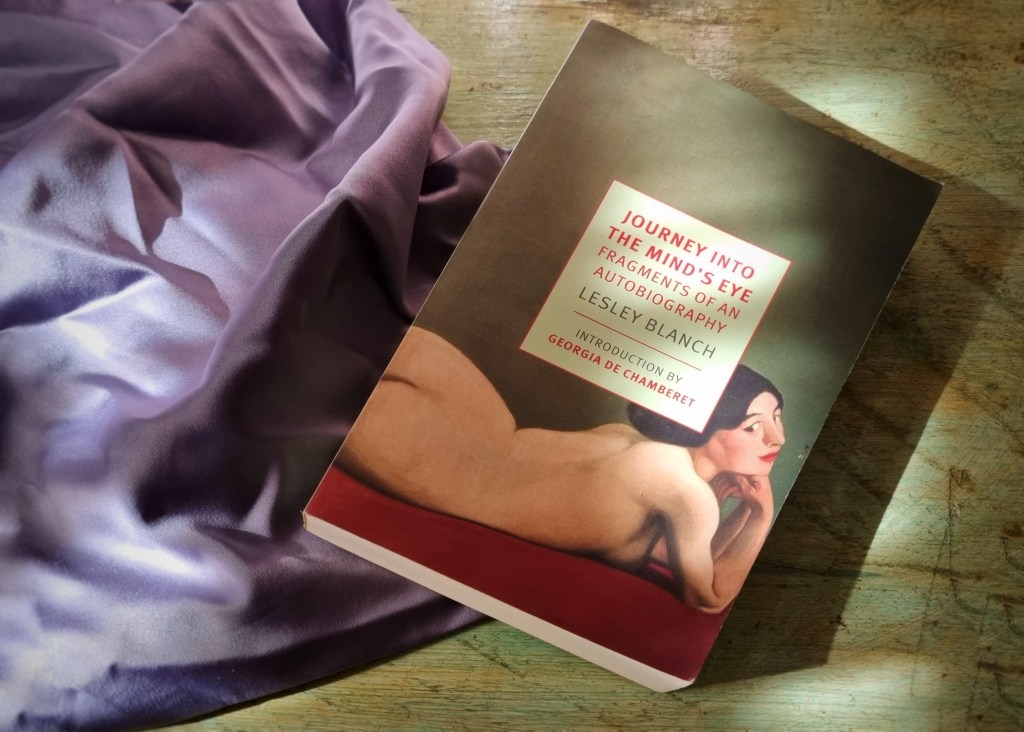
Lesley Blanch: Journey Into the Mind’s Eye

“To me, it has always seemed that each individual has such a moment. It is a fixed point in eternity, varying with each person, which they reach, sooner or later, in their trajectory through time. It is this moment which most perfectly expresses them, and to which essentially they belong, in which they live most fully. Both before and after, some awareness of this lies within them, so that in varying degrees of consciousness, they are seeking that moment in order to be fulfilled, or to find again in that fulfillment and setting, the persons who shared it with them.”


“A lifetime or a moment is all the same; a whole cycle lived richly, or thinly, one day. Each can prove to have been the meaning of a life. We cannot know, from where we stand. But if we seek, and are aware we have missed the moment we seek, our own absolute moment in time, then we live out our lives unfulfilled. In the words of an eastern proverb: we die with our eyes open — we cannot rest; even in death we are still looking for it.”


Never mind that her longings for a lost love and mine mingled as I luxuriated in the pages of this book. Never mind that some details will raise the eyebrows of conventional social constructs. (“Overweening conventions! They have us in a stranglehold from the cradle to the coffin,” writes Lesley Blanch.) Never mind the question of whether the Traveler corrupted her life or enhanced it; I have two opinions as contrasting as East and West. What is certain is that this woman ended up living by her own rules and did not lead a lackluster life. 

But to have bookshelves spilling over because of a geographic fascination and to have the books arranged by region; to have literary tastes swayed topographically; to explore entire worlds by turning pages; to spend hours on long bus rides poring over books; to have “everything I saw, or read, ate, or thought tinctured by my infatuation”; to travel and be particular about the precise lighting in which to see certain places because they look more beautiful in morning, noon, or afternoon light; to find areas of conflict irresistible and be chided for having “such violent desires”; to journey into the mind’s eye or into the heart of another; to see traveling as an act of “following a strain of fugitive music” — I’ve never felt this aspect of myself more probed and understood, that I wish I came across this book much sooner.

There are allusions to be unveiled in the captivating writing, and there are lessons to be gleaned from the interaction between cultures, but the line I’ll take to heart is, “Don’t be so finite,” said the Traveler.

Lesley Blanch lived to be a hundred and three, unapologetically, and infinitely.

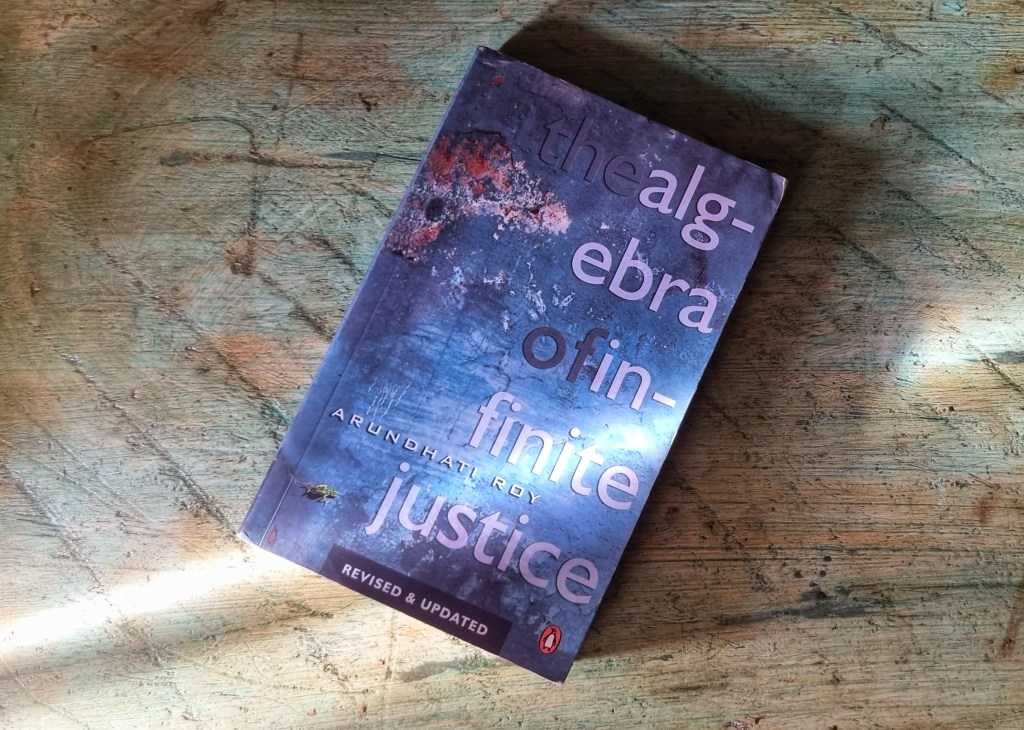
Arundhati Roy: The Algebra of Infinite Justice

“And Arundhati Roy wrote a ravishing novel, The God of Small Things, that catapulted her into international stardom, perhaps so that when she stood to oppose dams and corporations and corruption and the destruction of the local, people would notice… Perhaps they opposed the ravaging of the earth so that poetry too would survive in the world.”

This beautiful passage is from Rebecca Solnit’s Hope in the Dark, and The Algebra of Infinite Justice is Arundhati Roy’s book of essays that opposes dams and corporations and corruption and the destruction of the local.

People did take notice, and many of them attacked her and accused her of all sorts of things for it. She was also criticized for not providing enough solutions by those who lost sight of the fact that before we can arrive at solutions, we have to take the first step and pinpoint the problems and ask the uncomfortable questions. This, she does. Courageously. 

She asks about the necessity of nuclear weapons acquired in the name of “deterrence”, knowing that it is a matter that concerns humankind. “The nuclear bomb is the most anti-democratic, anti-national, anti-human, outright evil thing that man has ever made. If you are religious, then remember that this bomb is Man’s challenge to God. It’s worded quite simply: ‘We have the power to destroy everything that You have created.’ If you’re not religious, then look at it this way. This world of ours is 4,600 million years old. It could end in an afternoon.” On a relative scale, the same can be said of guns.

She aims questions at those who rail against the first world, but “actually pays to receive their gift-wrapped garbage”; she asks if corporate globalization is a mutant variety of colonialism; asks whether the building of dams are not “a brazen means of taking water, land and irrigation away from the poor and gifting it to the rich”; asks who and what has been sacrificed in the altar of “National Progress”; asks how Progress can be measured if we are not even aware of who has paid for it, referring to the millions of people and entire ecosystems displaced or extinguished by dams (a matter Filipino readers should not brush off — even our very own Gideon Lasco has called awareness to the environmental and sociocultural impacts of the Kaliwa Dam Project in the Philippines).

She asks everyone to be accountable: “Isn’t it true that there have been fearful episodes in human history where prudence and discretion would have just been euphemisms for pussilanimity? When caution was actually cowardice?”

“Fascism itself can only be turned away if all those who are outraged by it show a commitment to social justice that equals the intensity of their indignation. Are we ready… to rally not just on the streets, but at work and in schools and our homes, in every decision we take, and every choice we make?”


But I am most grateful for what resides with the difficult questions in that elegant mind of hers: “There is beauty yet in this brutal, damaged world of ours. Hidden, fierce, immense. Beauty that is uniquely ours and beauty that we have received with grace from others, enhanced, reinvented and made our own. We have to seek it out, nurture it, love it.”

“All we can do is to change its course by encouraging what we love instead of destroying what we don’t.”


“The only dream worth having… is to dream that you will live while you’re alive and die only when you’re dead…”

“Which means exactly what?” 

“To love. To be loved. To never forget your own insignificance. To never get used to the unspeakable violence and vulgar disparity of life around you. To seek joy in the saddest places. To pursue beauty to its lair. To never simplify what is complicated or complicate what is simple. To respect strength, never power. Above all, to watch. To try and understand. To never look away. And never, never forget.


In truth, these are as difficult as the questions, but who says these are not solutions?

Sema Kaygusuz: Every Fire You Tend

“Finally, I would like to say, I intended to write… not just in Turkish, but in the language of all who lament for the dead. And I intended to write it with the language of figs…”

The 1920 Treaty of Sèvres that was signed between the Allies of WWI and the Ottoman Empire is not explained here. There is nothing here that mentions how it marked the beginning of the partitioning of the empire, how Armenia was subsequently recognized as an independent state and a referendum was scheduled to decide the fate of the dream of a Kurdistan, but nothing of how the referendum never took place. No details of what exactly happened when the Kurds within Turkish borders clashed with Turkish nationalism; nothing of the decisions, events, or indecisions that led to the extermination of more than half of the Kurdish population in Turkey by 1938.

Throughout the book an unnamed and unidentified narrator addresses a woman muted by grief and coaxes her, not to speech, but to remembrance — a remembrance not of a specific event but of her spiritual and personal history, and the ancient mythology of her people; and I believe here lies the genius of this novel. Without explicitly saying that this book is about identity, Sema Kaygusuz makes this book wholly about identity. 

Out of the silence roars a powerful voice that resists all attempts at wiping out Kurdish identity. I have come to understand that this book is, above anything else, a rallying cry for the Kurdish people: For them to never forget who they are. To never give in to the silencing, and to never allow grief to estrange them from who they really are.

What is between these pages is something that we won’t find in the chronologies of history. What is written here is more profound. In this novel that reads more like a lengthy poem, Kaygusuz achieves the impossible task of giving shape to grief and silence, and intimating a manner of history that can only be expressed through obmutescence or poetry.


“Finally, I would like to say, I intended to write not just in Turkish, but in the language of all who lament for the dead. And I intended to write it with the language of figs… the fig tree whose fruit has, over the course of the history of civilization, seduced and destroyed, poisoned and healed, struck panic in those captivated by its pleasure, and been served like jewels at the tables of kings, pharaohs, and sultans — in order that I might set aside its vitalizing force, its enviable adventure, in writing. What I mean to say is that, over the course of this novel, I am not only my grandmother who survived the massacre: I am also her granddaughter, I am Hizir, and I am a fig, with its countless tiny seeds. Each of us has written the others into being.” — from the Afterword of Every Fire You Tend by Sema Kaygusuz


Thank you for knowing exactly what I’d love to read and for lending me your copy, Gabi. Always grateful. 🤍

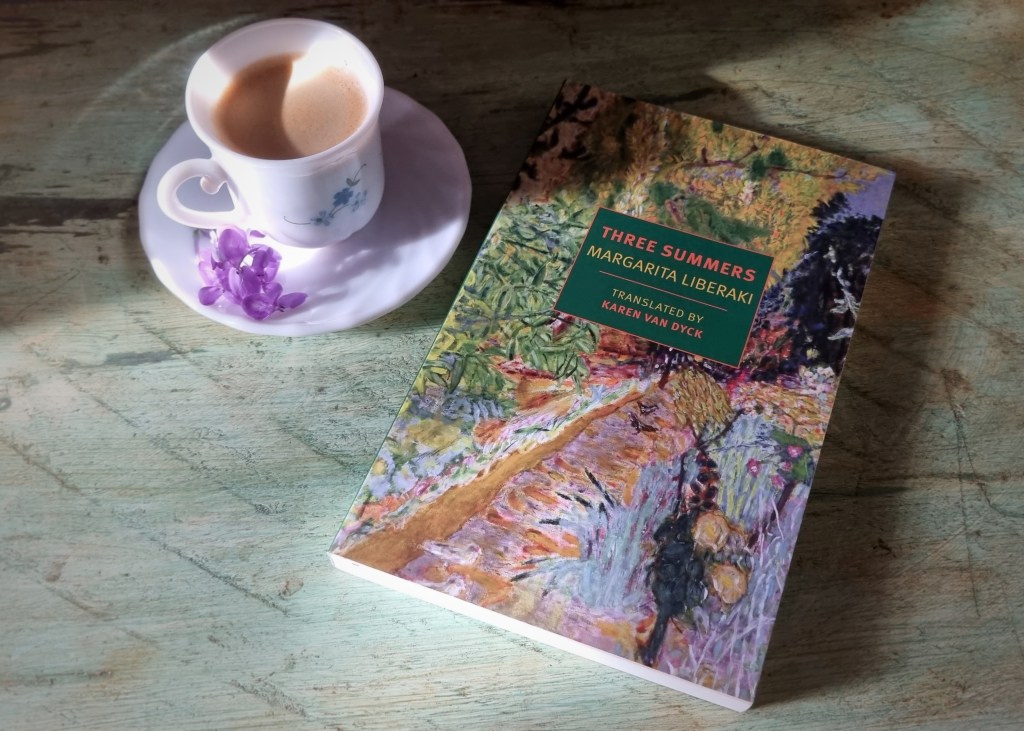
Margarita Liberaki: Three Summers

Fleeting patches of sunlight that decorate pieces of furniture linger on book pages furtively as I read, or momentarily set the crema of my espresso aglow, are lovely indications that summer is gently slipping into the Philippine islands after a sunless wet season. 

But why do I even dare write this in the face of a Liberaki who is an authority on sunshine? This Liberaki who does not merely write about it but makes it so tangible that one’s heart becomes dappled with sunlight, too?

There is a little bit of the Little Women in Liberaki’s three sisters in that it portrays in each sister how Woman can make different choices, pursue different interests, hold different priorities, think differently and still remain Woman; portrays how Woman can mean, or can be, “A great many things,” in the words of Alcott’s Jo March. Or as Liberaki’s Katerina replies, “Not just two, but thousands, Maria, or one which could be a thousand,” when Maria remarks on how Katerina seems to want to live two lives.

But Liberaki, daughter of Dionysus that she is, has a certain sensuality that Alcott did not make space for in her conservative depiction, although we love her just the same. This Liberaki sensuality is an elegant one, however, and treats female sexuality as part of life.

What made me pick this up for Women’s History Month was the curious case of an author who insisted on transliterating her name as Liberaki, rather than the more accurate Lymberaki, so that it would correspond to liberation. It is rare to come across an author’s name that already alludes to an untethered mind and sets the tone for a book. But how wonderful to discover that the same author has a command of artistic laws and lavishes attention to detail while creating an exquisite balance of light and shadow!

This sensitivity to art was what enthralled me! For what is sensitivity to art but a reinforced sensitivity to life? 


“The sun has disappeared from books these days. That’s why they hinder our attempts to live, instead of helping us. But the secret is still kept in your country, passed on from one initiate to another. You are one of those who pass it on.” —  Albert Camus to Margarita Liberaki

Three Summers was originally published in France through his recommendation.

Bushra Al-Maqtari: What Have You Left Behind?

“Do not travel to Yemen due to terrorism, civil unrest, health risks, kidnapping, armed conflict, and landmines. Avoid all travel to Yemen.”

I was constantly met with these words when, during lockdown, I made itineraries for the places I hope to visit in the future. If you know me well enough, I’ll probably be one of the first people you’ll think of whenever you see photos of the architecture in the old city of Sana’a, that stone house in Wadi Dhar, and the otherworldly trees and landscape of Socotra.

The hostile travel advisories did not prevent me from coming up with an itinerary, but my rational side knows it would be safer to travel to Yemen through literature for the time being.

Unfortunately, authors writing about, and especially those from, Yemen are hard to come by. You can imagine my eager anticipation when Fitzcarraldo Editions announced the launch of this book!


Warning: Do not read this in public. Unless you’re okay with weeping in public.

Every page is drenched in heartache and death. It’s the kind of book that Scholastique Mukasonga would call “a paper grave”. A book to put my puny troubles into perspective.

But I think my task as reader is not to highlight how this book made me feel; it’s to sound the sirens and ask others to take time to look into what is happening in a country that hardly enters the fringes of our consciousness.

Inspired by the work of Belarusian journalist and 2015 Nobel Prize laureate in literature, Svetlana Alexievich, Bushra Al-Maqtari traveled across her own war-torn country for two years to document the lives and deaths of civilians caught in the crossfire of the civil war that erupted in 2014 and which persists up to this day. But unlike Alexievich, Al-Maqtari lived, and continues to live, through the war of which she writes. 

This war has claimed hundreds of thousands of innocent lives, only to serve the greed for power of a few. The least we can do is listen, read, encourage others to do the same, and allow the power of fearless journalism and literature to achieve its goal.

Exceptionally written, it is an essential education and addition to a journalist’s shelf, or any human being’s shelf for that matter. It is a precious but painful work of journalism that makes me wonder at how difficult it must be to gather, to write, and to live these stories — especially as a woman.

The book is the result of one woman’s courageous initiative: “…to ward against forgetting, against feigning ignorance, against indifference,” to emphasize that the Yemeni people “are not voiceless, they are unheard.”

Listen.

Nawal El Saadawi: The Hidden Face of Eve

The best of Nawal El Saadawi’s books are nonfiction: They reveal the devastating truth that her works of fiction are, in fact, nonfiction.

A vital textbook for the study of women in the Arab world, The Hidden Face of Eve has a more academic structure compared to A Daughter of Isis, Walking through Fire, and her numerous memoirs that are deeply personal. But all her writings perfectly demonstrate how the personal is political, and there is not a hint of the tedium that we might encounter in textbooks.

The delicate preface alone is worth mulling over and digesting; and the book, thorough in the history and status of women in Arab society from pre-Islam days until the present, often enlightening or enraging, should be read in its entirety. Whether one agrees or disagrees with any of her views, no one will close this book without having learned anything substantial. Reading this showed me what a shallow understanding I have of the matter despite years of delving in books from Islamic nations.

Nawal does not launch into an angry tirade against religion, however, but against those who use religion “as an instrument in the hands of economic and political forces,” those who use religion to deprive women of knowledge and suppress the search for truth by intimidation and obscurantism, and those who misinterpret religion and utilize it as an instrument of oppression and exploitation. She challenges that religion, if authentic in the principles it stands for, “aims at truth, equality, justice, love, and a healthy wholesome life for all people, whether men or women.”

She criticizes feminism that is merely an instrument of a specific class, or a feminism that is fanatical and superficial, stressing that fanaticism of any form should be opposed, whether it be religion, political, or social. Interestingly, she even remarks on the “modern” woman, “who thinks that progress is manifested by a tendency to show more and more of her thighs,” but remains mentally and emotionally suppressed under the surface.

She therefore makes a stand for the education of the female child, the strengthening of the mind, a free mind, and a heightened level of consciousness, pointing out that a girl who has lost her personality through the throttling of her mind will lose the capacity “to think independently and to use her own mind,” and “will do what others have told her and will become a toy in their hands and a victim of their decisions.” Thus, “the emancipation of Arab women can only result from the struggle of the Arab women themselves, once they become an effective political force.” As we all know, this does not merely apply to Arab women. There is also the acknowledgement that “progress for women, and an improvement of their status, can never be attained unless the whole of society moves forward.”

Can you see why I wished to greet Women’s History Month by reading someone like Nawal El Saadawi? But because there is no one like Nawal El Saadawi, I read her.

“…with liberation they stand to lose nothing else but their chains…”

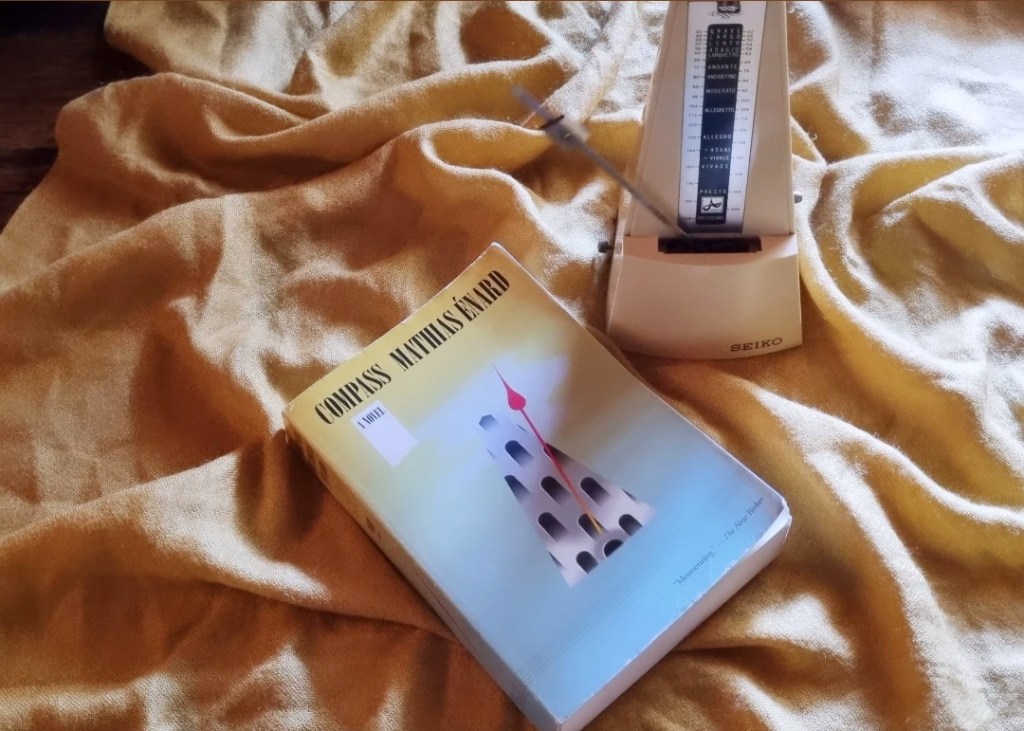
Mathias Énard: Compass

Mira, keep this close to Luis Sagasti’s A Musical Offering, close to Olga Tokarczuk’s Flights.

It is, after all, a musical offering — golden threads of western music’s entwining with the orient, of Liszt’s recitals in Constantinople, of how Nietzsche wanted to Mediterraneanize music, of the narrator’s replica of Beethoven’s compass that insisted on pointing east, but most of all because it reminds you beautifully that “music is a fine refuge against the imperfection of the world,” one that describes music as “time thought out, time circumscribed and transformed into sound… time domesticated, reproducible time, time shaped,” and cautions that “life is like a Mahler symphony, it never goes back, never retraces its steps…” but also that “this feeling of the passing of time is the definition of melancholy, an awareness of finitude from which there is no refuge.” Take note of how there is a metronome on the cover instead of a compass. Perhaps because a metronome goes back and forth between directions whilst keeping the music in time. 

It is about flights. A hypnotic trip across east and west, tick tock, east, west, art, love, time, self, other, literature, until they have intermingled and are present in each other, an adventure with Being — of traveling to the lands of your dreams and to your favorite cities, about crossing the borders of genres, art forms, literary forms, and geographical borders, but also flights from sanity, and traversing through memory, history, and dreams, suggesting that “our dreams might be more knowledgable than we.” Flights of flavors, an exotic dish not everyone will love; disturbing at times, an acquired taste with a scent of opium.

But keep this book close to Luis Sagasti’s A Musical Offering, close to Olga Tokarczuk’s Flights, close to your heart. Only you know how much this book means to you. Don’t forget you were constantly wide-eyed with wonder when you read it and you agreed with the following lines. How much you were in need of reading that last sentence!

“Sometimes I feel as if night has fallen, that western darkness has invaded the Orient of enlightenment. The spirit and learning, the pleasures of the spirit and learning, of Khayyam’s and Pessoa’s wine, have not been able to stand up to the twentieth century; I feel that the global construction of the world is no longer carried out by the interchange of love and ideas, but by violence and manufactured objects… You have to have… energy to constantly reconstruct yourself, always look mourning and illness in the face, have the perseverance to continue searching through the sadness of the world to draw beauty or knowledge from it.”

Olivia Manning: The Levant Trilogy

Despite being only approximately two-thirds the length of The Balkan Trilogy, it took me longer to finish reading The Levant Trilogy. 

Olivia Manning is not to blame, but rather the awry emotional state I was in when I read the latter. I even entertained the thought of setting it aside for a lighter read, but I was rewarded for pressing on. I’m glad I trusted the recommendation of friends who thought the trilogies are worth experiencing. As I approached the Levant’s third book, my pace finally picked up and I could hardly put it down again; and by the time I turned the last page, I was not ready to let Guy and Harriet Pringle go.

Among other things, I think the second trilogy is a surprising critique on imperialism and British presence in the Levant. (“Lord, the things we do to other people’s countries.”)

And as I re-viewed the six books mentally, it felt to me like the twenty years of writing between the first volume and the last is a peeling away of life’s layers of unrealistic romanticism; so that by the end, one is left with the stark nakedness of reality — of war, marriage, and life. 

Is it a bleak depiction of life? Not entirely. Manning seemed to say that it all depends on how you play the cards you’re dealt.