“I found in this library such books, about which I had not known and which I had never before seen in my life. I read them, and I came to know each scientist and each science. Before me lay the gates of inspiration into great depths of knowledge which I had not surmised existed.” — Ibn Sina (Avicenna)
Avicenna (980 – 1037) — philosopher, poet, astronomer, mathematician, physicist, the father of early modern medicine, among many other things — has been known to us as a Persian polymath. But he was, in fact, born in Uzbekistan. His early education began here in Bukhara.
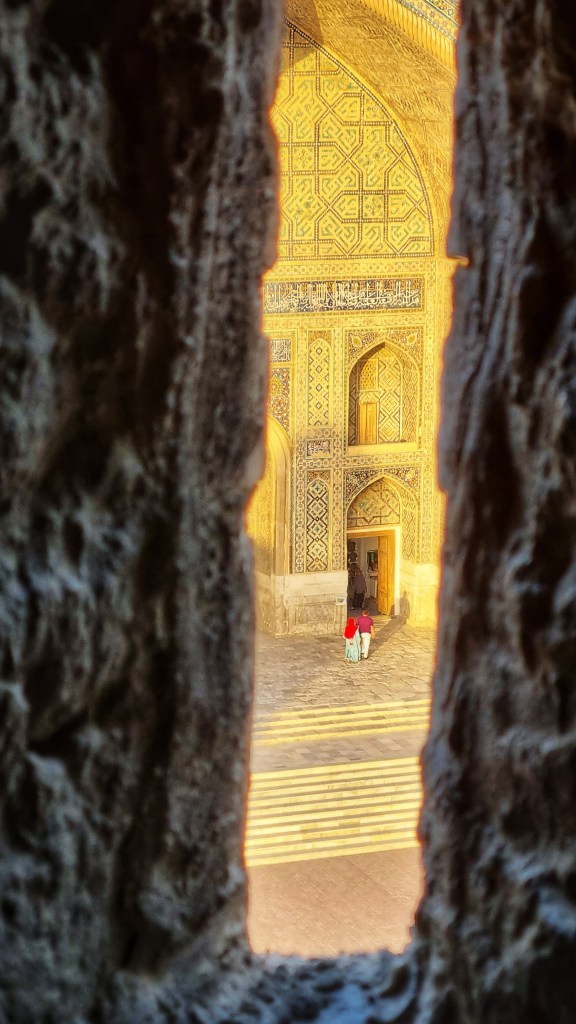
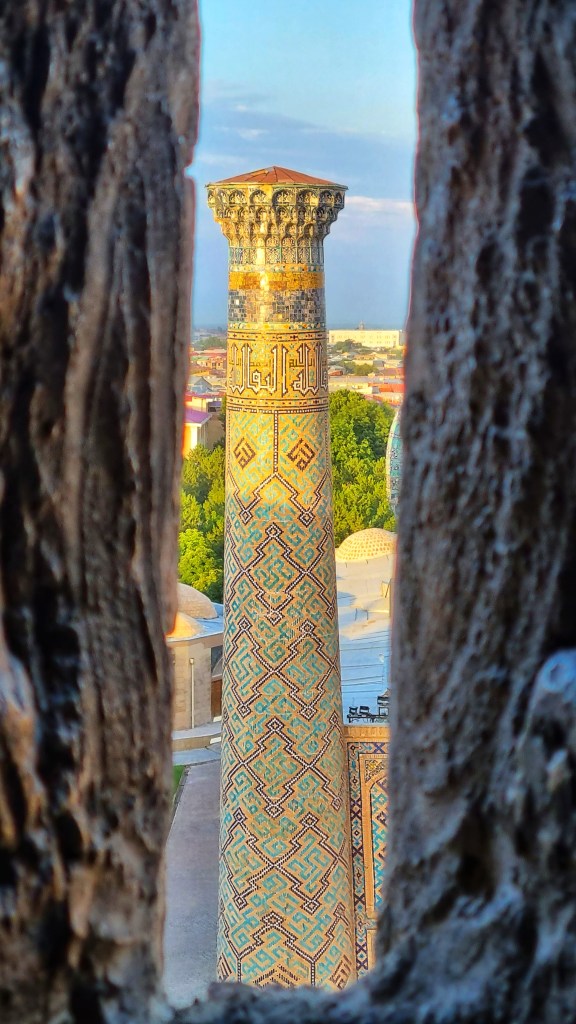
The library in the Ark of Bukhara has not survived the many conquests that Bukhara has been through, although this enormous structure that dwarfs me continued to be a fortress from circa 500CE until it fell to the Red Army in 1920.
Sadly, there is no way for me to find the books of which Avicenna wrote, but the book wide open before me now is Bukhara… and I am savoring every line.
“A city so deeply imbued with poetry that even the doctors wrote their medical treatises in verse.” This line by Elif Batuman, who wrote briefly about the height of the Timurid Renaissance, came back to me so clearly as I took my last look at Samarkand.
I can only commit these soft mornings in Samarkand to memory, as another gem in the Silk Route beckons…
It seemed to have been written in the stars that the first place I would be drawn to in Samarkand is the remnant of an observatory that was the most well-known throughout the Islamic Golden Age and the largest in Central Asia, preceding Tycho Brahe’s Uraniborg and Taqi al-Din’s observatory in Constantinople by more than a hundred years.
The great mathematician and astronomer behind this observatory, whose computation of the length of the sidereal year was more accurate than that of Copernicus’s, is Ulugh Beg.
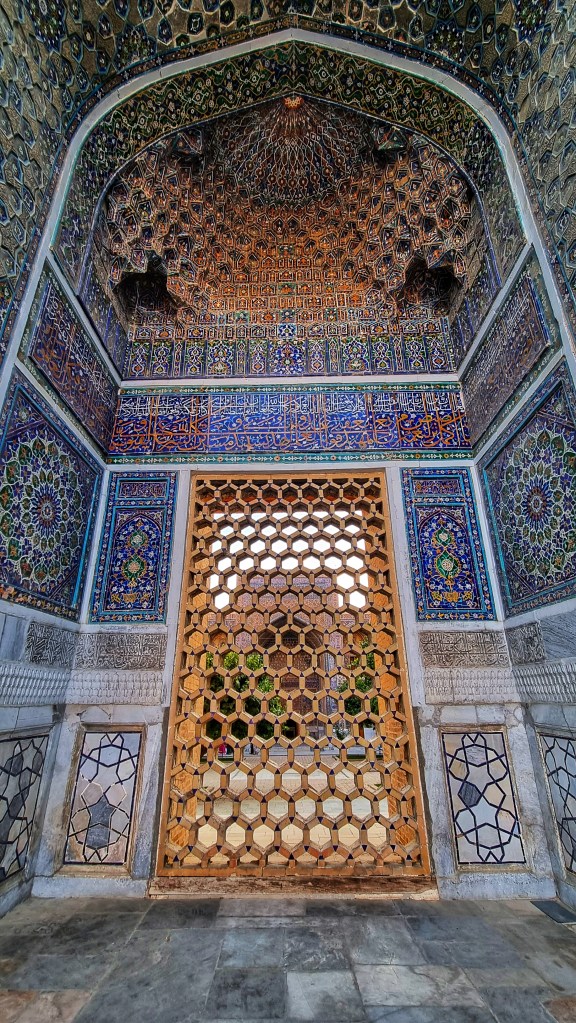
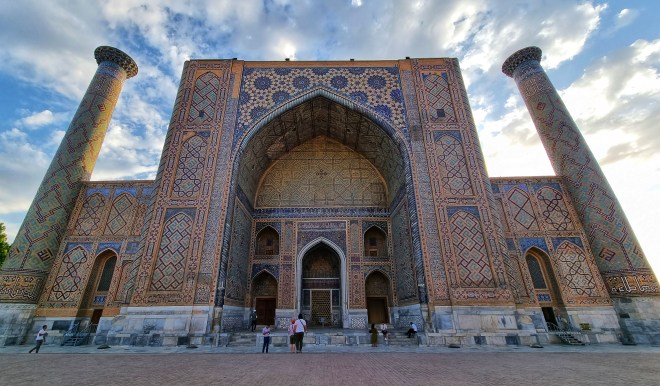
Although what remains of the observatory is the arc of a gigantic sextant (used to measure the transit altitudes of the stars and to produce the most comprehensive star catalogue in the period between Ptolemy and Tycho Brahe); the splendid madrasa that he built right at the heart of the city still stands.
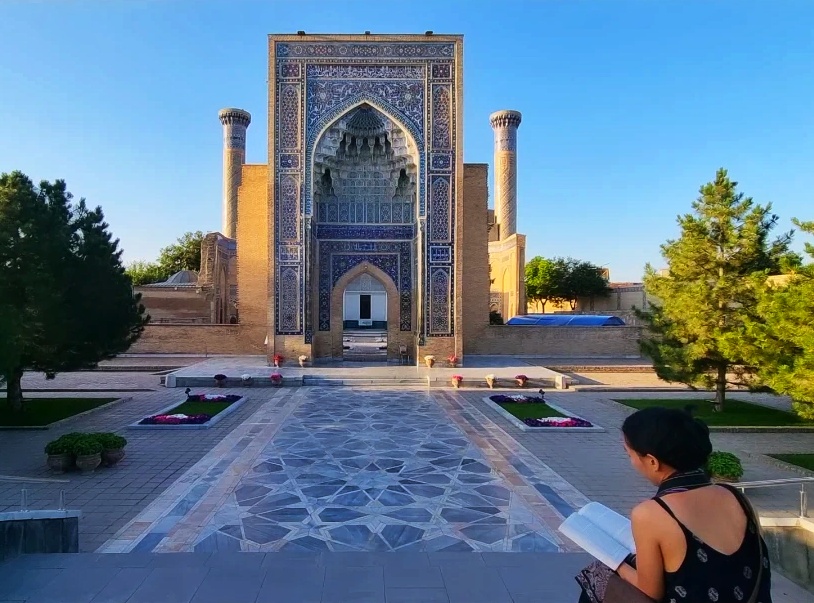
He turned Samarkand into an intellectual center, inviting mathematicians and astronomers to study there — but no longer by force. He was, after all, a sultan of the Timurid Empire, the grandson of Tamerlane, and his tomb lies at the foot of his grandfather’s in the Amir Timur Mausoleum.
When Soviet archaeologists exhumed this tomb in 1941, they allegedly found this inscription inside: “When I rise from the dead, the world shall tremble. Whoever opens my tomb shall unleash an invader more terrible than I.”
In a matter of hours, Hitler’s men invaded Russia resulting in millions of deaths. Stalin ordered the remains to be reinterred in 1942, and soon after, the Germans surrendered at Stalingrad. Coincidence or not, it is a remarkable story.
Two years ago, I listened to a series of podcasts about this man for whom this mausoleum was built. I found him frightening and intriguing! There aren’t enough books written about him, and eurocentric history merely dedicates one or two measly paragraphs to him!
This man, known in the West as Tamerlane, is Amir Timur, “iron” in their language. It was he who freed his people from the yoke of the Mongols and proceeded to establish the Timurid Empire in 1370 and conquered lands spanning parts of Russia, and north western India to Syria.
During his reign, he and his armies decimated 5 percent of the world’s population! On his Persian conquest, they massacred and constructed towers out of the bodies. He was as brutal as the Mongol Khans, but unlike them, he spared the intellectuals, the architects, the writers, the rug makers, the craftsmen, the artistic and the educated, and brought them to Samarkand. And thus began the flourishing of Timurid arts and architecture, well exhibited in this very mausoleum up to this day.
Where I am staying in Samarkand is a wall away from this mausoleum.
The moon was still up when I walked over this morning and the muezzin’s call to prayer accompanied my quiet footfalls.
I sat on the steps with a book thinking it would still be off limits at such an early hour, but the caretaker noticed me and offered to let me in and left me on my own!
Heart pounding and knees slightly trembling, I entered and thought I heard throat singing along with the muezzin’s call…
What is it about the rhythmic and harmonic counterpoints between a lone stringed instrument, a drum, and throat singing that fire up the blood and make you want to conquer the world? This must have been the music that ran through the veins of the formidable khans and Tamerlane. As if my heart was not already drumming wildly, the perfect soundtrack for how I felt greeted me through the train speakers — music so visceral, so empowering and liberating.
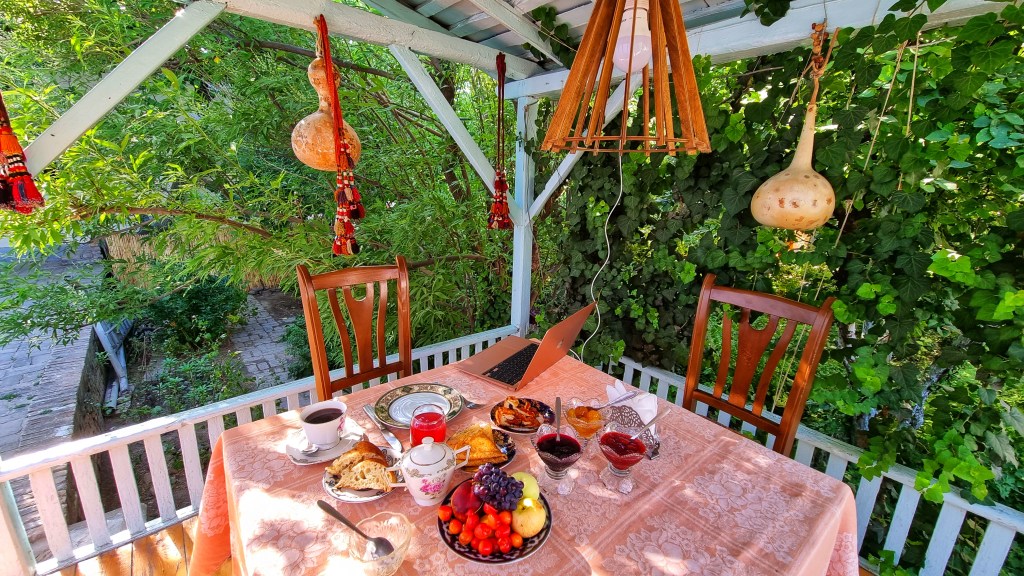
It was a day that started with a huge bowl of yogurt and honey, crisped walnuts that I did not expect to be so flavorful, plump dried apricots, raisins that had retained their blue, all these topped with crumbled cottage cheese; and a cup of coffee to further fuel an excitement that I had not felt in a long time.
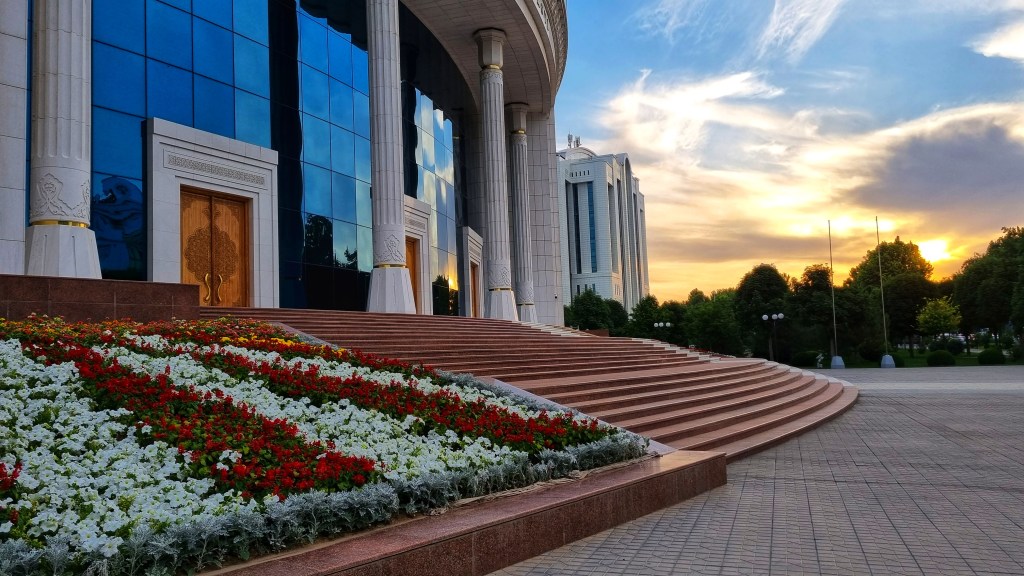
I left for the train station amidst a glorious Tashkent sunrise while half of me was still in disbelief that I was finally going to a land that had achieved mythical status in my mind, a land I thought I would only be able to visit through books.
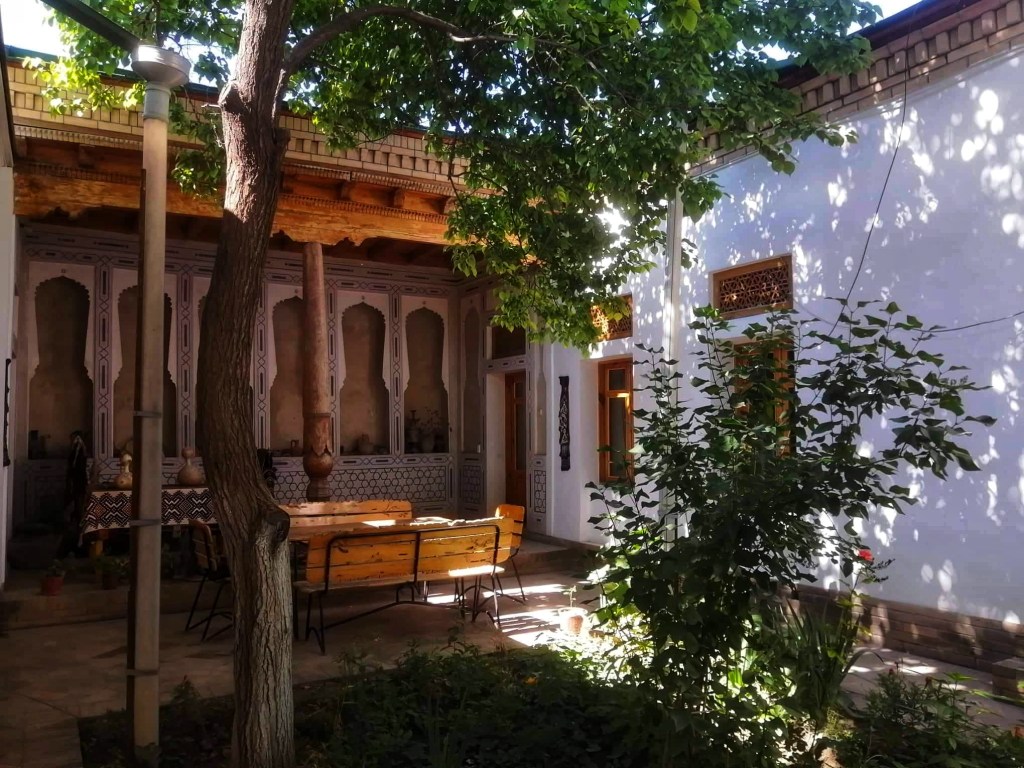
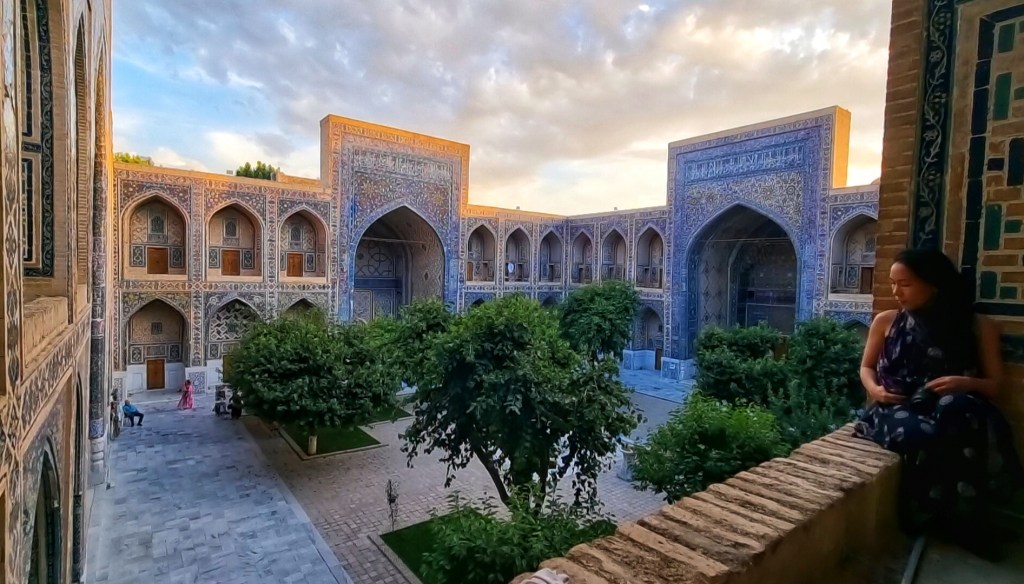
But today I walked into a poem. I found myself welcomed to a courtyard with a garden framed in abundant grapevines. My wonder must have been apparent that the owner of the guest house started pointing at each fruit-bearing tree and incanted, “Fig, apricot, orange, apple, quince, plum, persimmon, pear, peach, walnut, cherry, mulberry…”
“Mulberry? What the silkworms eat?” I asked.
“Yes.” She rummaged through the renowned leaves of silk history and held out gems of a deep magenta towards me.
As the mulberries burst into color and flavor in my mouth, I realized how perfectly symbolic this initiation was to a place that was once known to the Greeks as Maracanda — metropolis of the Sogdians, the wealthiest and most successful merchants of the silk roads.
What a most beautiful thing to finally be able to write in my journal, that today I arrived in Samarkand, the heart of the Silk Route.
In which city did Alexander Solzhenitsyn miraculously heal from a stomach tumor that he chose the place to be the setting of Cancer Ward? Where did Mikhail Bulgakov’s widow hide the manuscript of Master and Margarita before it was published? To where did Anna Akhmatova evacuate during the Leningrad siege? For which city did Vronsky refuse an assignment significant to his military career in favor of Anna Karenina? In which city is the oldest Quran kept? Tashkent.
It has played important roles in literary history, and literary history seems to be woven along the threads of daily life here. Three of Tashkent’s Metro Stations that I was able to pass through today are dedicated to writers: Alisher Navoi, the greatest writer in Chagatai history; Abdulla Qodiriy, the nonfictional character of the novel, The Devil’s Dance, which I read earlier this year, and writer of what is considered the first Uzbek novel; and Alexander Pushkin!
Abdulla Qodiriy (1894–1938), author of the first Uzbek novel, translator of Russian literature into the Uzbek language, and nonfictional protagonist of Hamid Ismailov’s The Devil’s Dance.
On the question of loneliness: “Isn’t that lonely, what you’re doing?”
(I have just returned from a solo trip to Uzbekistan.)
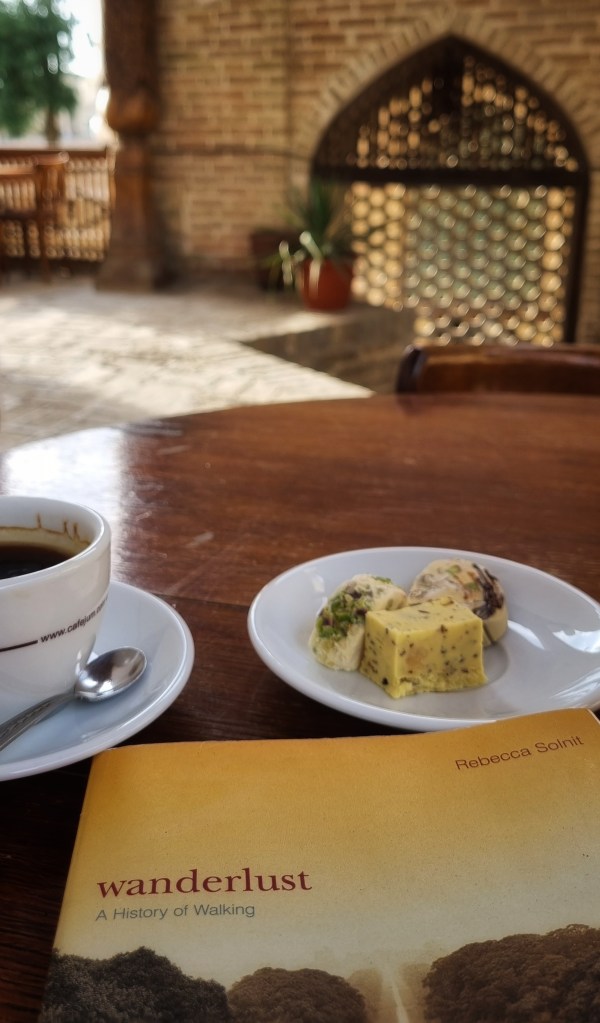
Well, these friends came along for the ride: The Naive and the Sentimental Novelist by Orhan Pamuk, for the long Istanbul flight; The Captain’s Daughter by Alexander Pushkin that was fortunate enough to have a photo at the Pushkin Metro Station in Tashkent and was enjoyed under the shade of the trees of Amir Timur Square; Wanderlust by Rebecca Solnit, read during those days at the Halva Book Cafe whilst waiting for the Bukharan sun to soften; and A Carpet Ride to Khiva by Turkish-British Christopher Aslan Alexander, which accompanied me through Khiva’s storied alleys.
As there is currently so much more outside book covers to commit to paper, I release myself from the discipline of writing book reviews this month. “Regular programming” will resume in this blog in July. Haha
But I have to mention that Pamuk, who sacrificed painting and architecture school so he could paint with words, taught me a Greek word through this book — “Ekphrasis”. Simply put, ekphrasis is, “To describe something, via words, for the benefit of those who have not seen it.” This inspired me to somehow practice ekphrasis in my little way as I traveled through Uzbekistan, and doing so has allowed me to savor experiences twice.
Pushkin, although political, was not as existentially heavy as Dostoevsky and not as heavy literally as Tolstoy — a purely delightful travel companion!
A Carpet Ride to Khiva seems to have left no stone unturned about Khivan society. It is written in simple prose, bursting at the seams with honest observations, this book is an entertaining overview of the country’s history and politics — which is, perhaps, one of the reasons why the author is banned in Uzbekistan, and why I only brought the e-book with me. I, too, have my own observations, but will keep them to myself for the time being. But it has to be noted that along with reading, traveling is a most comprehensive education on geopolitics, among other things, if one cares to engage and observe.
Solnit, with a title perfect for a trip, shared this Eskimo custom of offering an angry person release by walking the emotion out of his or her system by going in a line across the landscape; “The point at which the anger is conquered is marked with a stick, bearing witness to the strength or length of the rage.”
I, who had no anger to release, did mark the places that bore witness to the strength and length of… something else. I enjoy traveling solo. I would not keep doing it if I didn’t. It is almost like a sort of essential meditation for me and I always go home a better person. I do not feel sad with my own company. But I did mark those places, those experiences so ineffable I could think of only one person to share them with. I would prefer to call it love than loneliness. (But why is conquering anger about letting go and conquering something else the opposite? But I digress.)
As I reluctantly tuck in this unforgettable trip lovingly and a little bit pensively in the folds of memory, I am reminded that the Old Uzbek language had a hundred words for different kinds of crying. And I wonder, what about laughter? What about happiness?
There is something therapeutic and enlightening about these essays that are of diverse scope but which are bound with a single string. That string is language — and not just the spoken, but also the unspoken; the pre-verbal, the danced, the hidden, the sung, the articulate, the inarticulate, the visual.
Just a few books ago, Rica Bolipata – Santos beautifully expressed that writing is, “An added gift to the love of reading.”
For John Berger, writing is, “An offshoot of something deeper… our relationship with language.” Language, to him, is a creature, “A quivering almost wordless ‘thing’.”
Language is that which acquires a body when it is sung, or played, or danced, as in music; it is el duende of which Federico Garcia Llorca wrote, the spirit, the gestures, “Gestures that are the mothers of all the dances of the ages”!
But these string of thoughts also hint at the things that distract us from it, the diversions from what is “true, essential, and urgent.” More than that other book of his, this one will somehow recalibrate our ways of seeing, and if we allow it further, our ways of living.
The pre-verbal, the danced, the hidden, the sung, the articulate, the inarticulate, the visual, the musical… all at once, there is a sudden inspiration to live in every language I know.
Reading this reminded me of a trip to the National Museum of the Philippines. I went there for the masterpieces, but found myself spending more time, and being most delighted, in a room full of practice sketches by Amorsolo.
Exteriors are sketches, little fragments of writing that feel like ingredients for a larger canvas; and Annie Ernaux is the great artist who guides readers to become keener observers of people, of gestures, of the world beyond the intimacy of the self, of exteriors.
Peruse the sketches more carefully and find priceless lessons on writing and observing. Once in a while, we need an artist to lead us to details we should pay attention to. Once in a while, we need an Annie Ernaux to take our hand.
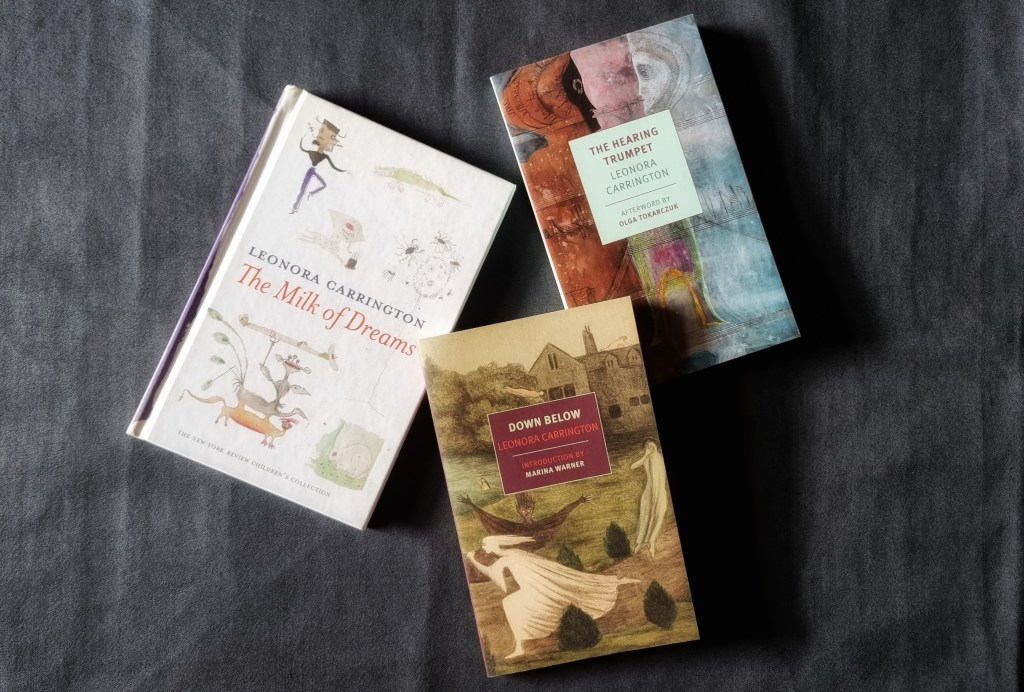
Dated 23rd of August 1943, this personal account begins with these plain words: “Exactly three years ago, I was interned in Dr. Morales’s sanatorium in Santander, Spain, Dr. Pardo, of Madrid, and the British Consul having pronounced me incurably insane.”
Down Below is a short but unpleasant read, devoid of the whimsy of her two other books that I read earlier this year. This one ironically chronicles a life’s descent into madness — rationally.
The life in question endured the turmoil of WWII; stormy relationships; the arrest of her lover, surrealist artist, Max Ernst, by the Nazis; rape, abuse, and suffering in a mental institution.
Reading her writings and looking at her paintings is to catch wind of that unique and bizarre voice from her depths, from down below… an abyss where only painting and writing would provide moments of reprieve.
Leonora Carrington died in 2011 without knowing that she, along with her otherworldly imagination, would be honored in the art world when the Venice Art Biennale would borrow its 2022 title from one of her books, The Milk of Dreams.
But she did know certain things while she lived: she knew how to shield herself from what she considered “the hostility of conformism”, and gave little mind to what others thought of her… and perhaps, in that respect, she was free.