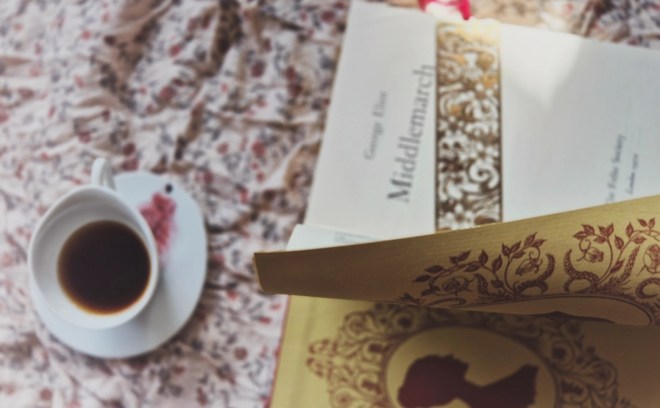
A more mature reader will often return to the classics with a reformed insight that the classics are not necessarily meant to be venerated but to be re-examined. Such a reader would trudge through old-fashioned language and time-consuming lengths to defy modern man’s preference for instant gratification and to seek resonance in the historical, intellectual, and emotional bulk. More often than not, the willing seeker finds — and finds more than they set out to find.
To read Middlemarch in a 21st century small town in the Philippines, and be transported to an early 19th century English rural community and notice the same players in society, espy similar outlooks that should be outdated by now but which still exist, and observe national political ferment trickling into daily lives to color preconceptions about other people, makes one marvel at the timelessness of George Eliot’s, or Mary Ann Evans’s, masterpiece.
The cracked spine of an old paperback that I’ve given away testifies to the struggle I had with this classic over two decades ago. Virginia Woolf thankfully absolves the young reader by deeming the novel “magnificent… which with all its imperfections is one of the few English novels written for grown-up people.”
Indeed, a younger reader would, perhaps, only register who marries whom and mistake that for the plot and find it wanting. Middlemarch is, to this older reader, a rich study in, and of, character: “Character is not cut in marble—it is not something solid and unalterable. It is something living and changing, and may become diseased as our bodies do.”
It is also a look into the inherent goodness in people: “I must observe that goodness is of a modest nature, easily discouraged, and when much elbowed in early life by unabashed vices, is apt to retire into extreme privacy…”
And while it is consistent about how character and goodness can be bettered, it serves as an admonition of how it can be lost.
Middlemarch, above all, exhibits that it is character and goodness that is at stake in daily living, and it is what should be constantly guarded and cultivated. Most of the characters in the novel fail miserably as humans, but as Lydgate says in earnest, “What I want, Rosy, is to do worthy the writing,” or in Ladislaw’s religion, “To love what is good and beautiful when I see it.”
Literature has been accused of being the most solitary of arts, and a thick tome like this can be rather demanding in 21st century fast-paced living. Grateful to my friend, Vera, for buddy-reading this with me and making 837 pages fun, enriching, less solitary, and totally worth it. As Dorothea puts it, “What do we live for if not to make life less difficult to each other?” True in reading, true in life.

