The two books I read in succession for the first week of May.
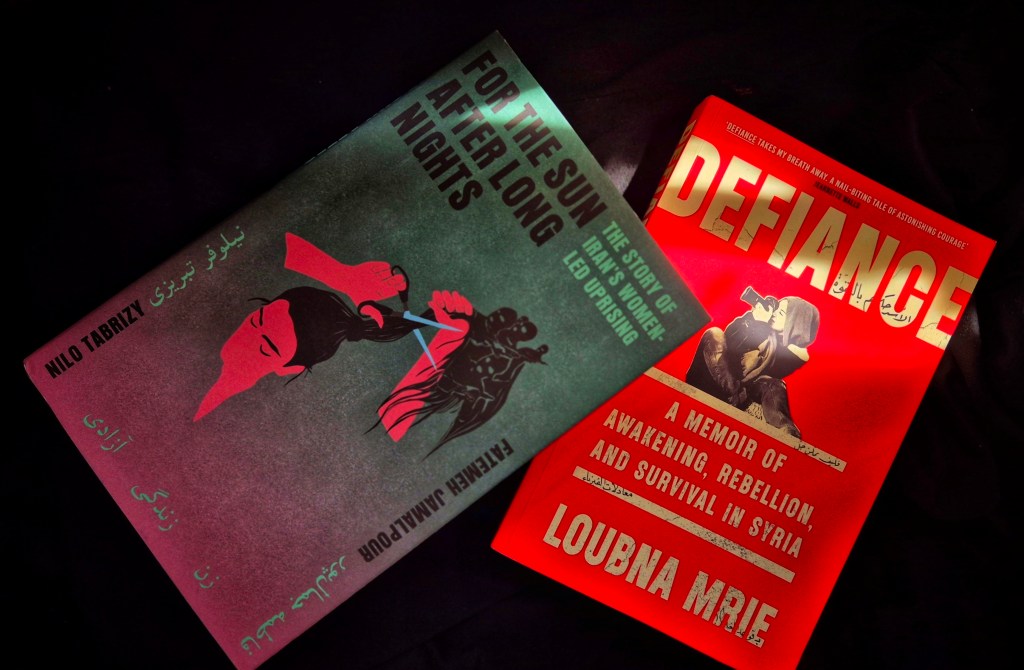
Defiance is the first book I’ve read that was written and published after the fall of the Assad regime. Striking not only for its incredibly human and candid account, but also for the fact that it is written by someone whose father led Bassel al-Assad’s security team, and whose American boyfriend’s public execution at the hands of the Islamic State the world witnessed.
For the Sun After Long Nights is the first book I’ve read about Iran that veers away from the 1979 Revolution and focuses on the Woman, Life, Freedom movement (ignited by the death of Mahsa Amini, who was detained and beaten for not wearing her hijab according to the imposed religious dress code, and who died in state custody in 2022). In this collaboration between two Iranian journalists, chapters alternate between the points of view of Fatemeh Jamalpour, who joined and covered the protests in Iran, and Nilo Tabrizy, who reported from overseas on the violence and injustices committed by the Iranian government.
The books are remarkable works of journalism written by young women, but this is not the only similarity they share:
Both shed light on the ethnic minorities of their respective countries, and reveal how these communities on the fringes of society are prone to abuse from the government because they do not get media exposure. Both books also emphasize how economic sanctions seldom achieve their goals and only affect those who do not have foreign bank accounts;
Both countries have had uprisings that were hijacked by Islamists, teaching their people tough lessons on revolutions that not everyone participating share the same idea of a nation’s future, but on the other hand, through a movement like Woman, Life, Freedom — the largest and most widespread uprising in Iran since the 1979 Revolution — learn that it is possible for everyone to come together for the same cause to shake up a regime and give it reason to be fearful of its demise.
The women in both books undergo rude awakenings to how oppression, especially towards women, trickles down from governments to communities and family units.
Most of all, the accounts are written because their writers believe in the power of documentation despite brutal consequences, and cling to the hope that documenting a government’s injustices is the first step towards ending it.
This made me ponder on our own country. This is what our journalists did during the Martial Law era when they defied censorship. But what did we do with those records? How easily we dismissed them during the last presidential election! Have we learned our lesson yet?

