“Mongoloid” as a term for Down syndrome has been considered offensive and obsolete by the time this book was published, and yet it is still being used here to describe a minor character. It is but a small spot in a galaxy of details and I’m not usually one to nitpick on political correctness, because I also tend to be guilty of political incorrectness at times, but this somehow cast a cloud on my appreciation. And although I read this about a week ago, it took some time for me to gather my thoughts.
_ _ _
Jokha Alharthi is the first Omani woman to have a novel translated into English. Marilyn Booth, the translator, has translated works by two favorite authors in my Silk Route & Fertile Crescent Reading Project, Elias Khoury and Nawal El Saadawi.
With that in mind, perhaps I set my expectations too high.
There are elements that I highly value: How each chapter is named after a character, and through these various perspectives from different social strata unfold the story and tapestry of Omani history and society; unique details of traditional wedding preparations through the eyes of the mother; captivating descriptions of Bedouin life; and Abdallah’s musings during an airplane flight that often wax poetic. The historical aspects led me to look into the British-mediated Treaty of Seeb and, hardly ever mentioned in reviews, the master-slave dynamic in such a society that plays a significant role in this novel, reminding the reader that it was only in 1970 that slavery was abolished in Oman.
Orbiting around the lives of three sisters in the village of al-Awafi, I immediately found a favorite in the middle sister, Asma. The reading sister, the one through whom references to the region’s literary traditions are made, the one who has read enough to see through the nonsensical beliefs and superstitions.
These three sisters in the cusp of a modern Oman, although bound to customs, had relatively more freedoms compared to women from other stories I’ve read of the region. And so it was with disappointment that I read how Asma readily agreed to an arranged marriage while the younger sister who spent more time prettifying herself was resolute in refusing hers. It can be argued that Asma did it in the hope of furthering her education and the younger had more foolish reasons for her refusal, but something still did not add up. The strong character that I admired at the beginning seemed to give way to a weaker one towards the end.
On the other hand, there is more to the novel than that. The fact that there is so much to pay attention to borders on both distracting and brilliant, but as far as novels translated to English are concerned, this is still currently the most intimate look into Omani life available to us.
In a way, it makes me look forward to what lies ahead in translated Omani literature — especially those written by women.
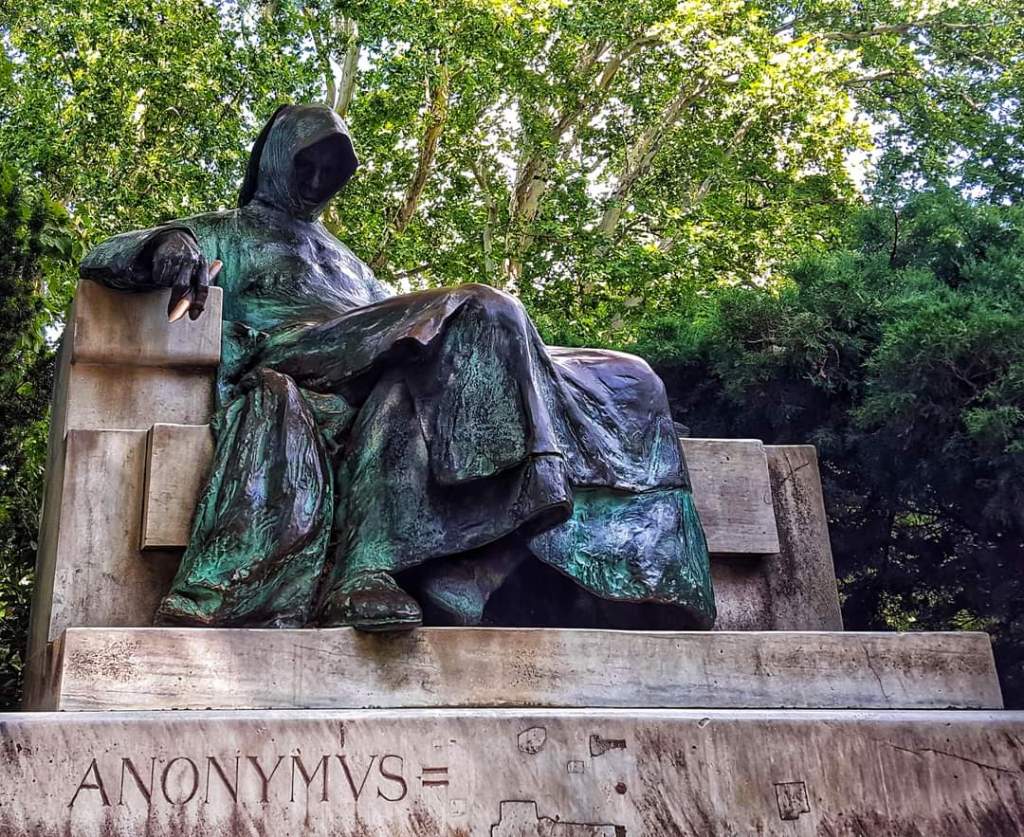
“As he spoke Lidia could see the schoolgirl Iza discussing the future with her father. She saw her as her father described her, as a pint-sized redeemer spreading out her school atlas and examining the map of Budapest because she wanted to see a major city, a really big city, and trying to work out where in City Park the statue of the historian Anonymous might stand. Iza loved the look of that hooded faceless figure. She saw it once when she was a young woman visiting Budapest…” – Magda Szabó, Iza’s Ballad
How pleased I was to have identified with Iza so much! There was even something close to a silent pride that I initially felt. It was as if I were reading my own mother’s description of myself – how Iza organized her life and her schedule, the tidiness, the discipline, the sense of responsibility, the restraint, her satisfaction in not having to give account of herself to anyone!
But how I trembled, as I turned the pages approaching the finale when I realized that it was because of this unrelenting self-discipline seeping into the cracks of her relationships that led to heartbreaking consequences.
It is for readers with aging parents. It is for every new generation that believes they are so much wiser than the previous one, so practical even in matters of the heart, and yet, unwittingly, so heartless.
It is for societies that reject the past and the old deeming these to be outdated and sentimental, failing to acknowledge that the past and the old hold the clues to the present and the new.
Although set in postwar Hungary, the spirit of this novel is contemporary: the timelessness of its message, its tragedies that are themselves the lessons, will gnaw at my soul for years to come.
Few books leave me feeling defeated. This one did. I felt so helpless under the influence of such simple but penetrating prose.
It is that dazed emotion one undergoes when someone so much wiser with experience sings in a pensive gasp, “I really don’t know life… at all…” Yes, someone like the inimitable Joni Mitchell, only Magda Szabó does it with an outstanding novel that she affectionately hands over to the reader saying, “You really don’t know life… at all…”
And in the presence of such masterful artistry and truth, what else can one do but applaud and weep?
Because I arrange my books based on geography, Nikolai Gogol, Mikhail Bulgakov, Vasily Grossman, and Irène Némirovsky among a few others share a spot on my shelf. They were all born in Ukraine while it was still under the Russian Empire.
Fire in the Blood was thought to be unfinished when Némirovsky died in Auschwitz in 1942. It was only through subsequent research years later that the rest of the manuscript was found and published posthumously.
She wrote this around the time she was arrested and deported to Auschwitz, but there is no pain of epic proportions in this book. There are none of Gogol’s ghosts, none of Bulgakov’s political caricatures, and none of Grossman’s wars.
At the beginning I was so convinced that this was simply a charming picture of rural life in an idyllic French village. She makes the reader believe that, until one surprising revelation after another piles up towards the end, and it reveals its own unique depth.
“Are we not all somewhat like these branches burning in my fireplace, buckling beneath the power of the flames?”
Fire in the Blood, the fire of youth contrasted with the sobriety of old age through the introspection of Sylvio and the lives of those around him leaves the reader with a subtle sting that leads to a silent contemplation on, or the questioning of, passion, love and life.
There may have been none of Gogol’s dark humor, none of Bulgakov’s satire, and none of Grossman’s reportage on tragedy, but perhaps Némirovsky deserves her place alongside these men as someone who lays bare the human heart.
“No, it wasn’t that simple. The flesh is easy to satisfy. It’s the heart that is insatiable, the heart that needs to love, to despair, to burn with any kind of fire… That was what we wanted. To burn, to be consumed, to devour our days just as fire devours the forest.”
The Mirador by Élisabeth Gille
Don’t you love it when an underexposed book surprises and transcends expectations? I had not anticipated The Mirador to contain this much beauty!
Having read nothing by Élisabeth Gille prior to this, I approached it as someone who was simply curious about her famous mother, Irène Némirovsky.
From her mother’s journals, letters, unpublished notes, “dreamed memories”, and with the help of her elder sister’s own memories and research, Gille recreates a striking portrayal of the mother they lost to Auschwitz when they were mere children.
Regardless of the applause that her novels garnered and despite her tragic fate, it was for her indifference and lack of political sense that Némirovsky was criticized. Gille, however, does not justify her mother’s shortcomings. She allows a beautiful irony to unfold through the pages and writes a lyrical and clearsighted grasp of her forebears, literature, history, and the political arena that surrounded Némirovsky from her early childhood in Kyiv, growing up in St. Petersburg, fleeing to Finland in the wake of the Russian Revolution, and building a life and a successful writing career in France until the German Occupation.
I must admit that I personally prefer the daughter’s writing over the mother’s, and it was saddening to learn that Gille died from cancer in 1996, only four years after The Mirador was published. But I beam at the thought that Némirovsky would have been so proud.
How cathartic it must have been for a daughter to write this! It makes one wonder at the mysterious power of writing — how it can liberate the writer and the subject at the same time, how it can be a simultaneous act of holding on and letting go.
“When I met Pablo, I knew that here was something larger than life, something to match myself against…”
“People always ask very bizarre questions like, ‘Why did Picasso like you?’ or ‘Why did Jonas Salk like you?’ So I said, ‘Well, usually, lions do not mate with mice!’”
I took an instant liking to this fascinating woman upon hearing her utter this line with a laugh in a documentary that my best friend shared years ago. Right then and there, I was determined to read Life with Picasso one day.
And here it is. The engaging conversationalist comes out in Gilot’s writing. With a clear and strong voice and nary a narcissistic hint, she does not make the book about her, but brings about an unsurpassed portrait of the man that was Pablo Picasso with all the contrasts of light and darkness. She does not play the victim of an eccentric genius, although the book tells us of how she draws the line not only on canvas but also in life.
I doubt if there can be a more intimate and honest account of how Picasso created, his thought process, his private life, and his artistic and political beliefs. As a rippling consequence, Gilot also paints a profound portrait of an extraordinary era that had a surfeit of literary and artistic personages that shaped history.
Stimulating discussions on Modern Art and its dilemmas, on artistic movements, on technique, color, composition; this account is nothing short of enlightening! There is no shortage of lessons on art, on living, on relationships, and on woman.
Introductions to Françoise Gilot usually begin in 1943 when she met Pablo Picasso with whom she lived for ten years and with whom she had two children; and continues on the same thread that in 1970, she married Jonas Salk who was famous for developing the polio vaccine.
What I find remarkable about this woman is how, despite the monumental names to which her name was attached, she remained her own person as an artist, and as a woman — who, apparently, just refused to mate with mice!
I am sure she was, above all, referring to an intellectual symbiosis.
“History’s only true heroes, the only true leaders of mankind are those who help to establish freedom, who see freedom as the greatest strength of an individual, a nation or state, who fight for the equality, in all respects, of every individual, people and nation.” – Vasily Grossman, Stalingrad
Everything Flows. Stalingrad. Life and Fate.
These three, read in this particular order reminds me of realist painting lessons: One starts by sketching the foundation and the outline, followed by painting the background and setting the mood for the main subject, and then finally filling in the details and emphasizing the contrast of light and shadow by articulating the source of light.
Because of its fullness, it is hard to believe that Everything Flows is an unfinished work, but after having read the three in succession, I now see it as a concise foundation on the scope of Grossman’s knowledge and profundity. Stalingrad exists to set a monumental stage, Life and Fate consummates the masterpiece.
Everything Flowsis a forceful literary piece in which the main character occasionally disappears to give way to in-depth analyses of Russia, Lenin, Stalin, other political figures of that era, and sometimes, its literature.
For someone considered the Tolstoy of the 20th century, it is important to note that the difference between Grossman and Tolstoy is that Tolstoy wrote about a war that took place before he was born, while Grossman wrote about wars in which he was a war correspondent. The things immortalized through his fiction, he experienced and witnessed firsthand.
He wrote at a time when there was hardly any published information regarding the Gulag, Collectivisation, the siege of Stalingrad, the Holocaust, Treblinka, 20th century’s lesser-known acts of genocide — the Armenian, the Circassian, and Ukraine’s Holodomor or Terror Famine — and he wrote of these things. Most of all, he did not merely write, he did so with unbelievable insight and clarity.
And because of current world events, I think there is no better time to read him.
He was born in Ukraine.
Stalingrad, an expression of how the siege impacted the lives of Russians and one particular extended family is, to me, epic in every sense of the word. But what will stay with me is the hopeful tone that Grossman maintained amidst all the human suffering!
“No wartime blackout has darkened the stars.”
Despite the horrors of which he wrote, he never fails to stop to admire beauty: “At times like this we cease to have distinct perceptions of light, space, silence, rustlings, warmth, sweet smells, the swaying of long grass or leaves — all the millions of ingredients that make up the world’s beauty. What we perceive then is true beauty, and it tells us only one thing: that life is a blessing.”
I believe this is also where he leaves clues about the kind of art he sought to achieve. In a brief chapter hides this beautiful passage that book reviews of Stalingrad (at least, the ones I’ve read) fail to mention:
Art of this kind does not separate people from the world. Art like this connects people to life, to other people and to the world as a whole. It does not scrutinize life through strangely tinted spectacles.
As they read this kind of book, people feel that they are being infused with life, that the vastness and complexity of human existence is entering into their blood, into the way they think and breathe.
But this simplicity, this supreme simplicity of clear daylight, is born from the complexity of light of different wavelengths.
In this clear, calm and deep simplicity lies the truth of genuine art. Such art is like the water of a spring; if you look down, you can see the bottom of a deep pool. You can see green weeds and pebbles. Yet the pool is also a mirror; in it you can see the entire world where you live, labor and struggle. Art combines the transparency of glass and the power of a perfect astronomical mirror.
All this applies not only to art; it is equally true of science and politics.”
And if you ask me, Grossman has achieved this in these three works.
Life and Fateis where the excruciating details are.
How can one convey the feelings of a man pressing his wife’s hand for the last time? How can one describe that last, quick look at a beloved face?
And yet he does!
I overestimated my courage when I set out to read this. Some of the most heartrending passages in literature are found between these pages: A Jewish mother who is about to be seized writes a long farewell letter to her son, the last words being, “Live, live, live for ever… Mama”; a woman, mad with hunger, who had just eaten her two children; a suffocating chapter of a scene where Jews are being herded like cattle to their deaths; a childless woman who had a chance at freedom but chose to hold the hand of a boy on the way to a gas chamber, and as she draws her last breath, she reflects, “I’ve become a mother.”
It took me longer to finish reading this than expected because I had to put it away so many times just to catch my breath or to calm myself down before continuing, not to mention a fever that made it difficult for me to read the last two hundred pages. But then again, Life and Fate concludes the painting. And what work of realism would be complete without its darkness?
The thing about masterpieces is that you cannot merely read them. You experience them.
As I review my notes of the three books, I notice recurring themes: Warnings about the tendencies of totalitarianism and its evils, what it means to be human, what causes one to cease being human, freedom, and kindness as the greatest achievement of the soul.
Never mind the fascinating passages on quantum mechanics that reflect Grossman’s knowledge in this field, never mind that Life and Fate contains some of the most illuminating discussions on Russian literature, never mind the other things about Grossman and his works that easily come up in internet searches, Raymond Chandler sums it up beautifully in his introduction to Life and Fate, “It is an exhortation to live.”
Whenever something momentous happens anywhere in the world, the first instinct of a reader is to read. Whether they be articles, books, or contrasting views on social media posts, a reader reads. And books, even when they are not capable of telling you everything, can still tell you a lot.
As soon as Sri Lanka’s protesters occupied their president’s palace and called for his resignation, I paused from this month’s reading goal to look into Sri Lanka.
The bad news: There is only one Sri Lankan on my shelf. The good news: It is Michael Ondaatje.
“Ceylon falls on a map and its outline is the shape of a tear,” writes this favorite author who is none other than the one who wrote about “the sadness of geography”.
Although I initially hoped otherwise, Running in the Family is not a thorough overview of the nation’s history or politics and turned out to be about family history; and yet I became so absorbed in it that I forfeited an early morning run to read it and finished it on the same day. Because after all, you learn a lot about a country through its people, through its literature, and reading along or between the lines.
There were times when it felt like I was reading about my own country: From superstitions, to drinking tubâ (coconut toddy), the humidity, the smell of durian, the attitudes, and our colonial past — “… the wife of many marriages, courted by invaders who stepped ashore and claimed everything with the power of their sword or bible or language.”
The ousting of leaders has been one of the recurring themes in my readings these past few years and I have read quite a bit to know enough that overthrowing a corrupt leader is not always an assurance of a better government (but also enough to know that the faults of the successor should never erase the sins of the previous one from the memory of its people, otherwise the vicious cycle only continues).
By the end of the book, I already felt a kinship with Sri Lanka’s people; and for now, we wait with bated breath for what is to come. While it is tempting to hope that, by some stroke of serendipity, my country and this land that used to be called “Serendip” by Arab sea traders will stumble upon great things in the future of our governments, we know we cannot leave it all to chance.
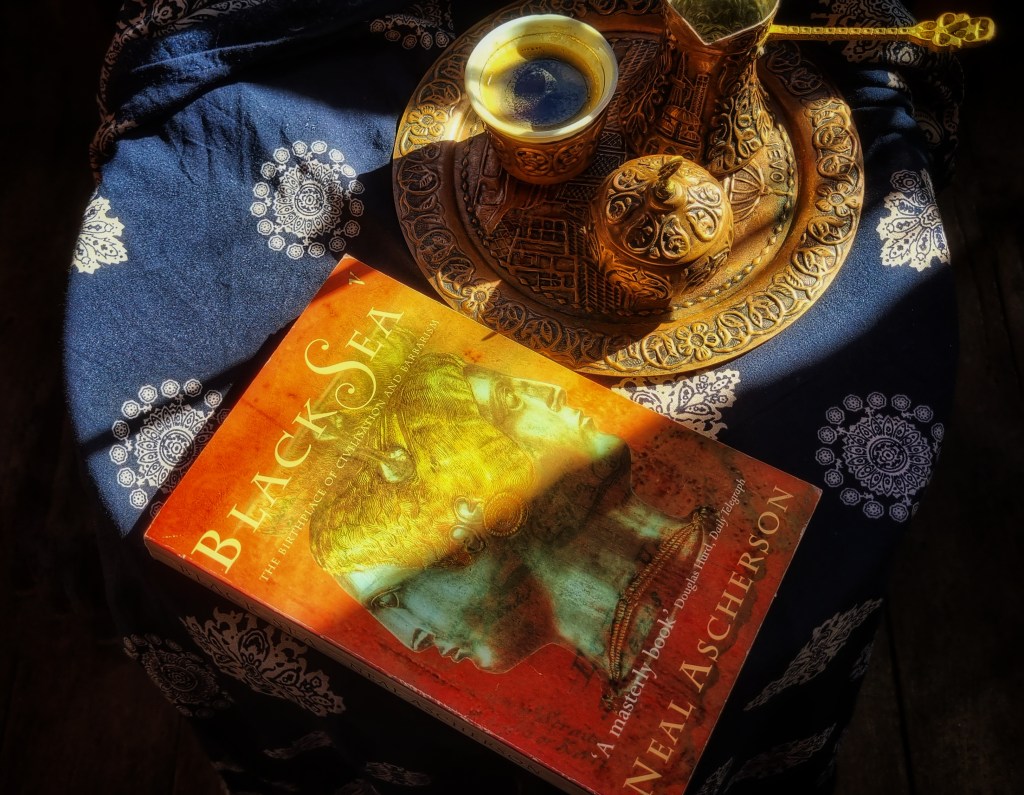
On a trip to Turkey in 2016, we landed at Sabiha Gökçen International Airport, which is on the Asian side of Turkey and closer to the Marmara Sea. The Istanbul Airport that opened in 2018 is on the European side, and just before landing on the meeting point of the world, one is gifted with a breathtaking view of the Black Sea.
I saw the Black Sea thrice from an airplane window on my most recent trip, and the irony dawned on me that this body of water that has sadly become the “largest mass of lifeless water in the world,” in fact, teems with so much history and so much… life!
This book written by Neal Ascherson about this birthplace of civilization and barbarism accompanied me, although I only finished reading it on my way back home. I don’t think I’ve read a more poetic history book!
“Human settlement around the Black Sea has a delicate, complex geology accumulated over three thousand years. But a geologist would not call this process simple sedimentation, as if each new influx of settlers neatly overlaid the previous culture. Instead, the heat of history has melted and folded peoples into one another’s crevices, in unpredictable outcrops and striations.”
Reading it brought me back to the landscapes of Tokarczuk’s The Books of Jacob and to where I’ve just been, merging the lands of my dreams with those places that are the epicenters of current world events. Because somewhere in the midst of this all, is the history of the Black Sea.
From its first mention in literature in the Bronze Age (where Jason and the Argonauts sailed upstream the Bosphorus to the Black Sea); to the different Central Asian tribes and kingdoms; to chapters that made me understand better the Russian Revolution and Communism’s life, course, and death in that region; to the question of Crimea, Russia and Ukraine’s relationship and to many things in between, I am in awe of how Ascherson sustained a poetic voice!
In a way, it answers our suspicions about how, despite all the earlier discoveries of the East in almost all fields, the West is still seen as more superior and more “civilized”. It is an enlightening investigation on the definitions of civilization and barbarism that surprisingly touches on feminism and immigration, which is quite different from what most minds have been programmed to believe.
Here is a history book that does not merely record events and dates, but most importantly, relationships. For as the author compellingly reveals, the Black Sea is not just a place but a pattern of relationships, and nothing like the symbiosis of the Bosporus Kingdom has ever happened.
A beautiful thing about traveling and reading is to be able to measure ourselves against the expanse of time and history, with the intention of acquiring more perspective, if only to acquire more life.
My last few days in Uzbekistan were supposed to be spent in Termez, a place bordering Afghanistan where Alexander (considered not so great in these parts of the world) founded a town. But after learning about the tragic earthquake in Afghanistan, and for the peace of mind of those I love (not that I’ve given them so much of that), I decided to be practical (yes, I can be, sometimes) and come back to Tashkent to be closer to the airport. Termez will have to wait; and perhaps, it is a romantic idea to leave something to come back for.
It is risky to travel these days, and it is crazy how the fate of some dreams and travel plans hang in the balance between two words — Positive or Negative. And when I asked my niece who works in a bank to change some currency for me, she reported that the bank declined upon learning of my destination, “Kay duol sa na-ay gyera.” (It is close to areas of conflict.) She had to go out of her way to another money changer. If one looks at the map, the bank is not wrong.
But here I am. Because when something feels right, it feels right. I booked my ticket with so much faith, and the itinerary that has been ready since 2020 finally came in useful.
“But I thought you wanted to go to Iran?” friends asked. I am in what used to be part of Persia. “Stan” is a Persian suffix that means “place of”. This is the place of the Uzbeks that was once of Persia. When the Achaemenids expanded their empire, they sought not to Persianize whomsoever they conquered but allowed different peoples and cultures to thrive — as long as they paid tribute, of course. And since we know borders are all but manmade, I am in the region of which I have been reading and dreaming for a long time… and it is intoxicating, and beautiful, and enriching.
The books I have been reading did not end on their last pages. The best books never do. They only give the reader a deeper yearning to continue the journey and the learning beyond the pages. They give one an urgency to live.
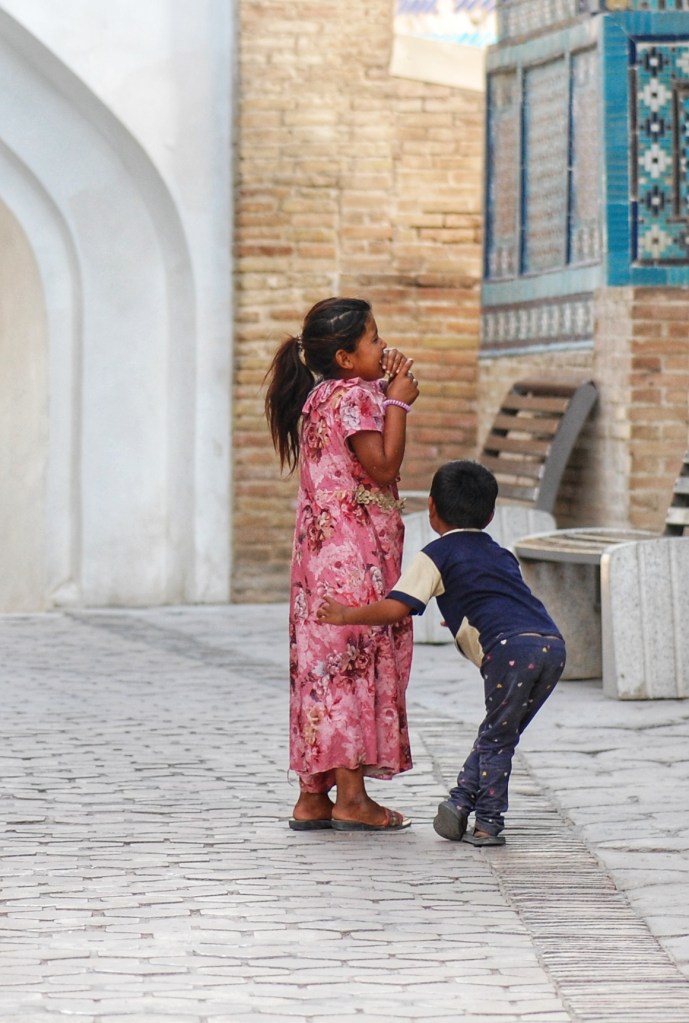
In the alley right below, a child sings in a language both strange and familiar to me. Strange because she sings in the Khorezmcha dialect, familiar because it is music.
A few meters away from her, women in traditional dress eclipse the child’s voice as they bargain with her mother, a scarf seller. These women are tourists from the other “Stan” nations. They flock the streets by sundown. (Western tourists tend to forego Khiva because it is out of the way. To get here from Bukhara, one has to drive for hours through an expanse of steppeland that seems to stretch to infinity, and the usual tourist would usually opt for another stamp on the passport from another Stan than come to Khiva. I am now closer to Turkmenistan than I am to Bukhara.)
But I also see Khiva changing right before my eyes. I see workers installing LED lights, replacing some crumbling bricks, and fixing the cracks of the old city, making it look new. And although they have the tourist’s best interest in mind, I feel a pinch in my heart. I know Khiva will not look the same in a few months, or weeks… and there is a bittersweetness in realizing that I came just in time — or perhaps, a few centuries late.
In the distance, the tallest minaret in Central Asia calls my attention, calls to prayer, calls time to stand still, and all falls silent.
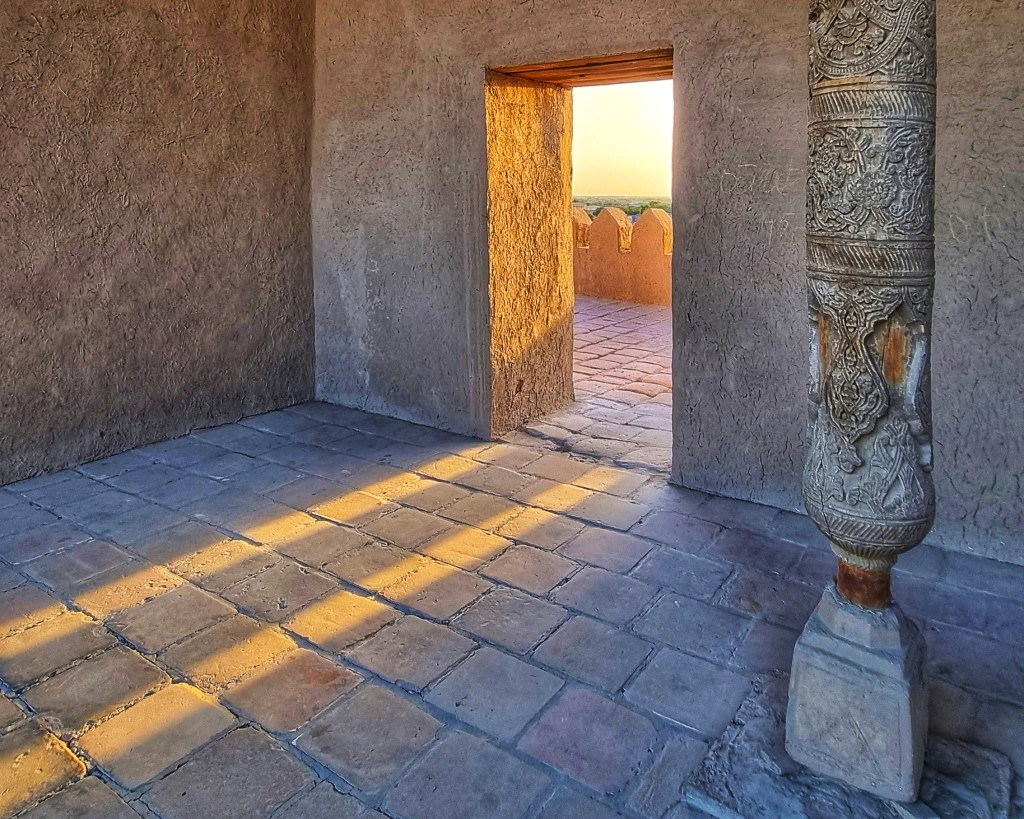
Does this balcony right outside my bedroom explain enough why I chose to stay in Khiva longer?
Resplendent, the summer solstice sunset gilds the citadel of Khiva.
Khiva, the former capital of Khwarazm.
Khwarazm, the region that gave us polymath Muhammad Ibn Musa al-Khwarizmi (780-850), who wrote the book Al-Jabr. From his name we have the word “algorithm,” and from Al-Jabr “algebra”.
The sun blazes differently here. And for knowledge, their wise men, too, seemed to burn so intensely.









 The Book-Butterfly