Sophy Roberts: The Lost Pianos of Siberia

Before Iran, before Persian history, it was Russia, its music, literature, and history that I was preoccupied with for years. (Remember how I named a pet fish “Shosta,” after Shostakovich, who leapt out of the fishbowl to his doom, and died a very dramatic Russian death?) Adulting eventually distracted me from this obsession until Iran took over and began to burn as big a flame in my consciousness.

This book brought me back to my teen years of being fascinated with Russia. As I turned the last page of this beauty, the traveler, the pianist, and the lover of stories in me were all brimming.

After all, Russia is the country of Tolstoy and Dostoevsky, of Rachmaninoff, and “piano music has run through the country like blood.”

Sophy Roberts, however, zones in on Siberia, that immense region that covers eleven percent of the world’s land mass, and home to ninety percent of Russia’s natural resources.

So, what does it have to do with pianos? A lot, apparently. This account traces how the instrument began to grip the heart of the country during the reign of Catherine the Great, how this mania was fueled by concert tours by Liszt and Clara Schumann, and how political prisoners from Poland, the land of Chopin, and Decembrist intellectuals (members of the unsuccessful revolt against Tsar Nicholas I in December 1825) who were exiled to Siberia made culture flourish in the hinterlands by bringing their books, their learning, and their music with them, leaving precious pianos in their wake. It also poignantly mentions that the only thing that survived the Romanov massacre was the piano that the young tsarevnas brought with them and on which they played during their last days.

But who would be insane enough to go to Siberia and track the lost pianos of Russia’s history? Sophy Roberts. And she’s my kind of insane. This book is already making me dream of becoming this kind of journalist and writing this kind of book when I grow up. Haha

Which lost things should I go looking for? 


P.S. One simple paragraph also made me understand the rise of Putinism and why he still has a strong following. This doesn’t mean I’m going to start being a Putin apologist, far from it. But it is a sign of a good work of journalism when it makes you see the other side of the coin.
Suad Amiry: Mother of Strangers

“It is human kindness, rather than religion or nationality, that conquers the human heart.”

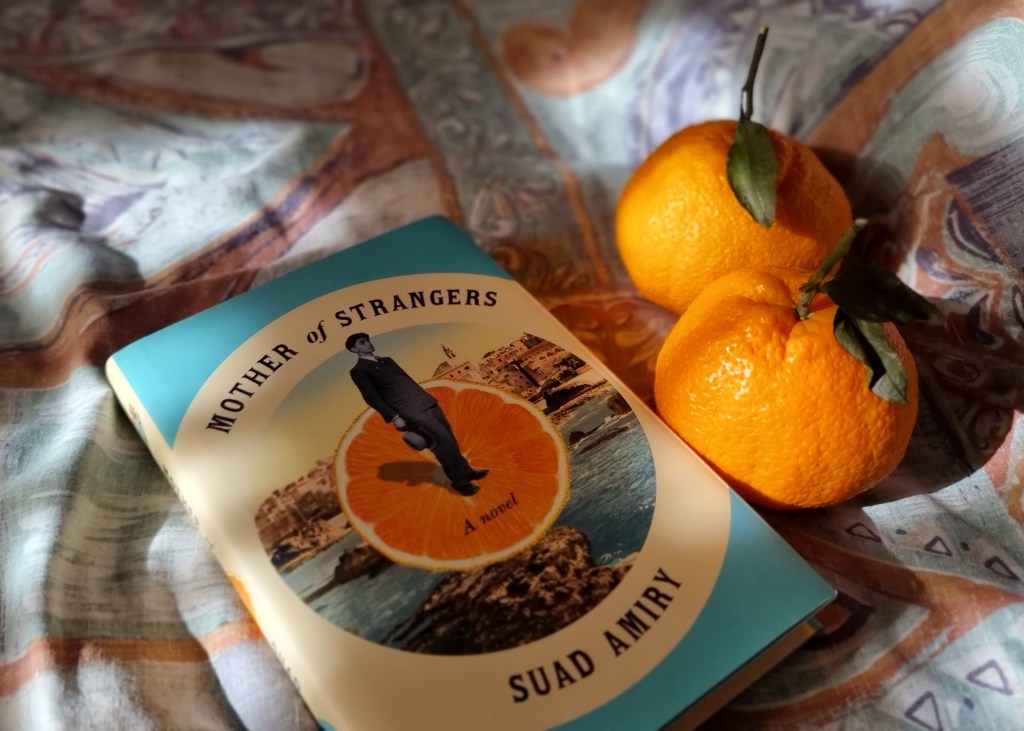
The “Mother of Strangers” is Jaffa. In case you, like me, wondered to whom or what the title referred.

Jaffa that was the richest and largest Arab city in Palestine. Jaffa, known all over the world for its pure gold — its oranges and orange groves. Jaffa, named after one of Noah’s sons who purportedly built the city after the great flood. Jaffa, a major city during the Ottoman Empire. Jaffa that was designated as part of Mandatory Palestine / the Arab state through the Partition Plan, but which Irgun decided to conquer before the end of the British mandate when Arab armies (Egyptian, Iraqi, Syrian, and Jordanian) could enter Palestine. And therefore, the helpless Jaffa that surrendered to the Haganah who promised to protect Jaffa and its people. (“However, before the ink had dried on the agreement, the city was violated, robbed, and the Haganah forces terrorized the few thousand Jaffans who remained.”)

It is more than a sad tale of young love as the blurb describes. Based on a true story, it tracks a seldom mentioned, but significant aspect, of history that is vital in our understanding of the Palestinian struggle. This is one of those books that show us that what is happening in Gaza is never so simple, and that it did not abruptly begin on October 7, 2023.

Mahmoud Darwish

By now, Palestine and Israel are probably on everyone’s radar. By now, young and old have probably taken a side, or have opinions; but sadly, based only on social media algorithms. By now, many have probably come across that post about the Palestinian writer, Mahmoud Darwish, who fell in love with a Mossad agent, reposted many times however false. (He did have a relationship with an Israeli-Jew that would haunt many of his works: “Rita” in his poems, Tamar Ben-Ami in real life, who later served for a time in the IDF.) Or he may be known to some as the controversial poet who criticized Hamas. 

I know his name from every important Palestinian work that I have read. It’s sad that it took a war for me to try harder to acquire his books and finally experience his writings. I have been reading these four collections slowly and carefully, in random order, and in-between other books. The very last piece, I read today. And yet, here I am, still lost for words that will give justice to this body of work.

How beautifully he writes! And how enlightening his works are of the Palestinian sentiment and predicament!

  • A River Dies of Thirst is where one will find the famous line, “All beautiful poetry is an act of resistance.”  
  • “In the Presence of Absence” hints at the term “present absentee” that refers to Arabs who fled or were expelled from their homes during the Nakba, and it is the volume that touched me the most.

“Poetry, then, is an act of freedom.”

“For what can a poet do before history’s bulldozer but guard the spring and trees, visible and invisible, by the old roads? And protect language from receding from metaphorical precision and from being emptied of the voices of victims calling for their share of tomorrow’s memory on that land over which a struggle is being waged? A struggle for what lies beyond the power of weapons: the power of words.”

“What does it mean for a Palestinian to be a poet and what does it mean for a poet to be Palestinian? In the first instance: it is to be the product of history, to exist in language. In the second: to be a victim of history and triumph through language. But both are one and the same and cannot be divided or entwined.”

  • Why Did You Leave the Horse Alone? is special not only for its poems but for being a bilingual edition! Even though I cannot read Arabic, I love tracing the elegant curves of its script with my eyes. 
  • Journal of an Ordinary Grief is anything but ordinary and it is the volume out of these four that I would readily recommend, no matter whose side one is on. Because maybe after turning the last page, one will be less concerned about taking sides, but be more concerned about having humanity.

Charlson Ong: A Song of War

Stunning. Cinematic. Unforgettable.

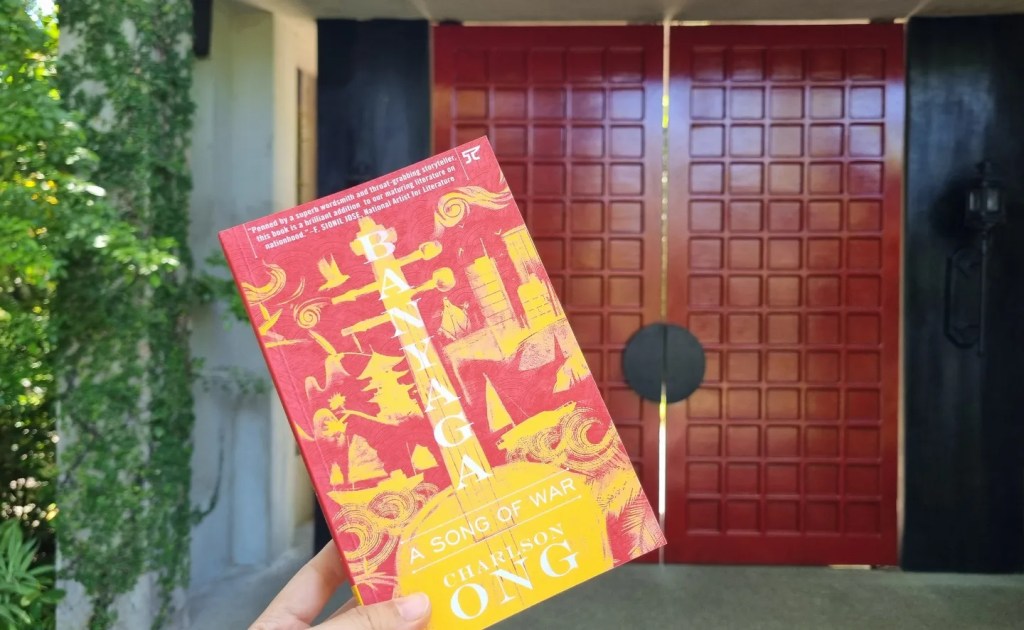
Banyaga: A Song of War weaves melodies, threads, saturated shades of scarlet, unattainable indigo, and moonlight yellow into the rich literary tapestry of our nation, and gives prominence to an underwritten perspective of Philippine history and literature — that of the Tsinoys, the Chinese Filipino.

The vivid imagery (beginning with Chinese boys caught in a brawl that results in a sworn brotherhood, on a ship heading for Manila) that remains consistent up to its plaintive ending in Manila Bay almost a century later; the fleshed-out personalities and exuberance of the characters; and the nonlinear narrative, brilliantly interlaced throughout the American occupation until the post-Martial Law era, tempts the mind’s eye to read this with a Wong Kar-Wai filter. With the acculturation of Chinese and Filipino traditions, and the subtle exposé on the workings of the government, economy, and political unrest as a backdrop, all of these lend to it a fullness of texture and quality that I have yet to encounter in any other Filipino novel published in the 2000s.

Banyaga, which means “foreigner” in our language, follows the lives of Ah Puy, Ah Sun, Ah Beng, and Ah Tin who hoped to escape poverty and political turmoil in China. Their dreams for better lives are soon trumped when they are rejected by relatives and family upon their arrival in Manila. As they are forced to fend for themselves and survive in a strange land that would become their only home, they will come to be known as Hilario Ong, Samuel Lee Basa, Antonio Limpoco y Palmero, and Fernando de Lolariaga. The different surnames suggest that the trajectory of their lives takes different turns, but an invisible thread would always bind the lives of the four sworn brothers and their families to each other and the course of Philippine history.

This novel has indelible scenes that will have you gasping in shock, push you on the edge of your seat, and break your heart repeatedly throughout the span of three hundred and seventy-three pages, but most of all, it will lead you to ponder on nationhood and leave you in awe of the heights that our nation’s literature has achieved.

Ismail Kadare: A Dictator Calls

When the International Booker Prize longlist was announced this year, I was thrilled to see the name of its inaugural winner with another nomination. A copy of A Dictator Calls was immediately secured

Having first encountered Ismail Kadare through Palace of Dreams, a book that warns against authorities who take away even the freedom of dreams, it was enough to make me want to read more.

This was eventually followed by The Three-Arched Bridge, which contrasts Ivo Andrić’s rich and lengthier The Bridge on the Drina by having the texture of a fable, making it easier to read despite the dark subject matter that this reader understood as a chilling metaphor for the new worlds and ideals founded on blood and, perhaps, a disturbing reminder of what is often sacrificed in the name of progress.

This resulted in a back-to-back reading of The Siege wherein I felt amazed to have been held in thrall by the intricacies of fifteenth century military strategies. The “necessary” presence of architects, engineers, poets, chroniclers, astrologers, and the harem on the battlefield added to the madness of war. The Kadare usually straightforward with prose was suddenly generous with details, and delightfully ridiculed war and testosterone, bringing to mind a line from Svetlana Alexievich who wrote, “War smells of men.” The Siege also makes us realize that even though warfare might have evolved greatly since then, man hasn’t. But what makes The Siege my favorite among the Kadare books that I’ve read is the twist of creativity in which the narrative is focused on the besiegers: With this brilliant move we are made privy to the thoughts and intents of those who intend to conquer or wipe out an entire people — “We could take their language,” or their religion: “You can’t call a country conquered until you have conquered its heaven… everything that has to do with the soul.” Trust Kadare to embed a powerful message in an easily overlooked passage, a lesson in what a people must guard and defend — everything that has to do with the soul.

These stories continue to be remarkably resonant. The allegories of tyrannies and parables about the threats of imperialism are redolent of current events, and I believe that even though his novels might need new translations, it also needs new readers.

But please allow me to be blunt: A Dictator Calls is not the best place to start if you’re new to his work.

For readers who would like to geek about a specific moment in Russian/Soviet literature that look into its literary figures and their associations, it can be an entertaining book. But for this fan’s expectations, and the looming promise of examining the relationship between writers and tyranny, it fulfills little and leaves this reader feeling that the book could have been so much more, especially from a writer of such magnitude as Kadare. 

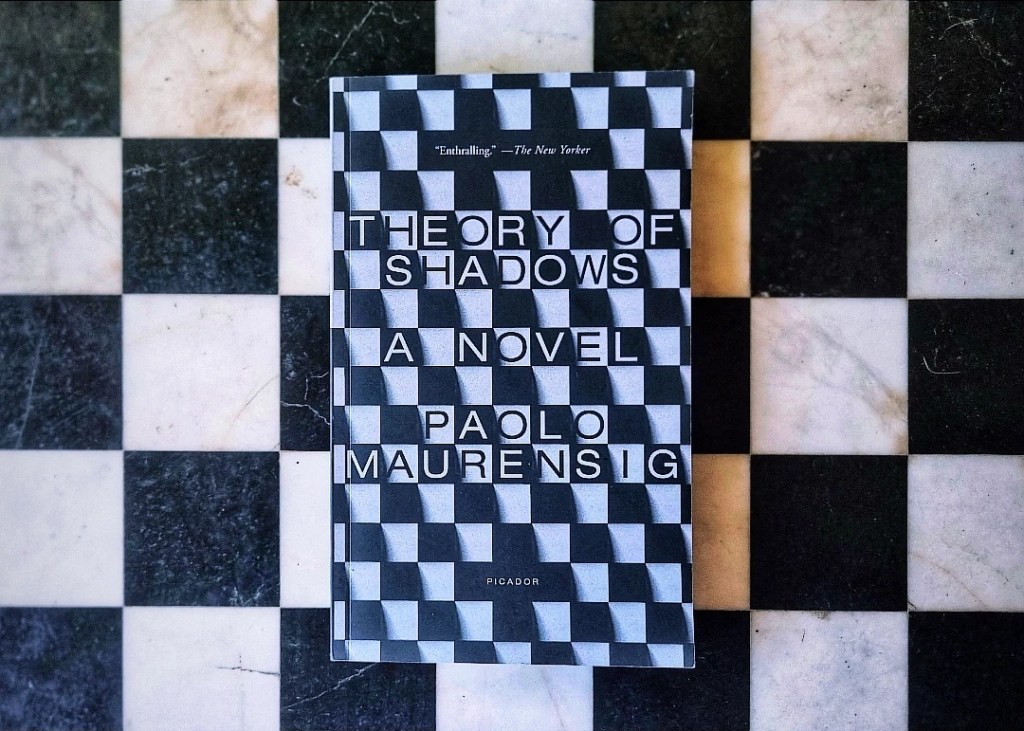
Paolo Maurensig: Theory of Shadows

Is it the fate for all chess novels to be dark?

I’m almost certain that one would not arrive at this book unless they have first been to Zweig’s Chess Story (a.k.a The Royal Game) or Nabokov’s The Defense (a.k.a The Luzhin Defence), or Maurensig’s very own The Lüneburg Variation — and therefore conscious about the sort of darkness to which I refer. 

While Nabokov’s Luzhin is based on the life (and death) of German chess master Curt von Bardeleben, the chess game in Zweig’s story is said to be patterned after a real game between Alekhine vs. Bogoljubow. Theory of Shadows turns the spotlight on the last days of the very same Alexander Alekhine, World Chess Champion, whose reputation was tainted by accusations of Nazi collaboration, and whose death remains a subject of contention.

The setting is 1946, just as the Nuremberg trials have begun in Germany, and Alekhine is preparing for a comeback in chess at idyllic Estoril, Portugal.

At his seaside hotel, Alekhine befriends another guest, a Jewish violinist, and their interesting conversations about music and chess lure me into the narrative. Alekhine exploits this friendship to console himself that he is not racist while he uses his obsession with chess as self-justification for his past actions. But when new hotel guests who recognize the grandmaster appear on the scene and question him about his past, his delusions disintegrate and his guilt becomes more apparent. Then comes the reckoning.

One way or another, there is always retribution when cooperating with evil. The reader can only conclude that Alekhine’s presence in Estoril was simply an endgame played by an unknown hand that very well could have been the Soviets, maybe even the Germans, or Fate, or simply Justice. 


“The real danger lies in not recognizing evil once it is already within us.”

This was Alekhine’s mistake. And it is the mistake of many who often shake hands with evil for personal gain.

Benjamin Labatut: The MANIAC

Robert Downey Jr. as Lewis Strauss appeared in my mind’s eye when I encountered the lines about Strauss being the person John von Neumann was speaking to on the telephone when the latter collapsed and was subsequently diagnosed with cancer; the person by von Neumann’s bedside as he lay dying; and the person who delivered von Neumann’s eulogy at the Princeton Cemetery.

It was Cillian Murphy as J. Robert Oppenheimer that I imagined when he was quoted as saying, “With the creation of the atom bomb physicists have known sin, and this is a knowledge which they cannot lose”; and when he was mentioned opposing the building of the hydrogen bomb through the MANIAC (Mathematical Analyzer, Numerical Integrator and Computer) — The MANIAC, whose chief architect was von Neumann.

The movie, Oppenheimer, and its characters are still fresh in our minds. But who is John von Neumann? And why doesn’t he figure in the film when these people were his contemporaries and colleagues, and when he played such a huge role in the Manhattan Project, aside from being credited for calculating the optimal height for the detonation of the bombs over Hiroshima and Nagasaki?

The second question can be answered by various speculations. Benjamin Labatut answers the first: He was the smartest human being of the 20th century.

“The cleverest man in the world… a genius, a very great genius,” according to Albert Einstein. The back cover sums up von Neumann as, “…the individual who birthed the modern computer, laid down the mathematical foundations of quantum mechanics, written the equations for the implosion of the atomic bomb, fathered the Theory of Games and Economic Behavior, heralded the arrival of digital life, self-reproducing machines, artificial intelligence, and the technological singularity…”

Labatut, rockstar that he is, goes beyond what we can find in Wikipedia; simplifies alien quantum talk into plain language; constructs a complex and eerie portrait of a flawed superhuman through the different lenses of von Neumann’s peers, rivals, friends, and family; and charts the seemingly unstoppable advancement of AI.

The book highlights the irony of what comes hand in hand with technological progress, how the rise of the computer was tied to and hastened by the nuclear arms race: “Just think about this for a second: the most creative and the most destructive of human inventions arose at exactly the same time. So much of the high-tech world we live in today, with its conquest of space and extraordinary advances in biology and medicine, were spurred on by one man’s monomania and the need to develop electronic computers to calculate whether an H-bomb could be built or not.”

In the first chapter we find an account of Austrian physicist Paul Ehrenfest waiting for the train and heading to his suicide, and it makes for a strong allegory for the shared fate of humanity and technology: “…even though he could not hear it, could not feel its faint rumbling in the distance, he still knew that it would come, there was no stopping it, in fact it had just arrived, he could see it rolling slowly into the platform, smoke billowing all around him as the whistle shrieked, but even then he still had time to turn back…and walk away, he still had time, and yet he stood, machinelike, propelled by a force he neither recognized nor understood, and took five steps with his legs as stiff as an automaton’s, to board the wagon and take his place among the rest.”

By reading this book, one can see why it was important for Labatut to write it: The portrait of John von Neumann is the portrait for, and of, our age.

Who needs science fiction when reality is this chilling?

Balsam Karam: The Singularity

“I come from a tradition of loss.”

Kurdish authors — whether their Kurdish-ness belongs to the Iranian, Iraqi, Turkish, or Syrian side — all come from the same amorphous tradition of storytelling, and they have an artful way of wrapping their own originality around this. But they also come from another kind of tradition; that of loss. 

Balsam Karam describes herself as, “a Kurdish writing in Swedish.” That is exactly why, even without checking what this novel is about, I immediately purchased a copy. There is a scarcity of Kurdish voices in literature, and this scarceness urges me to listen to each one.

Now I have found that this book is about mothers losing children; and children losing mothers; motherlands being uprooted of her children; and children being separated from their motherlands; written by a woman who is in the process of retrieving her voice when she thought she had lost it along with her firstborn; and all these meld into each other in a mosaic of poetry and prose.

Yes, it is fragmented and it is painful. That’s what loss feels like.

Linda Ty-Casper: The Three-Cornered Sun

“The chief glory of every people arises from its authors.”

Debatable to some, for sure. But I am inclined to agree with Samuel Johnson, and with Susan Sontag. Especially after having read The Three-Cornered Sun.

Read the review at exlibrisphilippines.com.

Nawal el Saadawi: Two Women in One

While I have long discovered that I prefer the nonfiction writer in Nawal, her fiction remains to be in a class by itself. (That’s why I still continue collecting what I can of her books, fiction and nonfiction, especially now that I’ve discovered these excellent editions — in terms of publication quality and translation — from Saqi Books.)

Two Women in One is not straightforward storytelling. There’s a tinge of Clarice in the free indirect prose. Unsettling, like any piece by Nawal; claustrophobic, and therefore, effective.

It’s not a good place to start if one is new to Nawal. The angst of a young woman, wanting to be an artist but who’s forced into medical school, is potent here. 

Conformity becomes suffocating to her, “Everything had the same color and shape to her. All bodies were similar, and all gestures and voices. She found herself running aimlessly… fleeing the deadly sameness within and without…” When she realizes that none of her life is her doing or her own choice, she unleashes a rebellious other woman in her. “Freedom is dangerous, but life without it is no life at all.”

But what I found most powerful in this work is the underlying message that unless Egypt is free, she cannot be free. “Egypt was not free. The chains were still there.” Because when all is said and done, how a nation treats their women, is always a measure of that nation. A woman’s personal freedom is often symbiotic and synonymous with national freedom.