Stefan Zweig: Genius and Discovery | Triumph and Disaster

“…in history as in human life, regret can never restore a lost moment,
and 1,000 years will not buy back what was lost
in a single hour.”

The day of the Philippine Elections has finally come! And no queue at the polling precinct is too long if you have the right books with you!

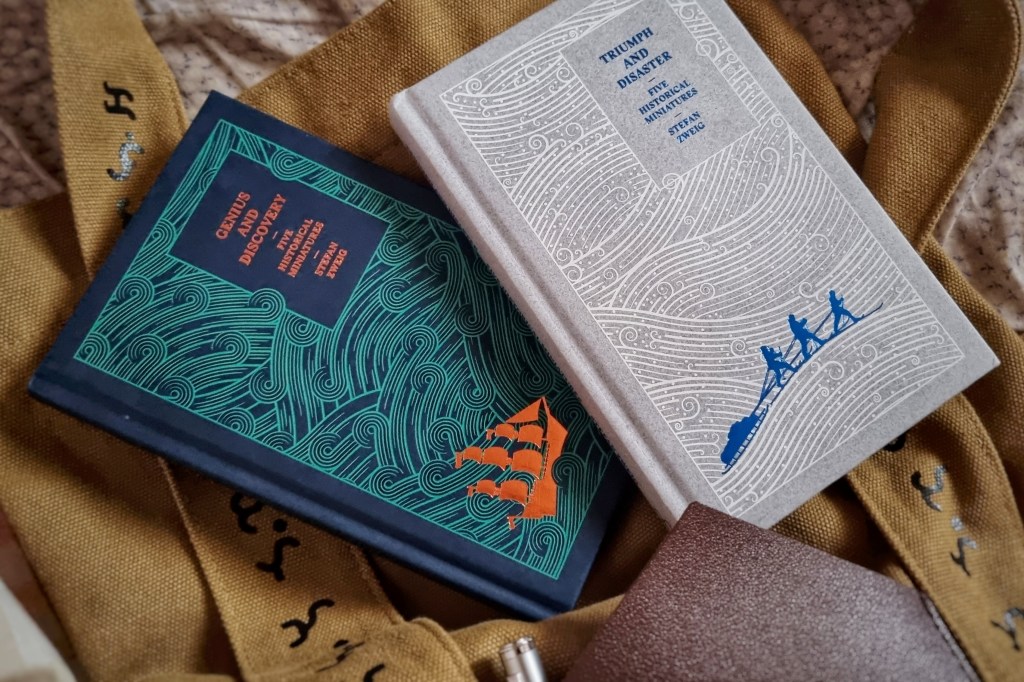
Five historical miniatures in each of these lovely books from Pushkin Press by distinguished Austrian writer, Stefan Zweig. There is nonetheless nothing “miniature” about the writing! In fact, they magnify some of history’s crucial moments and characters in such glorious and vibrant ways, you can only wish Zweig wrote more of these!

It was this line that leapt off the pages from the foreword of both books: “…a single Yes, a single No, a Too Soon or a Too Late makes that hour irrevocable for hundreds of generations while deciding the life of a single man or woman, of a nation…”

A single vote.

Dear Philippines, tomorrow we find out how we did.

Ivo Andrić: The Bridge on the Drina

Imagine a Serbian little boy being taken away from his mother as “blood tribute,” an Ottoman practice of forcibly recruiting soldiers from Balkan Christian subjects. Imagine the screams and the cries as the mother follows them to the Drina River, until the janissaries and the child embark on a ferry where they are parted forever.

This is the agony with which the book begins, and it made me wonder if I should shelve it for later. It felt too heavy to be read amid the volatile climate of the Philippine elections. But the writing made me want to read more, and I do not regret doing so.

This boy rose through the military ranks and became known as Mehmed Paša Sokolović, and in his later years, Grand Vizier of the Ottoman Empire. But the painful memory of separation never left him: “…he thought that he might be able to free himself from this discomfort if he could do away with that ferry on the distant Drina, around which so much misery… gathered and increased incessantly, and bridge the steep banks and the evil water between them, join the two ends of the road which was broken by the Drina and thus link safely and forever Bosnia and the East, the place of his origin and the places of his life. Thus it was he who first, in a single moment behind closed eyelids, saw the firm graceful silhouette of the great stone bridge which was to be built there.” Thus began the construction of the bridge over the Drina, at the part of the river where he last saw his mother. 

The main character in this novel is the bridge. This bridge that has withstood over four hundred years of tumultuous history.

— — —

Elif Shafak was a reading staple between November 2020 to January 2022 when I was steeped in my reading project to cover and uncover as many writings from places affected by the Silk Route; so when a friend learned that Elif Shafak had said that The Bridge on the Drina caused something in her to shift forever, this was enthusiastically recommended to me.

Of the nine books by Shafak that I read, the first one was The Architect’s Apprentice, set in sixteenth century Istanbul about a fictional apprentice working with the legendary Ottoman court architect, Sinan. The one commissioned to design the bridge on the Drina, the Mehmed Paša Sokolović Bridge, is none other than Mimar Sinan.

— — —

But authors are stories in themselves, and Ivo Andrić’s life is literally one for the books. Born to a poor family in Bosnia, he grew up playing on the very bridge he would later immortalize and earn him the Nobel Prize for Literature in 1961. The years in between include two World Wars and an extraordinarily rich and eventful life.

The introduction to this edition claims, “No better introduction to the study of Balkan and Ottoman history exists… no anthropologist has ever reported the process of cultural change so sensitively; no historian has entered so effectively into the minds of the persons with whom he sought to deal…” I can only agree!

Andrić arranges the perplexing layers of this region’s history from the 16th to the 20th century into an impassioned song that constantly returns to its main theme — the bridge.

“…The life and existence of every great, beautiful and useful building, as well as its relation to the place where it has been built, often bears within itself complex and mysterious drama and history… Therefore the story of the foundation and the destiny of the bridge is at the same time the story of the life of the town and of its people…”

“Life…renews itself despite everything and the bridge does not change with the years or with the centuries or with the most painful turns in human affairs. All these pass over it, even as the unquiet waters pass beneath its smooth and perfect arches.”

There is an excess of lessons to be learned from this work, and much to be said about the exceptional writing, but what made me read on was the pervading refrain of the enduring power of art and architecture, and the comforting thought that no matter the course of history, life always renews itself. 

Flowers from a Book

Augustus, John Williams

Augustus to a young Julia, on Cleopatra:

“…that was Cleopatra, she was Queen of a great country. She was an enemy to Rome; but she was a brave woman, and she loved her country as much as any Roman might love his; she gave her life so that she might not have to look upon its defeat.”

This passage is an example of the compassion with which John Williams treats his characters.

My copy of Augustus being secondhand, it was a lovely surprise to find this pressed beauty tucked between the pages featuring Cleopatra.

Link to main entry on Augustus

John Williams: Augustus

“Father, has it been worth it? Your authority, this Rome that you have saved,
this Rome that you have built? Has it been worth all that you have had to do?”

To have made palpable not only history, but the scope of human nature and the heart’s confidentialities; to have justly raised some of history’s forgotten women from the footnotes of the annals; to have retrieved a legendary man from his pedestal so he could tread in our minds as a mere mortal; to have given pensive credence to a line from that famous Quartet by Durrell in that the real ruins of Europe are its great men; there is but one word for the man, this book, the writing — august.

I have not read a more majestic novel!

As much as I want to reiterate the praises heaped upon this work and repeat the passages that moved me, I wish to put emphasis on what makes it meaningful to me as a woman — the noteworthy backstory, underscored by John McGahern in this edition, about the catalyst that gave us this book. In a conversation with writer Morton Hunt, John Williams learned the story of Augustus’ daughter Julia, whom the emperor deeply loved, but whom he sent into exile because she had broken the laws on adultery that he himself had enacted. The fascination with the fact that the only child of the first emperor of the Roman Empire had been overlooked in the histories led Williams to an immersion into the Roman world, which resulted in this work in which Julia is the heart.

It is this heart that grants us a compassionate portrait of Augustus. With this work published in 1971, and with that subtle power distinctly his, John Williams penned a revolutionary and enlightening approach on how to treat history’s women alongside the men — not to raise them unreasonably into women who played bigger roles in history than they actually did, but to remind us that they existed, they lived, and that they mattered.


Greeting this month with Memoirs of Hadrian and ending it with Augustus feels like a paradox at a time in my country when “history” is crafted to suit narratives and facts are doubted because they are purportedly written by the victors.

Friends, Romans, countrymen… in this, our history differs, because we have history written not by the victors but by the victims, and by those who became victims by speaking the truth. If we have the courage to question our history, we need also the courage to question our motives, and most of all, ask ourselves what kind of people our convictions empower.


“…nor did I determine to change the world so that my wealth and power might be enhanced… it was more instinct than knowledge, however, that made me understand that if it is one’s destiny to change the world, it is his necessity first to change himself.”

Literary Symmetry

“I have relinquished Rome to the mercies of Tiberius and to the accidents of time.”

Augustus, John Williams (1971)

“I accept with calm these vicissitudes of Rome Eternal.”

Memoirs of Hadrian, Marguerite Yourcenar (1951)

.

“The barbarian will become the Rome he conquers; the language will smooth his rough tongue; the vision of what he destroys will flow in his blood.”

Augustus, John Williams (1971)

“If ever the barbarians gain possession of the world then will be forced to adopt some of our methods; they will end resembling us.”

Memoirs of Hadrian, Marguerite Yourcenar (1951)

Lawrence Durrell: The Alexandria Quartet

On a flight not too long ago, my plane flew over a coastal region that shimmered in the dark. The sight gave me goosebumps, not from fear but from an inexplicable wonder. The captain soon announced that we were flying over Alexandria.

Alexandria. The city that, even from thousands of feet below, had impressed in me something ineffable; perhaps the tiniest psychic glimpse into why it has forever haunted the Cavafies, the Forsters, the Durrells, and the Acimans of the literary world.

Alexandria, where the legendary library once stood. Or should I say mouseion, as Lawrence Durrell does in Justine? This predecessor of the word museum, a space where the muses reside, the word which led me to ask; what do we keep in the museums of our mind?

The Alexandria Quartet: Justine, Balthazar, Mountolive, Clea — “intended to be judged as a single work,” wrote the author.

Justine is introduced to us by our unnamed narrator, and through a book a former lover has written about her that the narrator is reading. (A subtle acknowledgement to the storytelling traditions of the region? In addition, it should not escape us that the narrator’s criticism of the book within the book has allowed Durrell to present Justine in two different ways. Genius!)

The city is introduced synchronously through Durrell’s inimitable writing — sensual, alive, with a soft texture, “like flesh,” as I imagine Marguerite Yourcenar would say. Even at this point, he already leaves you wondering how it is possible to scrutinize a city and simultaneously dissect relationships so breathtakingly and so profoundly.

The captivating stage is set. There is a rumor of a second World War, there are Jews, Copts, Arabs, Greeks, Syrians, Egyptians, Frenchmen, and Englishmen in a chaotic, amoral brew. 

Amid the muddle, Durrell reads your mind and puts your words into the nameless narrator’s mouth, “I tried to tell myself how stupid all this was — a banal story of an adultery which was among the cheapest commonplaces of the city: and how it did not deserve romantic or literary trappings. And yet, somewhere else, at a deeper level, I seemed to recognize that the experience upon which I had embarked would have the deathless finality of a lesson learned.”

You’d suspect Justine is a metaphor for Alexandria, “For she is truly Alexandrian… she cannot be justified or excused. She simply and magnificently is; we have to put up with her.” By the end of the first book, you would think you are well-acquainted with the characters and with the city.

But no, the rest of the Quartet is there to prove you wrong over and over again. Balthazar turns everything upside down. Mountolive, more so. Clea, even more. Balthazar and Mountolive are not sequels; they re-contextualize the same story. Only Clea is a true sequel, but the whole Quartet is meant to shatter you. Even the sympathy that clings to the characters are carefully and painfully peeled away. Indignant, you cannot help but ask, “Why? What for?”

Then you remember, these 20th century writers are psychoanalysts and philosophers. They never let you have it easy. They write to question a reader’s perceptions and assumptions. They are masters in geopolitics and they effortlessly weave its nuances into the places and the characters, and the people become an extension of the spirit of the city, of the age. They write to counter and re-examine memory.

Love? That is what everyone says of this body of work. What hasn’t been said about this elegiac Quartet? This is not an education on how to live or love — if anything, I personally think it is an education on how not to — but I have found that it is an education on the creative process, writing to a point where pain becomes art, a paean to the difficulty of writing about truth, the human heart’s selected fictions and affections, relationships, a city, a person, memory, and their multi-faceted prisms… the very things that we keep in the museums of our mind.

Happy World Book Day!

Reader, I’ve done it.

I turned the last page of the Alexandria Quartet on World Book Day 2022!

About two decades ago, I stumbled upon a fourth of this elusive tetralogy in a secondhand bookstore. I say elusive because that is how beautiful books used to be, long before the advent of online booksellers and FullyBooked here in the Philippines. And you had to wait to chance upon certain books like you would for love, sometimes even thinking they’d never come. 

Ranked among the best English-language novels of the 20th century (I still feel that the 20th century writers remain unsurpassed), I decided to be romantic about it, telling myself that I would read none of it until I had collected all four books in the same edition — and secondhand. I only found the last piece of the puzzle last year and I knew it was time. 

The copies are all mass market paperbacks with vintage cover designs, spines that cracked as I opened them for the first time, and tanned pages that fell apart… as I, too, fell apart.

Maybe I now deserve to order the edition with the Jan Morris introduction? Perhaps after I write my review. But first, let me catch my breath…

Nawal El Saadawi: Searching

He vanishes. After seasons of being together and meeting every Tuesday in that restaurant overlooking the Nile, Farid does not show up. This catapults Fouada into a period of searching.

“How had a man become her whole life? She didn’t know how it happened. She wasn’t the sort of woman who gives her life to anyone. Her life was too important to give to one man. Above all, her life was not her own but belonged to the world, which she wanted to change.”

And yet, here she was, searching; for him? or has his disappearance allowed her to seek out a purpose and a deeper meaning to life? What was she seeking, exactly?

A female chemist in Cairo’s patriarchal society, Fouada is intelligent and strong-willed. But our daring author impales a nerve here, an uncomfortable truth rarely dissected and examined — the existential torment and uncertainty that women of strong character endure.

A Nawal El Saadawi work of fiction is an art film; one where nuanced cinematography captures the reflection of the sun on a window pane and which slowly pans toward the distress coursing through a woman’s veins; one that disquiets with its honesty; one with an unbroken tension that does not resolve, but bleeds into a thousand provoking questions as the end credits fade into darkness.

Travels around the PH with Aciman

It struck an evocative chord when Aciman indicated that writing about places are coded ways of writing about himself.  I, too, have been doing this unintentionally… even when the pandemic caused travel destinations to be proxied by books.

Writing to excavate, rearrange, cipher, decipher, lace a narrative, find a certain space, leave things behind, and even to hold on, are what these essays on elsewhere are inadvertently teaching me as it accompanies me on my current meanderings across this breathtaking archipelago. 

“I like thinking that perhaps this is how we should travel, without foresight or answers, adventitiously,” he writes.

My brain violently disagrees, but my heart seems inclined; and it appears to have been orchestrating adventitious travels behind the former’s back.

The first trips post-lockdown are not to places, but to people — to my nerve centers, my life’s capital cities.