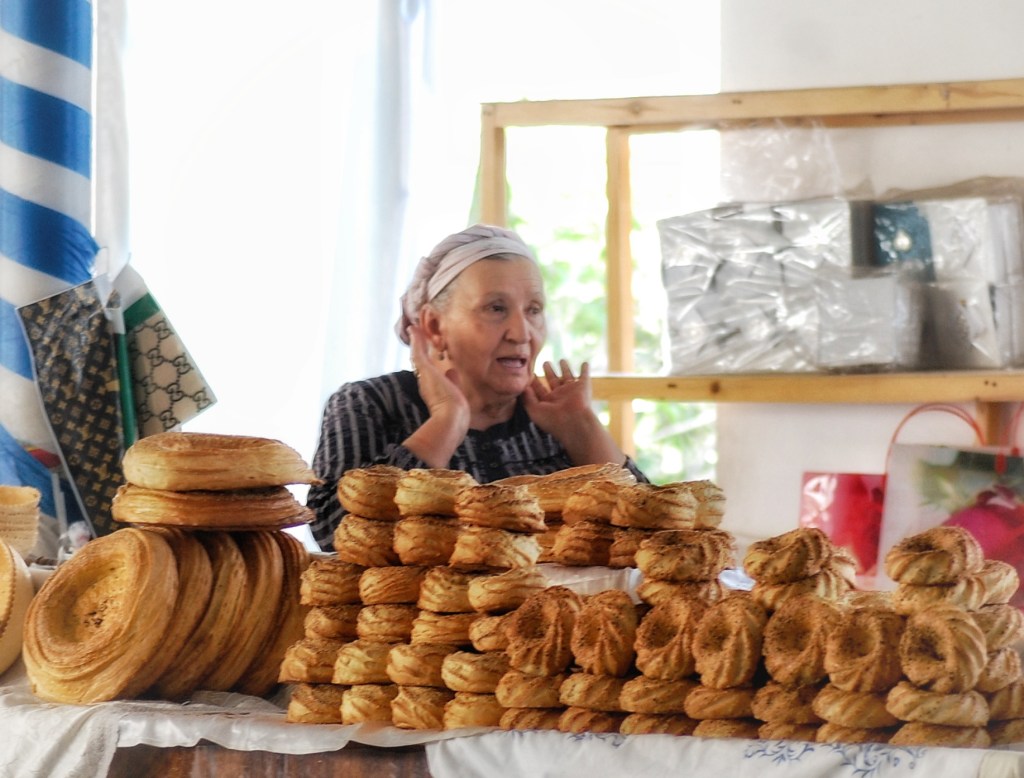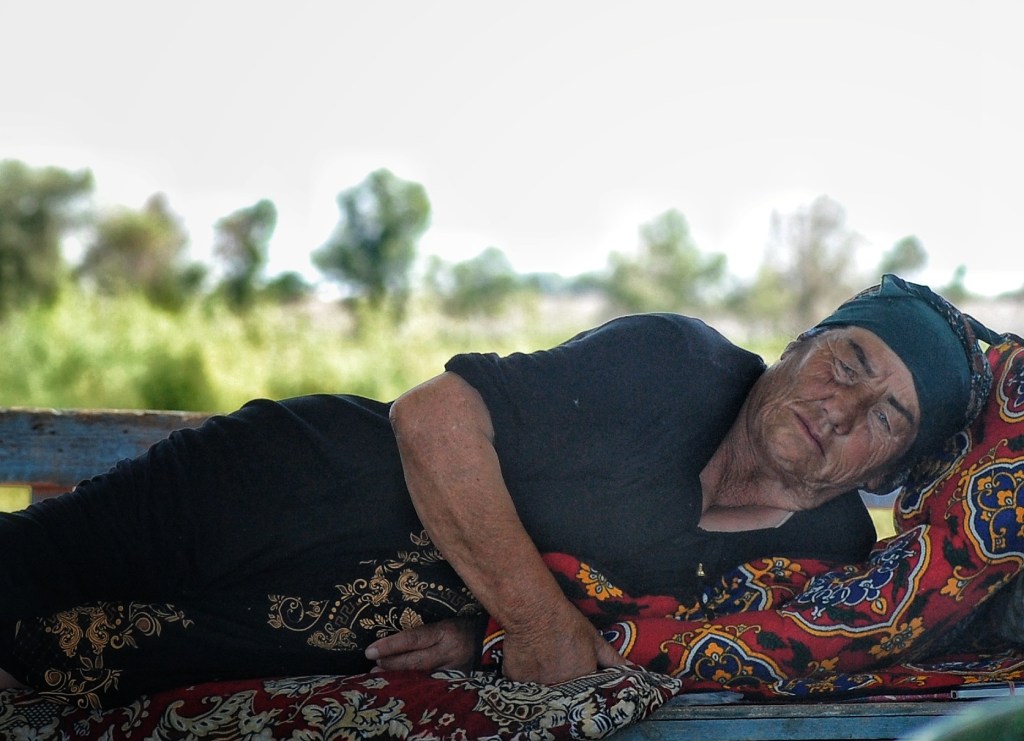
June 25, 2022 – Uzbekistan Beyond Book Pages

My last few days in Uzbekistan were supposed to be spent in Termez, a place bordering Afghanistan where Alexander (considered not so great in these parts of the world) founded a town. But after learning about the tragic earthquake in Afghanistan, and for the peace of mind of those I love (not that I’ve given them so much of that), I decided to be practical (yes, I can be, sometimes) and come back to Tashkent to be closer to the airport. Termez will have to wait; and perhaps, it is a romantic idea to leave something to come back for.

It is risky to travel these days, and it is crazy how the fate of some dreams and travel plans hang in the balance between two words — Positive or Negative. And when I asked my niece who works in a bank to change some currency for me, she reported that the bank declined upon learning of my destination, “Kay duol sa na-ay gyera.” (It is close to areas of conflict.) She had to go out of her way to another money changer. If one looks at the map, the bank is not wrong.

But here I am. Because when something feels right, it feels right. I booked my ticket with so much faith, and the itinerary that has been ready since 2020 finally came in useful.

“But I thought you wanted to go to Iran?” friends asked. I am in what used to be part of Persia. “Stan” is a Persian suffix that means “place of”. This is the place of the Uzbeks that was once of Persia. When the Achaemenids expanded their empire, they sought not to Persianize whomsoever they conquered but allowed different peoples and cultures to thrive — as long as they paid tribute, of course. And since we know borders are all but manmade, I am in the region of which I have been reading and dreaming for a long time… and it is intoxicating, and beautiful, and enriching.

The books I have been reading did not end on their last pages. The best books never do. They only give the reader a deeper yearning to continue the journey and the learning beyond the pages. They give one an urgency to live.

June 23, 2022 – Khiva, Uzbekistan

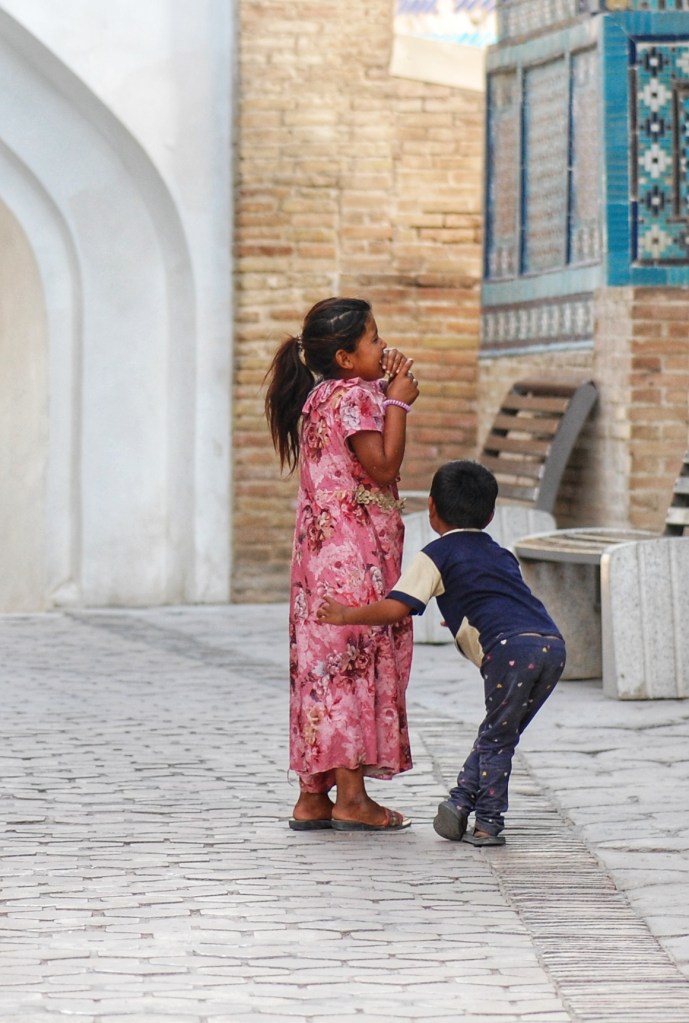
In the alley right below, a child sings in a language both strange and familiar to me. Strange because she sings in the Khorezmcha dialect, familiar because it is music.

A few meters away from her, women in traditional dress eclipse the child’s voice as they bargain with her mother, a scarf seller. These women are tourists from the other “Stan” nations. They flock the streets by sundown. (Western tourists tend to forego Khiva because it is out of the way. To get here from Bukhara, one has to drive for hours through an expanse of steppeland that seems to stretch to infinity, and the usual tourist would usually opt for another stamp on the passport from another Stan than come to Khiva. I am now closer to Turkmenistan than I am to Bukhara.)

But I also see Khiva changing right before my eyes. I see workers installing LED lights, replacing some crumbling bricks, and fixing the cracks of the old city, making it look new. And although they have the tourist’s best interest in mind, I feel a pinch in my heart. I know Khiva will not look the same in a few months, or weeks… and there is a bittersweetness in realizing that I came just in time — or perhaps, a few centuries late.

In the distance, the tallest minaret in Central Asia calls my attention, calls to prayer, calls time to stand still, and all falls silent.

Does this balcony right outside my bedroom explain enough why I chose to stay in Khiva longer?

© 2022 MDR
Khiva, Uzbekistan

Traveling Companions in Uzbekistan

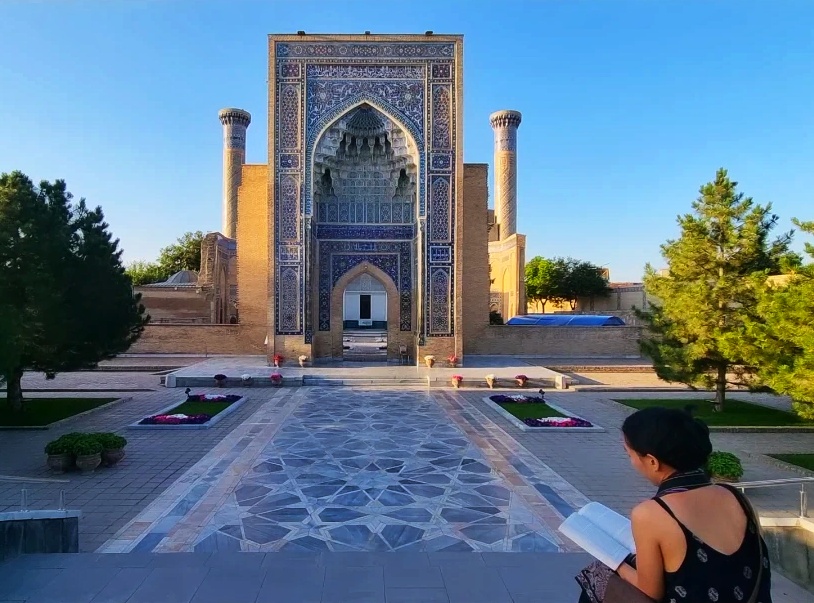
Samarkand, June 2022

On the question of loneliness: “Isn’t that lonely, what you’re doing?”

(I have just returned from a solo trip to Uzbekistan.)

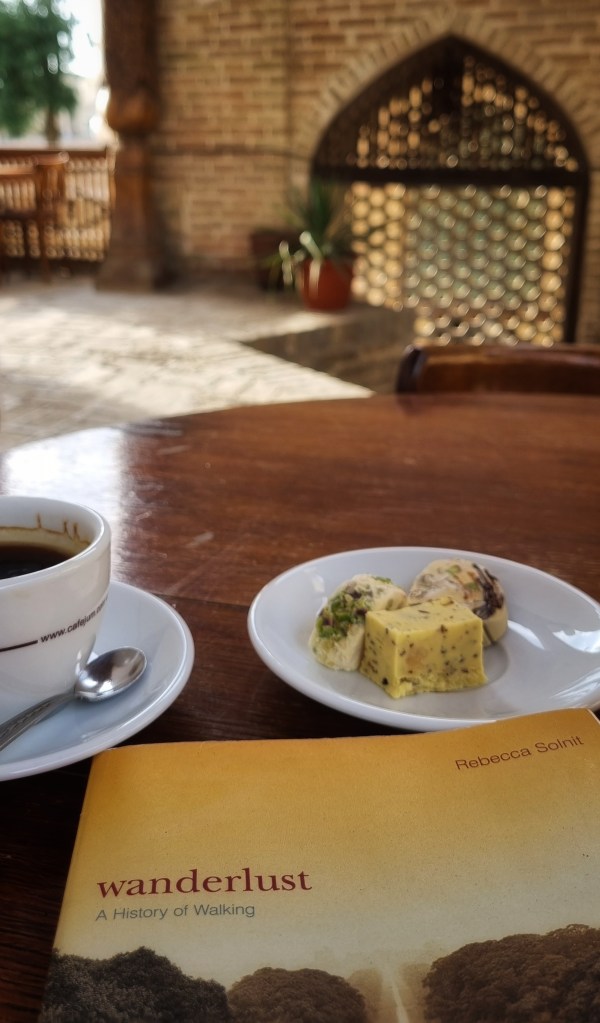
Well, these friends came along for the ride: The Naive and the Sentimental Novelist by Orhan Pamuk, for the long Istanbul flight; The Captain’s Daughter by Alexander Pushkin that was fortunate enough to have a photo at the Pushkin Metro Station in Tashkent and was enjoyed under the shade of the trees of Amir Timur Square; Wanderlust by Rebecca Solnit, read during those days at the Halva Book Cafe whilst waiting for the Bukharan sun to soften; and A Carpet Ride to Khiva by Turkish-British Christopher Aslan Alexander, which accompanied me through Khiva’s storied alleys.

As there is currently so much more outside book covers to commit to paper, I release myself from the discipline of writing book reviews this month. “Regular programming” will resume in this blog in July. Haha 

But I have to mention that Pamuk, who sacrificed painting and architecture school so he could paint with words, taught me a Greek word through this book — “Ekphrasis”. Simply put, ekphrasis is, “To describe something, via words, for the benefit of those who have not seen it.” This inspired me to somehow practice ekphrasis in my little way as I traveled through Uzbekistan, and doing so has allowed me to savor experiences twice.

Pushkin, although political, was not as existentially heavy as Dostoevsky and not as heavy literally as Tolstoy — a purely delightful travel companion!

A Carpet Ride to Khiva seems to have left no stone unturned about Khivan society. It is written in simple prose, bursting at the seams with honest observations, this book is an entertaining overview of the country’s history and politics — which is, perhaps, one of the reasons why the author is banned in Uzbekistan, and why I only brought the e-book with me. I, too, have my own observations, but will keep them to myself for the time being. But it has to be noted that along with reading, traveling is a most comprehensive education on geopolitics, among other things, if one cares to engage and observe.

Solnit, with a title perfect for a trip, shared this Eskimo custom of offering an angry person release by walking the emotion out of his or her system by going in a line across the landscape; “The point at which the anger is conquered is marked with a stick, bearing witness to the strength or length of the rage.”

I, who had no anger to release, did mark the places that bore witness to the strength and length of… something else. I enjoy traveling solo. I would not keep doing it if I didn’t. It is almost like a sort of essential meditation for me and I always go home a better person. I do not feel sad with my own company. But I did mark those places, those experiences so ineffable I could think of only one person to share them with. I would prefer to call it love than loneliness. (But why is conquering anger about letting go and conquering something else the opposite? But I digress.)

As I reluctantly tuck in this unforgettable trip lovingly and a little bit pensively in the folds of memory, I am reminded that the Old Uzbek language had a hundred words for different kinds of crying. And I wonder, what about laughter? What about happiness? 

John Berger: Confabulations

There is something therapeutic and enlightening about these essays that are of diverse scope but which are bound with a single string. That string is language — and not just the spoken, but also the unspoken; the pre-verbal, the danced, the hidden, the sung, the articulate, the inarticulate, the visual.

Just a few books ago, Rica Bolipata – Santos beautifully expressed that writing is, “An added gift to the love of reading.”

For John Berger, writing is, “An offshoot of something deeper… our relationship with language.” Language, to him, is a creature, “A quivering almost wordless ‘thing’.”

Language is that which acquires a body when it is sung, or played, or danced, as in music; it is el duende of which Federico Garcia Llorca wrote, the spirit, the gestures, “Gestures that are the mothers of all the dances of the ages”!

But these string of thoughts also hint at the things that distract us from it, the diversions from what is “true, essential, and urgent.” More than that other book of his, this one will somehow recalibrate our ways of seeing, and if we allow it further, our ways of living. 

The pre-verbal, the danced, the hidden, the sung, the articulate, the inarticulate, the visual, the musical… all at once, there is a sudden inspiration to live in every language I know.

Annie Ernaux: Exteriors

Reading this reminded me of a trip to the National Museum of the Philippines. I went there for the masterpieces, but found myself spending more time, and being most delighted, in a room full of practice sketches by Amorsolo.

Exteriors are sketches, little fragments of writing that feel like ingredients for a larger canvas; and Annie Ernaux is the great artist who guides readers to become keener observers of people, of gestures, of the world beyond the intimacy of the self, of exteriors.

Peruse the sketches more carefully and find priceless lessons on writing and observing. Once in a while, we need an  artist to lead us to details we should pay attention to. Once in a while, we need an Annie Ernaux to take our hand.

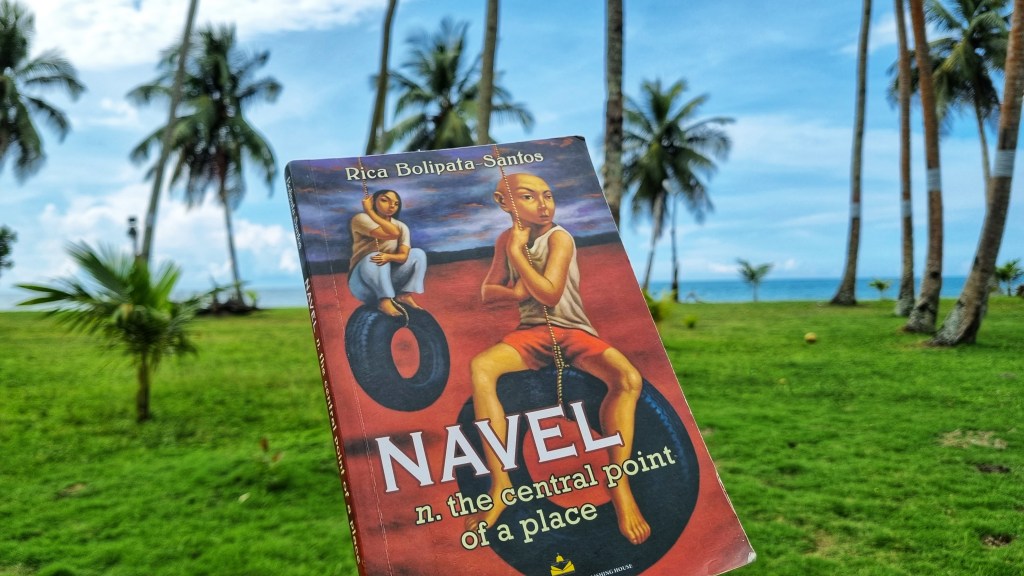
Rica Bolipata – Santos: Navel

“So, here, my navel. Cleaned and gutted out,” she writes in the preface.

It is pungent with honesty and courage of life as a woman in the Philippines. While motherhood seemed to be the more obvious leitmotif of this compilation of essays (and I have friends whom I think would benefit even more from this book than I will), there was also so much to relate to as a Filipina.

The author, separated from me by so much less than six degrees, comes from a renowned musical family; and somehow, this makes her stories of life and family seem even more accessible to me.

This book is another piece of evidence that Filipinos are some of the best essayists.

She posits somewhere in these pages that writing, aside from being the best solution to finding your way after getting lost, is an added gift to the love of reading. “An added gift to the love of reading.” Isn’t that beautiful?

In fact, it seems to be the strongest takeaway for me. Writing. Even for questions like, “What to do with all the physical evidence of the growth of the heart?”

Writing seems to be the answer, too.

After a whole month of the most uninspired book posts I have ever written, I am grateful to be reminded of this outgrowth of reading, this gift, this home — writing. 

Rafik Schami: Damascus Nights

“Writing is not the voice’s shadow but the track of its steps… only writing has the power to move a voice through time, and make it as immortal as the gods.”

In an attempt to read something that would get my mind off Philippine politics, I sought asylum at my Silk Route | Fertile Crescent shelf. This is one of the books from a hefty stack that a bookseller set aside for me because he knows of my current preferred literary flavors and reading project. And sure enough, I could hardly put this one down as soon as I started!

It is about a storyteller who loses his voice and the stories that allowed him to retrieve it.

As much as it is a wonderful reflection on writing and storytelling, Damascus Nights is, as you may have already guessed, a play on the Arabian Nights. But Rafik Schami makes the Arabian Nights what I would have preferred it to be! The fantastical quality of the original is still there, but he allows you to feel, smell, and hear the Syria before the humanitarian disaster, the lively early to mid-20th century Damascus, while weaving a social commentary on Damascene life, exploring identity and exile, foreign affairs, corruption, and a none too subtle criticism of its rulers! This turned out to be excessively political — without losing its humor and lightness!

Nevertheless, page 108 made me stop in my reading tracks. It is where an old man is insulted by an official, but his son who owns a teahouse begs him to refrain from retaliating: “‘That would ruin me,’ he said, ‘they’d shut down the place within hours.’ Someone would plant a handful of hashish somewhere, you see, or else a book by Lenin. The police would show up an hour later, and they’d find the hashish and the Lenin exactly where the man from the secret police had stashed them. The place would be closed and its proprietor thrown in prison for ten or twenty years.” Red-tagging and this so-called drug war abused to punish political or personal critics are some of the oldest tricks in the book, my friends. I will not write anything else on the matter. Even in reading, you cannot escape from something you care about.

Rafik Schami is another proof of the claim that we are missing so much as readers if we cease from exploring the literary wonders of this region. And isn’t his About the Author section the most charming you’ve ever encountered?

“…is an award-winning author who used to be a baker but didn’t like the flour and early hours. Since giving up baking, he has tried his hand at chemistry to discover the formula for immortality. What he found was that he could only do that through writing, because only literature lives forever.”

Excuse me as I go hunt for more books by Rafik Schami…

Milan Kundera: The Book of Laughter and Forgetting

“‘You begin to liquidate a people,’ Hübl said, ‘by taking away its memory. You destroy its books, its culture, its history. And then others write other books for it, give another culture to it, invent another history for it. Then the people slowly begins to forget what it is and what it was.’”

It was this quote from the book making the rounds on social media recently that led me to re-read The Book of Laughter and Forgetting, but then I found more to retrieve from the margins of memory.

“…but the past is filled with life, and its countenance is irritating, repellent, wounding, to the point that we want to destroy or repaint it… we fight for access to the labs where we can retouch photos and rewrite biographies and history.”

“They wanted to efface hundreds of thousands of lives from memory and leave nothing but an unstained age of unstained idyll.”

“…erased from the country’s memory, like mistakes in a schoolchild’s homework.”

“The constitution did indeed guarantee freedom of speech, but the laws punished anything that could be considered an attack on state security. One never knew when the state would start screaming that this word or that was an attempt on its security.”

Fortunately and unfortunately, Kundera reminds us that we are not alone in this plight, and there are still those who remember.

“The struggle of man against power is the struggle of memory against forgetting.”

It’s funny how this book made more sense when I read it as a younger person — the passages about music and literature I glorified, the obscenities I took as metaphors and almost everything else as literary symbols. Now that I’m older, it all seems absurd.

And it is absurd because of how real it has become.

Along with my old yellowed notes tucked between its pages lie the pretentiousness of a young reader and the confounding of an older one.

“You don’t have to burn books to destroy a culture. Just get people to stop reading them.” — Ray Bradbury, Fahrenheit 451

Luis Sagasti: Fireflies

Scheherazade in A Musical Offering, Penelope in Fireflies. I see what you did there, Mr. Sagasti! The mother weaver of stories of the East, and the mother un-weaver of storytelling of the West. Spun and spanned. And spangled.

“Now I’m drunk, with universe.”

Ever since the two Zweigs that got me through the long wait at the polling precincts, I have only found myself turning pages of several books but absorbing nothing, only to reread the same pages and still end up drifting. The way many people have treated our national elections like they would a mere cockfight is confounding. Your books are beautiful reprieves. Write some more, please. This is going to be a tough ride. We will need more of your magic.

Is there anything to understand?

Without the slightest doubt, art is the answer.

What we can’t be sure about is the question.