The fate of the fiddler is fatal… always giving yourself to others… always trying to make others whole…
…and if he was asked where it (music) came from, he answered that it probably came from grief, grieving over something, or just grief, and in the music grief could lighten and become soaring and the soaring could become happiness and joy, so therefore music was needed, therefore he had to play…
It was the violin on the cover that decided my first Jon Fosse. I wouldn’t have known where to start, and I have been eager to start ever since he received the Nobel for prose which “gives voice to the unsayable”.
And so it was the violin, or rather the fiddle. And because of the fiddle, I sit here a day after reading the last line. A day, because for an entire day I could not write anything about it. I could only feel and think of it and nurse this prolonged pinch in my heart. And maybe that’s how it’s supposed to be, and I should drop my attempt to say something clever about it.
Because I sit here and feel drenched by the weight of simplicity. Because in his words there is a childlike simplicity that humbles what we think we know about expressing life and about storytelling. Because Jon Fosse is a poet, and his poetry and prose bleed into each other, leaving no borders between them.
New year, new eyes: This has become an annual theme for my first book of the year, and it has usually involved non-fiction that prod me to look at history, music, literature, life, or the world with a set of new eyes.
This year, I was not able to plan my first book. My younger brother was home for the holidays and reading was not part of the itinerary. We spent most of our time adventuring in the kitchen and binge watching shows that I would normally forgo for reading if left to my own devices.
And it was on a brief solitude after lunchtime when I realized that it was already 2024 and I was without a reading plan.
Then these two books that haven’t yet made their way into my shelf caught my eye, presents from a dear friend who recently traveled to Japan. They came with a note that said, “Our hotel in Kyoto had a bookstore right across it…”
I flipped through There Was a Knock by Shinichi Hoshi because the author is not as widely known here in the Philippines as Natsume Sōseki. The next thing I knew, I was at the last page wanting more!
The few times I felt this entertained by a writer’s cleverness it was with the likes of Queaneau’s Exercises in Style and Calvino’s If on a winter’s night a traveler! But rather than being variations on a theme, each of Hoshi’s fifteen stories are unpredictable and different, and they only have one thing in common — the first line: There was a knock. Needless to say it’s a literary gem!
Botchan by Natsume Sōseki, on the other hand, took me more than halfway to warm up to the main character whom I found rather judgmental and cynical. It was Sōseki’s humorous and engaging writing that kept me going, but only to make me understand in the end that this is ultimately a book about human nature.
At first glance, I wouldn’t have considered any of these two as candidates for my annual first book of the year theme, but here we are and I do not regret it!
Perhaps that’s what having new eyes is all about, too!
Happy New Year and Happy New Eyes, dear fellow readers!
The phrase “a little luck” appears nine times in A Little Luck, just as “Elena knows” appears nineteen times in Elena Knows.
Does it matter? Not really. Maybe noticing those details says more of me as a reader than Claudia Piñeiro as a writer. One thing is certain; she does not repeat herself because she is running out of ways to say things. She is consistently unpredictable.
Elena Knows, which I read much earlier, is exceptionally written and translated. The choice to highlight a specific incapacitating disease that isn’t limited to women — to effectively confront every reader with what it feels like to lose bodily autonomy — is, I believe, the most impressive allegory that should be uncovered from under the many brilliant qualities of the novel. There are other apt adjectives for Elena Knows, but beautiful is not one of them.
But for the soulful strains of Piazzolla that wove through A Little Luck’s narrative; for how a woman damaged found the first steps to healing through literature; for how I thought it would all be about pain only to discover that it was principally about happiness; and for the sheer deftness of Piñeiro’s writing — this one is beautiful.
Just as unputdownable, just as suspenseful, just as affecting… and this time, beautiful.
This book does not say anything about Egon Schiele. But it very well could have been written by him, had he been a novelist instead of a painter.
An unexpected turn inside the Belvedere Museum in Vienna once brought me face to face with enormous paintings by Schiele. When you go to a place for Klimt and be confronted by Schiele, it is a staggering experience you will not easily forget.
Haunting eyes, naked and exaggerated anatomies, comical expressions, grotesque scenes, and dark humor — whether you like it or not, you cannot look away. Even if you eventually manage to, you will be forced to take another look, and another.
Because by some bizarre and compelling artistry, the artist wraps you around a strangely proportioned finger, the way Cheon Myeong-Kwan does in this whale of a tale.
So, do not let the cover design of the Archipelago Books edition with its happy colors fool you. Or maybe, let it fool you; so that it startles you, the way some skillful art and literature should. Maybe take that turn and be confronted by something you normally would not seek out.
Oftentimes, the art that we find grotesque are missives from a mind sensitive to how the world truly operates. For isn’t this book a critique on justice, economic, and social systems; and even on American influence through Hollywood? And aren’t these political caricatures in the guise of troubling characters and a metafictional storyline?
I would think twice before criticizing this book for what it seems on the surface, lest I become akin to that judge in 1912 who set fire to one of Schiele’s drawings at a trial wherein Schiele was accused of indecency.
“Reader, you will believe what you want to believe. That’s all there is to it.”
I call it my Fertile Crescent and Silk Route Reading Project and yet there is a glaring dearth of Chinese writers in my literary diet. Maybe because I know that Chinese literature is a sort of Pandora’s box disguised as an ornate lacquer case. One that would release a curse upon the reader. The curse of wanting to read and acquire more.
Unready for another full-blown obsession, this is me prying the lid of that box ever so gently.
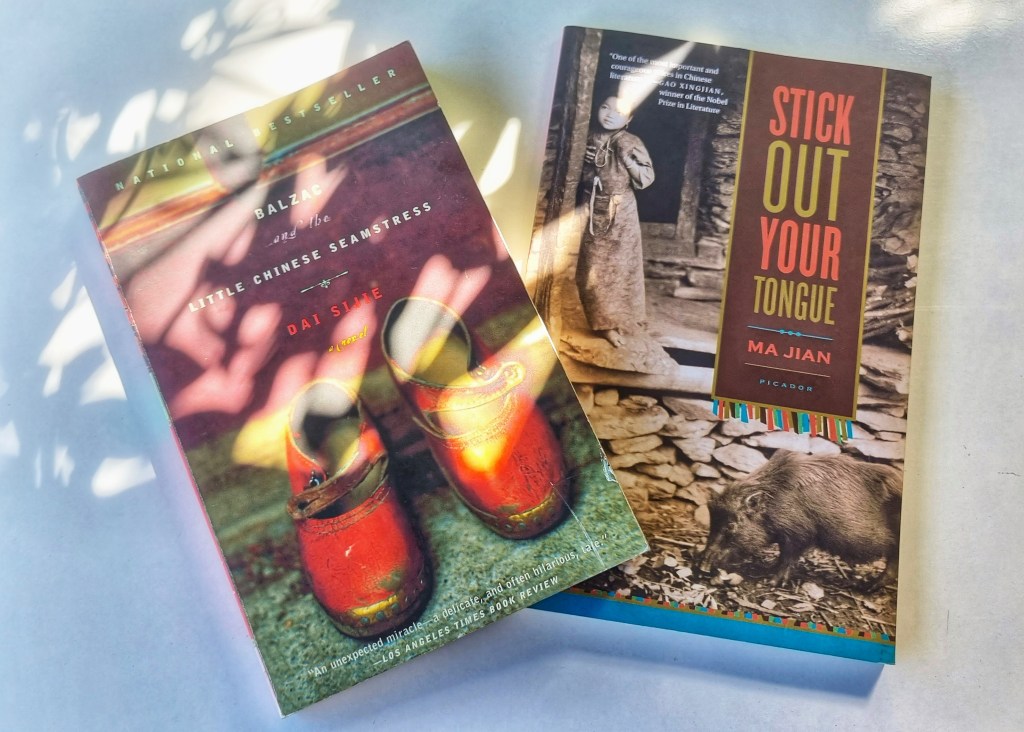
Dai Sijie’s Balzac and the Little Chinese Seamstrees is closer to Chinese fast food and so much easier and more pleasant to swallow than Ma Jian’s Stick Out Your Tongue; and I can only be glad that I read these two in succession so they could balance each other out.
Stick Out Your Tongue is the slimmer volume and yet its morbid stories of sky burials, incest, and disturbing Buddhist initiation rites juxtaposed with Tibet’s harsh landscape shakes one to the core. I cannot even think of recommending this book. But it is the afterword that I find especially striking as it draws attention to the destruction that the Chinese government has wrought in Tibet, or the fact that over a million Tibetans have died due to political persecution or famine — yet another case of a people denied control of their lands and destinies by a powerful bully.
Balzac and the Little Chinese Seamstress, on the other hand, offers more heartwarming and comic imagery as two bourgeois teenage boys navigate their “re-education” in the countryside during China’s Cultural Revolution. They were among the millions of China’s youth who were sent to the rural areas to be re-educated by peasants from the mid-60s to the mid-70s. Their lives take a turn when they meet the little Chinese seamstress, but these lives are truly altered when they unexpectedly encounter French literature at a time when “ignorance is in fashion”. It may not be classified as a literary masterpiece but it is a celebration of the transformative power of literature; and I can’t blame you if this book made you scour bookshops and the internet for a definitive English translation of Romain Rolland’s Jean-Christophe. That’s what it made me do.
Adania Shibli is the queen of stark but poignant and powerful prose. I’d feel pretentious if I tried to say more than necessary.
Having read Minor Detail already, I downloaded these books in response to her unjustly cancelled award ceremony at the Frankfurt Book Fair that was supposed to take place on October 20, 2023. Shibli’s first two works are described as non-political. I disagree. But maybe they are, if one compares them to Minor Detail, her most famous work, which exposes the rape and murder of a Palestinian girl by Israeli soldiers.
In these two books there is no talk of occupation or governments, most characters do not have names, locations are vague, they recount ordinary lives; but I don’t think it takes a genius to notice that the dismal lives depicted in these earlier works are consequences of systemic trauma and oppression.
For books such as these, it is not the reader’s duty to offer literary analysis, or to say whether they liked it or not. It is the reader’s duty to empathize. Because today, even empathy is hard to come by.
A writer who merely sits behind his desk or peers at his city through a tinted car window could not have written this.
The person who has written these stories is well-acquainted with the nooks and crannies of Dumaguete (or “Dumaguet” until it becomes “Dumaguete” again in page sixty), he has sought refuge under its acacia trees, he has gone to the market for puto maya and native cocoa, has frequented the chicken inasal places, he has walked its streets, he is burdened by its secrets, he is intimate with its ghosts and the living, and knows his city like a lover knows his beloved’s face.
Wasn’t this supposed to be a collection of fantasy and science fiction? Doesn’t Neil Gaiman’s blurb on the cover further suggest this?
Yes, it is; and yes, it does. But I recognize in this book what I recognize in favorite writers like Khoury, Pamuk, and Mahfouz. Their works are celebrations of their cities. The love affair they have with their cities seep into their stories regardless of genre. And yes, it is a book of heartbreak and magic, horror and fantasy, but look deeper and see that it is a celebration of Dumaguete — it’s landscapes, seascapes, its food, and the loves lost and found on its soil.
Beirut has Elias Khoury, Cairo has Naguib Mahfouz, Istanbul has Orhan Pamuk, Dumaguete has Ian Casocot.
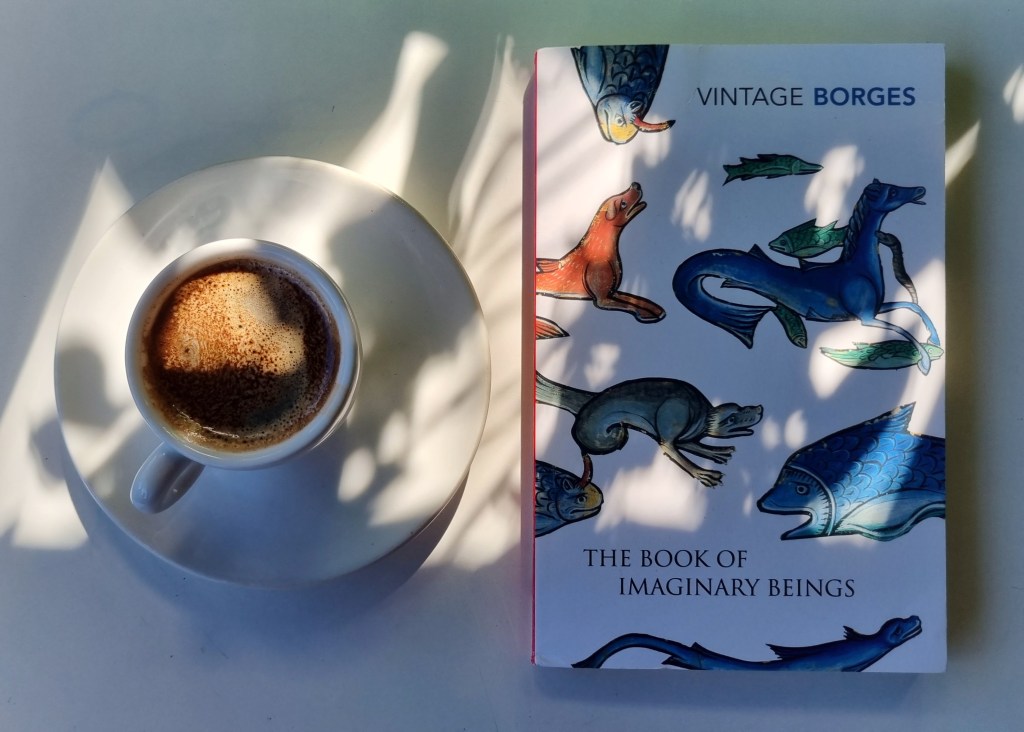
Mr. Borges acknowledged in the preface that a book of this kind is unavoidably incomplete, but I can’t help fantasize about how he would have enjoyed adding Filipino lore to this updated menagerie of a hundred and twenty had our creatures traveled to South America and entered the perimeters of his consciousness.
An earlier edition invited readers to send names, descriptions, and conspicuous traits of their local monsters. I would have nominated the Tikbalang, the Aswang, the Manananggal, the Sigbin, and one Filipino president or two.
Although the latter species probably wouldn’t have qualified owing to being non-fictional.
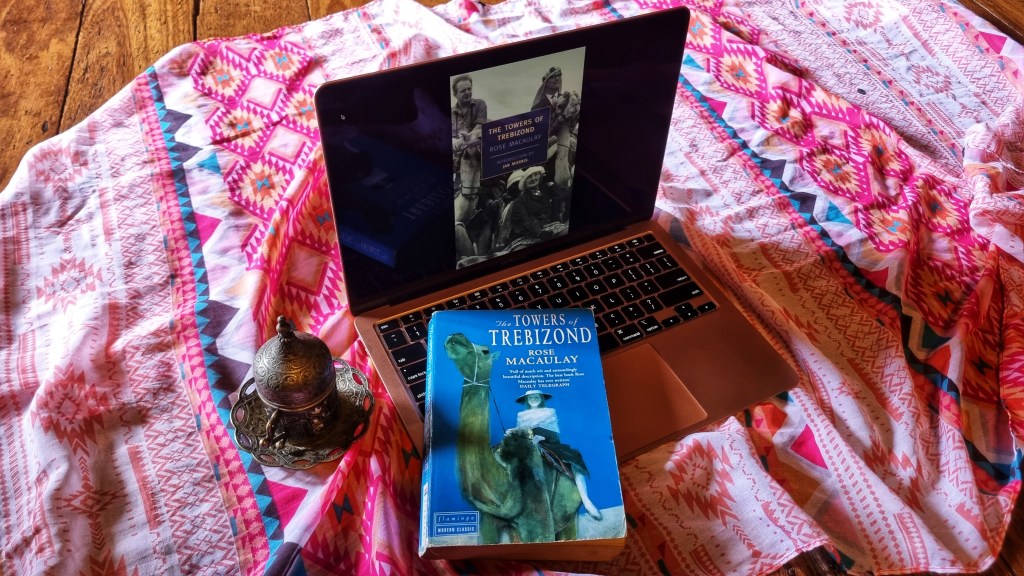
“I felt as if I had come not home, not at all home, but to a place which had some strange meaning, which I must try to dig up. I felt this about the whole Black Sea, but most at Trebizond.“
Feeling like I was not ready to tackle heavier themes than those in real life, I took this “adventure” novel out for a spin. It took me a while to warm up to it because it also took me a while to realize that this is not exactly a regular travelogue.
I see it as something else disguising as an adventure book. For beyond the mirage of exciting escapades in Turkey and the Middle East, it is a humorous critique on religion — different kinds. That being said, it is not a travelogue for the easily-offended. After all, Laurie is an agnostic narrator who admits to having a difficult relationship with religion, but sometimes has an outsider’s advantage of seeing through the hypocrisies and bigotries of the seemingly religious.
As our adventuress and her unlikely companions go deeper into the direction of historic Trebizond (Trabzon in modern Turkey) on camel-back, the ruminations on morality also deepen.
“I do not remember when I was in Cambridge we talked about such things… though we talked about everything else, such as religion, love, people, psycho-analysis, books, art, places, cooking, cars, food, sex, and all that. And still we talk about all these other things, but not about being good or bad.”
The ending confirms my hunch that while there is a literal Trebizond of which she writes, there is also another figurative Trebizond to which she refers. In a way, I am glad that this book did not turn out as I expected, and that it turned out to be so much more.
While I debate whether to order the NYRB edition solely for the Jan Morris introduction, I leave you with this poignant and relevant passage about Jerusalem:
“But what one feels in Jerusalem, where it all began, is the awful sadness and frustration and tragedy, and the great hope and triumph that sprang from it and still spring, in spite of everything we can do to spoil them with our cruelty and mean stupidity, and all the dark unchristened deeds of christened men. Jerusalem is a cruel, haunted city, like all ancient cities; it stands out because it crucified Christ; and because it was Christ we remember it with horror, but it also crucified thousands of other people, and wherever Rome (or indeed anyone else) ruled, these ghastly deaths and torturings were enjoyed by all, that is, by all except the victims and those who loved them, and it is these, the crucifixions and the flayings and the burnings and the tearing to pieces and the floggings and the blindings and the throwing to the wild beasts, all the horrors of great pain that people thought out and enjoyed, which make history a dark pit full of serpents and terror, and out of this pit we were all dug, our roots are deep in it, and still it goes on… And out of this ghastliness of cruelty and pain in Jerusalem that we call Good Friday there sprang this Church that we have, and it inherited all that cruelty, which went on fighting against the love and goodness which it had inherited too, and they are still fighting, but sometimes it is a losing battle for love and goodness…”
“I saw with my own eyes the end of a world… opened my eyes to the cruelty of the world. Isn’t that the point from which to date my break with childhood?”
It was not a reading slump. My readings simply could not veer away from articles on the Israel-Hamas war. Since October 7, reading for leisure felt so much like what Gideon Lasco would call “an embarrassment of privilege”.
But upon arriving from another short trip to the capital, a two-month late parcel containing Pushkin Press books that I ordered for Women in Translation Month greeted me. And because I am a strong believer in the seemingly late but apt arrival of books in our lives, I couldn’t resist picking up Banine.
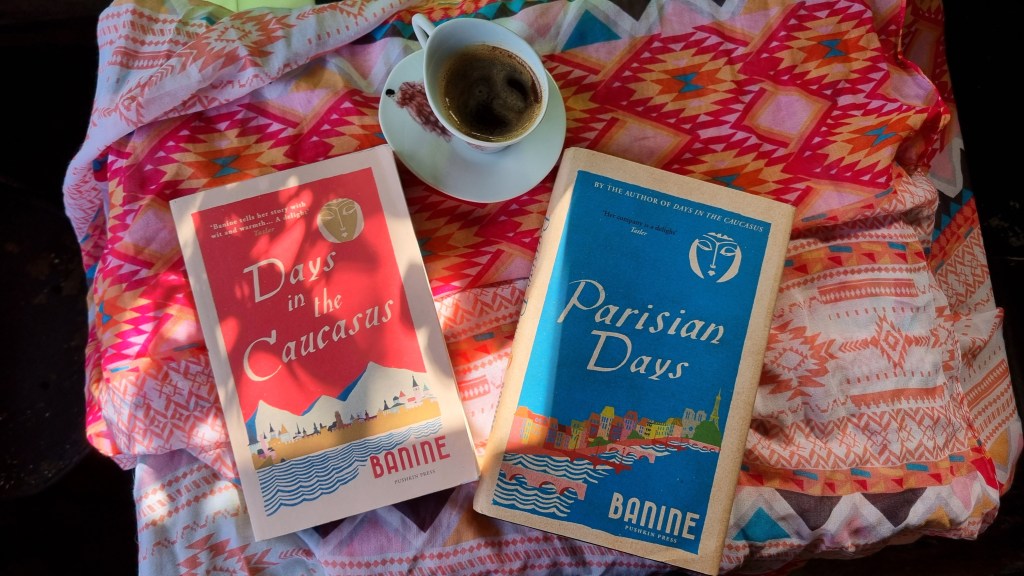
Although set over a century ago and published in 1946, Days in the Caucasus is not far removed from current events; freedom for women meant gaining precedence over the veil, climate change was already felt by our perceptive narrator, and it even offers a glimpse of the long-standing conflict between Azerbaijan and Armenia that made headlines again last month. As readers, we have also learned by now that a coming-of-age story is an unceasing current event.
But oh, to have Banine as a narrator is such a whiff of fresh air! There is already a Tolstoyan flavor in the first line of Days in the Caucasus when she opens with, “We all know families that are poor but ‘respectable’. Mine, in contrast, was extremely rich but not ‘respectable’ at all.” And thus begins a witty narration of an extraordinary place, an extraordinary time, and an extraordinary life.
Banine, born at the turn of the 20th century into a family of oil magnates in Baku when Azerbaijan was still part of the Russian Empire. That information alone heralds upheavals of every kind, yet she colors this turbulent part of life and history with an irresistible charm.
This heiress who lost her home, her freedom, and fortune when the Bolsheviks came into power had a special relationship with nature (“…they did not play dead with me; they replied in a simple language, sufficient for those who knew how to hear…”), loved playing the piano (“I was fortunate to have a consolation that I turned to with greater frequency — my piano …only the piano found favor with me…”), loved to read but also acknowledged its limits (“…those who claim that reading is a consolation for everything cannot feel very deeply — a powerful emotion leaves no spare mental capacity; it takes over, hypnotizes you, stops you thinking of anything else…”).
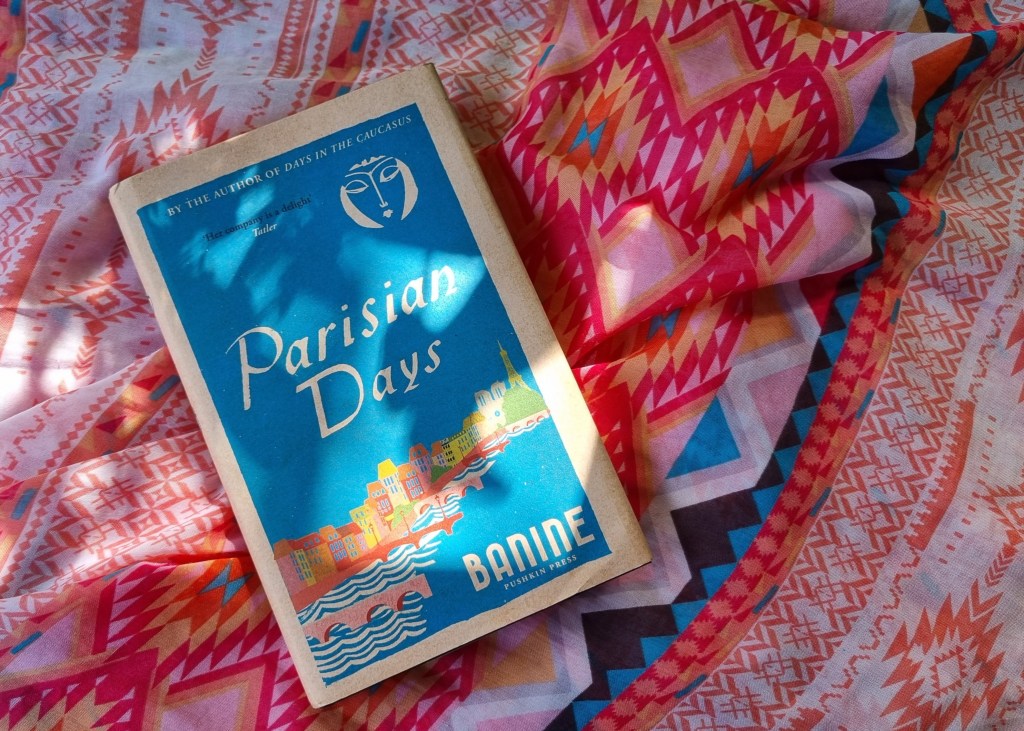
Parisian Days chronicles her subsequent life in Paris as an adult and an émigré. In it we see her humor and astute observations aging like fine wine. It makes one realize that these are some of the shoulders on which the Annie Ernaux-es of today have stood in order to write fearlessly about society and a woman’s intimate thoughts.
Banine is a lovely companion of a narrator who, whilst making light of her tragedies, makes us recognize our privilege of experiencing the loss of home and freedom only through the books and stories of others.
“In this atmosphere, everyone enjoyed every freedom as long as it didn’t impinge on the freedom of others.And isn’t that the definition of freedom?”
“It revealed to me an eternal truth: as long as the flight of a bird, the soughing of leaves, the wash of the sea bring joy to your senses and mind, life remains a precious gift.”
“Life was waiting for me. I had to go and meet it despite the burden of my reluctant heart.”




 The Book-Butterfly