“In every story, without exception, the woman looks back. She turns to stone on the spot.”
“Because Koreans don’t win the Nobel prize for literature,” says the young Nora in Past Lives when Hae Sung asked the aspiring writer why she was moving to Canada.
As much as I love that film that’s lodged in a heart space that I thought was only reserved for the Before Sunrise/Sunset/Midnight trilogy, I was glad Nora proved to be wrong when Han Kang became the first Korean and the first female Asian writer to be awarded the Nobel Prize in Literature.
Lauded for her “intense poetic prose that confronts historical traumas and exposes the fragility of human life,” it then became a goal to read Han Kang for Women’s Month this year.
It is one of the most atmospheric books I’ve read. I can almost feel the snowflakes falling on my heart until now.
The novel takes place on Jeju Island, a place that I regarded merely as a popular vacation spot thanks to KDrama and the island’s visa-free policy for Filipinos. It also drew international attention on December 29, 2024, when a Jeju Air flight overshot the runway and resulted in 179 fatalities. That’s all I knew of Jeju — until I read this.
What begins as a woman having a series of nightmares and discernibly living with an unnamed trauma, builds suspense when a friend in the hospital asks her to rescue a pet bird that was left alone at home after an accident occurred. What Kyungha discovers in her friend Inseon’s home in the dead of winter gradually opens her eyes to the Jeju massacre of 1948. It is such a hallucinatory reading experience that I had to verify if something that horrific really happened in idyllic Jeju Island’s history.
“Extermination was the goal. Exterminate what? The reds.” But Jeju’s inhabitants were not all reds, and yet it was easier for the military to operate by decimating the population. For nearly fifty years after the massacre, it was a crime punishable by law for a South Korean to mention the event. A huge percentage of the thousands that perished were innocent.
“Collateral damage.” That’s what they call it. Now where have I heard that term recently?
“What if all Palestinians vanished from their homeland overnight?”
This is the line that greets the reader on its French flap. Longlisted for the 2025 International Booker Prize, one would think that the question, and the novel, are a response to the Gaza War. Although uncannily timely, it was written in 2014.
In this story, all Palestinians disappear. There is fear, relief, and even joy. “This problem disappeared on its own. It is a divine miracle,” remarked one Israeli. Ariel, a journalist and liberal Zionist, tries to figure out what really happened and looks for traces by reading his missing friend Alaa’s letters to a dead grandmother.
The book is semi-epistolary as it alternates between Ariel’s articles and Alaa’s letters. In a clever contrast, Ariel’s articles look toward the uncertain future, while Alaa’s letters look into the past. “Perhaps I am writing out of fear. Against forgetfulness. I write to remember and to remind, so memories are not erased. Memory is my last lifeline.”
The articles and the poignant letters reveal the disparity of their personal histories: One looks at the same city as the Jaffa his people had lost; while one looks at it as Tel Aviv, with its Bauhaus architecture, the dream that came true.
In another Palestinian masterpiece, Adania Shibli’s Minor Detail, the entire book is a bullet in motion that hits you with a staggering force on the very last page. There is an abrupt and brutal finality.
There is no closure in Ibtisam Azem’s The Book of Disappearance. It ends without a concluding cadence and leaves the reader suspended in an unsettling limbo. But that does not imply that this book pales in comparison. Perhaps we are given a nanoscopic glimpse of what it feels like to be Palestinian.
“Only love and art can do this: only inside a book or in front of a painting can one truly be let into another’s perspective. It has always struck me as a paradox how in the solitary arts there is something intimately communal.”
An understated book that is a meditation and an education in art and life.
“I hope that when there is laughter, it’s laughter made wise by having known real grief — and when there is grief, it is made wise by having known real joy,” Kaveh Akbar writes in Martyr! Whether writing about art, architecture, Libya, or politics, Hisham Matar’s books are often so heartfelt — wholly made wise by having known sorrow and loss.
Fires, Marguerite Yourcenar
…because maybe, subconsciously, this month’s reading theme is about finding solace in the works of authors whose masterpieces have already left an impression on me, that I immediately dove into Yourcenar’s Fires without hesitation, having been incredibly moved by Memoirs of Hadrian in 2022.
She does admit, and warn, in the Preface that this book is, “the product of a love crisis” and that writing this was, in a way, “exorcising a very concrete love”; and yet it still surprised me that the elegance I encountered in Hadrian was replaced in Fires by a certain violence and ferociousness in the prose.
Antigone, Sappho, Clymenestra, and Achilles are just some of the main characters of the nine lyrical prose pieces, or stories, that Yourcenar amalgamates with her own experiences. I was left wondering if I understood the allusions correctly, or whether I understood anything at all.
One thing is certain, Fires is a masterclass on opening lines:
Phaedra’s piece begins with, “I hope this book will never be read.”
The Patroclus opening, “A heart is perhaps something unsavory. It’s on the order of anatomy tables and butcher’s stalls. I prefer your body.”
Lena’s? “Loving eyes closed is to love blindly. Loving eyes open is perhaps to love madly.”
“Love is a penalty. We are punished for not having been able to stay alone.” Clymenestra’s.
Face Shield Nation, Gideon Lasco
Articles that I looked forward to during the pandemic compiled in a book. Lasco was the voice of calm and reason at a time of confusion; evoking through his column the architectural definition of a column as a sturdy pillar of support. An essential time capsule of an era that we cannot afford to forget if we intend to learn from it. Read full entry here.
One Hundred Years of Solitude, Gabriel Garcia Marquez (a re-reading)
Growing up is realizing that Gabo is the real Melquiades who brought us magnets, magnifying lenses, astronomical observations, and mercurial storytelling. It was he who made imagination and literary possibilities flourish in the fertile and pristine Macondos of our minds, and who never really died. Read full entry here.
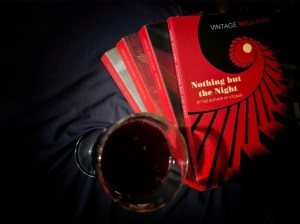
Nothing but the Night, John Williams
Maybe the first disappointment that assails the reader is the realization that, despite the slenderness of this volume, there is a heaviness in each page that restrains forward motion.
“Boring,” the lazy might judge hastily somewhere within the first three chapters. But one should not be too quick to criticize even though I myself could only read a couple of pages per sitting. For if one looks closer, and feels deeper, isn’t this genius, how John Williams conveys exactly what depression feels like?
“…there came to him that peculiar loneliness which is felt only in the monstrous impersonality of a multitude…”“What was the senseless circumstance which led him on and on, deeper and deeper into what seemed to him a maze labyrinth, devoid of pattern or meaning? …some unnameable power pushed him from one place to another, down paths he had no wish to travel, through doors he did not know and had no wish to know. All was dark and nameless and he walked in darkness.”
But then the reader is momentarily allowed to come up for air. I’m referring to the fourth chapter that is briefly set alight with a Proustian beauty! “That is the very best time of life, he thought: lost time.” And then John Williams proceeds to craft this fleeting tribute to the master searcher of lost time before he relinquishes the ethereal chapter to the fading light.
As the novel finally builds suspense, it spirals into a nihilistic darkness that ends with a violent and repulsive slap in the face.
Written in Burma when he was only twenty-two while recovering from injuries brought about by a plane crash over the Himalayas during WWII, he wrote this first novel at a particularly dark time when there was nothing else but the night.
The John Williams here is not the John Williams that gave us Stoner and Augustus. The John Williams here is the John Williams that would eventually give us Stoner and Augustus.
The Black Book, Orhan Pamuk
This reader has been through Pamuk’s longest novels and still felt the density of the mystery and prose in this book’s mere four hundred pages.
It explores the writing process and the precariousness of identity. It is also about how much the books we read, the stories we hear, the movies we watch, the everyday objects in our lives, and our city’s history shape the multiplicities of our being.
I enjoyed that twist at the end and relished the familiarity of Istanbul as a breathing character in a Pamuk novel. But maybe, just maybe, The Black Book is not for the Pamuk newbie, and not for those who are in a hurry.
The Golden Road, Willliam Dalrymple
It is not only the Silk Roads that are rising again, as Peter Frankopan proclaims in a forceful last line that gave me goosebumps. Rising, too, are buried or forgotten histories that have now resurfaced to challenge centuries of unquestioned narratives.
Frankopan’s The Silk Roads was an eye-opener, but The Golden Road takes this non-Eurocentric view of ancient and early medieval history to an intriguing direction by revealing India as a catalyst that transformed the world. Read full review here.
It is not only the Silk Roads that are rising again, as Peter Frankopan proclaims in a forceful last line that gave me goosebumps. Rising, too, are buried or forgotten histories that have now resurfaced to challenge centuries of unquestioned narratives.
Frankopan’s The Silk Roads was an eye-opener, but The Golden Road takes this non-Eurocentric view of ancient and early medieval history to an intriguing direction by revealing India as a catalyst that transformed the world.
The evidence lies in the art discovered in Afghanistan’s mountains and caves; in the archaeological treasures of an ancient Egyptian seaport; in Baghdad where the knowledge of ancient India converged with that of ancient Greece and Abbasid viziers were Sanskrit-literate; in Spain where Sa’id Al-Andalus championed Indian contribution to mathematics and astronomy; in Pisa where Fibonacci popularized what we call “Arabic numerals” but which are actually Indian; in Roman texts, some written by Pliny; in the jungles of India, or in its museums that appear to hold more Roman coins than any other country outside the Roman Empire; in China’s overlooked history where once upon a time it looked to India for enlightenment; in Sri Lanka and Central Java where Indian Buddhist literature achieved peak expression in architecture; in Cambodia’s Angkor Wat which Dalrymple refers to as the most spectacular of all Indic temples, and where one can find the oldest inscription that represents the number zero; in Brahmagupta’s 7th century writings that made him the first mathematician to record his exploration of the properties of zero, defining it as a number akin to the other nine rather than a void; in the numbers that dictate our most advanced technology to those we use in simple day-to-day calculations, “arguably the nearest thing the human race has to a universal language…”
[…and also in, if I may add, the Philippines where currently displayed in the Ayala Museum as part of the Gold of Our Ancestors exhibit is an intricately crafted, four-kilo gold sash from 10th to 13th century Mindanao that massively echoes the sacred thread, or upavita, in Hindu culture. (Dear William Dalrymple, or your cute son, Sam, please come to the Philippines to look into this? Haha)]
To engage in this book is also to question why India’s extraordinary role in world history has been subdued. The pulsating arteries of India’s influence that crossed continents and oceans, “spread not by the sword but by the sheer power of ideas,” has been brushed aside. It has never even been given a name. William Dalrymple calls it The Golden Road.
Although I prefer the William Dalrymple who does not make the “I” completely disappear in his travelogues, thereby giving his text a more endearing and personal touch, I like how this history book is not tediously academic and does not promise to be all-encompassing. Its readability serves as an introduction for those who would like to have a general idea of these trade, cultural, and intellectual routes that seem to have a life of their own apart from — although intersecting at times — the often romanticized Silk Roads.
The prolific stream of fascinating history from Dalrymple’s writings makes this reader feel fortunate to be alive in this age of rediscovery and information. The generosity of his work is encapsulated in my favorite line from this book: “The possession of knowledge is not weakened when shared with others but made more fruitful and more enduring.”
“Only love and art can do this: only inside a book or in front of a painting can one truly be let into another’s perspective. It has always struck me as a paradox how in the solitary arts there is something intimately communal.”
Yesterday was heavy. Not only for me but for a lot of people I care for, and for different reasons. It somehow made me yearn for Hisham Matar’s prose, because I don’t think I have read any other writer who speaks straight to my heart about life with such authenticity and accuracy and with such emotional and artistic intelligence. (I read three of his books in 2024, and one of them, My Friends, was the best book I read last year. Until now I cannot find the words to do it justice.)
So, I tried to see if there was an older book of his that escaped my attention. A Month in Siena was the answer. I finished reading it last night and had taken five pages worth of notes by midnight. I’m glad today is a Sunday so that I can reread my notes and fully process the beauty of this understated book that is a meditation and an education in art and life.
“I hope that when there is laughter, it’s laughter made wise by having known real grief — and when there is grief, it is made wise by having known real joy,” Kaveh Akbar writes in Martyr! Whether he is writing about art, architecture, his homeland, or politics, Hisham Matar’s books are often so heartfelt — wholly made wise by having known such things.
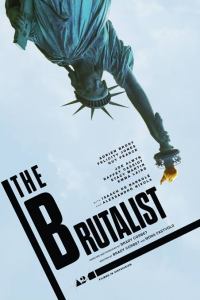
an author named Laszlo and an architect named Laszlo
a character who is a librarian and a character who builds a library
postmodern literature, modern architecture
asymmetry in form, symmetry in symbolism
stunning imagery and visuals; flashes of genius; wanting, plot-wise
striking passages from the book:
“…art is a cloud that provides shade from the sweltering heat, or a flash of lightning that splits the sky, where, in that shade’s shelter, or that lightning’s flash, the world simply becomes not the same as before.”
“…libraries (as I wrote near the end of my first notebook) are the most exceptional and exalted works of art…”
“Resist the idea that architecture is a building.”
striking passages from the film:
Van Buren: So, answer me one question; why architecture?
Laszlo: Is it a test?
Van Buren: Not at all.
Laszlo: Nothing can be of its own explanation – is there a better description of a cube than that of its construction? You know, some years ago, in March, a stranger knocked at the classroom door of the university where I frequently lectured. At once, all that was familiar and important to us was gone. We were too well-known at home. I thought my reputation might help to protect us but- it was the opposite. There was no way to remain anonymous; nowhere for my family to go. There was a war on, and yet it is my understanding that many of the sites of my projects have survived and are still there in the city. When the terrible recollections of what happened in Europe have ceased to humiliate us, I expect them to serve instead as a political stimulus, sparking the upheavals that so frequently occur in the cycles of peoplehood. I already anticipate a communal rhetoric of anger and fear; a whole river of such frivolities may flow un-dammed, but my buildings were devised to endure such erosion of the Danube’s shoreline.
Erzsebet: Losing a mother – it’s an unfathomable loss, you see. To lose one’s birth mother is to lose the very foundation on which we stand. The mind may not know its loss but the heart does.
Erzsebet: I suppose that deep inside, he worships at the altar of only himself…
Zsofia: We are going to Jerusalem… Binyamin has family there.
Binyamin: My older brothers relocated with their families in 1950. They became citizens.
Erzsebet: Life is difficult there. Have you thought this through?
A friend sent me a signed copy of Dalrymple’s The Golden Road from overseas a few months ago, and it still hasn’t arrived thanks to our lousy postal system. But as I wait, another friend lends me her copy of City of Djinns. It’s comforting to know that I won’t run out of Dalrymples (and kind, reading friends).
City of Djinns is Dalrymple’s second book after his debut, In Xanadu. Published only four years apart and yet the Dalrymple of Djinns is already so much wiser and more thoughtful than the one in Xanadu. It is one of his best books. City of Djinns is a precious gem in a brilliant bibliography that is a testament to how a series of meaningful travels can profoundly ripen a person and a writer.
And Delhi, this book’s chosen city, is one such city that seems like a heaving anarchy on the surface; but as this book’s adept writer shows us, if one dares to steep oneself in its murky river of humanity, one comes out of it acquiring a thousand and one lessons about the layers of its incredible history, about different faiths and cultures, and about the rise and fall of empires.
“The civilization I belong to — the civilization of Delhi — came into being through the mingling of two different cultures, Hindu and Muslim. That civilization flourished for one thousand years undisturbed until certain people came along and denied that that great mingling had taken place,” laments Twilight in Delhi author, Ahmed Ali.
India was where the sun finally set on the British Empire, and this book is another witness to how much the Partition — the British Empire’s parting gift to the Indian sub-continent — wreaked havoc on this particular city, whose towers, ironically, used to be, “The resting place of the sun”.
Delhi is not a destination and subject for the faint-hearted. It takes a Dalrymple to deftly paint the interplay of light and dark, of myth and truth, of what was and what is.
“Is this the way to the Museum of Books?” The main entrance where a statue of Shota Rustaveli stood guard seemed to have been closed for an indefinitely long time, so I had to walk around the loggia and look for another door.
“Follow me,” the guard said without hesitation and led me through office backdoors and hallways lined with filing cabinets and some curious eyes peering through them when the rhythmic footfalls of my boots echoed through the corridors.
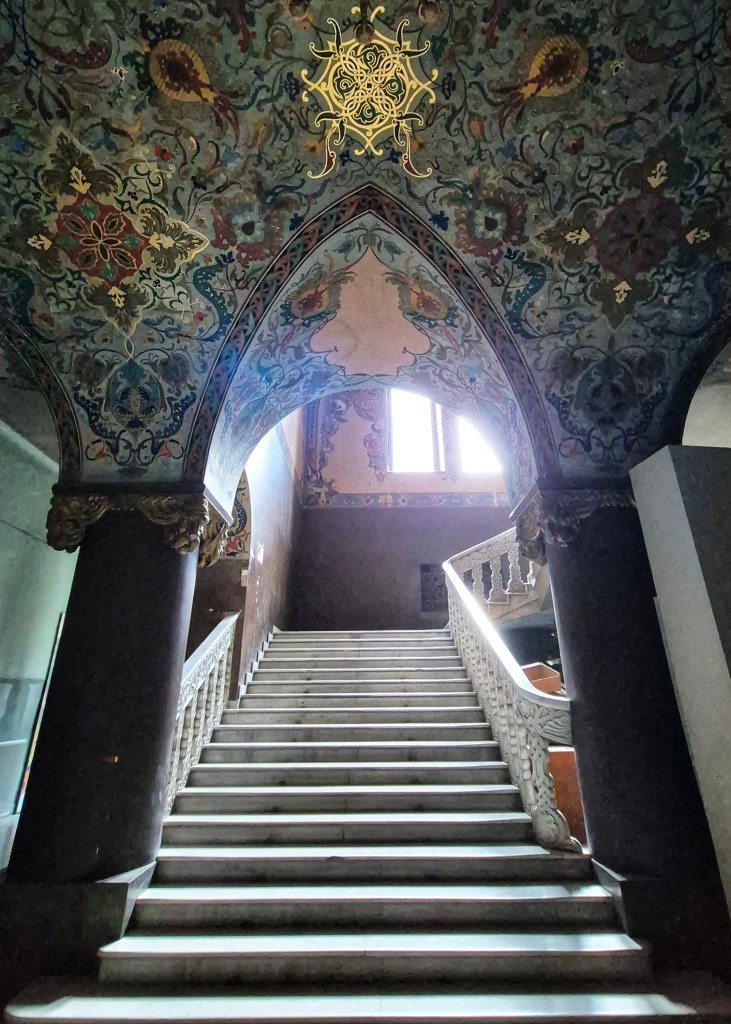
Just as I was feeling a little lost and self-conscious for being the only non-employee around, he turned around and said, “When you’re done, just exit the way you came in.” He left me, alone, staring open-mouthed at what was the entrance hall of Tbilisi’s Museum of Books.
Amber sunshine streamed through the windows, casting light on intricate adornments that I had never seen applied to buildings before. It was as if I was drawn inside a page of a medieval illuminated manuscript.
I soon learned that the building is a collaboration between the architect Anatoli Kargin and well-known painter Henry Hrinevski, who was also a book illustrator and manuscript illuminator as well as a scholar on traditional Georgian architecture, but who was sadly arrested and killed during Stalin’s Great Purge.
The building was completed in 1916 and erected as a bank, but became part of Georgia’s series of libraries, fittingly so, in 1931. It is Building I out of V monumental buildings housing the National Parliamentary Library of Georgia.
Recognized as one of the finest museums dedicated to the written word, it boasts of personal libraries of Georgia’s eminent authors, the first book printed in the Georgian language, and autographed works by famous writers including Victor Hugo.
I went there for the books but came out deeply impressed knowing that the building that holds such treasures is, itself, one for the books.
“I hope you’ll remember me,” one of my guides said after a lovely day. “If not me, I hope you’ll remember my people and my country. I hope you’ll remember us as people who know how to live, and I hope your trip taught you a thing or two about how to live. I hope you love your country as much as we love ours.” Then he held out his glass of wine and said, “May this be the worst day of our lives. Gaumarjos!”
How their words for saying “cheers” and “hello” are rooted in the word for victory already speaks volumes of their history. Geographically flanked by some of the greatest empires the world has known, this isthmus connecting Europe to Asia has been bathed in blood for centuries. It is crazy to think that I have lived far longer than their democracy.
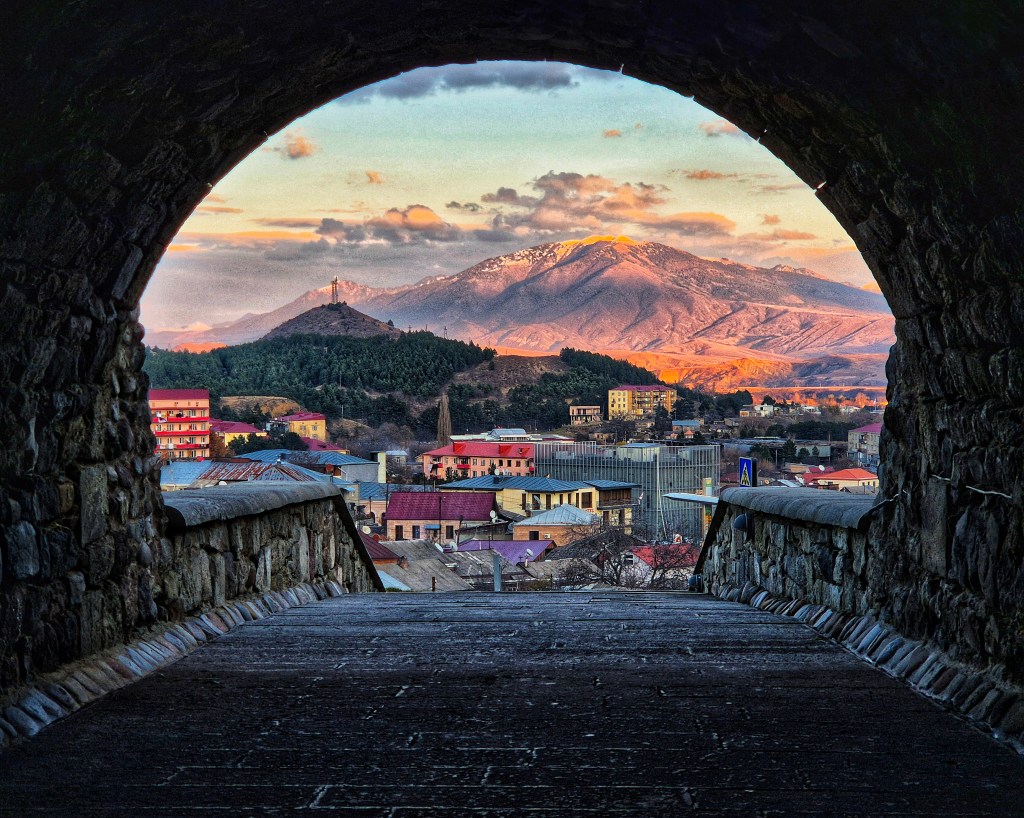
I have written my guide’s words in my journal, and they keep coming back to me as news of the intensifying protests reaches me here at home. I witnessed the peaceful protests in Tbilisi first-hand and it made me question if the media had exaggerated things. But I just saw a tranquil avenue I walked through many times swarming with protesters, now I’m not sure what’s really happening out there anymore. I can’t ask the people I’ve met because, as a rule, I rarely exchange contact details with people I meet in my travels.
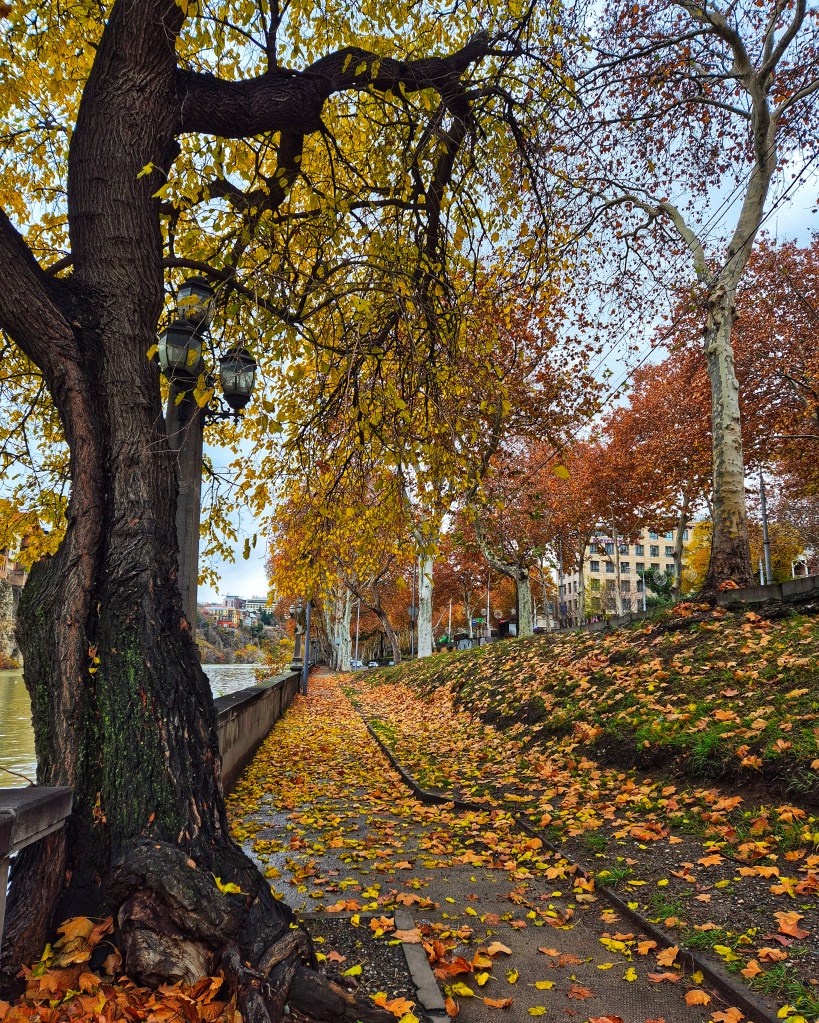
But I do keep Georgia and her people on my mind. I remember them as people who know how to live. I know how much profound pride and love they have for their country, far from the shallow, sloganeering kind of pride and love for country. I hope their streets and their pathways remain free from conflict and violence, because I, for one, found peace walking down those avenues and through those pathways.
Thus begins one of Pushkin’s most personal and most poignant poems, it inspired the composer, Rimsky-Korsakov to set it to music.
The full moon, an air balloon, and the Bridge of Peace over the Kura River
“Such sadness and such ease; my melancholy’s light…”
Has any other poet ever expressed this exact point in loving and having lost; when there is still sadness, but there is now ease; when there is melancholy, but it has become light?
On hills of Georgia lies the covering of night. There is darkness, but there is beauty, and there is light.

























 The Book-Butterfly