Neal Ascherson: Black Sea

On a trip to Turkey in 2016, we landed at Sabiha Gökçen International Airport, which is on the Asian side of Turkey and closer to the Marmara Sea. The Istanbul Airport that opened in 2018 is on the European side, and just before landing on the meeting point of the world, one is gifted with a breathtaking view of the Black Sea.

I saw the Black Sea thrice from an airplane window on my most recent trip, and the irony dawned on me that this body of water that has sadly become the “largest mass of lifeless water in the world,” in fact, teems with so much history and so much… life!

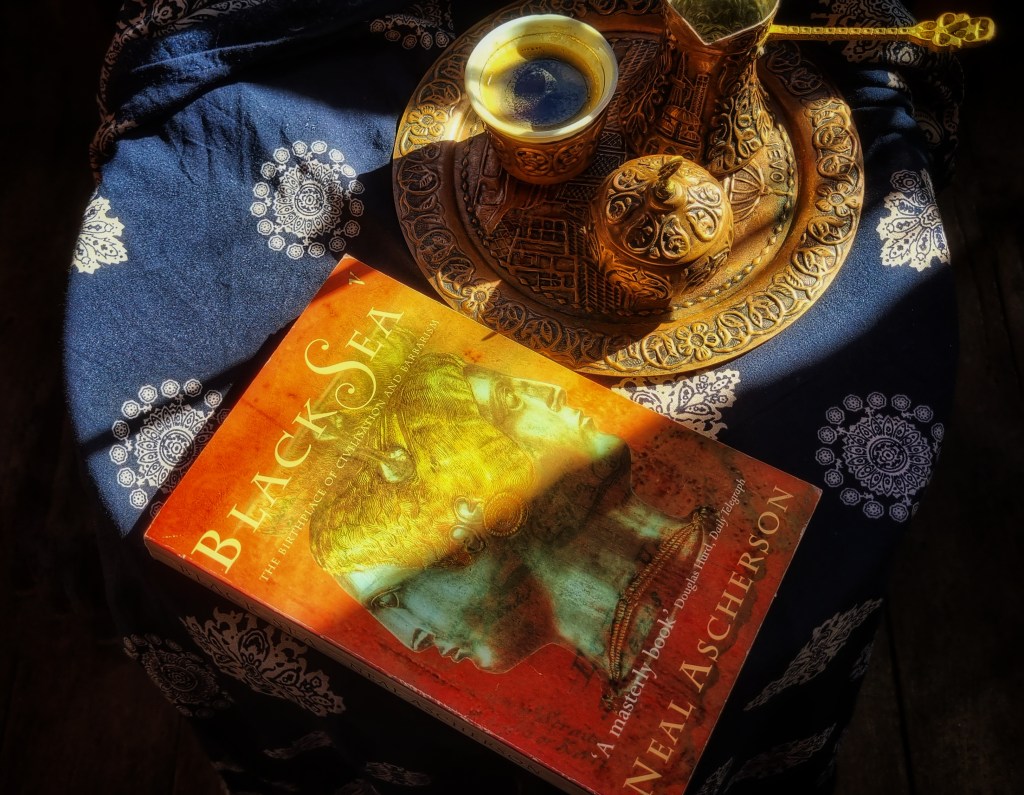
This book written by Neal Ascherson about this birthplace of civilization and barbarism accompanied me, although I only finished reading it on my way back home. I don’t think I’ve read a more poetic history book!

“Human settlement around the Black Sea has a delicate, complex geology accumulated over three thousand years. But a geologist would not call this process simple sedimentation, as if each new influx of settlers neatly overlaid the previous culture. Instead, the heat of history has melted and folded peoples into one another’s crevices, in unpredictable outcrops and striations.”

Reading it brought me back to the landscapes of Tokarczuk’s The Books of Jacob and to where I’ve just been, merging the lands of my dreams with those places that are the epicenters of current world events. Because somewhere in the midst of this all, is the history of the Black Sea.

From its first mention in literature in the Bronze Age (where Jason and the Argonauts sailed upstream the Bosphorus to the Black Sea); to the different Central Asian tribes and kingdoms; to chapters that made me understand better the Russian Revolution and Communism’s life, course, and death in that region; to the question of Crimea, Russia and Ukraine’s relationship and to many things in between, I am in awe of how Ascherson sustained a poetic voice!

In a way, it answers our suspicions about how, despite all the earlier discoveries of the East in almost all fields, the West is still seen as more superior and more “civilized”. It is an enlightening investigation on the definitions of civilization and barbarism that surprisingly touches on feminism and immigration, which is quite different from what most minds have been programmed to believe.

Here is a history book that does not merely record events and dates, but most importantly, relationships. For as the author compellingly reveals, the Black Sea is not just a place but a pattern of relationships, and nothing like the symbiosis of the Bosporus Kingdom has ever happened.

A beautiful thing about traveling and reading is to be able to measure ourselves against the expanse of time and history, with the intention of acquiring more perspective, if only to acquire more life.

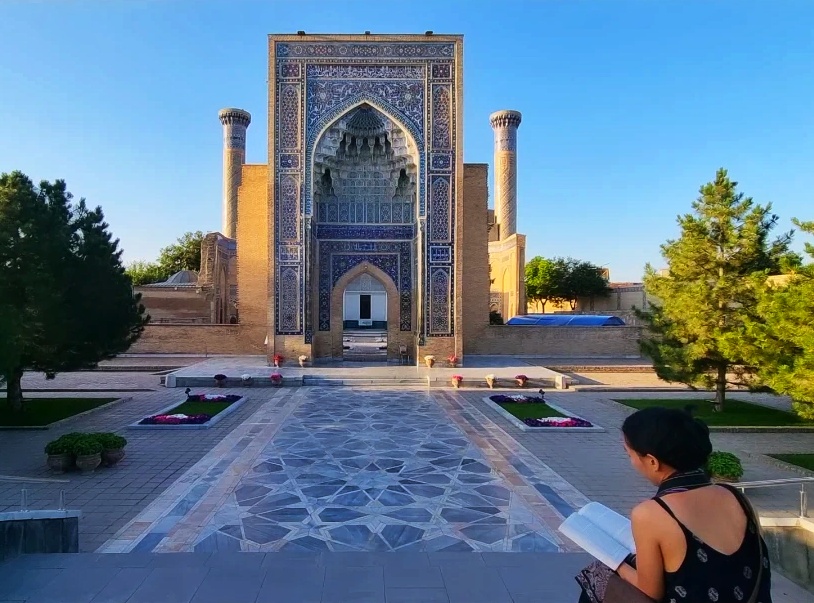
Traveling Companions in Uzbekistan

Samarkand, June 2022

On the question of loneliness: “Isn’t that lonely, what you’re doing?”

(I have just returned from a solo trip to Uzbekistan.)

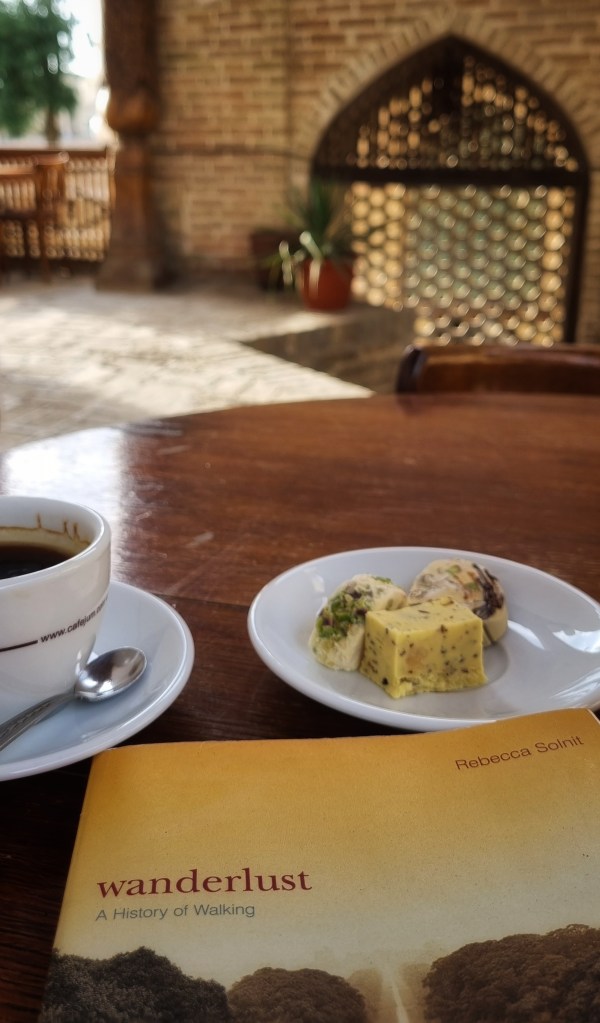
Well, these friends came along for the ride: The Naive and the Sentimental Novelist by Orhan Pamuk, for the long Istanbul flight; The Captain’s Daughter by Alexander Pushkin that was fortunate enough to have a photo at the Pushkin Metro Station in Tashkent and was enjoyed under the shade of the trees of Amir Timur Square; Wanderlust by Rebecca Solnit, read during those days at the Halva Book Cafe whilst waiting for the Bukharan sun to soften; and A Carpet Ride to Khiva by Turkish-British Christopher Aslan Alexander, which accompanied me through Khiva’s storied alleys.

As there is currently so much more outside book covers to commit to paper, I release myself from the discipline of writing book reviews this month. “Regular programming” will resume in this blog in July. Haha 

But I have to mention that Pamuk, who sacrificed painting and architecture school so he could paint with words, taught me a Greek word through this book — “Ekphrasis”. Simply put, ekphrasis is, “To describe something, via words, for the benefit of those who have not seen it.” This inspired me to somehow practice ekphrasis in my little way as I traveled through Uzbekistan, and doing so has allowed me to savor experiences twice.

Pushkin, although political, was not as existentially heavy as Dostoevsky and not as heavy literally as Tolstoy — a purely delightful travel companion!

A Carpet Ride to Khiva seems to have left no stone unturned about Khivan society. It is written in simple prose, bursting at the seams with honest observations, this book is an entertaining overview of the country’s history and politics — which is, perhaps, one of the reasons why the author is banned in Uzbekistan, and why I only brought the e-book with me. I, too, have my own observations, but will keep them to myself for the time being. But it has to be noted that along with reading, traveling is a most comprehensive education on geopolitics, among other things, if one cares to engage and observe.

Solnit, with a title perfect for a trip, shared this Eskimo custom of offering an angry person release by walking the emotion out of his or her system by going in a line across the landscape; “The point at which the anger is conquered is marked with a stick, bearing witness to the strength or length of the rage.”

I, who had no anger to release, did mark the places that bore witness to the strength and length of… something else. I enjoy traveling solo. I would not keep doing it if I didn’t. It is almost like a sort of essential meditation for me and I always go home a better person. I do not feel sad with my own company. But I did mark those places, those experiences so ineffable I could think of only one person to share them with. I would prefer to call it love than loneliness. (But why is conquering anger about letting go and conquering something else the opposite? But I digress.)

As I reluctantly tuck in this unforgettable trip lovingly and a little bit pensively in the folds of memory, I am reminded that the Old Uzbek language had a hundred words for different kinds of crying. And I wonder, what about laughter? What about happiness? 

Rafik Schami: Damascus Nights

“Writing is not the voice’s shadow but the track of its steps… only writing has the power to move a voice through time, and make it as immortal as the gods.”

In an attempt to read something that would get my mind off Philippine politics, I sought asylum at my Silk Route | Fertile Crescent shelf. This is one of the books from a hefty stack that a bookseller set aside for me because he knows of my current preferred literary flavors and reading project. And sure enough, I could hardly put this one down as soon as I started!

It is about a storyteller who loses his voice and the stories that allowed him to retrieve it.

As much as it is a wonderful reflection on writing and storytelling, Damascus Nights is, as you may have already guessed, a play on the Arabian Nights. But Rafik Schami makes the Arabian Nights what I would have preferred it to be! The fantastical quality of the original is still there, but he allows you to feel, smell, and hear the Syria before the humanitarian disaster, the lively early to mid-20th century Damascus, while weaving a social commentary on Damascene life, exploring identity and exile, foreign affairs, corruption, and a none too subtle criticism of its rulers! This turned out to be excessively political — without losing its humor and lightness!

Nevertheless, page 108 made me stop in my reading tracks. It is where an old man is insulted by an official, but his son who owns a teahouse begs him to refrain from retaliating: “‘That would ruin me,’ he said, ‘they’d shut down the place within hours.’ Someone would plant a handful of hashish somewhere, you see, or else a book by Lenin. The police would show up an hour later, and they’d find the hashish and the Lenin exactly where the man from the secret police had stashed them. The place would be closed and its proprietor thrown in prison for ten or twenty years.” Red-tagging and this so-called drug war abused to punish political or personal critics are some of the oldest tricks in the book, my friends. I will not write anything else on the matter. Even in reading, you cannot escape from something you care about.

Rafik Schami is another proof of the claim that we are missing so much as readers if we cease from exploring the literary wonders of this region. And isn’t his About the Author section the most charming you’ve ever encountered?

“…is an award-winning author who used to be a baker but didn’t like the flour and early hours. Since giving up baking, he has tried his hand at chemistry to discover the formula for immortality. What he found was that he could only do that through writing, because only literature lives forever.”

Excuse me as I go hunt for more books by Rafik Schami…

Margaret Atwood: Penelopiad (The Play)

Yesterday was a proper Monday, exhausting; and by nine in the evening I was off to the Ithaca of my subconscious.

Naturally, I woke up too early. Some strange urge made me go straight to my shelf and reach out for this.

And despite being in the middle of another book, I curled back into bed with this and a cup of coffee. Ambrosia was unavailable. 

The epic, echoed into a play by the incomparable Margaret Atwood through the eyes of Penelope, read within the length of one cup savored slowly against a gentle rain, and Penelope’s Naiad mother’s reminder to her daughter, was all I needed to read before the sun appeared.

“Remember this — water does not resist. Water flows… Water always goes where it wants to go, and nothing in the end can stand against it. Water is patient. Dripping water wears away stone. Remember that my child. Remember you are half water. If you can’t go through an obstacle, go around it. Water does.”

Bahiyyih Nakhjavani: The Woman Who Read Too Much

“The woman is you,” remarked those who saw me with this book.

I can only hope to be half as courageous.

But who is she? “To read is to pray,” she taught. “To write is to trust.” Her words had claws, they said, but at the same time they recognized that her silence were double the weight of her words.

She believed in these: That sometimes, illiteracy was fear; that truth conquered fear; that denial was difficult in the face of truth; that the best told lies can prove short-sighted before the long truths of eternity; and that there was no escape for those who took refuge in their ignorance. And of pride? “Love had nothing to do with it.”

Who was she again? Throughout the story we only know her as the woman who read too much. All the women in the book were not given names. Set during the Qajar Dynasty in the 1800s when literacy among women in Persia was not encouraged, and the details of their lives were largely invisible and unrecorded — as it had been for centuries, and as it had been for most parts of the world; this clever literary trick by Bahiyyih Nakhjavani is most likely a curtsy to Virginia Woolf who wrote, “For most of history, anonymous was a woman.”

“No marker on her grave then? None.” Her death is something readers will know right from the beginning. Her story is written in such a peculiar way that it moves forward while moving backwards simultaneously, proving that the best of these Iranian women writers are masters not only in subtlety but also in form, and one can only try not to blink and miss allusions or be helplessly lost.

“History is filled with screams that are ignored.” The reading woman is executed for what she stands, for opposing unreasonable orthodoxy, “for stating the obvious rather than for deviating from the truth,” condemned for showing other women “how to inscribe their lives on the pages of history… giving them the tools by which to be autonomous.” Her death only fanned the flames of the emancipation of women, especially the emancipation of the mind.

Nakhjavani surprises us in the afterword by revealing that the woman who read too much; who, after all, had a name, was a real woman. Tahirih Qurratu’l-Ayn, the symbolic mother of literacy in Iran.

I glance around my library as I write and wonder at the sudden awareness that, on my shelves organized by geography, the Iran section is the only one where women authors outnumber the men. What better way to honor her!

Here in the midst of “look how far we’ve come” and “miles to go before we sleep,” reading this makes me ponder on the women who came before us; back to Enheduanna (2286-2251 BCE), a woman, the first known author, and to the endless library of history we long to fill… and read.

We’ve always had the rights of the mind at our disposal. We need only take up courage to use them.

The world changed when definitions of womankind were altered.”

The Beekeepers

Try as we might to hope that the two apian titles speak only of positive lessons from bees — of how theirs is a society where each one functions for the good of the entire colony, of how they continue to work even when everything around them is dying — I am afraid they don’t.

Two beekeepers of neighboring nations; one real, the other fictional. Both written by women; one an Iraqi journalist and poet, the other a novelist who volunteered in refugee centers, herself a daughter of Cypriot refugees.

The Beekeeper of Sinjar is Abdullah Shrem. When DAESH (ISIS) began terrorizing Yazidi communities and abducting their women including Abdullah’s sister, he took advantage of his knowledge of the terrain and select personal contacts to rescue and smuggle women back to safety. Each time he saved a captive woman, he felt that he was also saving his sister.

Among the stolen women was Nadia Murad, who received the Nobel Peace Prize in 2018, the first Iraqi and Yazidi to be awarded the prize.

Dunya Mikhail initially inserts poems into a journalistic approach and recounts distressing interviews with the rescued women who were sold, beaten, and raped repeatedly, but who nonetheless opened up to the author so that she could write about their suffering. “It’s important that your book see the light of day, so that the world will know what’s going on here.” The journalistic eventually veers into the poetic, and I feel that this is one of the books from the region that will endure not only as an overwhelming account but also as a literary work.

The Beekeeper of Aleppo is the fictional Nuri Ibrahim, but through him and the plight he shares with his blind wife, Christy Lefteri expresses the unspeakable realities and consequences of war, of lives ended, uprooted, wasted, abused, and destroyed.

“War,” writes Dunya Mikhail, “comes with various names but with only one face.”

Even though it seems that love and hope is universal, unfortunately, so is war.

“The problem isn’t that the world is going to end, but that it continues without any change.” — Nadia Murad

Conversations with Edward Said and Gabriel Garcia Marquez

What a pleasure to have spent the past few days eavesdropping on these conversations!

My introduction to Edward W. Said was not through my current reading project but through classical music years ago via the Daniel Barenboim connection when they co-wrote an illuminating book and founded the West-Eastern Divan Orchestra — Said a Palestinian intellectual and Barenboim an Israeli pianist and conductor, bringing together musicians from areas of conflict to show the world that it is possible to create peace among people from these nations, to harmonize, and produce beautiful music. And now, I am reintroduced to Said through the enlightening forewords he has written for many of the literary works I am reading from that part of the world.

As for dear Gabo, I still vividly remember the day my best friend presented me with my first Marquez in our teens and I gave him John Fowles’ The Magus in return. This act of his, which was not entirely innocent, led to a Latin American reading stage that brought me to magical literary adventures.

When asked whether the inability to love is very serious, Gabo replies, “I don’t think there’s any human misery greater than that. Not only for the person afflicted but for all those whose misfortune it is to come within his orbit.” Love is something to be learned, he adds, and even lets one of his fictional characters echo this.

Said on the hand, gave me more lines to note in my journal and reminded me why he was once an intellectual crush.

“I’ve never felt myself to belong to any establishment of any kind, any mainstream. I’m interested in mainstreams, I’m jealous of them, I sometimes, occasionally, envy people who belong to them—because I certainly don’t—but on the whole I think they’re the enemy. I feel that authorities, canons, dogmas, orthodoxies, establishments, are really what we’re up against. At least what I’m up against, most of the time. They deaden thought.”

“I think a lot of this business we were talking about earlier, about politics and culture being separate, is really laziness. There’s a critical establishment that says you’re supposed to only study this, and that’s because you don’t have the time or the energy to study other things. For me it’s a manifestation of laziness and idleness. And all of them, it seems to me, in the end, really don’t advance to anything.”

“And far from being right, I think it’s important to be critical.”

These conversations bring together two significant reading phases of my life. 

What struck me this time was in realizing how much their musical tastes influenced their writings greatly. Chopin among others for Said, Bartok and Caribbean music for Gabo. Because he was a revolutionary says the former and the mixture of the two had to be explosive says the latter. Through this we see that they did not confine themselves to one form of art but saw art as something encompassing rather than something to be compartmentalized. 

Said and Gabo are very much alive in these pages. These great minds that impacted and straddled two centuries while they lived; and even in death, continue to change the way we think, read, and perceive the world; their inspiration consistently outliving the last page of each of their books; saying it in their own distinct way but always reminding us to live as fully and as passionately as we can.

Mourid Barghouti: I Saw Ramallah

“Here I am walking toward the land of the poem…”

When a poet writes a memoir, the entire book is a poignant song. Exiled from his homeland after the Six Day War, Mourid Barghouti returns after thirty years and sings of his experience and his memories.

“And now I pass from my exile to their… homeland? My homeland? The West Bank and Gaza? The Occupied Territories? The Areas? Judea and Samaria? The Autonomous Government? Israel? Palestine? Is there any other country in the world that so perplexes you with its names?”

And yet, as Edward W. Said intimates in the foreword, the account is free of bitterness and recrimination.

“I know that it is the easiest thing to stare at the faults of others and that if you look for faults you see little else. Which is why—after each setback that befalls us—I look for our faults too; the faults of our song. I ask if my attachment to the homeland can reach a sophistication that is reflected in my song for it. Does a poet live in space or time? Our homeland is the shape of the time we spent in it.”

The pages teem with beautiful questions…

“Who has stolen our gentleness?”

“Are they really afraid of us or is it we who are afraid?”

“What should we remember and what should we forget?”

“Did I paint for strangers an ideal Palestine because I had lost it?”

…and express in simple ways the everyday sorrows of displacement.

“I have never been able to collect my own library. I have moved between houses and furnished apartments, and become used to the passing and the temporary. I have tamed myself to the feeling that the coffeepot is not mine.”

But in the vast desert of pain, there is room for love and joy…

“Love is the confusion of roles between the giver and the taker.”

“Joy needs training and experience. You have to take the first step.”

…and even vaster spaces for art. 

“I said to myself that the heart of the matter was in a detailed knowledge of life, and of the human maturity that is the foundation for all artistic maturity. These are features that no work of art worthy of the name can do without, whatever the lived experience. What is important is the piercing insight and the special sensitivity with which we receive experience, not simply our presence at the event, which, important as it is, is not enough to create art.”

I Saw Ramallah — read, once again, to humanize what we tend to generalize.

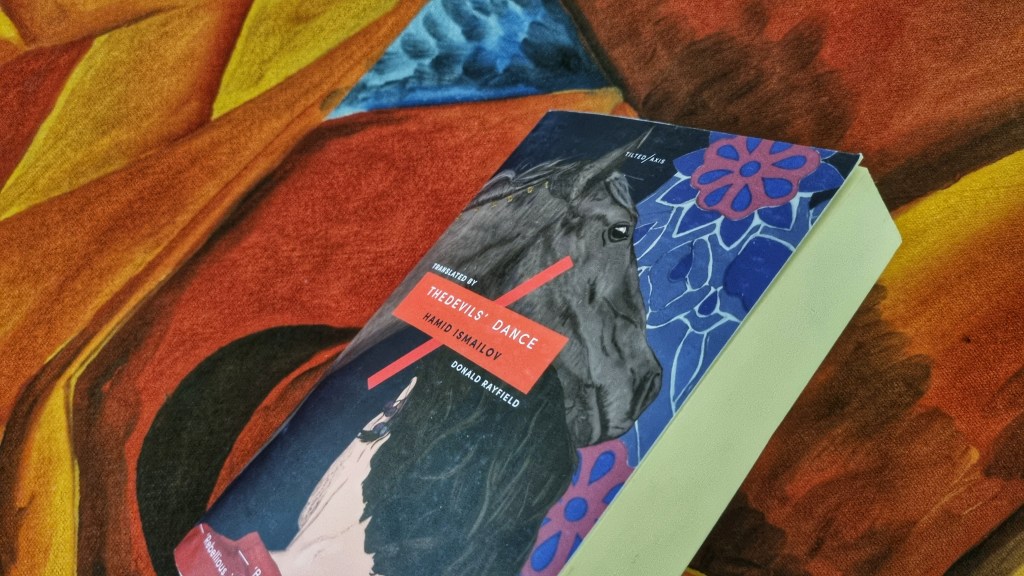
Hamid Ismailov: The Devils’ Dance

Old Uzbek language has one hundred words for different manners of crying, and special verbs for gestures like gazing imploringly into a lover’s face. 

Elif Batuman writes about this in The Possessed, and I reacted to this information as a reader would and thought, “How rich Uzbek literature must be!”

So here I am. Few things are more appealing to this reader than a scarcely-translated and relatively scarcely-read novel by an author whose works are banned in his own country.

It is intense in both intellectual and emotional degrees, and probably not too easy for those who are unacquainted with the Arabian Nights fashion of telling stories within stories within stories. This is one of those jealous novels that demand your full attention, but also one of the most masterful I have read for my Silk Route Reading Project.

The characters are real figures from Uzbek history. It chronicles the arrest of the nation’s prominent writer, Abdulla Qodiriy, by the Soviet secret police in the 1930s. His abduction interrupted the work on what he himself believed would be his greatest masterpiece, a novel about 19th-century poet-queen Oyxon. Abdulla Qodiriy’s manuscripts were subsequently burned and his last novel remained unwritten, but this is where Hamid Ismailov spins an imagined tale of Abdulla Qodiriy who, despite being in prison and enduring its horrors, continues to write the novel in his mind. 

In this book we have Hamid Ismailov telling a story about Abdulla Qodiriy who is telling a story about Queen Oyxon.

“Wasn’t the concoction of endless misfortunes that made up Oyxon’s life a reflection of the nation? …when and how had Oyxon’s tragic life-story turned into Abdulla’s own?” Concerning betrayals or intellectual persecution, perhaps Ismailov’s, too.

Yes, it is absolutely political, but how the Uzbek character is laid bare, their superstitions, their literary traditions, the exceptionally moving ending that had a cinematic quality which inspired a soundtrack in my mind, and most of all the tormenting pleasure of a writer’s thought process and how it is like a dance with jinns; these are the reasons why I think this is the perfect initiation to Uzbek literature — albeit complete with figurative hazing.

Expect no less from a people who has a hundred words for crying.

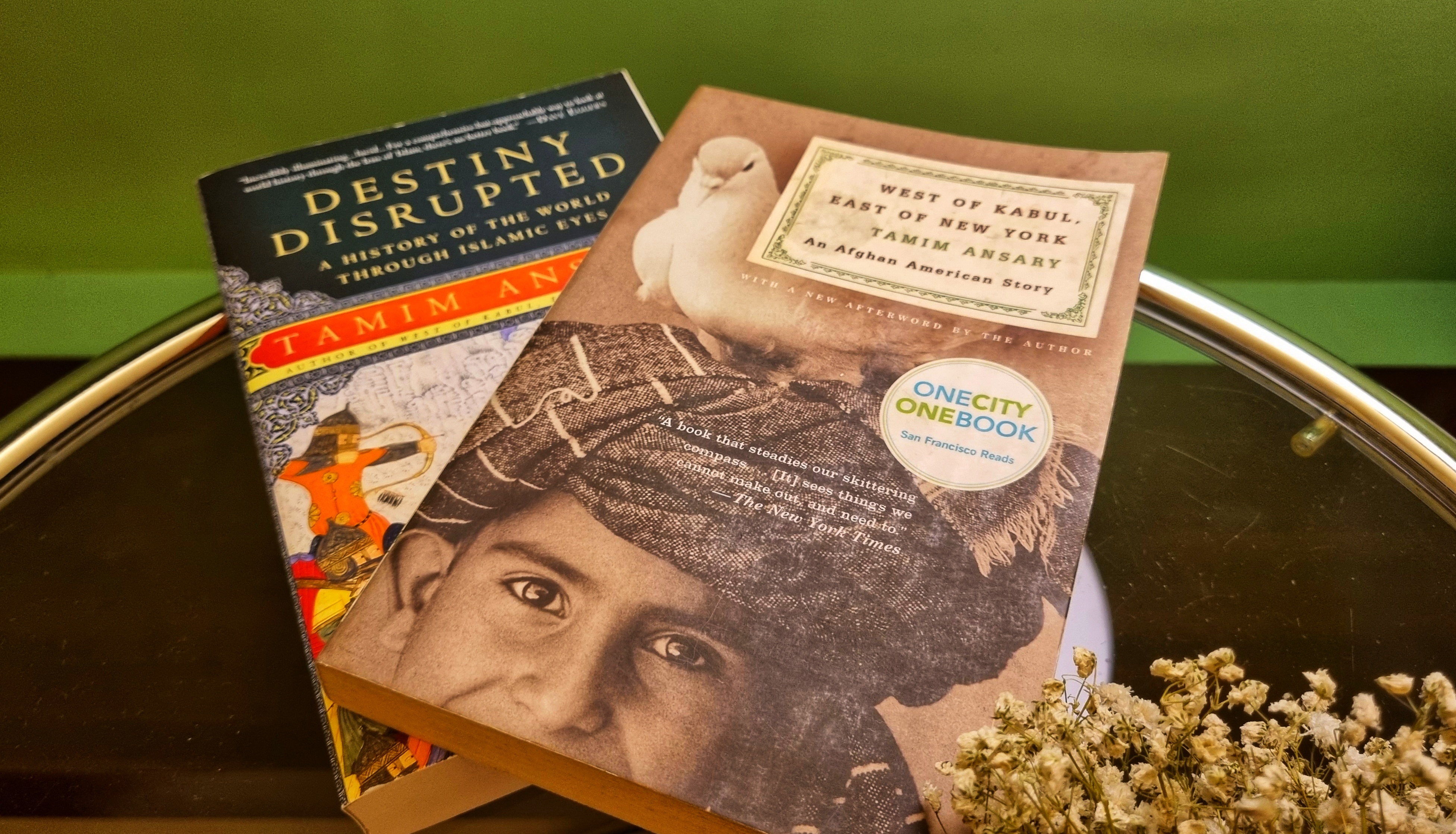
Tamim Ansary: West of Kabul, East of New York

I finished reading this book the day an article from the New York Times came into my inbox: “Afghanistan Has Become the World’s Largest Humanitarian Crisis.”

A passage from page 59 immediately came to mind: “We just shared the towering profundity of our loss, tasting that resignation to fate that came to us from our Afghan soil, for even as children, we knew that loss would deepen us. That’s what it means to be an Afghan.”

Published after 9/11 when it was Osama bin Laden and the Taliban that put Afghanistan on the map of the majority of Western consciousness, and during a time when the world was angry and calling for the bombing of Afghanistan as retribution, Ansary felt an urgency to let the world know that the Taliban and Bin Laden are not Afghanistan. 

“It’s not only that the Afghan people had nothing to do with this atrocity. They were the first victims of the perpetrators… Some say, Why don’t the Afghans rise up and overthrow the Taliban? The answer is, They’re starved, exhausted, hurt, incapacitated, suffering… There are millions of widows. And the Taliban has been burying these widows in mass graves. The soil is littered with land mines, the farms were all destroyed by the Soviets.”

“We come now to the question of bombing Afghanistan back to the Stone Age. Trouble is, that’s been done. The Soviets took care of it already.”

Make the Afghans suffer? They’re already suffering. Level their houses? Done. Turn their schools into piles of rubble? Done. Eradicate their hospitals? Done. Destroy their infrastructure? Cut them off from medicine and health care? Too late. Someone already did that.”

And yet, this memoir gave room to a heart-warming aspect of Ansary’s writing. From his childhood in Kabul and Lashkargah to adulthood in the United States, there was still space for life, love, friendship, and even for travel.

Unfortunately, 20 years after this book’s publication, the dam is breaking in Afghanistan once more.

History is like a river, except people can only live in lakes, so they dam the current and build villages by still waters — but the dam always breaks.”