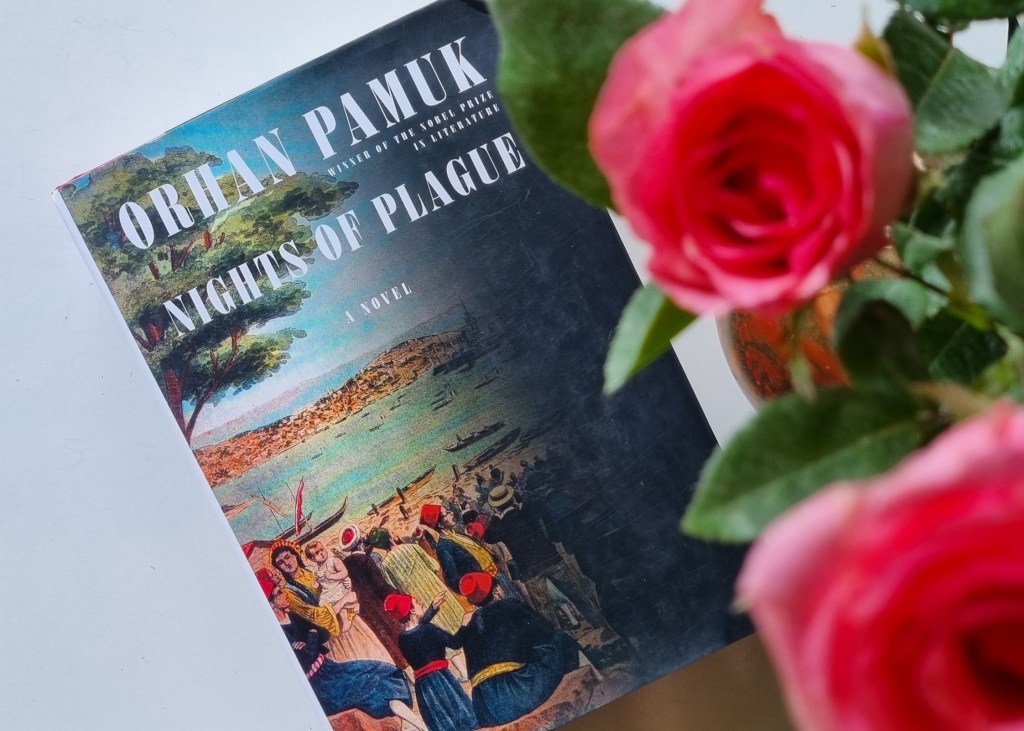
Orhan Pamuk: Nights of Plague

Orhan Pamuk’s longest novel to date unravels with a pace that tends to linger, to wit: it is not for readers who are in a hurry. For that reason, I found it strangely refreshing. Strange because it is a plague narrative that is not meant to be refreshing, refreshing because of the reading experience it provided; defiant of the modern reader’s preference for a literary quick fix, and defiant of our silly reading goals that have more to do with the number of books rather than the languid relishing in an author’s descriptive prowess.

Perhaps I simply feel at home in the expression of an author whose mind is a museum of melancholy, but I am now sensing that part of the allure is in how his books are written for their own sake — written because he felt they needed to be written rather than written for their salability. Isn’t that pure art?

Set in 1901, in the fictional island of Mingheria, “on the route between Istanbul and Alexandria,” it is a curious deviation from a usual Pamuk novel that stays within reach of Istanbul. While Snow is set farther in eastern Turkey, an invented island between Crete and Cyprus is still a surprising backdrop for seasoned Pamuk readers; but only until we realize that the creation of Mingheria allows for a certain leverage and freedom for political criticism. Methinks Mingheria speaks more about Turkey than it does about an imaginary island nation in 1901. 

This novel can teach a thing or two about running a nation during a plague; about epidemiology; how to deal with resistance from different sectors against quarantine measures; how plagues do not distinguish between Christian or Muslim; how failed attempts at containing a plague can fan the flames of a revolution; how revolutions can be exploited; the similarities between solving a murder and stopping an epidemic; and living or loving through the sickness and political ferment. It is about plagues, revolutions, nationalism, the administrative and language reforms that ensue, the fickleness of governments, about the accidents of history, how history is made, and how history is written.

It echoes Camus’ The Plague in the way that the narrator’s significance is revealed only at the end and also for the chilling reminder that plagues reappear throughout history “for the bane and enlightenment of men”.

Unfortunately, man easily forgets, and unwittingly asks to be reminded ever so often.

Sabahattin Ali: Madonna in a Fur Coat

“And what a pity that is: a dash of curiosity is all it takes to stumble upon treasures we never expected.”

This is true for people, and it is true for books including this one.

“For wasn’t there sufficient pleasure to be had in silent patience… When we walked side by side, did I not feel his humanity most profoundly? Only now did I begin to understand why it was not always through words that people sought each other out and came to understand each other, and why some poets went to such lengths to seek out companions who could, like them, contemplate the beauties of nature in silence. Though I did not know what I was learning from this silent man walking alongside me, I was certain that I was learning far more than I would have done from a teacher in years.”

In this little treasure of a book, there are traces of Before Sunrise in the manner of dialogue and hints of Stoner in the life of the main character that, had it not been written decades prior, I would have believed it to be inspired by both. And yet, it could very well be the other way around. That reading Madonna in a Fur Coat brought these special titles to mind should already say enough of its merits.

But we write about what we have read to simmer in the experience. To cling to the characters a little bit more as if to comfort them even though, in truth, it is us who seek comfort. To investigate their strengths and their flaws and hold them up against our own and consider if we would be as strong or as weak, whether we could love as much, love enough, or truly love at all. To write about how this particular book gently chides us for our superficial encounters and interactions, and how it nudges us to search into the loneliness of other people as much as our own. To untangle our thoughts and give them enough time to be rewired with whatever wisdom we just gleaned, because we know it is not exactly in the writing but in the thinking, and then in the living.

Miljenko Jergovic: Sarajevo Marlboro & Ivo Andric: Omer Pasha Latas

She knew there would be pain in these books. But don’t people in the warmest climes imbibe hot drinks to temper the body’s response to heat? By that logic, here she is; steeped in the rich wordscape and sorrowful history of the Balkans.

The first days of November find this reader still silenced by life. A point in which literature remains among the few things left that can coax words out of her.

Sarajevo Marlboro and Omer Pasha Latas fell into her possession around the same time. That both books come from two of her favorite publishers, that the earth tones of their elegant covers match her autumnal soul, that both authors are exemplary, that their stories juxtapose on the same geographical region, were reasons enough to read them together.

Jergović’s extraordinary vignettes is a dip into a sea of humanity and tragedy in the midst of the Yugoslav wars. Andrić, born a century before these wars, whose words seem to flow as naturally as a limpid stream in the Bosnian countryside, write of a different time under the Ottoman rule, but of eerily similar sufferings.

Sarajevo Marlboro, traces of life retrieved from the rubble, fragments that suggest that the real casualties of war are the living; Omer Pasha Latas, unfinished at the time of Andrić’s death. But none of these books leave this reader dissatisfied. It is strangely easy to be drawn into the hypnotic quality of the details.

Both books intimate our need for context and our need for stories if only to make sense of life and divine its purpose; they whisper about the lies of those in power and of fabricated histories; but both beautifully manifest the ephemerality of life.

Andrić’s last word: “Music”. Jergović’s last paragraph: “You can never list or recall the private libraries that have burned down in Sarajevo… But the fate of the Sarajevo University Library, its famous city hall, whose books took a whole night and day to go up in flames, will be remembered as the fire to end all fires, a last mythical celebration of ash and dust. It happened, after a whistle and an explosion… Gently stroke your books, dear stranger, and remember they are dust.”

Dust: Like everything else we deem precious in this world. So while she can, this reader will stroke her books. They don’t always hold the answers, but they hold her, and hold the dusty, broken pieces of herself together.

Tariq Ali: The Islam Quintet

Shadows of the Pomegranate Tree: There is something so consuming about how this first novel of The Islam Quintet commenced: The cinematic intensity of a man crying out, “What is the point of life without our books of learning?” then jumping to his death into a wall of flames fueled by two million manuscripts and the collective knowledge and culture of an entire peninsula!


Eight years after the book-burning, after the confiscation of everything written in Arabic, after 1492, after the War of Granada, after the fall of the last Muslim state in Iberia, this period, this place with its beguiling names — Al-Andalus (Andalusia), Ishbiliya (Seville), Gharnata (Granada), and the Banu Hudayl family come alive through Tariq Ali’s storytelling.

Under the reign of Ferdinand and Isabella seven hundred years of Muslim rule in Spain ended, and so did the coexistence of Jews and Muslims in the region as they were given a choice between conversion to Christianity, slavery, or exile.

“Did I not tell you when they burnt the books that it would not stop at that?”

Expecting the story to be mainly about the clash between religions, I was surprised to find that most of the characters have a secular and progressive worldview. Tariq Ali’s reputation as one of today’s leading intellectuals shines through as the story also becomes an accessible introduction to Islamic philosophers and philosophy. Moreover, the novel does not predictably dwell on praising the former glories of Islam but even remarks on its defeats and self-destruction. 

The straightforward prose that is not without its poetry deceived me into thinking that I would be safe from tears, but this rare and affecting glimpse into the death throes of the Islamic Golden Age left me heartbroken.

I suspect that this was written not out of nostalgia for an age gone by, but as an admonition for the present; and once again, a sobering reminder that throughout history, those who destroyed books never stopped there.


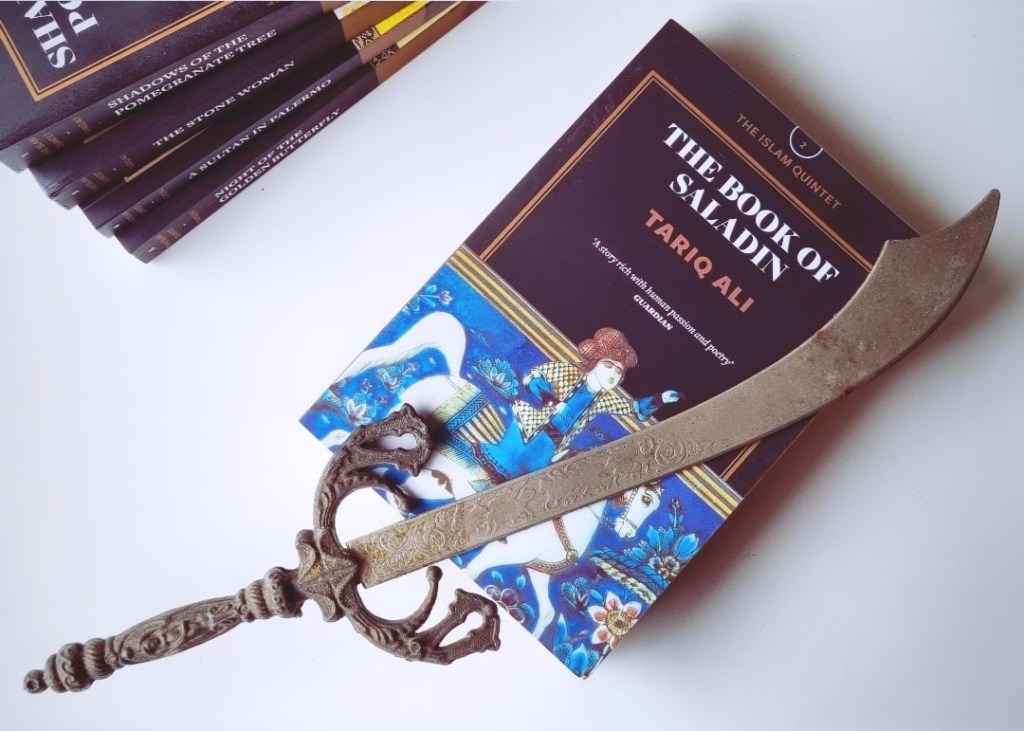
The Book of Saladin: Saladin has long been among the most intriguing historical figures on my list. How he is esteemed in both western and eastern accounts is quite telling of this character.  What’s not to admire in a dignified man who resolved to take Jerusalem from the Crusaders without bloodshed?

I do not think that this second volume of the Islam Quintet was ever intended to be the definitive portrayal of Saladin, however. Humor and wit is not absent here, and I enjoyed the author’s light-hearted approach especially that life has been heavy lately. Through this fictional memoir recounted through a Jewish scribe, Tariq Ali humanizes the legend.

This will not be to the taste of conservative Muslims and Catholics. There is a flavor of heresy against both faiths. The erotic aspect is also unanticipated from a book about the “Righteousness of the Faith”, but I reminded myself that a significant part of classical Arabic literature and the sexual practices of that period are, in fact, not too different from what is revealed here.

But the former should not distract readers from the following:

How this book is a criticism on how women are seen and treated in society. “Her father had given her a manuscript by the Andalusian Ibn Rushd (Averroes), and she talked of him in a reverential tone. She told us of how Ibn Rushd had criticized the failure of our states to discover and utilize the ability of women.”

How this is an exploration on religious hypocrisy, skepticism, and faith. “If heresy is another way of expressing the struggle for the real God, then I am a heretic and proud of the fact.”

How there was peace and respect between Jews and Muslims in Saladin’s court, as seen through the fictional scribe, Ibn Yakub and the nonfictional physician, Ibn Maymun (Maimonides).

How even the greatest men in history are only human.

How truth remains elusive, and yet there are men and women who dedicate their lives pursuing it.

“The service of great kings may carry its own rewards, but the service of truth goes unrewarded and is, for that very reason, worth far more.”


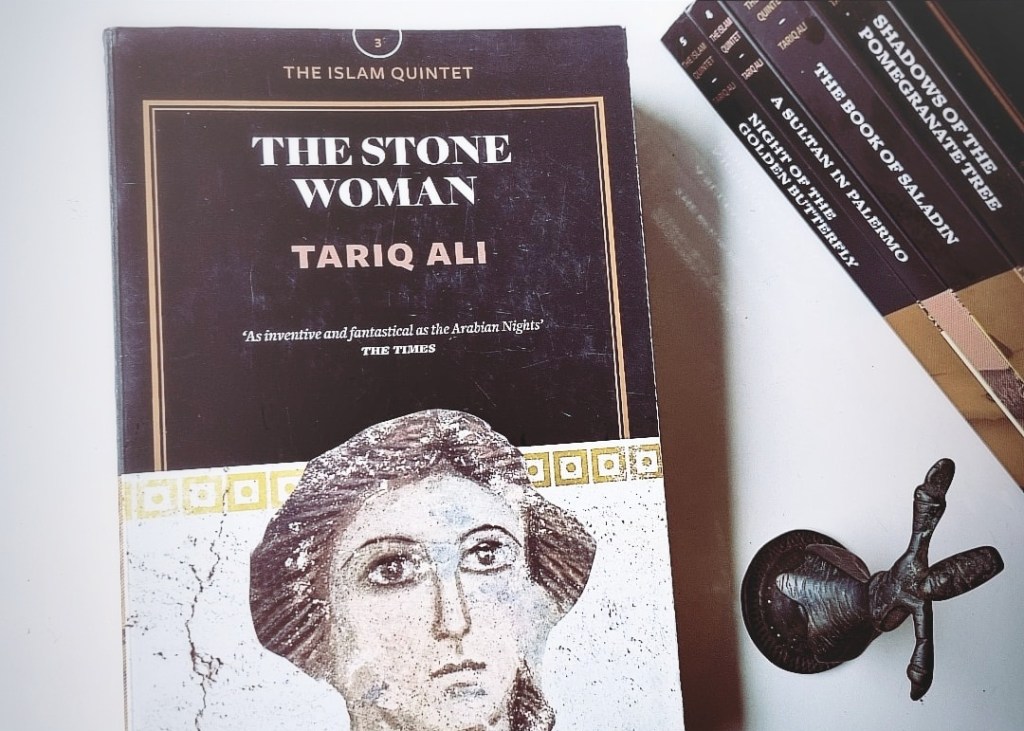
The Stone Woman: It was only halfway through the book when I began warming up to it — when the attention turned more towards matters of state and away from matters of the heart.

I have the highest regard for Tariq Ali and his non-fiction, but there was something unconvincing about the way this book was written in female first person. The first two volumes of The Islam Quintet are remarkable for being among the few books that delve into those particular situations in history; but for this third volume, I have to admit that there are better books written about the decline of the Ottoman Empire.

Set in Istanbul, The Stone Woman is a statue of a pagan goddess at the palace of the descendants of the nonfictional Ottoman admiral, Yusuf Pasha. Throughout the centuries, she has been a mute confidant to members of the family, and it is around her that the stories of their lives unfold. And so does the story of the last days of the “Sick Man of Europe,” the Ottoman Empire.

There are harsh political truths tucked away in this book but I wonder if the love affairs of the characters deflect attention from what is important.

But was this book another way of saying that whether it concerns affairs of the heart or empires, nothing is eternal?


A Sultan in Palermo

“Isn’t the search for knowledge always dangerous?”

Al-Idrisi is one of the illustrious names associated with the Islamic Golden Age. He is known for capturing the interest of the Norman King Roger II of Sicily who commissioned this learned man from Muslim Spain to produce a large-scale geographic work that would become the most accurate map of the known world for almost three centuries, the Kitab Rudjdjar or Tabula Rogeriana, also known as “The Book of Roger”.

Al-Idrisi’s own writings say little of himself and more about his patron. A Sultan in Palermo takes advantage of this and weaves an imagined narrative about al-Idrisi’s life in Sicily. Romantic and political intrigue mingle in this book, but I enjoyed how it is a none too serious pondering on science and religion, and how grains of wisdom can be found in the dialogue. It also revived Palermo in my mind as a prominent trade center between east and west in medieval times and stirred travel lust in me. 

However, I have to admit that I thought this volume could have been so much more! But it also made me realize that the books in this series should not be expected as consummate works but treated as pointers to historical periods and characters that we rarely think about, and considered as cues to ponder on timeless issues that concern our past, present, and future.

These books are not perfect, but in their own way, they light the way.


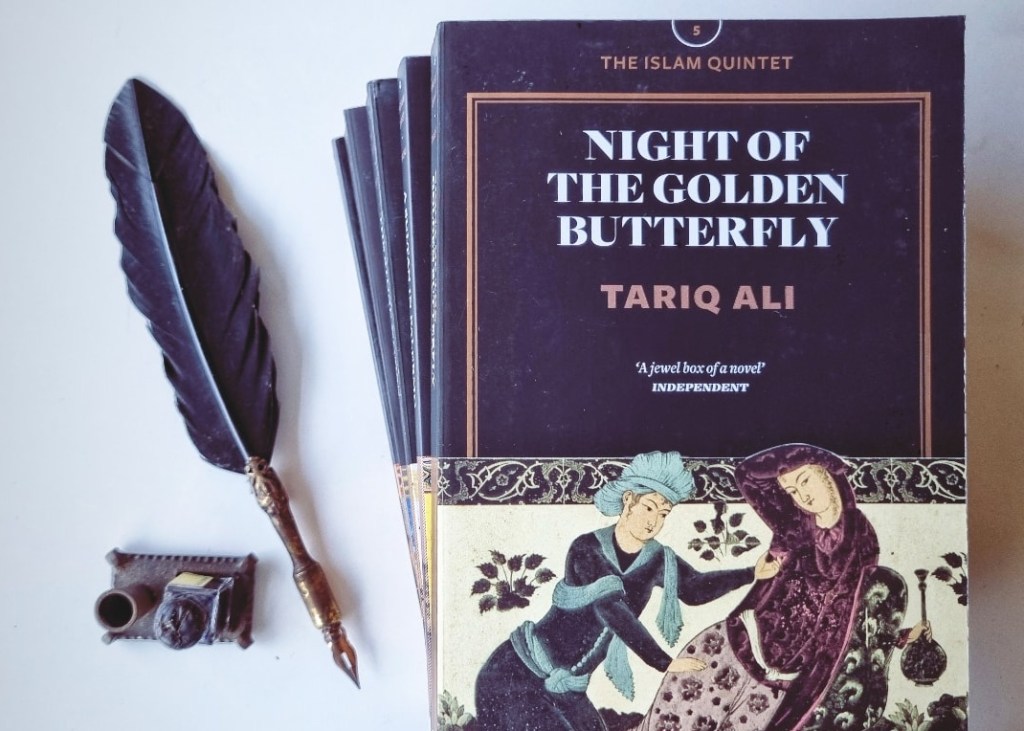
Night of the Golden Butterfly: Well, that was a strong finale! I am glad that I did not allow the third volume and the expletives at the beginning of this one to discourage me from pressing on. I would recommended this to those who would like a clearer glimpse of the political temperature in Pakistan sans the Rushdie-an literary caricatures and magic realism.

No longer set in the past, the reader is brought to twenty-first century New York, London, Paris, and Islamabad.

There is an interesting mix of characters, a generation still experiencing the traumatic aftermath of the Indian Partition and living long enough to witness the Islamophobia wrought by 9/11. One is an artist who expresses the pains of the Partition through his art, and who claims that without the Partition, there wouldn’t have been a need to paint. Another is a descendant of the Chinese Muslim, Du Wenxiu, who led the Panthay Rebellion in Yunnan, and subsequent sultan of the Dali Sultanate for a decade during the Qing Dynasty; thus continuing the vein of the previous volumes by calling attention to history’s forgotten corners of Islamic ascent into glory but also their decline.

A sensitive reader will perceive that the truths here are not merely well-researched but that they are truths the author has lived through. The narrator, after all, is a writer from Lahore.

Unfortunately, these are also truths that this reader is living through. Here is a nation suffering from cancer. Cancer being corruption and its rulers with their ill-gotten gain. A nation supposedly under intensive chemotherapy but there are already signs that the drugs being administered are producing new cancers. Who cannot relate? 

Only the blind. And I can only return to a particular quote from this Quintet’s first volume that, through all five books, through different historical eras, and in different parts of the world, has proved true: “Blind faith would not get us anywhere.”
Magda Szabó

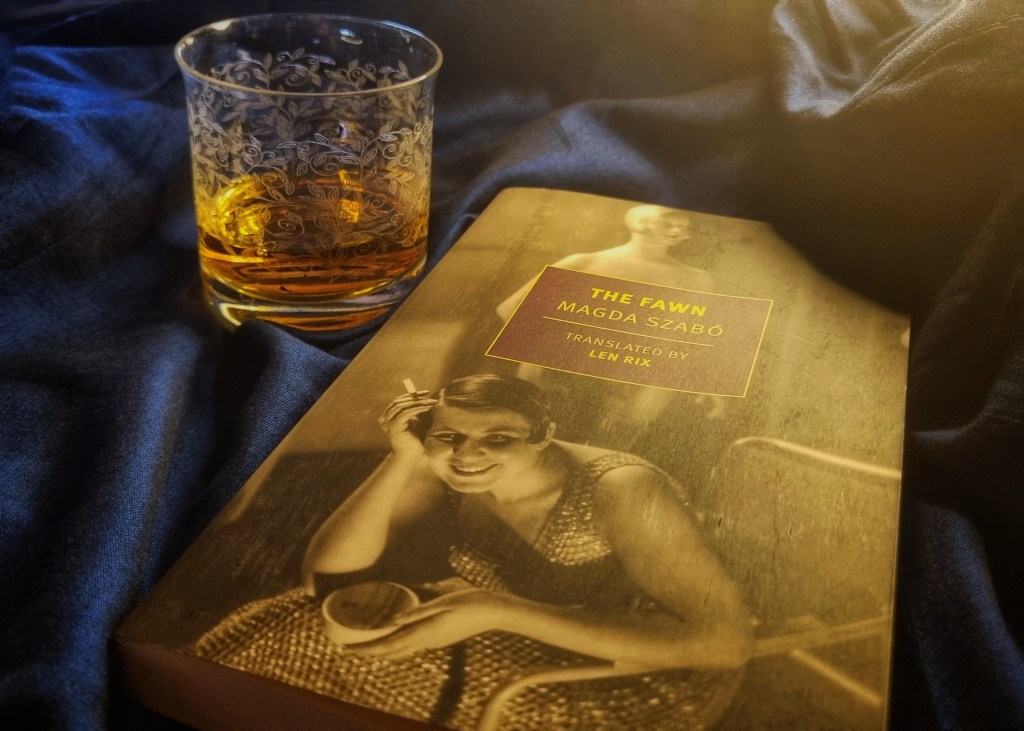
The Fawn

April 18, 2023

“I wanted to be with you sooner…” This first line, a faint melody, I imagine played by a solitary piano. This unwavering, melancholic undertone, suggesting that Eszter Encsy is addressing someone who is no longer in her life.

There is a calm, almost cold, but delicate aching to be accepted and understood. Recollections of childhood come across as confessions and explanations… including that time she did not mean to kill the fawn.

But how did that seemingly dispensable incident earn the title of the book? Perhaps the fawn is meant to symbolize the fragility of youth, and how easily it can be broken.

Magda Szabó, who died with a book in her hand, has bequeathed to the world novels that aim straight for the soul. She wrote of women; women who do not have to be faultless. She did not demand heroics from them or for them to be worthy of admiration or to be idealized. She only asked that they live — live intensely, and learn.

And yet, I did not expect her to go to the extent of Eszter. The moral puzzles are not vague here, it is made quite clear what kind of person we have as a central figure right from the beginning: “I could never have undertaken to be a good girl and never to tell lies…” “I lie so easily I could have made a career out of it…” “I was also laughing at the monster I really am…” “I wasn’t a very nice person and I wasn’t very friendly…”

We immediately get the picture. Appalled, we double-check the synopsis, even though Szabó readers know that her synopses hardly describe what one encounters between the pages. But we read on. Because Szabó is brilliant. Because we suspect that a gut punch or two awaits round the bend. Because oftentimes, nothing is what it initially seems. Because she writes of those difficult spaces between people that most of us are too inattentive, too timid, or too unimaginative to explore. Because we know that behind all her stories is a carefully woven leitmotif of a history she mourns. Because Szabó is always subtly reminding us of consequences, of how we cannot extricate our personal histories from that of our nation. Because she is eternally thought-provoking, and therefore, rewarding.

…and because those elegiac strains from that lonesome piano will linger long after you’ve turned the last page.

Katalin Street

October 13, 2022

Of the invasions of history into our lives; of moral intricacies, those shadowlands between right and wrong; of the love we give, we take, or do not receive — and a fatal overdose of any of the three; of faulty assumptions and miscalculations; of the tangled complexities of relationships between friends, family, and lovers, and even with ideologies and a nation; of the deaths we die before our real deaths; of things we realize too late; of the damage we wreak on those we love; and the irretrievable losses that time inflicts on us… Some books carry with them all that is unutterable and aim straight for your soul, not out of cruelty but out of an earnest art, and disclose that life will silence you… over and over again.

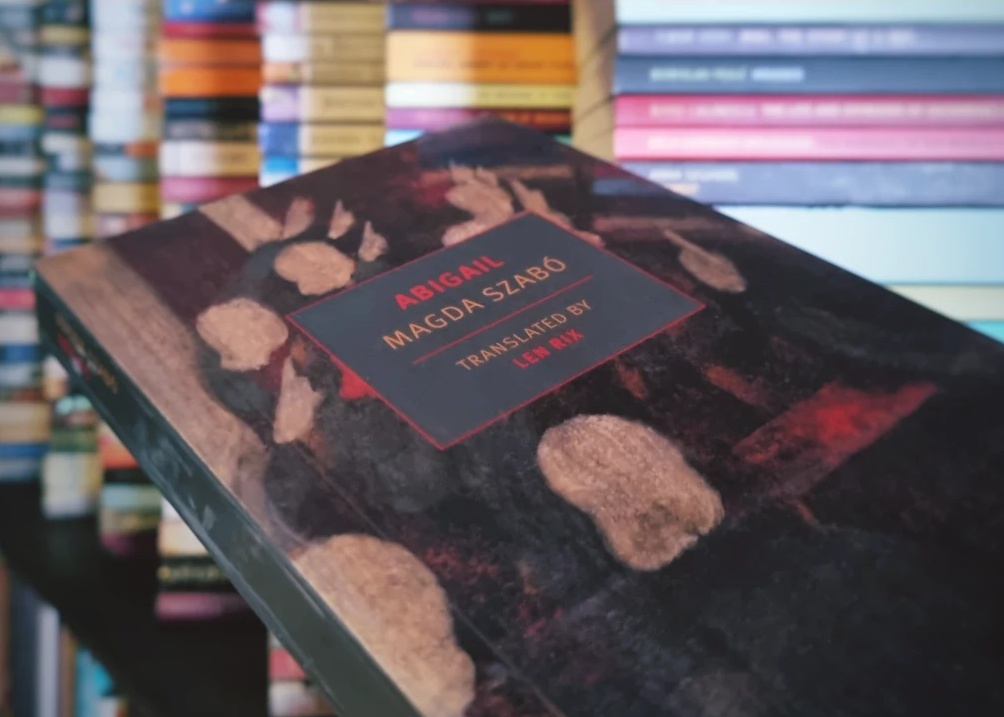
Abigail

September 22, 2022

“In any work of literature the most interesting bits are in the detail,” Kőnig had often said in his lessons. “Be sure to attend to them closely.”

If I had a daughter, she’d find this book in a collection I created for her.

Reading this, she’d be reminded that heroines do not have to be faultless; that the surest assumptions can often be wrong; that no matter how clever we think we are, there are people wiser still; that actions always have consequences; that friendship is precious; that even in the most repetitive of routines and what we deem the bleakest of days, life will find ways to astound or surprise us.

If she philosophizes and reads deeper into the book, as I suspect a daughter of mine will, she will venture to question where childhood ends and adulthood begins, and attempt to come up with answers of her own, or a hundred questions more.

If she develops an awareness of history and politics, as she must, she will be sensitive to Magda Szabo’s subtle activism and glean the lessons of sacrifice and duty.

And I imagine this book — so engaging and difficult to put down — will only fuel the love for reading in her.


Can you tell that I read this through the eyes of a wide-eyed adolescent, and not through the eyes of an adult still haunted by the painful and confounding strains from Iza’s Ballad and The Door but who, nonetheless, acknowledges that Magda Szabó has now become a favorite?

Iza’s Ballad and The Door gnaws at the soul. Abigail educates the heart.

The Door

September 2, 2022

“But a door can hint at so much more.” — Geetanjali Shree, Tomb of Sand

Having come fresh from a streak of world literature for Women in Translation Month, which included Tomb of Sand, I have become more attuned to the implication of doors being more than architectural features. Doors as metaphors for boundaries.

But in contrast to Geetanjali Shree’s doors where, ideally, anyone came and went; Magda Szabó’s door was meant to remain shut. The physical door of the latter was not only a boundary but the framework of a person’s dignity.

Szabó’s Iza’s Ballad turned out to be the most exquisitely written work from my WiTMonth selection, so I wasted no time in taking a peek into this door.

Curiously, Iza’s Ballad and The Door both have characters hired as household help who do not work for the money. One is a minor character in Iza’s Ballad, but in The Door it is the baffling, the imposing, elderly Emerence, one of the two central figures in the story. Adding to the intrigue is the younger and other main character, a writer, the author’s namesake.

Two decades of love-hate relationship yield misunderstandings and reconciliations, but also critiques on each other’s lives, on art, and on their clashing beliefs. At some point, the writer eventually achieves “the prize” and receives a prestigious recognition for her work, but not without the question of what it cost.

There is a challenge in talking about this book without giving away what the author meticulously wrapped in layers, because reading Szabó is like a careful and deliberate peeling of an onion. The core is shrouded in well-executed veneers where even the revelations continue to maintain a mystery that lead toward a confounding finality.

But she is yet another testament to my hunch that 20th century writers remain unsurpassed. Even with a tinge of absurdism, there is that deep exploration into the dark of interior characterization, a delving in the psychological, spiritual, and philosophical condition of its characters, if only to pose the argument of what it is that really matters in life.

Iza’s Ballad

August 18, 2022

 © 2018 MDR
Budapest, Hungary

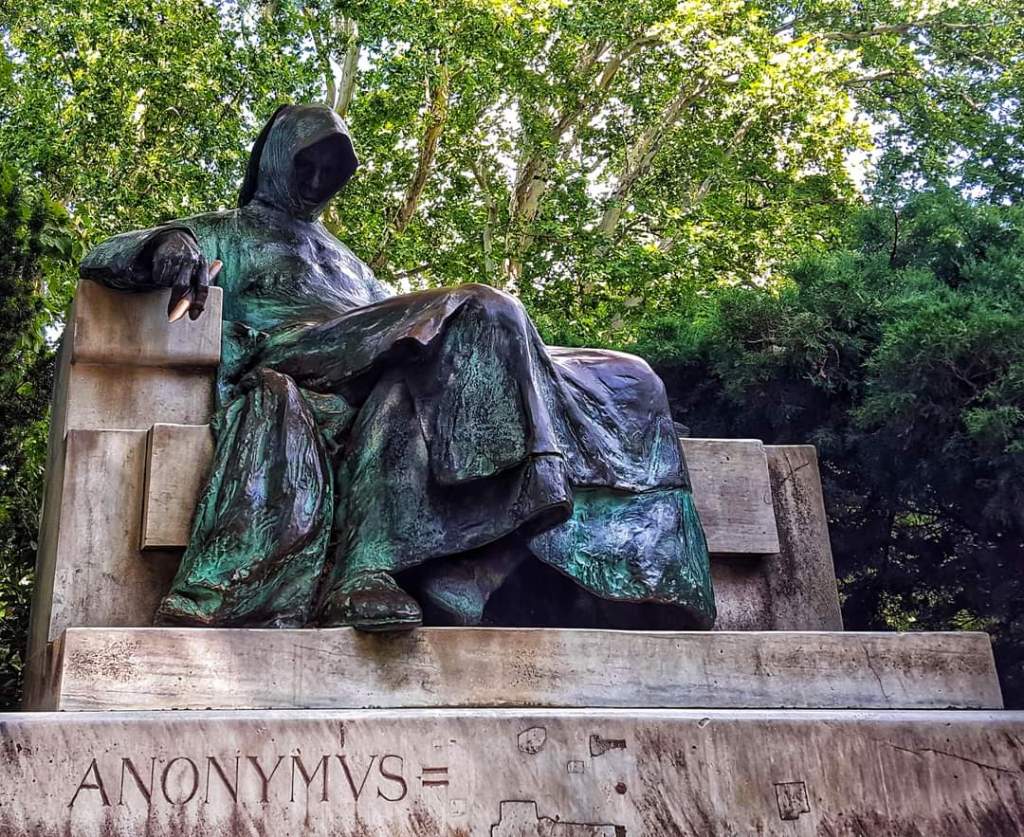
“As he spoke Lidia could see the schoolgirl Iza discussing the future with her father. She saw her as her father described her, as a pint-sized redeemer spreading out her school atlas and examining the map of Budapest because she wanted to see a major city, a really big city, and trying to work out where in City Park the statue of the historian Anonymous might stand. Iza loved the look of that hooded faceless figure. She saw it once when she was a young woman visiting Budapest…” Magda Szabó, Iza’s Ballad

How pleased I was to have identified with Iza so much! There was even something close to a silent pride that I initially felt. It was as if I were reading my own mother’s description of myself how Iza organized her life and her schedule, the tidiness, the discipline, the sense of responsibility, the restraint, her satisfaction in not having to give account of herself to anyone!

But how I trembled, as I turned the pages approaching the finale when I realized that it was because of this unrelenting self-discipline seeping into the cracks of her relationships that led to heartbreaking consequences.

It is for readers with aging parents. It is for every new generation that believes they are so much wiser than the previous one, so practical even in matters of the heart, and yet, unwittingly, so heartless.

It is for societies that reject the past and the old deeming these to be outdated and sentimental, failing to acknowledge that the past and the old hold the clues to the present and the new.

Although set in postwar Hungary, the spirit of this novel is contemporary: the timelessness of its message, its tragedies that are themselves the lessons, will gnaw at my soul for years to come.

Few books leave me feeling defeated. This one did. I felt so helpless under the influence of such simple but penetrating prose.

It is that dazed emotion one undergoes when someone so much wiser with experience sings in a pensive gasp, “I really don’t know life… at all…” Yes, someone like the inimitable Joni Mitchell, only Magda Szabó does it with an outstanding novel that she affectionately hands over to the reader saying, “You really don’t know life… at all…”

And in the presence of such masterful artistry and truth, what else can one do but applaud and weep?

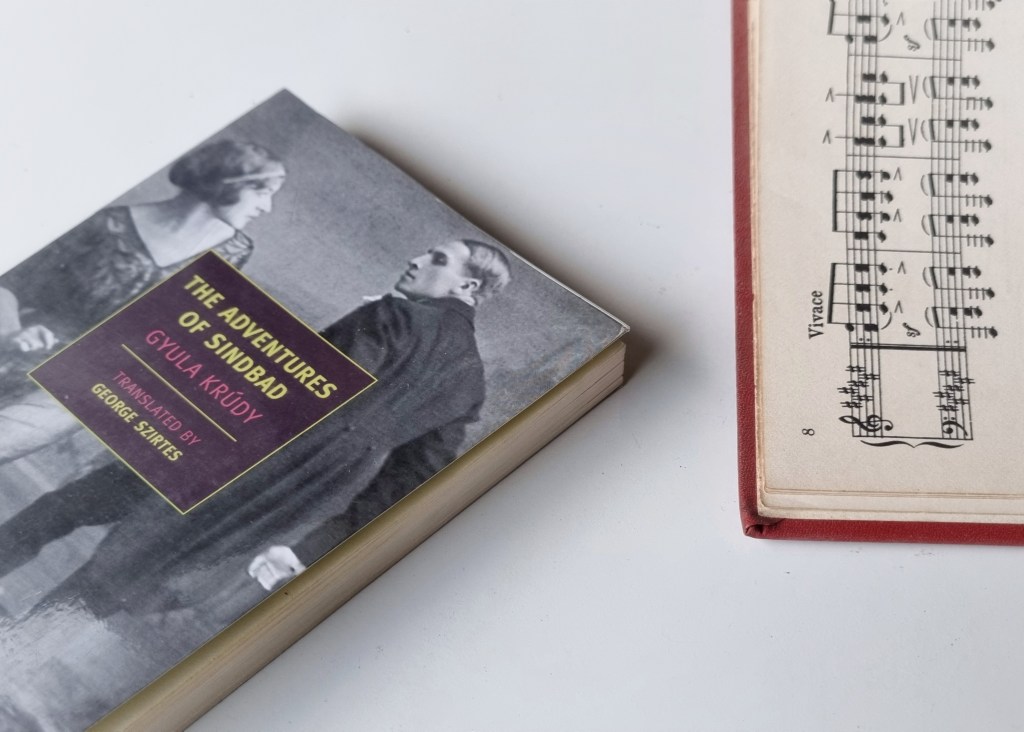
Gyula Krúdy: The Adventures of Sindbad

Having sensed, perhaps, that I am loving the Hungarian bend of my Silk Route Reading Project, a bookseller inserted this surprise as a thoughtful gift along with my book-mail.

With a protagonist named after a character from The Thousand and One Nights, one can immediately sense the literary flavors that meet and fuse along these cultural routes.

Readers would be dissatisfied if they treated this like a novel, however. Although often related, the brief chapters should be read as a collection of stories, each one capable of standing on its own like any story from a Chekhov anthology.

These “adventures” are primarily amorous, and I would have easily dropped this book had I overlooked the sad irony masked behind the comic caprice.

Sindbad speaks beyond the grave, literally. More often than not, he is the ghost of a womanizer who committed suicide and returns to visit the women with whom he has had affairs, whether in his memories or through his phantasmic imaginings. Some of these women, victims of his philandering ways, some seductresses themselves.

“Bearing all this in mind it is understandable that the unhappy young man should have taken his own life. His desires were incapable of fulfillment. It was of no consolation to him that one hundred and seven women had reciprocated his love.”

But having died, Sindbad is described to have grown wise in death. On one occasion, he even laments how the dead see no change in the living.

Even so, it is too late to start again.

“Why can’t you find peace in the other world?” one woman asks Sindbad.

It would seem that peace and love are things you can strive for only in the world of the living.

Antal Szerb: Journey by Moonlight

Have you ever read a novel by a Hungarian author that is not a page-turner?

I haven’t!

“I need a drink. Because I have to tell you who Tamás Ulpius was, and how he died,” on the fourteenth page, is the same bomb of intrigue that Magda Szabó drops on page three of The Door when she writes, “Thus far I have lived my life with courage, and hope to die that way, bravely and without lies. But for that to be, I must speak out. I killed Emerence.”

Intrigue is the paprika that flavors Hungarian pages up until the very end.


I was drawn to this book not for what the blurb promised, but for its writer: Antal Szerb, who sadly perished in a camp during the Holocaust. But like Irène Némirovsky, also a Catholic Jew who nonetheless shared a similar fate despite their conversion to another faith, there is nothing politically blatant in their writings.

There is, however, a certain psychological depth in Szerb’s style that makes it extremely appealing to me. The characters themselves are not that likeable but they seem to represent the state of disorientation of the generation between the first and the second world wars.

“‘There’s nothing wrong with you,’ said the doctor, ‘just horrendous exhaustion. What were you doing, to get yourself so tired?’

‘Me?’ he asked, meditatively. ‘Nothing. Just living.’ And then he fell asleep again.”

Death plays a role in this novel, but so does Life. An existential crisis and unresolved issues of his youth haunt the main character and result in the fickleness of his decisions. He abandons his wife on what was supposed to be an idyllic honeymoon in Italy, and there begins what seems to be a muted exploration into the psychopathology of guilt.


In this edition’s introduction, we learn of Szerb’s fascination for Italy; “its art, its history, its people, its language, its ancient towns and their narrow back streets.” He had lived there as a young man from 1924 to 1929 and the country took hold of him. He returned in 1936, suspecting that it was for the last time. In a travel journal entry, he wrote, “I initially wanted to go to Spain… but it occurred to me that I simply must go to Italy, while Italy remains where it is, and while going there is still possible. Who knows for how much longer I, or any of us, will be able to go anywhere? The way events are moving, no one will be allowed to set foot outside his own country.”

Needless to say, his suspicions tragically proved true, but this final trip to Italy gave birth to this novel, which is a poignant love letter to Italy.

But through all of what Szerb says with clarity or through undertones, what I found most disquieting were descriptions of the generation’s moral insanity, how they viewed war with indifference — “bore the changing times on their backs with astonishing passivity, and lived quite unconnected with their own remarkable history.”

And unfortunately, Antal Szerb did not live to tell the tale, but we all know what happened next.

Farnoosh Moshiri: At the Wall of the Almighty

“What did I do with my hands as a free man?” he asks himself.


A bearded guard leads him from his solitary confinement to another cell. He is on a leash, and he knows that he is in the central prison of the Holy Republic. This is all he knows. Severe torture has made him forget everything else, including his name.

With such a dismal opening, one can excuse why I shelved this, the heaviest volume on my Iran book stack, for over a year despite my deep fascination for the region and its extremely underrated writers.

My personal reading prompt for September was to go through an NYRB editions reading spree. But is there a more pressing reading prompt than the ongoing protests in Iran? I realize that we — as readers, and through our reading choices — have the power to call attention to things happening across the world and to rally with those who need a voice.

I instantly felt it was time to meet this unnamed character who is forced to admit guilt to an unknown sin that, along with his name, he cannot recall. Through daily episodes of psychological and physical torture, he slips in and out of consciousness, reality and dreams. Fragments of his childhood and of his life tease his sanity, the key players of society whose ideologies and actions lead to the revolution take shape in his mind, and the story unfolds. He begins to remember Sahar, a twin sister whom he loved deeply; and by and by his desire to die begins to be replaced by the desire to know what happened to her.

‘Sahar is dawn,’ I say, ‘the end of darkness, when the sun comes out. Daylight trapped in night.’

Categorized as a work of magic realism, I find that the magic realism is, at first, subdued, but one which crescendoes into an anarchy. Readers who are not enthusiasts of the genre should not be dissuaded, however, because we eventually recognize that it is merely our tortured character’s memories and hallucinations merging with reality, metaphors, and childhood fantasies.

This is Farnoosh Moshiri’s first novel, but its depth and calibre surpass many works by more established writers. I have not read a more harrowing ending, but I also have not read a more excellent Iranian novel.

Here is an apt literary device condemning oppressive governments that incapacitate people to distinguish nightmare from reality, and condemning regimes that engender systemic mind-conditioning that edge a nation into losing its identity — those tyrannies that ultimately coerce you into forgetting who you are.


What are we doing with our hands as free men and women; what are we doing with freedom? I ask myself.

First of all, we defend it.

Magda Szabó: Abigail

“In any work of literature the most interesting bits are in the detail,” Kőnig had often said in his lessons. “Be sure to attend to them closely.”

If I had a daughter, she’d find this book in a collection I created for her.

Reading this, she’d be reminded that heroines do not have to be faultless; that the surest assumptions can often be wrong; that no matter how clever we think we are, there are people wiser still; that actions always have consequences; that friendship is precious; that even in the most repetitive of routines and what we deem the bleakest of days, life will find ways to astound or surprise us.

If she philosophizes and reads deeper into the book, as I suspect a daughter of mine will, she will venture to question where childhood ends and adulthood begins, and attempt to come up with answers of her own, or a hundred questions more.

If she develops an awareness of history and politics, as she must, she will be sensitive to Magda Szabo’s subtle activism and glean the lessons of sacrifice and duty.

And I imagine this book — so engaging and difficult to put down — will only fuel the love for reading in her.


Can you tell that I read this through the eyes of a wide-eyed adolescent, and not through the eyes of an adult still haunted by the painful and confounding strains from Iza’s Ballad and The Door but who, nonetheless, acknowledges that Magda Szabó has now become a favorite?

Iza’s Ballad and The Door gnaws at the soul. Abigail educates the heart.

Patrick Leigh Fermor: A Time to Keep Silence

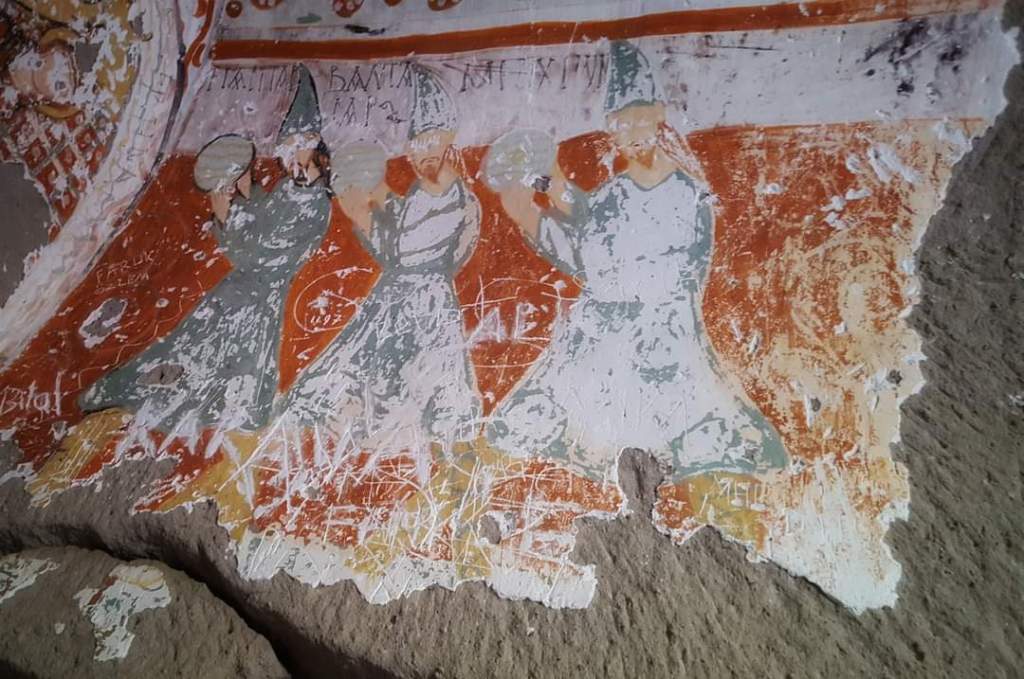
The book had me at its cover; a landscape distinctly Cappadocia, one of my favorite places in the world, however otherworldly.

It had me at the introduction by Karen Armstrong. Who else more suited to introduce such a book?

Patrick Leigh Fermor had me at, “The book was based — whole passages of it word for word — on letters I wrote at the time to a correspondent (whom I later married) without the remotest thought of publication.”

He had me the entire time because reading his prose felt like meditation.

A Time to Keep Silence is a lovely exemplification of that Thomas Merton line I encountered through Rebecca Solnit earlier this year: “The inner journey is the interpolation of the meanings and signs of the outer pilgrimage. One can have one without the other. It is best to have both.”

Known for traveling to Turkey on foot and for being one of the finest travel writers of the past century, this is a record of Fermor’s travels to a more inward direction. Through Europe’s monasteries with their divine libraries, chanting monks, cloistered lives, and vows of silence, and to Cappadocia’s abandoned rock monasteries, we are made recipients of their histories and these letters, too; but most of all, of the contemplation on modern man’s need for silence and solitude.

For someone who recently took three weeks off from social media to retreat from its noise and with only one foot back inside, this book expressed many of my unspoken thoughts, and I can only agree with a constant book friend who thinks that the only problem with this book is that it is too short. 

Here’s to places, experiences, or books where “…the troubled waters of the mind grow still and clear, and much that is hidden away and all that clouds it floats to the surface and can be skimmed away; and after a time one reaches a state of peace that is unthought of in the ordinary world.”