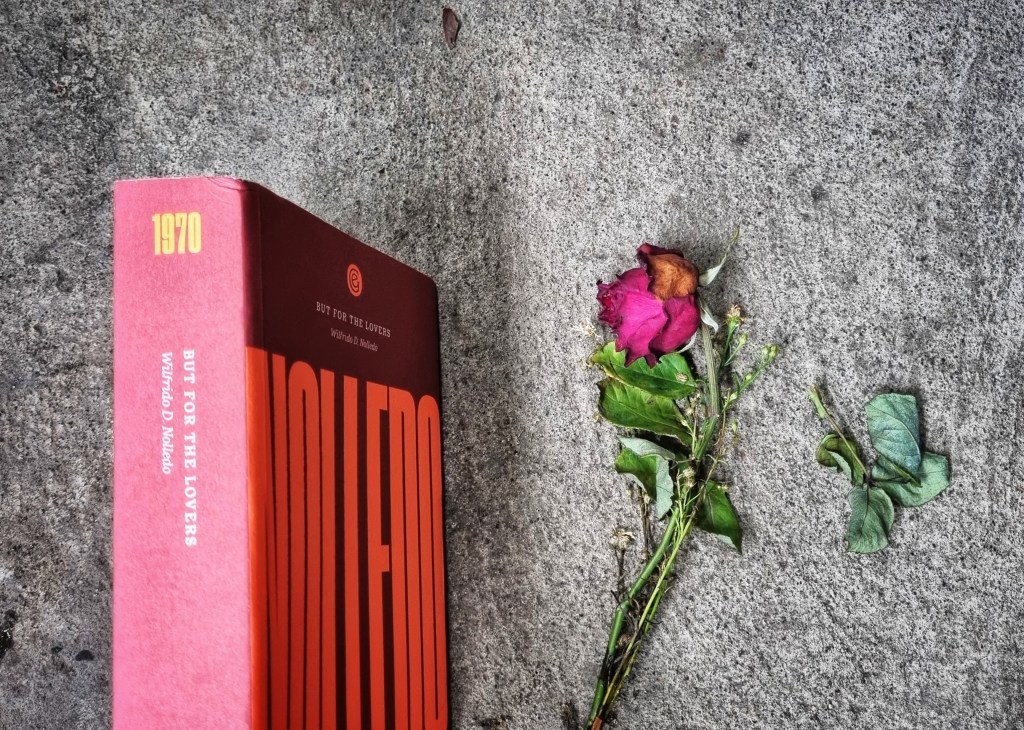
Before Salman Rushdie there was Wilfrido Nolledo. We find the same clever wordplay, but Nolledo reigns supreme in five languages and a couple of Filipino dialects or more, inclusive of Italian musical terms and Tagalog (they did not call this a feat of language for nothing); there’s that humor that catches by surprise when misery is expected; political caricatures and blaspheming characters that provoke fatwas from the high priests of governments; and those vulgarities that examine moral codes as though asking whether we’d also find war and injustice obscene.
Thanks to countless movies, documentaries, and novels, my generation can conjure mental images of what Paris and other European cities looked like in the final days of WWII, but only few can picture the desolation and the confusion of Manila when it was the bomb-ridden chessboard of the imperial powers. Nolledo encapsulates it for us. But one must not expect a literary Amorsolo, because here is a postmodern Hieronymus Bosch.
“And won’t we be doing the reader an injustice by presuming he can’t digest such stuff?” Nolledo asks in response to a suggestion to cut the manuscript to keep readers interested. And so, signifying that it was written not to sell but for art, he gives it to us, gives it to us hard.
It is not going to be everyone’s cup of barako. It is an explosive halo-halo that is difficult to swallow at times. A revolution on one’s literary tastebuds. Before Rushdie there was Nolledo, but I am only discovering this now. It’s time we did.
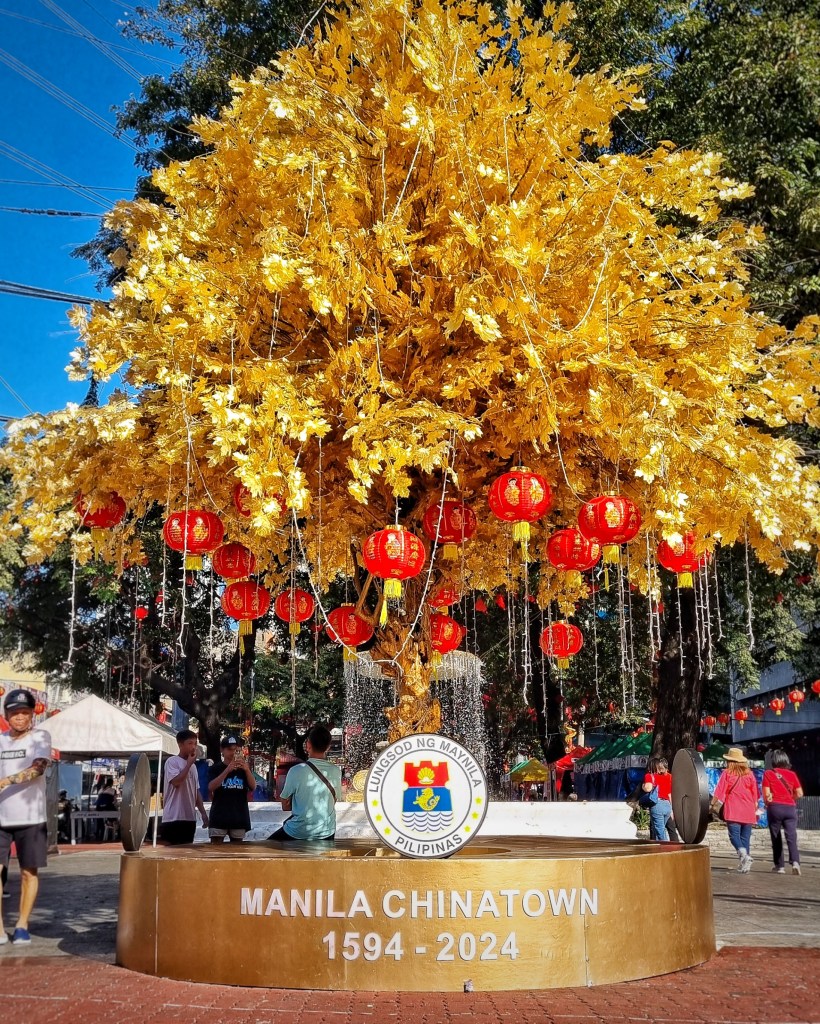
Binondo prides itself on being the oldest Chinatown in the world. Established in 1594, it is, as one would expect, steeped in history and stories.
Today’s walking tour (Jose Rizal’s Binondo) with THE Ambeth R. Ocampo and Ivan Man Dy, explores what is not commonly known to Filipinos: The Manila in Jose Rizal’s novels takes place outside of Intramuros and is instead set in Binondo and neighboring San Nicolas, Santa Cruz, and Quiapo.
From following Ibarra’s footsteps in the opening of Noli Me Tángere to the the site of the opium den where Kapitan Tiago ended up, we walked through Binondo’s tiny alleys (one aptly named Hormiga after the Spanish word for ant), past Antonio Luna’s birth house and the many storied nooks of Binondo.
For the book signing scheduled at the end of the tour, after a filling lunch at Ilang-Ilang Restaurant, I brought my copy of Cabinet of Curiosities — Mr. Ocampo’s latest book, which I read last month and which he signed today after confirming if my first name is really Miracle. It was an apt choice because this tour seemed to be a continuation of the book as we witnessed nonverbal proofs of Philippine culture and heritage. History, in the strictest sense, relies on written sources, but Mr. Ocampo highlights this need to trace the past in other ways when the document trail encounters a dead end. “History not only comes from archives and libraries; sometimes it comes from paintings, music and other forms of art,” and oftentimes, cabinets of curiosities. Binondo is a giant cabinet of manifold curiosities.
“History is not always what we want or how we imagine it,” is another line from Cabinet of Curiosities that rings true.Not only did I discover lesser-known aspects of Philippine history today, but I also learned about our National Hero’s more human side. What continues to leave a pinch in my heart, however, was Mr. Ocampo’s remark on what would happen if Rizal were alive today. Believing that he would continue to voice out what most of us would not like to hear, “He is someone that we would shoot all over again.”
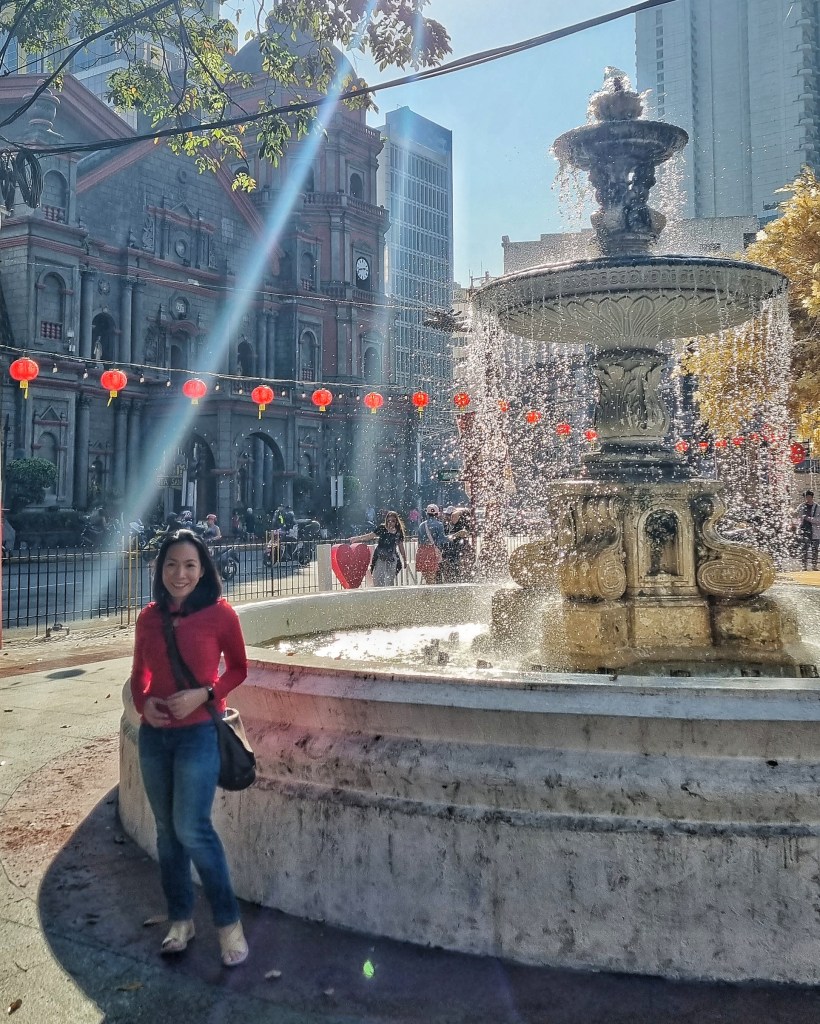
I’m extremely grateful to Gabi for thinking of me when a slot for the tour became available. Being both early birds, we arrived at the Binondo Church an hour before everyone else and we took shade under four hundred years of history. Built in 1596, the original structure has gone through typhoons, the great earthquake of 1863, and the destruction of the Second World War. Its three-phase reconstruction was completed in 1984 and it remains the centerpiece of Binondo. And there we were, two history fangirls, whispering about politics, religion, and life, hushed by the weight of our national history and our personal histories, learning that these difficult topics should not necessarily be avoided, but be discussed with utmost respect and humility. Moreover, it was meaningful to share this experience with someone who understands that one of the best things about learning our history is that you meet pieces of your heritage, you meet pieces of yourself.
“Ikaw si Peter?!” It was more verdict than question.
They insisted he was Peter over and over again as they beat him up mercilessly.
How did his late evening drive to 7-Eleven turn into a nightmare? It all happened so fast.
The last thing he remembered was stopping at a corner to respond to a message when several men grabbed him, one on each arm and one on each leg. They thrust him into a van and assaulted him.
He was only certain of one thing: He was not, never was, never will be, Peter.
He was not Peter, but the men turned out to be cops on a buy-bust operation. And they forced him to admit, forced him to be Peter.
He who was not Peter was locked up for two days in one of those horrible Philippine detention cells until he was able to contact a good lawyer and apply for bail. The cops raised a case against him. They claim he was caught buying drugs from another man. They accused him of resisting arrest. They put him on the watch list.
He is not Peter. I would know. I’ve known him since forever, and he’s been one of my dearest friends almost right from the moment we met as kids. Alongside his best qualities, I know his sins and his faults. The use of illegal drugs is not one of them. But don’t take my word for it. Trust the two drug test results, urine and hair follicle. Both turned out negative.
Despite that, the case continues. It has been going on for over a year. He has had to go through every single hearing, tremble in his seat each time and listen to the cops pile lies upon lies, even on his birthday. There are times when he would be at court by 8:00 a.m. and the hearing would start at 11:30 a.m. Sometimes he would wait half a day, only for it to be cancelled. He who is not Peter has had to put so much of life on hold because he was mistaken for Peter.
It’s unfair. The trauma is taking a toll on him. I laugh with him to get his mind elsewhere, but I cry for him in private. But for some twisted reason, I am grateful.
I am grateful that he was mistaken for Peter on October 2022. The other Peters between 2016 to mid-2022, the real ones and the ones mistaken for them, could not even put life on hold. There was no life to put on hold. Life was not an option.
“Forget that their name is Marcos. Forget that their name is Duterte. Forget that their name is Aquino. Duterte the First begat Duterte the Second. Aquino the Second begat Aquino the Third. Marcos the First begat Marcos the Second begat Marcos the Third, presidents begetting presidents, begetting vice presidents, rotating and revolving and rotating again. Their names live in airports and amphitheaters, on paper bills and street signs, along the highways where the corpses are still being found. Forget the names of their sons and daughters and remember their dead instead.”
“After this time in the Middle East, I learnt what it was like to carry the weight of people’s stories — and the role that journalists play in bearing witness. Our job was to serve as a funnel, a conduit, and in so doing, hopefully remind viewers across the world that we’re all the same. To elicit even a smidgen of empathy for those who might seem different to you.”
A piano student of mine is studying Debussy’s Claire de Lune, and I recently explained that being emotionally connected to a piece makes it more difficult and exhausting to perform, but (un)fortunately, life and music can only be meaningful that way. And it is this balance between technique and emotional connection that we spend our whole lives trying to master.
After reading this book, I realized that the aforementioned is not only true for music, but for journalism as well; and these pages are a record of a journey in probing and understanding that balance.
I love the unpretentiousness of this book. It does not claim to be a powerful journalistic work. Sometimes it tells you something as simple and true as, “The world turns. And that is what matters. It turns — and we humans keep going. Through conflict. Through inhumanity. Through heartbreak.”
Yes, there is nothing in the passage indicating that this Filipina journalist is vying for the Pulitzer, at least with this book; but it is powerful and heartwarming in the sense that it speaks to me of things that I need to take note of, not only when I read it from cover to cover on the most restful Sunday I’ve had in months, but throughout life, especially when things get tough.
That’s what you will find here: Life lessons from a recovering journalist. There is a certain universality to it, for aren’t we all recovering from something?
A writer who merely sits behind his desk or peers at his city through a tinted car window could not have written this.
The person who has written these stories is well-acquainted with the nooks and crannies of Dumaguete (or “Dumaguet” until it becomes “Dumaguete” again in page sixty), he has sought refuge under its acacia trees, he has gone to the market for puto maya and native cocoa, has frequented the chicken inasal places, he has walked its streets, he is burdened by its secrets, he is intimate with its ghosts and the living, and knows his city like a lover knows his beloved’s face.
Wasn’t this supposed to be a collection of fantasy and science fiction? Doesn’t Neil Gaiman’s blurb on the cover further suggest this?
Yes, it is; and yes, it does. But I recognize in this book what I recognize in favorite writers like Khoury, Pamuk, and Mahfouz. Their works are celebrations of their cities. The love affair they have with their cities seep into their stories regardless of genre. And yes, it is a book of heartbreak and magic, horror and fantasy, but look deeper and see that it is a celebration of Dumaguete — it’s landscapes, seascapes, its food, and the loves lost and found on its soil.
Beirut has Elias Khoury, Cairo has Naguib Mahfouz, Istanbul has Orhan Pamuk, Dumaguete has Ian Casocot.
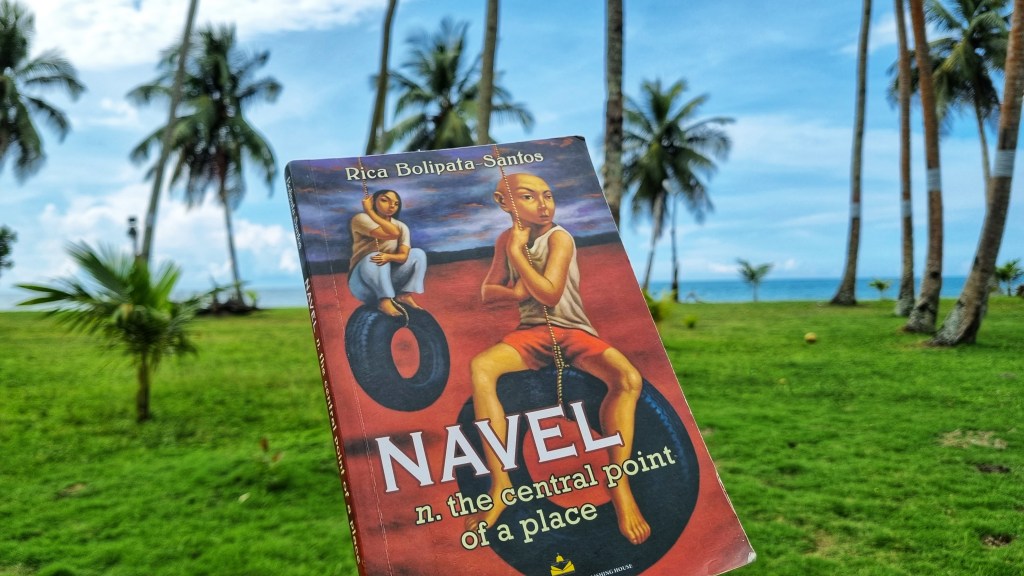
“So, here, my navel. Cleaned and gutted out,” she writes in the preface.
It is pungent with honesty and courage of life as a woman in the Philippines. While motherhood seemed to be the more obvious leitmotif of this compilation of essays (and I have friends whom I think would benefit even more from this book than I will), there was also so much to relate to as a Filipina.
The author, separated from me by so much less than six degrees, comes from a renowned musical family; and somehow, this makes her stories of life and family seem even more accessible to me.
This book is another piece of evidence that Filipinos are some of the best essayists.
She posits somewhere in these pages that writing, aside from being the best solution to finding your way after getting lost, is an added gift to the love of reading. “An added gift to the love of reading.” Isn’t that beautiful?
In fact, it seems to be the strongest takeaway for me. Writing. Even for questions like, “What to do with all the physical evidence of the growth of the heart?”
Writing seems to be the answer, too.
After a whole month of the most uninspired book posts I have ever written, I am grateful to be reminded of this outgrowth of reading, this gift, this home — writing.
These books were read little by little and treated as breathers between larger works, but they are by no means inferior or less meaningful to me. Having finally read the last of the essays, these three are now among the most prized books on my shelf. And I say this with confidence: Filipinos are my favorite essayists!
Using nature as a leitmotif, Aimee Nezhukumatathil’s World of Wonders nudges us to keep our eyes open with childlike curiosity and to keep our hearts soft. It is amazing how she touches on racism, school shootings, climate change, and life’s difficulties without any hint of vitriol. Her writing is refreshing — not like a cool drink on a summer day. Refreshing like a good cry that unburdens the heart and reminds you of life’s wonders. Our hearts need this.
Gideon Lasco’s The Philippines is Not a Small Country is a gift to the Filipino people that we should embrace with gratitude. He shows us the Philippines for what it really is and how deserving it is of new and hopeful eyes. What I’ve written about Pamuk and his relationship with Turkey, I can also write about Lasco and his relationship with our country: He is someone who recognizes a nation profoundly inside out, from its complicated politics to its inner conflicts and issues, its customs and traditions… and offers a viewpoint only a lasting lover can deliver who, after having seen a beloved’s glories and deepest flaws and undesirable secrets, remains and continues to love.
“When we realize that we Filipinos, far from passive victims of history, have always been active in making not just our history but that of the world, we begin to overcome the feeling of smallness that sets back our geopolitical imagination. What our past should give us is not an enmity for those who pressed us but an empathy for those who experience oppression.
What our past should give us is neither a feeling of victimization nor entitlement but a dignity of a people that has suffered much — but has overcome more.”
Even though there is so much to resonate with and quote from Carmen Guerrero Nakpil’s Woman Enough and Other Essays, despite being written between 1951-1961, I’m choosing to end with these relevant reminders as today we witness President Duterte’s final State of the Nation Address.
— “Politics is not all crooks and racketeers and ten percenters. It is not the loud, interminable speeches… or the handshaking in the barrios while a photographer snaps his camera or the number of dancing girls given to each delegate to the national convention. That is not politics, but only its aberrations. Among many of us, those practices have come to mean politics. But they are only the abuse of politics.”
— “This is one of the beautiful paradoxes of politics. Politics may make us, but it is for us to shape it.”
— “You should learn to look at elections, not as contests in goodness or popularity between two or more men, but as a national stock-taking, an occasion for citizens to make up their minds which course of national action to choose over another.”
— “You see how important it is for all citizens to be intelligent, well informed and judicious.”
— “The question is not whether some of us do not love our country or some of us do. The question is in what way we love it.”
— “As a parting favor, I would like to ask you all intelligent women not to take my word for this or for anything. Think about the things we have discussed here, and ponder on them yourself. Discuss them with your friends, seek the opinion of others, but make the decision yourself.”
— “In your intelligence, application, your honesty with yourself, and in your wisdom, will lie the future of the Philippines.”






 The Book-Butterfly