Magda Szabó: Iza’s Ballad

 © 2018 MDR
Budapest, Hungary

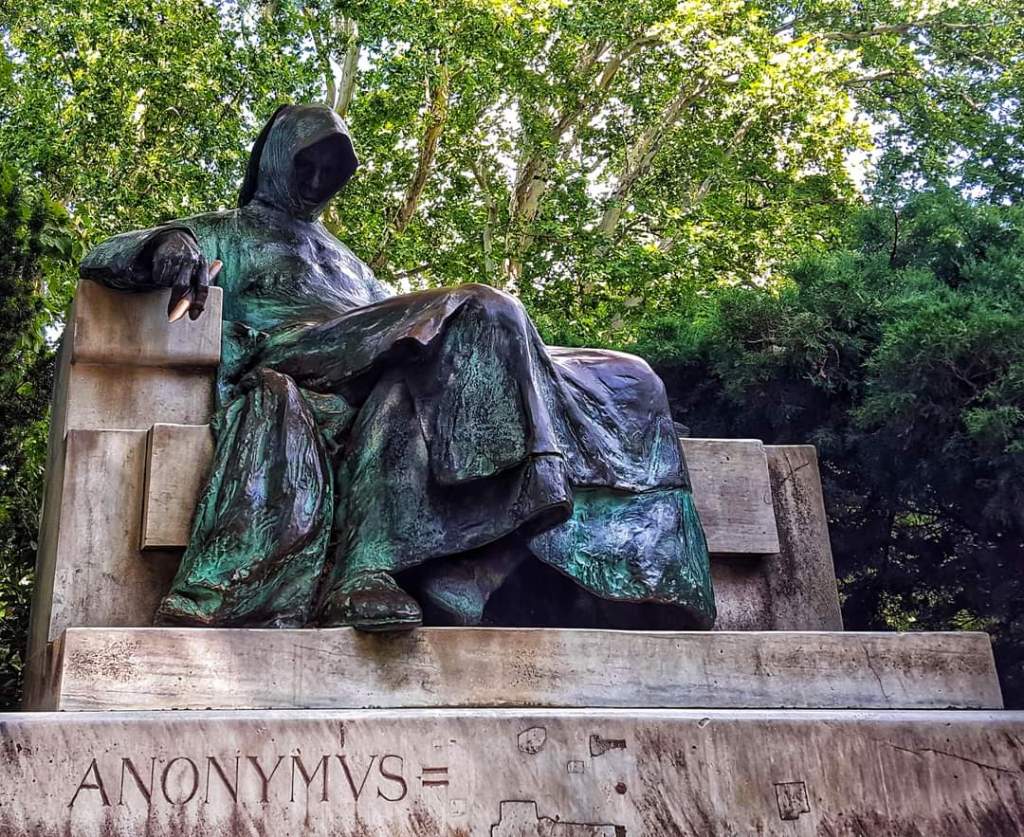
“As he spoke Lidia could see the schoolgirl Iza discussing the future with her father. She saw her as her father described her, as a pint-sized redeemer spreading out her school atlas and examining the map of Budapest because she wanted to see a major city, a really big city, and trying to work out where in City Park the statue of the historian Anonymous might stand. Iza loved the look of that hooded faceless figure. She saw it once when she was a young woman visiting Budapest…” Magda Szabó, Iza’s Ballad

How pleased I was to have identified with Iza so much! There was even something close to a silent pride that I initially felt. It was as if I were reading my own mother’s description of myself how Iza organized her life and her schedule, the tidiness, the discipline, the sense of responsibility, the restraint, her satisfaction in not having to give account of herself to anyone!

But how I trembled, as I turned the pages approaching the finale when I realized that it was because of this unrelenting self-discipline seeping into the cracks of her relationships that led to heartbreaking consequences.

It is for readers with aging parents. It is for every new generation that believes they are so much wiser than the previous one, so practical even in matters of the heart, and yet, unwittingly, so heartless.

It is for societies that reject the past and the old deeming these to be outdated and sentimental, failing to acknowledge that the past and the old hold the clues to the present and the new.

Although set in postwar Hungary, the spirit of this novel is contemporary: the timelessness of its message, its tragedies that are themselves the lessons, will gnaw at my soul for years to come.

Few books leave me feeling defeated. This one did. I felt so helpless under the influence of such simple but penetrating prose.

It is that dazed emotion one undergoes when someone so much wiser with experience sings in a pensive gasp, “I really don’t know life… at all…” Yes, someone like the inimitable Joni Mitchell, only Magda Szabó does it with an outstanding novel that she affectionately hands over to the reader saying, “You really don’t know life… at all…”

And in the presence of such masterful artistry and truth, what else can one do but applaud and weep?

Némirovsky: Fire in the Blood | Gille: The Mirador

Fire in the Blood by Irène Némirovsky

Because I arrange my books based on geography, Nikolai Gogol, Mikhail Bulgakov, Vasily Grossman, and Irène Némirovsky among a few others share a spot on my shelf. They were all born in Ukraine while it was still under the Russian Empire.

Fire in the Blood was thought to be unfinished when Némirovsky died in Auschwitz in 1942. It was only through subsequent research years later that the rest of the manuscript was found and published posthumously.

She wrote this around the time she was arrested and deported to Auschwitz, but there is no pain of epic proportions in this book. There are none of Gogol’s ghosts, none of Bulgakov’s political caricatures, and none of Grossman’s wars.

At the beginning I was so convinced that this was simply a charming picture of rural life in an idyllic French village. She makes the reader believe that, until one surprising revelation after another piles up towards the end, and it reveals its own unique depth.

“Are we not all somewhat like these branches burning in my fireplace, buckling beneath the power of the flames?”

Fire in the Blood, the fire of youth contrasted with the sobriety of old age through the introspection of Sylvio and the lives of those around him leaves the reader with a subtle sting that leads to a silent contemplation on, or the questioning of, passion, love and life.

There may have been none of Gogol’s dark humor, none of Bulgakov’s satire, and none of Grossman’s reportage on tragedy, but perhaps Némirovsky deserves her place alongside these men as someone who lays bare the human heart.

 “No, it wasn’t that simple. The flesh is easy to satisfy. It’s the heart that is insatiable, the heart that needs to love, to despair, to burn with any kind of fire… That was what we wanted. To burn, to be consumed, to devour our days just as fire devours the forest.”

The Mirador by Élisabeth Gille

Don’t you love it when an underexposed book surprises and transcends expectations? I had not anticipated The Mirador to contain this much beauty!

Having read nothing by Élisabeth Gille prior to this, I approached it as someone who was simply curious about her famous mother, Irène Némirovsky.

From her mother’s journals, letters, unpublished notes, “dreamed memories”, and with the help of her elder sister’s own memories and research, Gille recreates a striking portrayal of the mother they lost to Auschwitz when they were mere children.

Regardless of the applause that her novels garnered and despite her tragic fate, it was for her indifference and lack of political sense that Némirovsky was criticized. Gille, however, does not justify her mother’s shortcomings. She allows a beautiful irony to unfold through the pages and writes a lyrical and clearsighted grasp of her forebears, literature, history, and the political arena that surrounded Némirovsky from her early childhood in Kyiv, growing up in St. Petersburg, fleeing to Finland in the wake of the Russian Revolution, and building a life and a successful writing career in France until the German Occupation.

I must admit that I personally prefer the daughter’s writing over the mother’s, and it was saddening to learn that Gille died from cancer in 1996, only four years after The Mirador was published. But I beam at the thought that Némirovsky would have been so proud.

How cathartic it must have been for a daughter to write this! It makes one wonder at the mysterious power of writing — how it can liberate the writer and the subject at the same time, how it can be a simultaneous act of holding on and letting go.

Françoise Gilot | Carlton Lake: Life with Picasso

“When I met Pablo, I knew that here was something larger than life,
something to match myself against…”

“People always ask very bizarre questions like, ‘Why did Picasso like you?’ or ‘Why did Jonas Salk like you?’ So I said, ‘Well, usually, lions do not mate with mice!’”

I took an instant liking to this fascinating woman upon hearing her utter this line with a laugh in a documentary that my best friend shared years ago. Right then and there, I was determined to read Life with Picasso one day.

And here it is. The engaging conversationalist comes out in Gilot’s writing. With a clear and strong voice and nary a narcissistic hint, she does not make the book about her, but brings about an unsurpassed portrait of the man that was Pablo Picasso with all the contrasts of light and darkness. She does not play the victim of an eccentric genius, although the book tells us of how she draws the line not only on canvas but also in life.

I doubt if there can be a more intimate and honest account of how Picasso created, his thought process, his private life, and his artistic and political beliefs. As a rippling consequence, Gilot also paints a profound portrait of an extraordinary era that had a surfeit of literary and artistic personages that shaped history.

Stimulating discussions on Modern Art and its dilemmas, on artistic movements, on technique, color, composition; this account is nothing short of enlightening! There is no shortage of lessons on art, on living, on relationships, and on woman. 

Introductions to Françoise Gilot usually begin in 1943 when she met Pablo Picasso with whom she lived for ten years and with whom she had two children; and continues on the same thread that in 1970, she married Jonas Salk who was famous for developing the polio vaccine.

What I find remarkable about this woman is how, despite the monumental names to which her name was attached, she remained her own person as an artist, and as a woman — who, apparently, just refused to mate with mice!

I am sure she was, above all, referring to an intellectual symbiosis.

Traveling Companions in Uzbekistan

Samarkand, June 2022

On the question of loneliness: “Isn’t that lonely, what you’re doing?”

(I have just returned from a solo trip to Uzbekistan.)

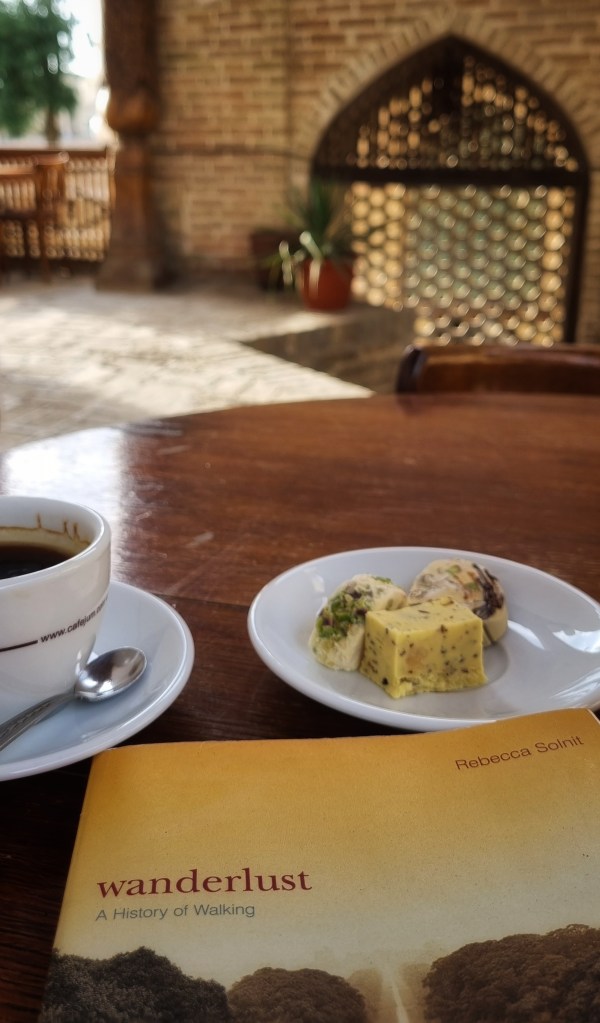
Well, these friends came along for the ride: The Naive and the Sentimental Novelist by Orhan Pamuk, for the long Istanbul flight; The Captain’s Daughter by Alexander Pushkin that was fortunate enough to have a photo at the Pushkin Metro Station in Tashkent and was enjoyed under the shade of the trees of Amir Timur Square; Wanderlust by Rebecca Solnit, read during those days at the Halva Book Cafe whilst waiting for the Bukharan sun to soften; and A Carpet Ride to Khiva by Turkish-British Christopher Aslan Alexander, which accompanied me through Khiva’s storied alleys.

As there is currently so much more outside book covers to commit to paper, I release myself from the discipline of writing book reviews this month. “Regular programming” will resume in this blog in July. Haha 

But I have to mention that Pamuk, who sacrificed painting and architecture school so he could paint with words, taught me a Greek word through this book — “Ekphrasis”. Simply put, ekphrasis is, “To describe something, via words, for the benefit of those who have not seen it.” This inspired me to somehow practice ekphrasis in my little way as I traveled through Uzbekistan, and doing so has allowed me to savor experiences twice.

Pushkin, although political, was not as existentially heavy as Dostoevsky and not as heavy literally as Tolstoy — a purely delightful travel companion!

A Carpet Ride to Khiva seems to have left no stone unturned about Khivan society. It is written in simple prose, bursting at the seams with honest observations, this book is an entertaining overview of the country’s history and politics — which is, perhaps, one of the reasons why the author is banned in Uzbekistan, and why I only brought the e-book with me. I, too, have my own observations, but will keep them to myself for the time being. But it has to be noted that along with reading, traveling is a most comprehensive education on geopolitics, among other things, if one cares to engage and observe.

Solnit, with a title perfect for a trip, shared this Eskimo custom of offering an angry person release by walking the emotion out of his or her system by going in a line across the landscape; “The point at which the anger is conquered is marked with a stick, bearing witness to the strength or length of the rage.”

I, who had no anger to release, did mark the places that bore witness to the strength and length of… something else. I enjoy traveling solo. I would not keep doing it if I didn’t. It is almost like a sort of essential meditation for me and I always go home a better person. I do not feel sad with my own company. But I did mark those places, those experiences so ineffable I could think of only one person to share them with. I would prefer to call it love than loneliness. (But why is conquering anger about letting go and conquering something else the opposite? But I digress.)

As I reluctantly tuck in this unforgettable trip lovingly and a little bit pensively in the folds of memory, I am reminded that the Old Uzbek language had a hundred words for different kinds of crying. And I wonder, what about laughter? What about happiness? 

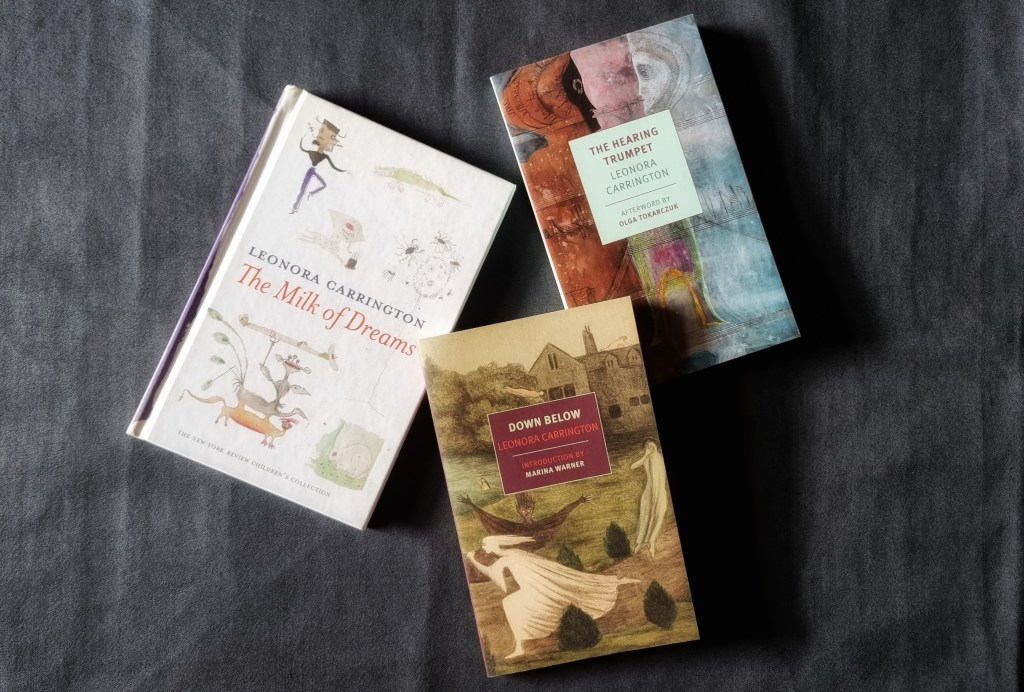
Leonora Carrington: Down Below

Dated 23rd of August 1943, this personal account begins with these plain words: “Exactly three years ago, I was interned in Dr. Morales’s sanatorium in Santander, Spain, Dr. Pardo, of Madrid, and the British Consul having pronounced me incurably insane.”

Down Below is a short but unpleasant read, devoid of the whimsy of her two other books that I read earlier this year. This one ironically chronicles a life’s descent into madness — rationally.

The life in question endured the turmoil of WWII; stormy relationships; the arrest of her lover, surrealist artist, Max Ernst, by the Nazis; rape, abuse, and suffering in a mental institution. 

Reading her writings and looking at her paintings is to catch wind of that unique and bizarre voice from her depths, from down below… an abyss where only painting and writing would provide moments of reprieve. 

Leonora Carrington died in 2011 without knowing that she, along with her otherworldly imagination, would be honored in the art world when the Venice Art Biennale would borrow its 2022 title from one of her books, The Milk of Dreams.

But she did know certain things while she lived: she knew how to shield herself from what she considered “the hostility of conformism”, and gave little mind to what others thought of her… and perhaps, in that respect, she was free.

Simone Schwarz-Bart: The Bridge of Beyond

The woman who has laughed is the same one as she who will cry, and that is why one knows already, from the way a woman is happy, how she will behave in the face of adversity. I’d liked that saying of Queen Without a Name, once, but now… it frightened me, and above all it saddened me, for I saw clearly that I didn’t know how to suffer.

At a time when the “music of the whip” was supposed to be no longer in their ears, the great-granddaughter of a freed slave tells her story; and through her story, the history of their people, the history of their women.

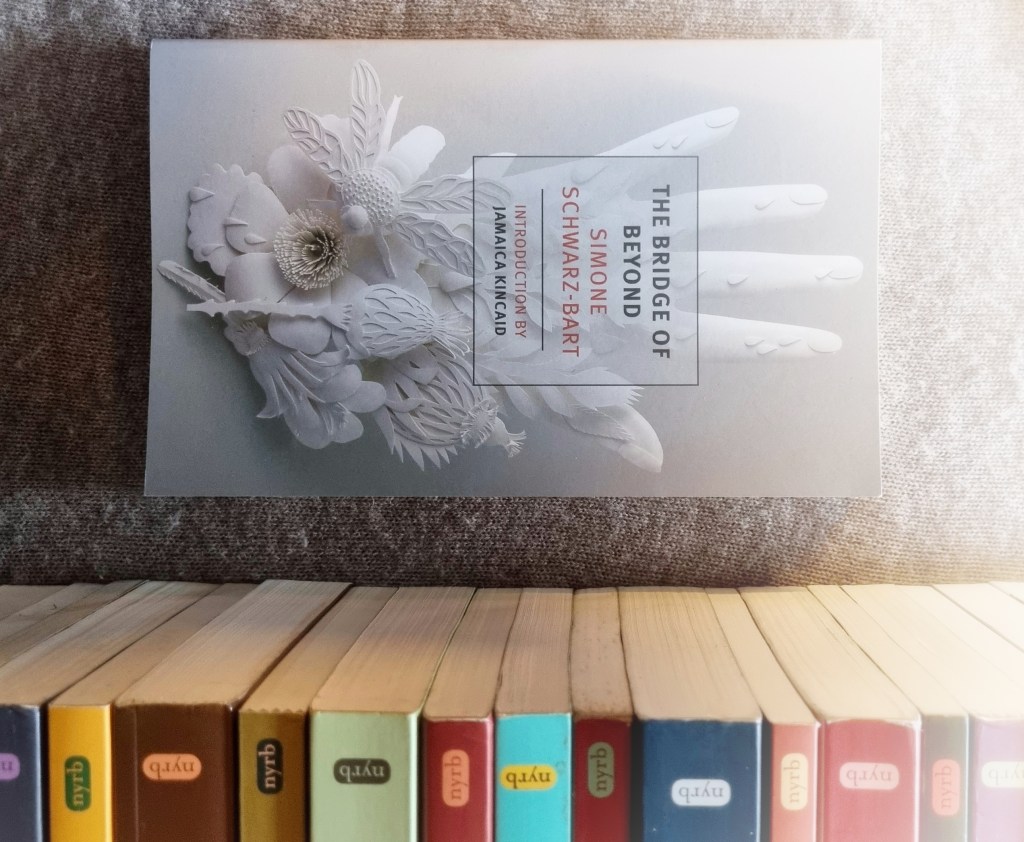
Beyond the beautiful cover designs and the excellent translations of NYRB publications, I am most grateful for how they usually bring together two forces of literature in a single book — Jamaica Kincaid, projected to be awarded the Nobel Prize in Literature in 2021 writes the introduction to this edition of Simone Schwartz-Bart’s potent novel.

The only downside is that if someone like Kincaid has already extracted the essence and bottled it for us in the introduction, my words would immediately pale in comparison and attempting a review would be futile; and all I can do is agree with her when she writes of this book as, “An unforgettable hymn to the resilience and power of women.” Truly a masterpiece, not only of Caribbean literature but also of feminist literature.

Although Kincaid did leave something out for me to realize on my own — that there are many forms of slavery; sometimes it is imposed on people, sometimes it is inherited, and sometimes we impose it upon ourselves. 

There is so much sorrow in this book and I thought of putting it down many times because there was already so much sorrow in the world as I read it. 

But a novel touching on slavery can only ask questions about freedom, the same way a novel about sorrow can only be a contemplation on happiness. And so I read…

Benjamin Labatut: When We Cease to Understand the World

“What was beyond our grasp was neither the future nor the past,
but the present itself.”

It is a mistake to suspect that this book will help one make sense of the world.

I fell victim to this assumption that I even intended this to be my first read of 2022 if not for delayed shipments caused by Typhoon Odette/Rai.

Read from cover to cover within 24 hours, partly because the web Labatut weaves is sheer genius and the subject of quantum mechanics is so fascinating, but also partly because of a panicked speed when what I sought to find — comfort and hope — was still nowhere to be found even as I approached the final pages.

“…it was mathematics — not nuclear weapons, computers, biological warfare or our climate Armageddon — which was changing our world to the point where, in a couple of decades at most, we would simply not be able to grasp what being human really meant. Not that we ever did… but things are getting worse… But it’s not just regular folks; even scientists no longer comprehend the world. Take quantum mechanics, the crown jewel of our species, the most accurate, far-ranging and beautiful of all our physical theories. It lies behind the supremacy of our smartphones, behind the Internet, behind the coming promise of godlike computing power. It has completely reshaped our world. We know how to use it, it works as if by some strange miracle, and yet there is not a human soul, alive or dead, who actually gets it. The mind cannot come to grips with its paradoxes and contradictions. It’s as if the theory had fallen to earth from another planet, and we simply scamper around it like apes, toying and playing with it, but with no true understanding.”

I fell in love with mathematics later in life and even though my dabbling in the subject is nowhere close to the mathematical heights mentioned in the book, I wondered at every morsel. But mathematics, as wondrous and beautiful as it is, has not always been wielded for the good and has often passed through the hands and minds of the eccentric and the disturbed.

Labatut draws us to this dark side. To say that this book is unsettling is an understatement. And reviewing it through my distilled notes highlights the irony and alarm:

  • Mary Shelley, recalled to have warned us through her monstrous masterpiece of “the risk of the blind advancement of science.”
  • Fritz Haber, first to obtain nitrogen, recipient of the 1918 Nobel Prize in Chemistry, accused by his wife of “perverting science by devising a method for exterminating human beings on an industrial scale.”
  • Albert Einstein, who sensed that following one of quantum mechanics’ pioneers Werner Heisenberg’s line of thinking would lead to a darkness that would infect the soul of physics.
  • Karl Schwarzschild, contributed greatly to the general theory of relativity, said to have possessed a “peculiar form of a fear that physics would be incapable of… finding an order in the universe.” “…the most frightful thing about mass at its most extreme degree of concentration was not the way it altered the form of space, or the strange effects it exerted on time: the true horror, he said, was that the singularity was a blind spot, fundamentally unknowable. Light could never escape from it, so our eyes were incapable of seeing it. Nor could our minds grasp it, because at the singularity the laws of general relativity simply broke down. Physics no longer had meaning… If matter were prone to birthing monsters of this kind, Schwarzschild asked with a trembling voice, were there correlations with the human psyche?”

“Don’t they understand that we are rising up only to fall?”

“We have reached the highest point of civilization. All that is left for us is to decay and fall.”

  • Alexander Grothendieck, leading figure in the creation of modern algebraic geometry, withdrew from the world not because he hated human beings but for the protection of mankind. “Grothendieck said that no one should suffer from his discovery, but he refused to explain what he meant when he spoke of ‘the shadow of a new horror.’”
  • Shinichi Mochizuki, awarded the Fields Medal, the highest honor that can be bestowed upon a mathematician, who, after publishing six hundred pages that contained a proof of an important conjecture in number theory, deleted his blog and announced that “in mathematics, certain things should remain hidden, ‘for the good of all of us.’”

Benjamin Labatut, you go to such great lengths if only to say, in this strange and brilliant way, that innocence is bliss?

Leonora Carrington: The Hearing Trumpet

Because I heard about this book through Bjork, my mind immediately appointed her as the protagonist’s voice in my head. If you don’t know how oddly endearing that is, search for that video of Bjork talking about her TV.

So although our main character is a nonagenarian, the whimsical nature of the book had no problem merging with my brain’s choice of voice.

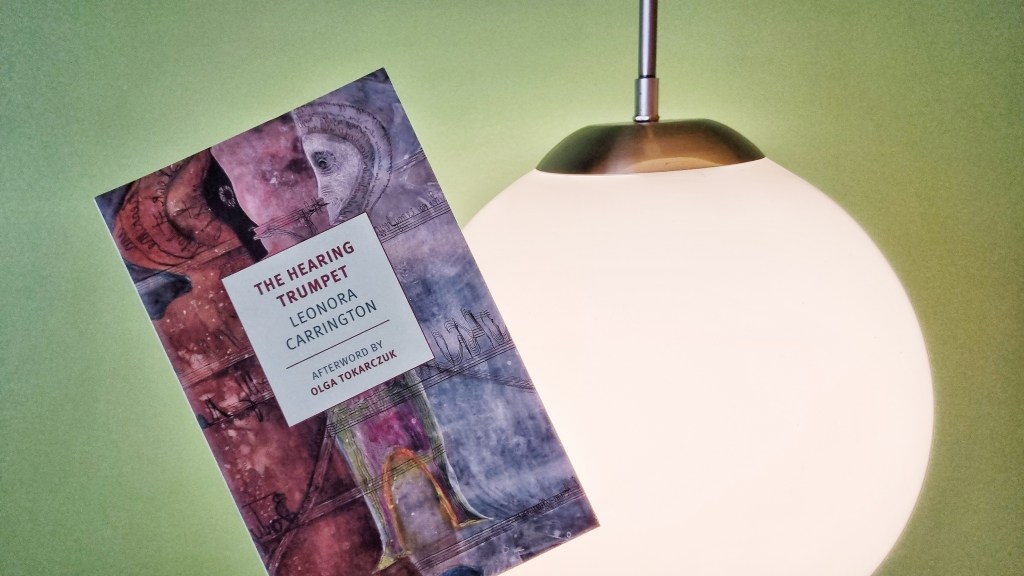
The author was unknown to me, but I soon learned that I am acquainted with her former lover’s art —  that of Max Ernst. Apparently, Leonora Carrington herself was also a surrealist painter; and yes, that is her work on the cover of this NYRB edition.

And as it is with art, it overflows through different channels of your being and explores different media, but it stems from the same soul. Needless to say, this is also a surrealist novel.

And as it is with surrealist art, we find ourselves wading through allusions, symbolisms; reality becomes warped, and rules are contorted, and it certainly gets weird. But as it is with paintings, there are only certain people you would gift with surrealist art, those are the same people to whom you would recommend this book. 

But why do we read novels in the first place? Olga Tokarczuk asks and answers in the afterword — an afterword which, I believe, is already a ratification of her Nobel: “To gain a broader perspective on everything that happens to people on Earth. Our own experience is too small, our beings too helpless, to make sense of the complexity and enormity of the universe; we desire to see life up close, to get a glimpse of the existence of others… we are seeking a communal order, each of us a stitch in a piece of knitted fabric. In short, we expect novels to put forward a certain hypotheses that might tell us what’s what. And banal as it might sound, this is a metaphysical question: On what principles does the world operate?” She continues to write that a nongenre novel like this “passes disturbing comment on things we never stop to question.” As it is with Bjork’s music, so it is with this novel.

There is an act that the protagonist commits close to the end that seemed most monumental to me (a potential spoiler, so I will refrain from mentioning it, although I am up for a discussion with those who have read this) but which Tokarczuk does not mention in the afterword. It is possible that she left it out to urge us to develop our own thoughts. Besides, what is the point of all this art if we don’t?