April in Books

April was manic. It called for two short story collections in sympathy of a fractured attention span.


Silk, Silver, Spices, Slaves, Lio Mangubat First, prepare a cup of tablea tsokolateKapeng barako will do, but because cacao seeds arrived in the Philippines earlier than coffee through the Galleon Trade, I’ll opt for the former to pair with this book. When the chocolate brew is ready, steep yourself in the richness of both history and drink. Read full entry here.


Covert Joy, Clarice Lispector

There’s nothing here that a Clarice fan hasn’t read. And it’s arguably redundant to have this book when these twenty stories have already appeared in that hefty volume of The Complete Stories. But can you resist an edition that has one of your favorite Lispector stories as the titular story of a collection? No.

Because the thing is, reading Clarice is an experience; re-reading her is a veneration. And if I may say so, a none too covert joy. 

“Sometimes I’d sit in the hammock, swinging with the book open on my lap… I was no longer a girl with a book: I was a woman with her lover.”


The Dissenters, Youssef Rakha

“…it is Time that happens to people. We talk about having and saving and wasting it as if it is ours to work with, but really it is we who are time’s property.”

Egypt’s modern history is a story of revolutions, but its revolutions are especially ones that are true to the word’s literal meaning — a return, a cycle, a recurrence. How can one analyze over seventy years of a nation’s tumultuous history from its first president up to the current one? Through a woman’s life, answers Youssef Rakha. “Woman after woman using men’s failures and her body to write the ultimate description de l’Égypte.”


Canone Inverso, Paolo Maurensig

Ironic how I have acquired and read Maurensig’s three chess novels but have only read the novel about music now; but how delightful to discover that Bach’s Chaconne is what decorates the endpaper of this edition and learn that the piece plays a role in the story! As a work of literature, Canone Inverso may not be something one would call a masterpiece, but I cannot deny how this story gripped me from beginning to end. It’s a splendid book to entertain a reading musician!

It is only post-novel that I’m finding out that there is a movie for which Ennio Morricone composed the soundtrack! (And Sophie is played by Mélanie Thierry, who is the girl in the window that inspires the pianist in Legend of 1900, but in Canone Inverso she is the pianist!) All the while I read this, I was really thinking about how it would make a cinematic feat through the vision of an insightful director. I could already hear the dramatic soundtrack and imagine the cinematography, the light coming through the windows as dusk falls on the heurigen of Grinzing, and virtuosic music piercing the air…


To the Wedding, John Berger

What shall we do before eternity?

Take our time.

Not all blurbs are to be believed. But when it’s Michael Ondaatje who writes, “Wherever I live in the world, I know I will have this book with me,” and when a friend whose literary taste is most similar to yours recommends it, you just believe. But prepare to have your heart broken.

How was it possible to write a complexly poignant novel with fragmented vignettes? How does one distinguish between poetry and prose? This book deftly blurs the lines.

The Glass Room, Simon Mawer

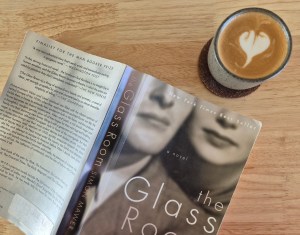
The Glass Room, but not the ‘room’ of English, expresses the author. Rather, the Teutonic ‘raum’ with a broader sense of space. The novel correspondingly hints at architecture while maintaining a broader sense of architecture by concerning itself beyond the architect and the building, and taking into account the lives that inhabit a particular space. Similarly, it is an acknowledgment of how one cannot write about the Modernist shift in architecture without conveying how it is an entire geopolitical and cultural movement. Read full entry here.

Heart LampBanu Mushtaq

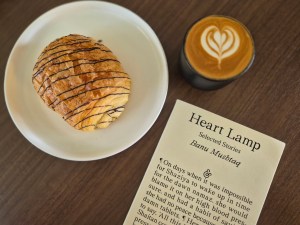
How do you extinguish the light in a woman’s heart?

With these short stories Banu Mushtaq seems to count the ways.

Addendum: Through a Booker discussion with Ex Libris friends a day before the awards were announced, I understood that the winner of the International Booker Prize should define 2025. As touched as I was with this book, I did not think it would fit the criterion. And yet it emerged as the winner: The first book originally published in Kannada (the official language of the author’s state of Karnataka in southern India) and the first collection of short stories to win the award.

Through this I am reminded: Woman is always relevant, and that stories of everyday life are still worth telling.

 Journey to the Edge of Life, Tezer Ozlu

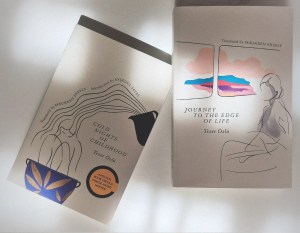
“It is the boundless realm of literature that has set me on this road, through words and beyond them…”

Yes, yes, and yes.


Clarice Lispector: The Apple in the Dark

“It was as if love were the desperate clumsy shape that living and dying take…”

“If it hurts, that’s the way in which things are alive.”

“But what kind of silence did she want to share with him?”

I love you.
Yes, he said after a pause.
Both sat quiet for an instant, waiting for the echo of what she said to die.

The Penguin Classics covers got it right. Surrealist Giorgio de Chirico’s art answers the dreamlike quality of Clarice Lispector’s writing. Not in the sense that reality is bent, but in the sense that the unconscious corridors and objects of the soul, heart, and mind are suspended, isolated, turned over, and perused in poetic abstractions that only she can get away with. 

New Directions Publishing chose to be literal. With an apple. In the dark. And it’s an effective counterpoint to the metaphysical prose that the contemporary reader is more than willing to bite into. “After all a person is measured by his hunger… All I’ve got is hunger. And that unstable way of grasping an apple in the dark — without letting it fall.” But what is this hunger? And what is this apple? 

The book is about Martim, a fugitive who finds his way to an outlying ranch run by two women. There is a storyline. There is suspense and there are surprise twists. Lispector readers know that these are things she does not always give us because she deems them secondary to the subliminal probing of how we love, how we desire, how we live, and how we exist. Clarice for whom writing and being are one and the same thing. But she is especially generous here. This longest novel of hers is not fixed and final. It’s a sentient thing wherein her words and the reader gestate. It is a book only a Clarice Lispector can write.


It’s one of my favorite reading months and I’m thrilled to have kicked it off with Hurricane Clarice. Happy Women’s Month to the women who hunger for life and endless learning!

Natalia Ginzburg

The City and the House (March 2023)

“The telephone isn’t made for saying important things that need time and space.”


Happiness, as Such (August 2024)

The merit of Natalia Ginzburg’s epistolary novels — whether they are wholly or partially comprised of an exchange of letters between characters — is their being time capsules of an age when corresponding through letters was the principal means of remote communication. It was in letters that banalities could be reported as much as consequential information, and people were allowed space to be frank. Letters tracked the growth, or stagnation, of their writers. Self-expression flowed freely where individual and shared stories unfolded. Ginzburg seems to have maximized on the medium and preserved it, foreknowing a time, our time, when letter writing would be at the point of near extinction.


“Happiness… It is like water; one only realizes it when it has run away.”

Voices in the Evening (January 2024)

Of sad loves and sad lives. For me to truly appreciate Ginzburg’s work and write something of worth about it is, perhaps, to regard it as a whole after I’ve read everything she’s ever written.

For now, this book only evokes a specific memory:

He and I had just listened to the whiskey-soaked voice of Tom Waits. We said we did not want to end up like the people sung by the raspy voice.

But we can’t really predict life, we agreed. 

We can only try, I said.

We did not try hard enough.


Mathias Énard: Compass

Mira, keep this close to Luis Sagasti’s A Musical Offering, close to Olga Tokarczuk’s Flights.

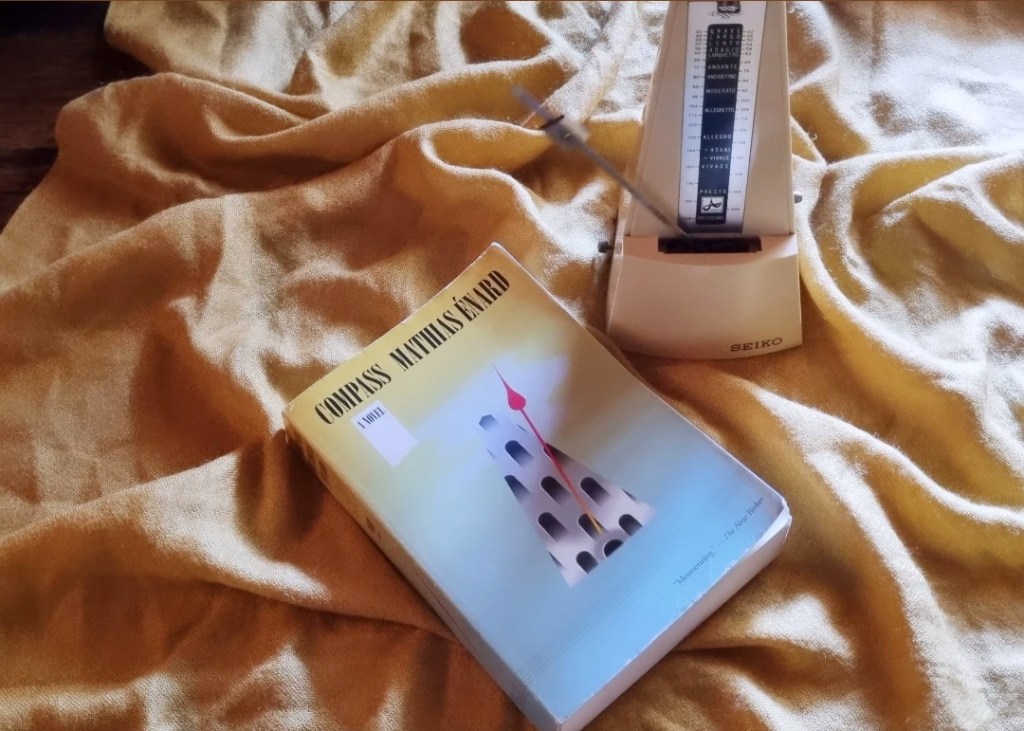
It is, after all, a musical offering — golden threads of western music’s entwining with the orient, of Liszt’s recitals in Constantinople, of how Nietzsche wanted to Mediterraneanize music, of the narrator’s replica of Beethoven’s compass that insisted on pointing east, but most of all because it reminds you beautifully that “music is a fine refuge against the imperfection of the world,” one that describes music as “time thought out, time circumscribed and transformed into sound… time domesticated, reproducible time, time shaped,” and cautions that “life is like a Mahler symphony, it never goes back, never retraces its steps…” but also that “this feeling of the passing of time is the definition of melancholy, an awareness of finitude from which there is no refuge.” Take note of how there is a metronome on the cover instead of a compass. Perhaps because a metronome goes back and forth between directions whilst keeping the music in time. 

It is about flights. A hypnotic trip across east and west, tick tock, east, west, art, love, time, self, other, literature, until they have intermingled and are present in each other, an adventure with Being — of traveling to the lands of your dreams and to your favorite cities, about crossing the borders of genres, art forms, literary forms, and geographical borders, but also flights from sanity, and traversing through memory, history, and dreams, suggesting that “our dreams might be more knowledgable than we.” Flights of flavors, an exotic dish not everyone will love; disturbing at times, an acquired taste with a scent of opium.

But keep this book close to Luis Sagasti’s A Musical Offering, close to Olga Tokarczuk’s Flights, close to your heart. Only you know how much this book means to you. Don’t forget you were constantly wide-eyed with wonder when you read it and you agreed with the following lines. How much you were in need of reading that last sentence!

“Sometimes I feel as if night has fallen, that western darkness has invaded the Orient of enlightenment. The spirit and learning, the pleasures of the spirit and learning, of Khayyam’s and Pessoa’s wine, have not been able to stand up to the twentieth century; I feel that the global construction of the world is no longer carried out by the interchange of love and ideas, but by violence and manufactured objects… You have to have… energy to constantly reconstruct yourself, always look mourning and illness in the face, have the perseverance to continue searching through the sadness of the world to draw beauty or knowledge from it.”

César Aira: The Musical Brain and Artforum

Life is like a book of short works by César Aira; you never know what you’re gonna get. But do try one and surprise yourself. Besides, who can resist book covers such as these? And how cool is that lenticular?

I have now accepted that a César Aira title is a blind date with a story or an essay. There might be some straightforward titles, but they are still no indication as to where his imagination will take you. How could I have known that A Brick Wall would be musings about cinema and childhood memories, or that the most musical one would not be the title story, or that Artforum isn’t exactly about art, or that my favorite line would come from one of the stories that didn’t appeal to me so much?

But then again, he writes in Athena Magazine, “Wasn’t that the definition of literature: the world turned upside down?”

The favorite line: “Elegance is a form of energy.”

The titles I recommend from The Musical Brain, and in this particular order: Picasso, In the Cafe, Poverty, and Acts of Charity.

As for Artforum, I don’t think any other author could be more eloquent about the maniacal acquisition of the printed word, a.k.a book-hoarding:

“One can say that they are only material objects, that other things bring true happiness. But would that be true? There always has to be something material, even love needs something to touch. And in my proceeds of that joyful day, the material was so entwined with the spiritual that it transcended itself, without ceasing to be material…they were paper and ink, and they were also ideas and reveries. They reproduced the dialectic of art itself… material made spirit is the luxurious border where reality communicates with utopia.”

You’re welcome!

César Aira: The Famous Magician

A writer is confronted with a magician who makes an offer of magical powers in exchange for something horrendous — to abandon Literature forever. But having already accomplished much as a writer and a reader, he finds a certain appeal to exploring a new life.

“Perhaps something new was beginning for me, after a lifetime spent among books: a superior kind of reading, the reading of the real world.”

“Still, giving up writing and reading… would leave me without any consolation. It would be like giving up on life itself. On the other hand, I couldn’t help imagining all I could do with the powers he was offering me. Giving up Literature was a terrible wrench; moments before it had seemed unthinkable, and I still couldn’t envisage it. And yet, what was Literature, what had it been for me if not the protean power of transformation…”

He is caught in a quandary that is not too different from the balancing act we readers perform on a daily basis. And isn’t Literature in itself a magical power?

But I’ll stop before I reveal too much of this delightfully quirky little book. Here is a bite-sized literary confection with a hint of caprice, sprinkled with a dash of art, and best relished within the span of a cup of coffee. Expect a philosophical aftertaste!


“Readers seek out fellow readers as much as they seek out books, though fellow readers are, alas, more difficult to find. So we hold onto them for life.”

Isn’t this lovely passage from the book the very reason why I am here writing this and why you are here reading this?

The Beekeepers

Try as we might to hope that the two apian titles speak only of positive lessons from bees — of how theirs is a society where each one functions for the good of the entire colony, of how they continue to work even when everything around them is dying — I am afraid they don’t.

Two beekeepers of neighboring nations; one real, the other fictional. Both written by women; one an Iraqi journalist and poet, the other a novelist who volunteered in refugee centers, herself a daughter of Cypriot refugees.

The Beekeeper of Sinjar is Abdullah Shrem. When DAESH (ISIS) began terrorizing Yazidi communities and abducting their women including Abdullah’s sister, he took advantage of his knowledge of the terrain and select personal contacts to rescue and smuggle women back to safety. Each time he saved a captive woman, he felt that he was also saving his sister.

Among the stolen women was Nadia Murad, who received the Nobel Peace Prize in 2018, the first Iraqi and Yazidi to be awarded the prize.

Dunya Mikhail initially inserts poems into a journalistic approach and recounts distressing interviews with the rescued women who were sold, beaten, and raped repeatedly, but who nonetheless opened up to the author so that she could write about their suffering. “It’s important that your book see the light of day, so that the world will know what’s going on here.” The journalistic eventually veers into the poetic, and I feel that this is one of the books from the region that will endure not only as an overwhelming account but also as a literary work.

The Beekeeper of Aleppo is the fictional Nuri Ibrahim, but through him and the plight he shares with his blind wife, Christy Lefteri expresses the unspeakable realities and consequences of war, of lives ended, uprooted, wasted, abused, and destroyed.

“War,” writes Dunya Mikhail, “comes with various names but with only one face.”

Even though it seems that love and hope is universal, unfortunately, so is war.

“The problem isn’t that the world is going to end, but that it continues without any change.” — Nadia Murad