The soundtrack: Wails from professional mourners and murmurs among the attendees. The novel opens with a funerary scene in Cairo at the turn of the twentieth century.
“God refuses to grace his home,” they whisper of an honored guest in the crowd. “Sad is a house deprived of a son,” they lament. “Not one son!” they say of this man who has four wives but “only” daughters. We enter yet another world where men are favored over women — even by the women.
The titular character who becomes this man’s fifth wife is uneducated and easily swayed by superstition. Although the author treats her with compassion, Zanouba’s unhappy fate seems to me a gentle critique on the tolerance and perpetuation of this mindset among women.
It is unimaginable for me to dethrone Naguib Mahfouz as the king and Nawal el Saadawi as the queen of Egyptian literature, but Out El Kouloub deserves a significant spot in the tapestry of Egyptian literature. I’m delighted with the discovery of this relatively obscure author who sheds light on Cairene women as Nawal el Saadawi does but without the rage, and paints early 20th century Cairo as perceptively as Naguib Mahfouz but through a more feminine frame of reference.
Although Out El Kouloub grew up in Cairo, she fled to France during the Nasser regime. Once dubbed “the richest woman in Egypt” by many, Out El Kouloub’s life is as intriguing as her stories. The work is translated from the French by Nayra Atiya, as all of Out El Kouloub’s books were written in French.
On Women in Translation Month 2023, I write this for the rare reader who tries to look for traces of Out El Kouloub (1899–1968) in #bookstagram and finds only six frames bearing her hashtagged name. This will be the seventh. There should be more.
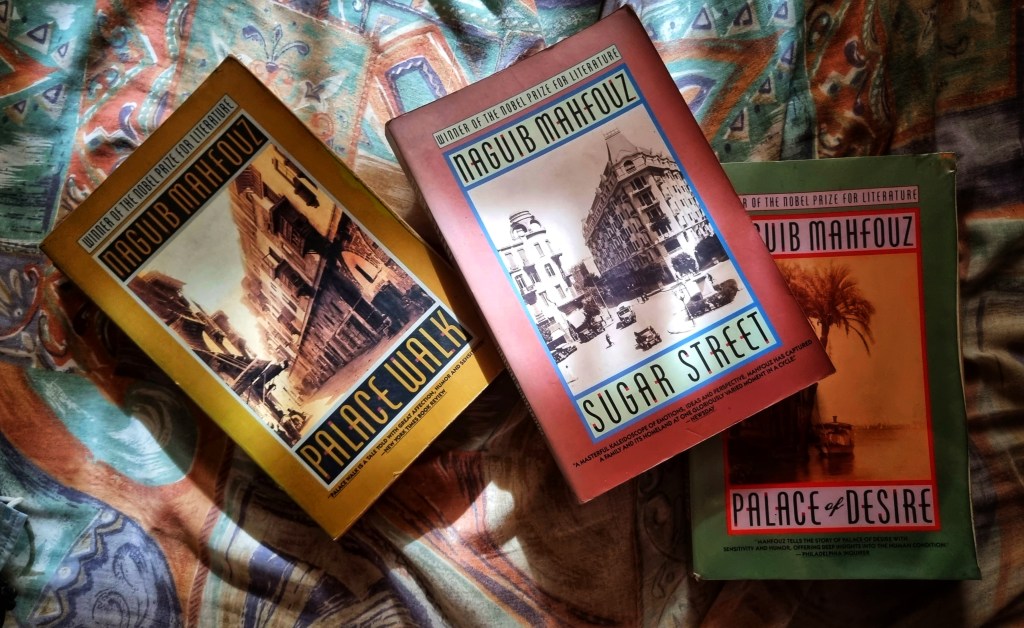
There are better editions with attractive new covers now. Mine still carry the designs of the first American edition of the English translation, but I love how the first volume depicts the antique mashrabiyas of Old Cairo. These projecting windows with intricate latticework are some of my favorite features of traditional Islamic architecture. They seem to me exemplars of how a thing of beauty and tradition can become a refuge or a prison.
And yet, not even these mashrabiyas could shield Ahmad Abd al-Jawad and his family from life, love, death, and a changing world.
It is often said that the Cairo Trilogy is a family saga spanning three generations, from the period of the Egyptian revolt against British colonizers in 1919 to the final days of the Second World War. But it is more than a family saga: It is an astute record of a society, a city, a nation, and a world in transition.
I admit that I found good reason to put the first volume down. I was constantly infuriated by how women were perceived and treated by the male characters, by how men justified their immorality and hypocrisy and got off scot-free while women were punished severely for the most innocent blunders, and by how women themselves accepted this as the natural order of things. Those passages were deeply frustrating.
But Mahfouz’s exquisite storytelling carried me through. He does not so much describe Cairo as transport me there — into the volatile political scene of an Egypt yearning for independence, through its wondrous or disreputable backstreets and alleys, and especially into the women’s cloistered lives so I could hear the questions brewing in their hearts, and eventually to the reflection of society’s gradual development through the change in attitude toward women and their education.
In this trilogy, imperial tyranny juxtaposes with tyranny in the family, but through it all, an incredible compassion and empathy emanates from Mahfouz who humanizes everyone, even the tyrants.
Before I knew it I was at the final page of the last volume, not quite ready to let go, and contemplating on the fact that I had just read one of the finest works of literature ever written.
Cleopatra’s era is closer to the invention of the iPhone than it is to the construction of the pyramids of Giza. A podcast episode that I listened to years ago pointed this out. The fact still blows my mind. When they are mere numbers written on a page, the breadth of history’s timeline cannot be fully grasped until such a comparison is made; but to make those epochs come alive is a task for the novelist.
Khufu’s Wisdom is set in Ancient Egypt’s Fourth Dynasty (circa 2625 – 2500 BCE). Khufu, also known as Cheops, whose sarcophagus rests in the Great Pyramid of Giza, is the pharaoh to whom Egypt’s biggest pyramid is commonly attributed when people are not busy attributing it to aliens. Rhadopis of Nubia in the Sixth Dynasty (circa 2350 – 2710 BCE), gravitates around a courtesan and King Merenra’s short-lived reign. Thebes at War, set between the Seventeenth to Eighteenth Dynasty (1630-1292 BCE), reimagines the interval when Egypt was ruled by the Hyksos or “foreign kings”.
I have read several works by Naguib Mahfouz before taking on this trilogy but have found this to be the easiest to read and the most entertaining thus far! Yes, the language is grand and often pompous — it has to match its pharaonic subjects! Yes, some details can be politically incorrect by today’s standards — the publication years of each volume are as follows: 1939, 1943, and 1944! But reading this made me feel like a very young girl again; one who cannot help but be swept away with abandon into wondrous tales of the past. How I was able to imagine the stories as grand cinematic adaptations in my head is proof of Mahfouz’s skill as a storyteller!
Although the stories are easy to read, they are not as simple as they seem on the surface:
Khufu’s Wisdom is a classic contemplation on fate and duty, and about the difficult submission to both. My favorite passage comes from a secondary character who asks the protagonist, a skilled warrior, “And now, tell me, are you reading anything useful? …the virtuous mind never dismisses wisdom even for a day, just as the healthy stomach does not renounce food for a day… The virtue of the science of war is that it trains the soldier to serve his homeland and his sovereign with might, though his soul does not benefit at all. And the soldier who is ignorant of wisdom is like the faithful beast — nothing more… if the soul isn’t nourished by wisdom then it sinks to the level of the lesser creatures.”
It was in Rhadopis of Nubia where I felt the political undertones deepen. While it also questions the role of beauty and art, there are questions posed to corruption in theocracies and the tricky relationship between king and clergy. In the hall of Rhadopis, politicians and all manner of men gathered to be entranced, even though it was believed to be a most dangerous thing to set eyes upon her. Her tragic tale left me wondering whether she inspired Salman Rushdie’s Enchantress of Florence and whether she is, as I continue to reckon Rushdie’s enchantress, an allegory for Power.
Thebes at War is the most dramatic out of all the three and a most fitting finale for the trilogy. It is where one will find this line, “Weeping is no use, gentlemen. The past will disappear into ancient times and obliteration so long as you are content to do nothing but mourn it.”
Mahfouz is a man who did more than mourn Egypt’s past. He has built literary edifices forged from existing architectural wonders and archaeological findings, constructed modern allegories out of ancient lives and times, and transformed them into timeless political missives — knowing that there will always be those who are doomed to forget and repeat the follies of history.
The best of Nawal El Saadawi’s books are nonfiction: They reveal the devastating truth that her works of fiction are, in fact, nonfiction.
A vital textbook for the study of women in the Arab world, The Hidden Face of Eve has a more academic structure compared to A Daughter of Isis, Walking through Fire, and her numerous memoirs that are deeply personal. But all her writings perfectly demonstrate how the personal is political, and there is not a hint of the tedium that we might encounter in textbooks.
The delicate preface alone is worth mulling over and digesting; and the book, thorough in the history and status of women in Arab society from pre-Islam days until the present, often enlightening or enraging, should be read in its entirety. Whether one agrees or disagrees with any of her views, no one will close this book without having learned anything substantial. Reading this showed me what a shallow understanding I have of the matter despite years of delving in books from Islamic nations.
Nawal does not launch into an angry tirade against religion, however, but against those who use religion “as an instrument in the hands of economic and political forces,” those who use religion to deprive women of knowledge and suppress the search for truth by intimidation and obscurantism, and those who misinterpret religion and utilize it as an instrument of oppression and exploitation. She challenges that religion, if authentic in the principles it stands for, “aims at truth, equality, justice, love, and a healthy wholesome life for all people, whether men or women.”
She criticizes feminism that is merely an instrument of a specific class, or a feminism that is fanatical and superficial, stressing that fanaticism of any form should be opposed, whether it be religion, political, or social. Interestingly, she even remarks on the “modern” woman, “who thinks that progress is manifested by a tendency to show more and more of her thighs,” but remains mentally and emotionally suppressed under the surface.
She therefore makes a stand for the education of the female child, the strengthening of the mind, a free mind, and a heightened level of consciousness, pointing out that a girl who has lost her personality through the throttling of her mind will lose the capacity “to think independently and to use her own mind,” and “will do what others have told her and will become a toy in their hands and a victim of their decisions.” Thus, “the emancipation of Arab women can only result from the struggle of the Arab women themselves, once they become an effective political force.” As we all know, this does not merely apply to Arab women. There is also the acknowledgement that “progress for women, and an improvement of their status, can never be attained unless the whole of society moves forward.”
Can you see why I wished to greet Women’s History Month by reading someone like Nawal El Saadawi? But because there is no one like Nawal El Saadawi, I read her.
“…with liberation they stand to lose nothing else but their chains…”
“No one of you has ever possessed my mind. No one. And no matter how often you took my body my mind was always far away out of your reach, like the eye of the sun during the day, like the eye of the sky at night.”
In a culture where a buffalo has more worth than a woman, where love and marriage are usually two different things, where there is a disconnect between religious devotion and actions, where a man has the freedom to sin but where a woman can get stoned for being a victim, Nawal treads dangerously with her words.
She throws difficult questions at religion and those who are in power, beats us out of complacency and privilege, and prods us to be angry at injustice and inequality.
This is not the book I would recommend to someone who is new to her writings, but a seasoned Nawal reader would probably consider this an epitome of her literary prowess.
Prose-wise, it is the most ornate. Content-wise, it is the most potent. Form-wise, it is her most sophisticated. And wading through all of that is not so easy.
Different narrators for each chapter can get disorienting; the victims narrate, the criminals narrate, so do the dead, and oftentimes about the same incident. When it comes to the women, one can get confused trying to identify whether it is the mother speaking, or the daughter, or the new wife, or the first wife, or the mistress, or the sister. But I realize the intention: It is to emphasize the fact that they are women, and because they are women they suffer all the same.
“Like in The Thousand and One Nights, the beginning of each tale merged with the end of the one which had preceded it, like the night merges with the day…” And then she draws us away from Scheherazade to a lesser-viewed aspect of this literary heritage and culture, and points the spotlight at the hypocrisy of King Shahryar.
Through it all, the question that seems to reverberate loudest in my mind is this: What can we do if the leaders, those who are in power, the ones assigned to mete out judgment, are the perpetrators of the crime?
Because at times, they are. Not only in some culture foreign to us. But in ours, too.
On a flight not too long ago, my plane flew over a coastal region that shimmered in the dark. The sight gave me goosebumps, not from fear but from an inexplicable wonder. The captain soon announced that we were flying over Alexandria.
Alexandria. The city that, even from thousands of feet below, had impressed in me something ineffable; perhaps the tiniest psychic glimpse into why it has forever haunted the Cavafies, the Forsters, the Durrells, and the Acimans of the literary world.
Alexandria, where the legendary library once stood. Or should I say mouseion, as Lawrence Durrell does in Justine? This predecessor of the word museum, a space where the muses reside, the word which led me to ask; what do we keep in the museums of our mind?
The Alexandria Quartet: Justine, Balthazar, Mountolive, Clea — “intended to be judged as a single work,” wrote the author.
Justine is introduced to us by our unnamed narrator, and through a book a former lover has written about her that the narrator is reading. (A subtle acknowledgement to the storytelling traditions of the region? In addition, it should not escape us that the narrator’s criticism of the book within the book has allowed Durrell to present Justine in two different ways. Genius!)
The city is introduced synchronously through Durrell’s inimitable writing — sensual, alive, with a soft texture, “like flesh,” as I imagine Marguerite Yourcenar would say. Even at this point, he already leaves you wondering how it is possible to scrutinize a city and simultaneously dissect relationships so breathtakingly and so profoundly.
The captivating stage is set. There is a rumor of a second World War, there are Jews, Copts, Arabs, Greeks, Syrians, Egyptians, Frenchmen, and Englishmen in a chaotic, amoral brew.
Amid the muddle, Durrell reads your mind and puts your words into the nameless narrator’s mouth, “I tried to tell myself how stupid all this was — a banal story of an adultery which was among the cheapest commonplaces of the city: and how it did not deserve romantic or literary trappings. And yet, somewhere else, at a deeper level, I seemed to recognize that the experience upon which I had embarked would have the deathless finality of a lesson learned.”
You’d suspect Justine is a metaphor for Alexandria, “For she is truly Alexandrian… she cannot be justified or excused. She simply and magnificently is; we have to put up with her.” By the end of the first book, you would think you are well-acquainted with the characters and with the city.
But no, the rest of the Quartet is there to prove you wrong over and over again. Balthazar turns everything upside down. Mountolive, more so. Clea, even more. Balthazar and Mountolive are not sequels; they re-contextualize the same story. Only Clea is a true sequel, but the whole Quartet is meant to shatter you. Even the sympathy that clings to the characters are carefully and painfully peeled away. Indignant, you cannot help but ask, “Why? What for?”
Then you remember, these 20th century writers are psychoanalysts and philosophers. They never let you have it easy. They write to question a reader’s perceptions and assumptions. They are masters in geopolitics and they effortlessly weave its nuances into the places and the characters, and the people become an extension of the spirit of the city, of the age. They write to counter and re-examine memory.
Love? That is what everyone says of this body of work. What hasn’t been said about this elegiac Quartet? This is not an education on how to live or love — if anything, I personally think it is an education on how not to — but I have found that it is an education on the creative process, writing to a point where pain becomes art, a paean to the difficulty of writing about truth, the human heart’s selected fictions and affections, relationships, a city, a person, memory, and their multi-faceted prisms… the very things that we keep in the museums of our mind.
He vanishes. After seasons of being together and meeting every Tuesday in that restaurant overlooking the Nile, Farid does not show up. This catapults Fouada into a period of searching.
“How had a man become her whole life? She didn’t know how it happened. She wasn’t the sort of woman who gives her life to anyone. Her life was too important to give to one man. Above all, her life was not her own but belonged to the world, which she wanted to change.”
And yet, here she was, searching; for him? or has his disappearance allowed her to seek out a purpose and a deeper meaning to life? What was she seeking, exactly?
A female chemist in Cairo’s patriarchal society, Fouada is intelligent and strong-willed. But our daring author impales a nerve here, an uncomfortable truth rarely dissected and examined — the existential torment and uncertainty that women of strong character endure.
A Nawal El Saadawi work of fiction is an art film; one where nuanced cinematography captures the reflection of the sun on a window pane and which slowly pans toward the distress coursing through a woman’s veins; one that disquiets with its honesty; one with an unbroken tension that does not resolve, but bleeds into a thousand provoking questions as the end credits fade into darkness.
I did not read these books. I inhaled the force of these books — in big and small gasps, and by the end of the third, I could not part with her. I do not think I can ever part with her. You would want to acquire her strength through osmosis!
She is my writer. Belonging to that rare breed who, even when writing about their lives, call attention to matters beyond themselves. Her words insist that you come out of her books knowing more about yourself, about the world.
Indeed, there are authors whose lives are as intense as their books. Nawal El Saadawi is one of them. Writer, activist, physician, and psychiatrist, her eventful life consists of losing her job as Director of Public Health Education due to political pressure, being imprisoned as a vocal critic of President Anwar Sadat and released only a month after his assassination, running for the Egyptian presidency in 2004, appearing on an Islamic fundamentalist death list, and being a potential Nobel laureate in literature until her death in March this year.
When it is Doris Lessing herself who says this is something we should all be reading, what is there left for me to say?
Woman at Point Zero & God Dies by the Nile
October 2021
Two books undiluted in their scathing criticism of religious hypocrisy among men and leaders, corruption, and the brutal treatment of women.
Both stories are based on real lives, and these are not to be read if you would rather prevent yourself from seething.
Written in 1973 and 1976, these stories and themes should have already become irrelevant at this point in history.
That they still aren’t is the tragedy.
Searching
April 2022
A Nawal El Saadawi work of fiction is an art film; one where nuanced cinematography captures the reflection of the sun on a window pane and which slowly pans toward the distress coursing through a woman’s veins; one that disquiets with its honesty; one with an unbroken tension that does not resolve, but bleeds into a thousand provoking questions as the end credits fade into darkness.
The Fall of the Imam
August 2022
“No one of you has ever possessed my mind. No one. And no matter how often you took my body my mind was always far away out of your reach, like the eye of the sun during the day, like the eye of the sky at night.”
In a culture where a buffalo has more worth than a woman, where love and marriage are usually two different things, where there is a disconnect between religious devotion and actions, where a man has the freedom to sin but where a woman can get stoned for being a victim, Nawal treads dangerously with her words.
She throws difficult questions at religion and those who are in power, beats us out of complacency and privilege, and prods us to be angry at injustice and inequality.
This is not the book I would recommend to someone who is new to her writings, but a seasoned Nawal reader would probably consider this an epitome of her literary prowess.
Prose-wise, it is the most ornate. Content-wise, it is the most potent. Form-wise, it is her most sophisticated. And wading through all of that is not so easy.
Different narrators for each chapter can get disorienting; the victims narrate, the criminals narrate, so do the dead, and oftentimes about the same incident. When it comes to the women, one can get confused trying to identify whether it is the mother speaking, or the daughter, or the new wife, or the first wife, or the mistress, or the sister. But I realize the intention: It is to emphasize the fact that they are women, and because they are women they suffer all the same.
“Like in The Thousand and One Nights, the beginning of each tale merged with the end of the one which had preceded it, like the night merges with the day…” And then she draws us away from Scheherazade to a lesser-viewed aspect of this literary heritage and culture, and points the spotlight at the hypocrisy of King Shahryar.
Through it all, the question that seems to reverberate loudest in my mind is this: What can we do if the leaders, those who are in power, the ones assigned to mete out judgment, are the perpetrators of the crime?
Because at times, they are. Not only in some culture foreign to us. But in ours, too.
The Hidden Face of Eve
March 2023
The best of Nawal El Saadawi’s books are nonfiction: They reveal the devastating truth that her works of fiction are, in fact, nonfiction.
A vital textbook for the study of women in the Arab world, The Hidden Face of Eve has a more academic structure compared to A Daughter of Isis, Walking through Fire, and her numerous memoirs that are deeply personal. But all her writings perfectly demonstrate how the personal is political, and there is not a hint of the tedium that we might encounter in textbooks.
The delicate preface alone is worth mulling over and digesting; and the book, thorough in the history and status of women in Arab society from pre-Islam days until the present, often enlightening or enraging, should be read in its entirety. Whether one agrees or disagrees with any of her views, no one will close this book without having learned anything substantial. Reading this showed me what a shallow understanding I have of the matter despite years of delving in books from Islamic nations.
Nawal does not launch into an angry tirade against religion, however, but against those who use religion “as an instrument in the hands of economic and political forces,” those who use religion to deprive women of knowledge and suppress the search for truth by intimidation and obscurantism, and those who misinterpret religion and utilize it as an instrument of oppression and exploitation. She challenges that religion, if authentic in the principles it stands for, “aims at truth, equality, justice, love, and a healthy wholesome life for all people, whether men or women.”
She criticizes feminism that is merely an instrument of a specific class, or a feminism that is fanatical and superficial, stressing that fanaticism of any form should be opposed, whether it be religion, political, or social. Interestingly, she even remarks on the “modern” woman, “who thinks that progress is manifested by a tendency to show more and more of her thighs,” but remains mentally and emotionally suppressed under the surface.
She therefore makes a stand for the education of the female child, the strengthening of the mind, a free mind, and a heightened level of consciousness, pointing out that a girl who has lost her personality through the throttling of her mind will lose the capacity “to think independently and to use her own mind,” and “will do what others have told her and will become a toy in their hands and a victim of their decisions.” Thus, “the emancipation of Arab women can only result from the struggle of the Arab women themselves, once they become an effective political force.” As we all know, this does not merely apply to Arab women. There is also the acknowledgement that “progress for women, and an improvement of their status, can never be attained unless the whole of society moves forward.”
Can you see why I wished to greet Women’s History Month by reading someone like Nawal El Saadawi? But because there is no one like Nawal El Saadawi, I read her.
“…with liberation they stand to lose nothing else but their chains…”
Two Women in One
March 2024
While I have long discovered that I prefer the nonfiction writer in Nawal, her fiction remains to be in a class by itself. (That’s why I still continue collecting what I can of her books, fiction and nonfiction, especially now that I’ve discovered these excellent editions — in terms of publication quality and translation — from Saqi Books.)
Two Women in One is not straightforward storytelling. There’s a tinge of Clarice in the free indirect prose. Unsettling, like any piece by Nawal; claustrophobic, and therefore, effective.
It’s not a good place to start if one is new to Nawal. The angst of a young woman, wanting to be an artist but who’s forced into medical school, is potent here.
Conformity becomes suffocating to her, “Everything had the same color and shape to her. All bodies were similar, and all gestures and voices. She found herself running aimlessly… fleeing the deadly sameness within and without…” When she realizes that none of her life is her doing or her own choice, she unleashes a rebellious other woman in her. “Freedom is dangerous, but life without it is no life at all.”
But what I found most powerful in this work is the underlying message that unless Egypt is free, she cannot be free. “Egypt was not free. The chains were still there.” Because when all is said and done, how a nation treats their women, is always a measure of that nation. A woman’s personal freedom is often symbiotic and synonymous with national freedom.
Aladdin asked, “Who are the associates of devils?” “A prince without learning, a scholar without virtue… the corruption of the world lies in their corruption.”
Twenty pages into this book and it already felt like I was reading Crime and Punishment instead of another variation of the Arabian Nights. Apparently, it is not a retelling of the Arabian Nights but a grim sequel drained of the amusement and is, instead, a disquieting political message and social commentary. It weighs heavily.
Right at the beginning it exposes the false piety and corruption of those who are in power when a man of good social standing commits a heinous crime and the poor are arrested, questioned, and accused, whilst the authorities “believe in mercy even when we are chopping necks and cropping heads.”
Characters of the Arabian Nights appear throughout the book, their lives intertwined, but the genies are not the type that fulfill wishes. Some play fateful pranks and some act like consciences, testing the human capacity for good and evil, or calling out the faults of those in power, “If you are called upon to do good, you claim you are incapable; and if you are called upon to do evil, you set about it in the name of duty.” And those in power justify their deeds by saying, “He who’s too decent goes hungry in this city.”
As Scheherazade intimates to Sultan Shahryar, “The fact that stories repeat themselves is an indication of their truth, Your Majesty.” True enough. We see these stories repeated outside of fiction and right smack in the middle of our lives.
This novel is, indeed, a ratification of Naguib Mahfouz’s Nobel Prize.
“Wisdom is a difficult requirement — it is not inherited as a throne is.”
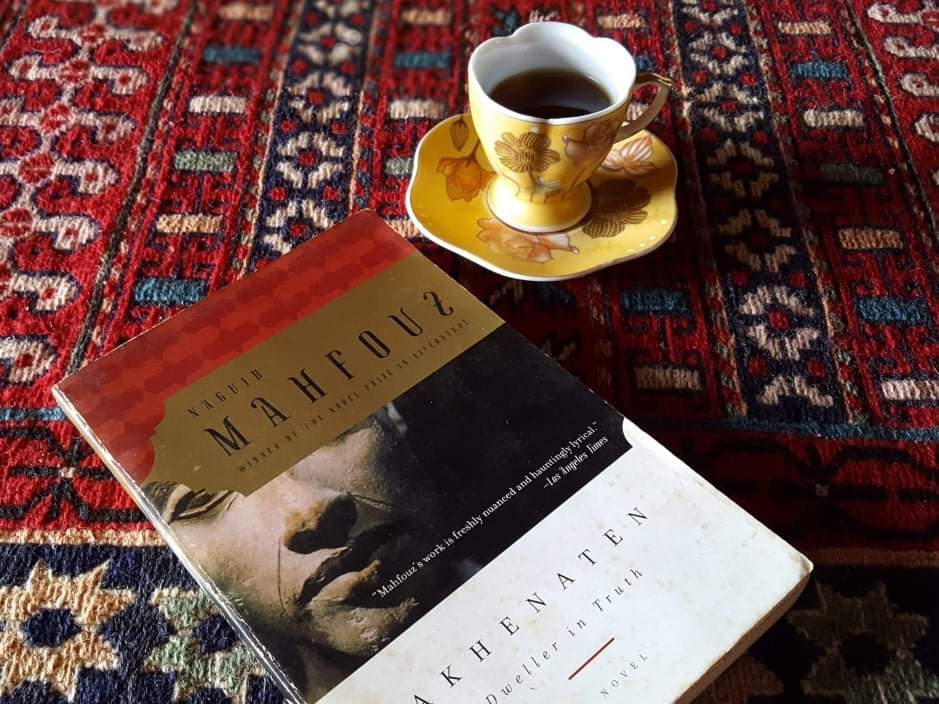
For its size, this book is surprisingly so many things at once! It is a subtle commentary on religion and faith aside from being an inquiry into the life of Egypt’s most controversial pharaoh who was persecuted and known as the “heretic pharaoh” for his monotheistic beliefs.
There is something so simple and elegant in the way Egyptian Nobel laureate Naguib Mahfouz allows Akhenaten’s story to unfold through the fictional narrator’s quest for the truth as he interviews the pharaoh’s contemporaries. Each chapter is named after these characters and it is through them that the reader is shown conflicting opinions and theories about the pharaoh and his powerful and beautiful queen, Nefertiti.
“…to set off along the path of history in search of truth, a path that has no beginning and no end, for it will always be extended by those who have a passion for eternal truth.”
What gave me goosebumps after reading it was when I learned that, out of all the days, The Metropolitan Opera was also streaming the premiere staging of Philip Glass’s Akhnaten! It became a mesmerizing continuation to what I had just read.



 The Book-Butterfly