That’s why we need to read women. What does that have to do with it? It has everything to do with it.
Give me a back cover blurb without telling me the book is by Piñeiro and I would notbe very interested. The descriptions of her novels are unattractive to me, especially if they are about flies and women killing their husbands’ lovers.
But tell me a book is written by Piñeiro and I would read it without even asking what it’s about, even if it seems to be about flies.
Because if you just trust Piñeiro’s storytelling prowess and allow her to take you on a satisfying ride, you eventually learn that when it comes to the word “fly,” there is the noun, and there is the verb, and she’s ultimately writing about freedom.
Predictably unpredictable. She does it again. But this time, more heartwarming than one would expect, and more blatantly feminist.
The phrase “a little luck” appears nine times in A Little Luck, just as “Elena knows” appears nineteen times in Elena Knows.
Does it matter? Not really. Maybe noticing those details says more of me as a reader than Claudia Piñeiro as a writer. One thing is certain; she does not repeat herself because she is running out of ways to say things. She is consistently unpredictable.
Elena Knows, which I read much earlier, is exceptionally written and translated. The choice to highlight a specific incapacitating disease that isn’t limited to women — to effectively confront every reader with what it feels like to lose bodily autonomy — is, I believe, the most impressive allegory that should be uncovered from under the many brilliant qualities of the novel. There are other apt adjectives for Elena Knows, but beautiful is not one of them.
But for the soulful strains of Piazzolla that wove through A Little Luck’s narrative; for how a woman damaged found the first steps to healing through literature; for how I thought it would all be about pain only to discover that it was principally about happiness; and for the sheer deftness of Piñeiro’s writing — this one is beautiful.
Just as unputdownable, just as suspenseful, just as affecting… and this time, beautiful.
“If I were moved by any kind of power at all, it would be the power of revealing absolutely everything about who we are.”
It’s been so long ago that I have started to question whether Florentina Ariza ever truly loved Fermina Daza. And why is it that what remains most vivid in my mind is how Dr. Urbino’s tasseled slippers made Fermina weep after his death?
“The thing you remember most is what has most deeply affected you,” writes Renato Cisneros. Have I always been affected by loss, or afraid of the space of another’s absence?
I apologize. I have fully digressed right from the beginning! Is it even possible to digress right from the beginning?
But what makes the writing and the translation of The Distance Between Us so satisfying is that it is reminiscent of my first encounters with the Latin American greats! (Not the magic realism aspect for there is none of that here, but in the way the writer involves the reader intimately by making the characters palpable, using subtle tricks of psychoanalysis to dig as far within as they can so that one can gaze even into the unconscious.) But perhaps, most of all, for the moving premise of a son writing a book in an attempt to reduce the distance between him and his deceased father, a controversial figure in Peru’s turbulent history: A poignant endeavor to understand who the father really was in order for the son to fully understand himself. To acknowledge the faults of the father so as not to perpetuate them. To break the cycle and confront, rather than escape as his father and forebears have done, “Ignoring and later burying the thornier details of their pasts, they turned their backs on the intrigues of their shared history, embarking on a course of permanent disorientation…”
And yet, “Just as a father is never prepared to bury his son, a son is never prepared to dig up his father.” His undertaking brought to light his father’s amorous affairs; classified information that led him to acknowledge, though he loved him, that his father was a villain, but also that villains are made of wounds; the discovery that his parents were never legally married; and then to write about their love, to legitimize it — “This novel is my parents’ lost marriage certificate.”
Forget my likening Charco Press books to espresso shots. This strong blend of the personal and the political compelled me to spend hours and days between its pages. “Authenticity” is such an abused term nowadays that I sometimes wonder if the overuse has marked the word with a tinge of insincerity. Then comes along a book like this that keeps such doubts at bay. A work devoid of the inauthenticities of biographies and brimming with the honesty that confronts us in fiction.
Was I wrong to wish that the son of a dictator who is now our current president could be more like this son? But I digress, again.
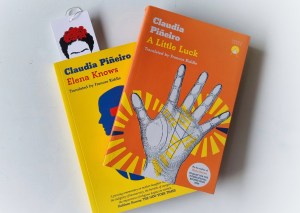
Elena Knows (April 2023) | A Little Luck (November 2023)
The phrase “a little luck” appears nine times in A Little Luck, just as “Elena knows” appears nineteen times in Elena Knows.
Does it matter? Not really. Maybe noticing those details says more of me as a reader than Claudia Piñeiro as a writer. One thing is certain; she does not repeat herself because she is running out of ways to say things. She is consistently unpredictable.
Elena Knows, which I read much earlier, is exceptionally written and translated. The choice to highlight a specific incapacitating disease that isn’t limited to women — to effectively confront every reader with what it feels like to lose bodily autonomy — is, I believe, the most impressive allegory that should be uncovered from under the many brilliant qualities of the novel. There are other apt adjectives for Elena Knows, but beautiful is not one of them.
But for the soulful strains of Piazzolla that wove through A Little Luck’s narrative; for how a woman damaged found the first steps to healing through literature; for how I thought it would all be about pain only to discover that it was principally about happiness; and for the sheer deftness of Piñeiro’s writing — this one is beautiful.
Just as unputdownable, just as suspenseful, just as affecting… and this time, beautiful.
“That’s why we need to read women. What does that have to do with it? It has everything to do with it.“
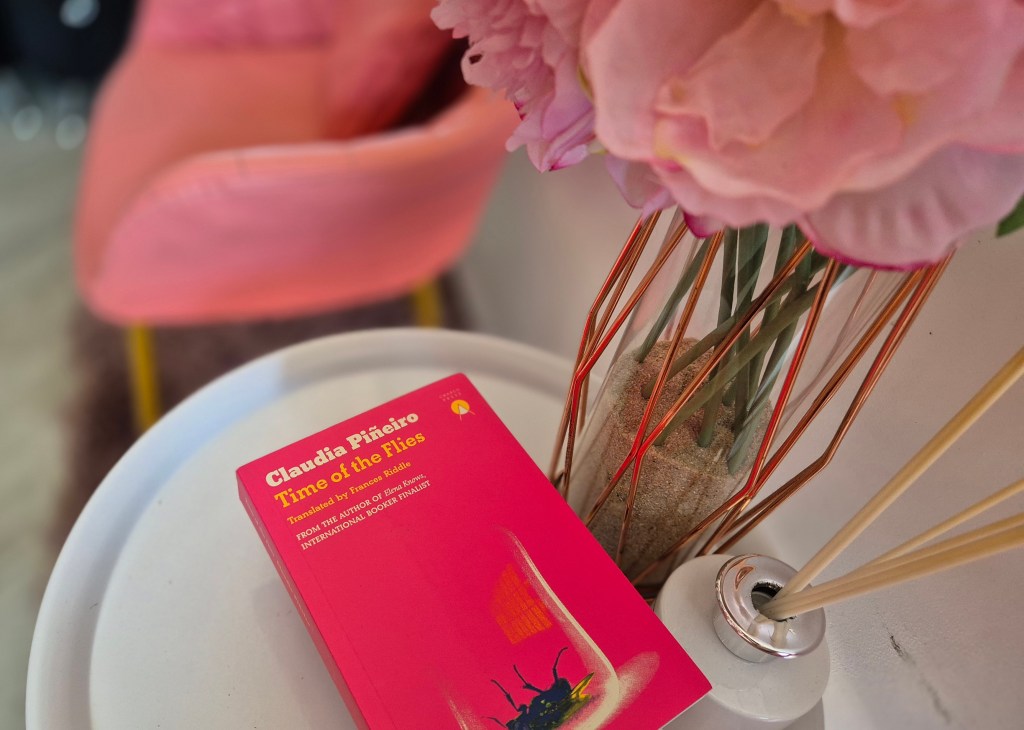
Time of the Flies, Claudia Piñeiro (August 2024)
Give me a back cover blurb without telling me the book is by Piñeiro and I would notbe very interested. The descriptions of her novels are unattractive to me, especially if they are about flies and women killing their husbands’ lovers.
But tell me a book is written by Piñeiro and I would read it without even asking what it’s about, even if it seems to be about flies.
Because if you just trust Piñeiro’s storytelling prowess and allow her to take you on a satisfying ride, you eventually learn that when it comes to the word “fly,” there is the noun, and there is the verb, and she’s ultimately writing about freedom.
Predictably unpredictable. She does it again. But this time, more heartwarming than one would expect, and more blatantly feminist.
“If I were moved by any kind of power at all, it would be the power of revealing absolutely everything about who we are.”
The Distance Between Us, Renato Cisneros (May 2023)
It’s been so long ago that I have started to question whether Florentina Ariza ever truly loved Fermina Daza. And why is it that what remains most vivid in my mind is how Dr. Urbino’s tasseled slippers made Fermina weep after his death?
“The thing you remember most is what has most deeply affected you,” writes Renato Cisneros. Have I always been affected by loss, or afraid of the space of another’s absence?
I apologize. I have fully digressed right from the beginning! Is it even possible to digress right from the beginning?
But what makes the writing and the translation of The Distance Between Us so satisfying is that it is reminiscent of my first encounters with the Latin American greats! (Not the magic realism aspect for there is none of that here, but in the way the writer involves the reader intimately by making the characters palpable, using subtle tricks of psychoanalysis to dig within as far as they can so that one can gaze even into the unconscious.) But perhaps, most of all, for the moving premise of a son writing a book in an attempt to reduce the distance between him and his deceased father, a controversial figure in Peru’s turbulent history: A poignant endeavor to understand who the father really was in order for the son to fully understand himself. To acknowledge the faults of the father so as not to perpetuate them. To break the cycle and confront, rather than escape as his father and forebears have done, “Ignoring and later burying the thornier details of their pasts, they turned their backs on the intrigues of their shared history, embarking on a course of permanent disorientation…”
And yet, “Just as a father is never prepared to bury his son, a son is never prepared to dig up his father.” His undertaking brought to light his father’s amorous affairs; classified information that led him to acknowledge, though he loved him, that his father was a villain, but also that villains are made of wounds; the discovery that his parents were never legally married; and then to write about their love, to legitimize it — “This novel is my parents’ lost marriage certificate.”
Forget my likening Charco Press books to espresso shots. This strong blend of the personal and the political compelled me to spend hours and days between its pages. “Authenticity” is such an abused term nowadays that I sometimes wonder if the overuse has marked the word with a tinge of insincerity. Then comes along a book like this that keeps such doubts at bay. A work devoid of the inauthenticities of biographies and brimming with the honesty that confronts us in fiction.
Was I wrong to wish that the son of a dictator who is now our current president could be more like this son? But I digress, again.
Chic French flaps that double as bookmarks, attractive colors, dimensions that fit in any handbag, and cover designs that could easily pass as pieces from the Museum of Modern Art: Charco Press indulges the busy contemporary reader.
It’s a section of my shelf that has lately become, perhaps unfairly, my go-to for a literary quick fix; where I’d proceed to grab a book without giving it too much thought — the way you would your car keys, the way I would a doppio from an espresso bar — on my way out to an appointment.
Small doses that pack a punch, style-wise, thought-wise, or both, delivering that stimulating and undiluted shot without demanding too much time and space. Yes, there are blends more intense or smoother than others. Some are darker roasts, and some have notes of an exotic flavor that make you gaze twice, sometimes longingly, inside an already empty demitasse. Some have a thick and bittersweet crema that cling to your lips, tongue, and insides long after you’ve downed the shot. But whatever the Charco Press barista has in store, it’s sure to come from a spread of South American blends that jolt our sleepy minds awake.
A Musical Offering, Luis Sagasti (February 2022)
Now, I’ve heard there was a secret chord / That David played, and it pleased the Lord / But you don’t really care for music, do you?
How can you not love a book that quotes Leonard Cohen on the first page? And truly, if you care for art and music, exquisite is an understatement of how this book is written. With an enchanting thread, Sagasti strings The Goldberg Variations, Bach, The Beatles, Brahms, Messiaen, Glenn Gould, Rothko, Mahler, Scheherazade… yes, Scheherazade! Because literature is still undoubtedly under her spell. Sagasti’s musical offering puts us in the shoes of the bewitched Persian King Shahryar, and this musician can only dream of a thousand nights more…
Fireflies, Luis Sagasti (May 2022)
Scheherazade in A Musical Offering, Penelope in Fireflies. I see what you did there, Mr. Sagasti! The mother weaver of stories of the East, and the mother un-weaver of storytelling of the West. Spun and spanned. And spangled. “Now I’m drunk, with universe.” Your books are beautiful reprieves. Write some more, please. We will need more of your magic.
“Without the slightest doubt, art is the answer. What we can’t be sure about is the question.“
The President’s Room, Ricardo Romero (February 2023)
The only part I felt I understood was the author’s note, but which I liked, because it speaks of the incendiary power of literature. At the end of this story of a nameless suburb in a nameless country where every house has a room reserved for the president, I had more questions than answers. But perhaps that is the point. To question, especially the things that people do not bother to question.
Two Sherpas, Sebastián Martinez Daniell (April 2023)
One of the many things I learned during a trip to Nepal was that it had never been colonized. Two Sherpas made me re-think this view when I realized how imperialism, with its enduring effects, encroaches on the mind and the sentiments of a people.
Unlike other books set in the Himalayas, the action takes place internally, inside the minds of two sherpas, one old, one young, as they look on an Englishman who has fallen from a ridge. The world looks different from up there, and there is much to glean from their perspective.
Trout, Belly Up, Rodrigo Fuentes (April 2023)
How simply evocative, these seven interrelated short stories! Subtle in depicting different social classes, but forthright in expressing that suffering is a shared experience, inextricable from the human condition.
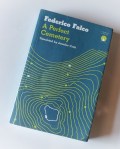
A Perfect Cemetery, Federico Falco (November 2023)
It’s like walking into a museum of modern art and then stopping at five evocative pieces that touch or disturb something incomprehensible inside of you, and you leave the museum feeling full… of questions.
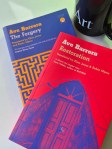
The Forgery, Ave Barrera (August 2024)
It’s probably best to read Balzac’s The Unknown Masterpiece prior to The Forgery. Had I not read it in 2022, I would not have recognized the numerous references. I regard The Unknown Masterpiece as an important record of the transition from the Romantic to the Modern period. This one, however, follows a painter in a series of unfortunate events inside the labyrinth of Mexican surrealism. I can see Modern Art lovers enjoying this book. Ave Barrera leaves you satisfyingly scratching your head. Does that make sense? But who’s talking about making sense?
Restoration, Ave Barrera (March 2026)
Misogyny has roots in the foundations of society, it escapes through the cracks of our country’s great houses, and cultivated inside rooms where women are not supposed to enter.
Misogyny is perpetuated in careless conversation and by those who laugh in response to what some presidents, law makers, and important men consider funny or normal. It is also perpetuated by women who allow it.
“We all know what happens in stories to women who open doors that men have forbidden them from opening,” Jasmina says, in Restoration.
If the forbidden room in this novel feels like a metaphor for the Epstein Files… it is. Because such rooms have always existed.
And if there’s one thing I know about Ave Barrera, it’s that she doesn’t hand the story on a silver platter. Harnessing her knowledge of art and architecture, she asks you to confront rooms, hunt for symbols, open locked doors, and lead you to the dark labyrinths of the male gaze.
I, too, am surprised why this did not make it to the International Booker Prize longlist.
Scheherazade in A Musical Offering, Penelope in Fireflies. I see what you did there, Mr. Sagasti! The mother weaver of stories of the East, and the mother un-weaver of storytelling of the West. Spun and spanned. And spangled.
“Now I’m drunk, with universe.”
Ever since the two Zweigs that got me through the long wait at the polling precincts, I have only found myself turning pages of several books but absorbing nothing, only to reread the same pages and still end up drifting. The way many people have treated our national elections like they would a mere cockfight is confounding. Your books are beautiful reprieves. Write some more, please. This is going to be a tough ride. We will need more of your magic.
“Weren’t you just reading The Books of Jacob?” My mom asked when she saw me with this a day after I finished reading Olga Tokarczuk’s magnum opus.
“Recovery read,” I answered with a wink.
She shot me a questioning look.
“You know how runners do a short recovery run within 24 hours after a marathon?”
She could only laugh and shake her head.
It was the perfect easy run for this reader! In fact, I think every little detail of this book is perfect!
From the cover design, to the French flaps, to the first page that quotes Leonard Cohen:
Now, I’ve heard there was a secret chord / That David played, and it pleased the Lord / But you don’t really care for music, do you?
And truly, if you care for art and music, brilliant is an understatement of how this book is written. Think Apeirogon, think When We Cease to Understand the World but instead of physicists and mathematicians, musicians and artists — Bach, The Beatles, Brahms, Messiaen, Glenn Gould, Rothko, Mahler, Scheherazade… yes, Scheherazade!
Haven’t we already noticed that literature around the world is still undoubtedly under her spell, especially the Eastern Europeans and South Americans? Argentine Luis Sagasti’s musical offering puts us in the shoes of the bewitched Persian King Shahryar.







 The Book-Butterfly