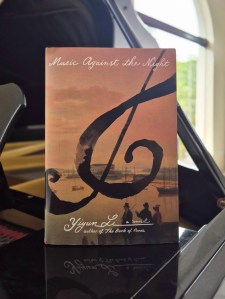
By the time my students get to the middle of their grade one book in piano, they will already know what a nocturne is; a night song, an expressive piece that often evokes the close of day. By the time they get to grade two, they will be introduced to Chopin, the composer who ensured a place for the nocturne in every classical pianist’s fingertips.
Music Against the Night tells the story of a prodigy touted to be the next Mozart by his family, the 18th century Irish virtuoso, John Field, who first conjured the nocturne, but who endures as a mere footnote on a Chopin biography. It is also about Adelaide Percheron, another prodigy in French India, who would fight her way to Europe where she would cross paths with John Field, and whose extraordinary life would provide the story with an ingenious feminist streak, but who would have sadly remained a footnote of a footnote, if not for this book.
This reader is mindblown by Field’s milieu, which Yiyun Li reanimates so masterfully! Encounters with Beethoven, Haydn, Czerny, Clementi, and Clara Wieck-Schumann (who was trained in the John Field Method), pepper the novel. Yiyun Li recalls a passage from War and Peace where Countess Rostova requests a musician to, “Play me my favorite nocturnes by Master John Field.” Possibly Tolstoy’s personal tribute to Field, his mother’s music teacher.
In a clever trick with the novel’s non-linear form, John and Adelaide are apart for almost the entire book, and it ends with their meeting. The author, known for her stoic clarity, rejects melodrama and writes life’s tragedies with straightforward language. But I realized that one should not be deceived; it is only at the last sentence where everything will come rushing at you, leaving you with a sustained ache that lasts as long as the strains of a nocturne on your heart.
It takes one as acquainted with darkness as Yiyun Li to perceive through the music that, oftentimes, nocturnes were invoked by their composers as music not necessarily about the night, but against the night, against the abyss. Because as she and her characters very well understand, there is music, and outside of that, silent darkness.
Although I would argue that this book is a work of sophisticated polyphony as it explores intricate themes such as the pressures that come with being a prodigy, the commodification of music that seems to be discordant with artistry, the lure of fame and the lust for recognition, and the personal sacrifices one must make to pursue a career in music, it is still a nocturne in the way the purity of its melodic lines float above everything else, and it is very much a nocturne in the sense that Yiyun Li wrote this as her personal music against the abyss.
To paraphrase a line from the book: What is art for, if not to count, mark, and endure time?
In Music Against the Night, Clementi tells John Field, “But we must pay attention to the biographies of great musicians. Why is that, John?” To which the young John answered, “That’s how I can understand their music.”
To fully grasp a musical opus, classical musicians are often required to do a research about the piece and the composer before a performance. I have carried on this habit from music to literature.
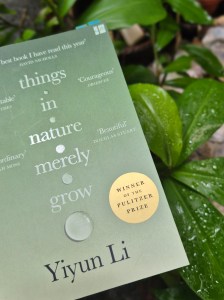
Grateful to a dear friend for lending me her copy of Things in Nature Merely Grow that profoundly informed my understanding of why Yiyun Li had to write about nocturnes, and about the fraught lives of John Field and Adelaide Percheron. This work transcends description, and I highly recommend it as a companion read to Music Against the Night.

