
A Month in Siena, Hisham Matar

“Only love and art can do this: only inside a book or in front of a painting can one truly be let into another’s perspective. It has always struck me as a paradox how in the solitary arts there is something intimately communal.”
An understated book that is a meditation and an education in art and life.
“I hope that when there is laughter, it’s laughter made wise by having known real grief — and when there is grief, it is made wise by having known real joy,” Kaveh Akbar writes in Martyr! Whether writing about art, architecture, Libya, or politics, Hisham Matar’s books are often so heartfelt — wholly made wise by having known sorrow and loss.
Fires, Marguerite Yourcenar

…because maybe, subconsciously, this month’s reading theme is about finding solace in the works of authors whose masterpieces have already left an impression on me, that I immediately dove into Yourcenar’s Fires without hesitation, having been incredibly moved by Memoirs of Hadrian in 2022.
She does admit, and warn, in the Preface that this book is, “the product of a love crisis” and that writing this was, in a way, “exorcising a very concrete love”; and yet it still surprised me that the elegance I encountered in Hadrian was replaced in Fires by a certain violence and ferociousness in the prose.
Antigone, Sappho, Clymenestra, and Achilles are just some of the main characters of the nine lyrical prose pieces, or stories, that Yourcenar amalgamates with her own experiences. I was left wondering if I understood the allusions correctly, or whether I understood anything at all.
One thing is certain, Fires is a masterclass on opening lines:
Phaedra’s piece begins with, “I hope this book will never be read.”
The Patroclus opening, “A heart is perhaps something unsavory. It’s on the order of anatomy tables and butcher’s stalls. I prefer your body.”
Lena’s? “Loving eyes closed is to love blindly. Loving eyes open is perhaps to love madly.”
“Love is a penalty. We are punished for not having been able to stay alone.” Clymenestra’s.
Face Shield Nation, Gideon Lasco

Articles that I looked forward to during the pandemic compiled in a book. Lasco was the voice of calm and reason at a time of confusion; evoking through his column the architectural definition of a column as a sturdy pillar of support. An essential time capsule of an era that we cannot afford to forget if we intend to learn from it. Read full entry here.
One Hundred Years of Solitude, Gabriel Garcia Marquez (a re-reading)

Growing up is realizing that Gabo is the real Melquiades who brought us magnets, magnifying lenses, astronomical observations, and mercurial storytelling. It was he who made imagination and literary possibilities flourish in the fertile and pristine Macondos of our minds, and who never really died. Read full entry here.
Nothing but the Night, John Williams
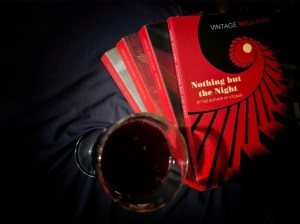
Maybe the first disappointment that assails the reader is the realization that, despite the slenderness of this volume, there is a heaviness in each page that restrains forward motion.
“Boring,” the lazy might judge hastily somewhere within the first three chapters. But one should not be too quick to criticize even though I myself could only read a couple of pages per sitting. For if one looks closer, and feels deeper, isn’t this genius, how John Williams conveys exactly what depression feels like?
“…there came to him that peculiar loneliness which is felt only in the monstrous impersonality of a multitude…” “What was the senseless circumstance which led him on and on, deeper and deeper into what seemed to him a maze labyrinth, devoid of pattern or meaning? …some unnameable power pushed him from one place to another, down paths he had no wish to travel, through doors he did not know and had no wish to know. All was dark and nameless and he walked in darkness.”
But then the reader is momentarily allowed to come up for air. I’m referring to the fourth chapter that is briefly set alight with a Proustian beauty! “That is the very best time of life, he thought: lost time.” And then John Williams proceeds to craft this fleeting tribute to the master searcher of lost time before he relinquishes the ethereal chapter to the fading light.
As the novel finally builds suspense, it spirals into a nihilistic darkness that ends with a violent and repulsive slap in the face.
Written in Burma when he was only twenty-two while recovering from injuries brought about by a plane crash over the Himalayas during WWII, he wrote this first novel at a particularly dark time when there was nothing else but the night.
The John Williams here is not the John Williams that gave us Stoner and Augustus. The John Williams here is the John Williams that would eventually give us Stoner and Augustus.
The Black Book, Orhan Pamuk

This reader has been through Pamuk’s longest novels and still felt the density of the mystery and prose in this book’s mere four hundred pages.
It explores the writing process and the precariousness of identity. It is also about how much the books we read, the stories we hear, the movies we watch, the everyday objects in our lives, and our city’s history shape the multiplicities of our being.
I enjoyed that twist at the end and relished the familiarity of Istanbul as a breathing character in a Pamuk novel. But maybe, just maybe, The Black Book is not for the Pamuk newbie, and not for those who are in a hurry.
The Golden Road, Willliam Dalrymple

It is not only the Silk Roads that are rising again, as Peter Frankopan proclaims in a forceful last line that gave me goosebumps. Rising, too, are buried or forgotten histories that have now resurfaced to challenge centuries of unquestioned narratives.
Frankopan’s The Silk Roads was an eye-opener, but The Golden Road takes this non-Eurocentric view of ancient and early medieval history to an intriguing direction by revealing India as a catalyst that transformed the world. Read full review here.
 The Book-Butterfly