Percival Everett is an unlikely choice to read on a trip to Batumi. But before his international fame catapulted with “James,” a retelling of Huckleberry Finn — which just won the National Book Award — he wrote “For Her Dark Skin,” a retelling of Medea’s story. The modern and humorous take is a contrasting companion read to Euripedes’ “Medea.” Everett’s version has only one word on the first page: Colchis.
Colchis, in Greek mythology the opulent kingdom, the place Jason and the Argonauts had ventured forth to obtain the Golden Fleece, homeland of Medea; and in recent times, the city by the Black Sea dominated by financial-oil dynasties of the Rothschilds and the Nobels; modern-day Batumi.


The scenic and comfortable train ride from Tbilisi to this city bordering Turkey is something worth experiencing. Seeing snow-capped mountains in the window gradually dissolve into the shores of the Black Sea was already worth the five-hour trip.
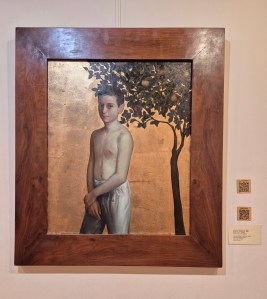
But when I arrived, the city’s superficiality was what I instantly felt. The hodgepodge of strange architecture seemed almost grotesque, and the sports cars driven by the showy spawn of Russian oligarchs did nothing to expunge that feeling. To shake off my first impression, I strolled to the corniche where the sunset was setting against the Black Sea. A dog was wading in and lapping up its history-rich waters, locals were sitting by the banks despite the wind chill, then I sought refuge in its art gallery which, thankfully, was a nice building. And then I started to soften, and I reminded myself why I was there.


I was there because of the stories: Because of everything I read about the Black Sea; because of Medea’s tragedy, whose statue is the centerpiece of its main square; because of Ali & Nino, whose two figures pass through one another as the sun sets, and separate again after a few minutes, depicting the bittersweet cycle of what is deemed to be the greatest love story of the Caucasus — written by a writer who happened to be Stalin’s first biographer and whose life was as adventurous and intriguing as his writings.

What Paul Theroux writes in the afterword is especially true of Batumi: “Ali and Nino is both a love story and a cultural artifact, and part of its message is that governments rise and fall, wars rage, cities are laid to waste, people are displaced, authors die. What remains? Well, written words remain…”
If my photos of Batumi look like an incohesive potpourri, that’s on Batumi. What weaves all these images together is intangible and invisible, but also transcendent — the stories.
 The Book-Butterfly
Its time to revisit Ali and Nino. God i love that book!
LikeLiked by 1 person
Love stories hit differently when they’re set in “our” countries, no? Haha! ❤️
LikeLike
I think you are right!
LikeLike