“I saw with my own eyes the end of a world… opened my eyes to the cruelty of the world. Isn’t that the point from which to date my break with childhood?”
It was not a reading slump. My readings simply could not veer away from articles on the Israel-Hamas war. Since October 7, reading for leisure felt so much like what Gideon Lasco would call “an embarrassment of privilege”.
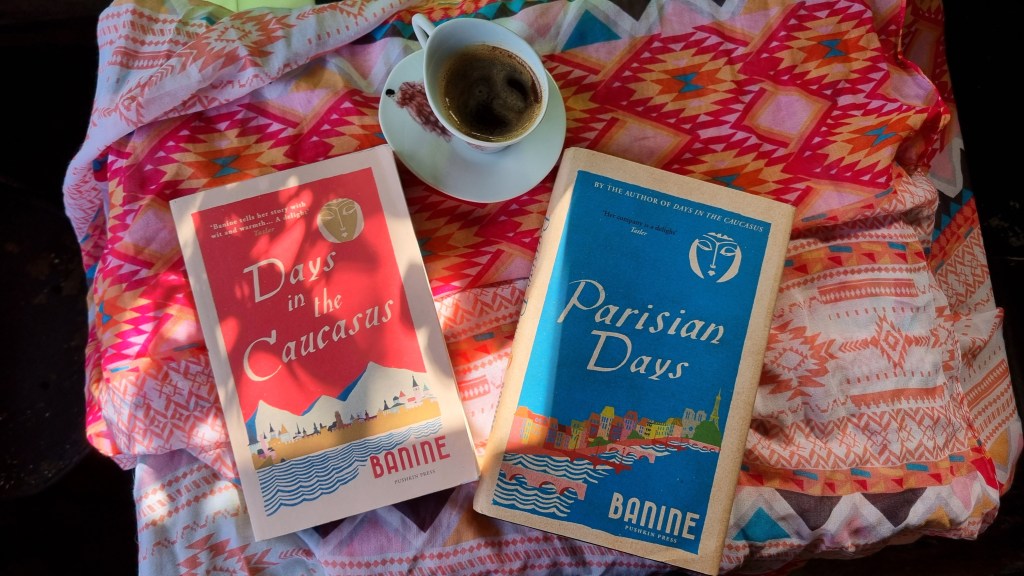
But upon arriving from another short trip to the capital, a two-month late parcel containing Pushkin Press books that I ordered for Women in Translation Month greeted me. And because I am a strong believer in the seemingly late but apt arrival of books in our lives, I couldn’t resist picking up Banine.
Although set over a century ago and published in 1946, Days in the Caucasus is not far removed from current events; freedom for women meant gaining precedence over the veil, climate change was already felt by our perceptive narrator, and it even offers a glimpse of the long-standing conflict between Azerbaijan and Armenia that made headlines again last month. As readers, we have also learned by now that a coming-of-age story is an unceasing current event.
But oh, to have Banine as a narrator is such a whiff of fresh air! There is already a Tolstoyan flavor in the first line of Days in the Caucasus when she opens with, “We all know families that are poor but ‘respectable’. Mine, in contrast, was extremely rich but not ‘respectable’ at all.” And thus begins a witty narration of an extraordinary place, an extraordinary time, and an extraordinary life.
Banine, born at the turn of the 20th century into a family of oil magnates in Baku when Azerbaijan was still part of the Russian Empire. That information alone heralds upheavals of every kind, yet she colors this turbulent part of life and history with an irresistible charm.
This heiress who lost her home, her freedom, and fortune when the Bolsheviks came into power had a special relationship with nature (“…they did not play dead with me; they replied in a simple language, sufficient for those who knew how to hear…”), loved playing the piano (“I was fortunate to have a consolation that I turned to with greater frequency — my piano …only the piano found favor with me…”), loved to read but also acknowledged its limits (“…those who claim that reading is a consolation for everything cannot feel very deeply — a powerful emotion leaves no spare mental capacity; it takes over, hypnotizes you, stops you thinking of anything else…”).
Parisian Days chronicles her subsequent life in Paris as an adult and an émigré. In it we see her humor and astute observations aging like fine wine. It makes one realize that these are some of the shoulders on which the Annie Ernaux-es of today have stood in order to write fearlessly about society and a woman’s intimate thoughts.
Banine is a lovely companion of a narrator who, whilst making light of her tragedies, makes us recognize our privilege of experiencing the loss of home and freedom only through the books and stories of others.
“In this atmosphere, everyone enjoyed every freedom as long as it didn’t impinge on the freedom of others.And isn’t that the definition of freedom?”
“It revealed to me an eternal truth: as long as the flight of a bird, the soughing of leaves, the wash of the sea bring joy to your senses and mind, life remains a precious gift.”
“Life was waiting for me. I had to go and meet it despite the burden of my reluctant heart.”
It is and it isn’t Kafkaesque. It is because, not too long ago, the Tutsi people woke up as inyenzi — cockroaches. It isn’t because it is no longer allegory, no longer fiction.
“The soldiers… were always there to remind us what we were… cockroaches. Nothing human about us. One day we’d have to be got rid of.”
Mukasonga, who lost an entire family, an entire clan, and an entire people in the genocide, chronicles life as a Tutsi in Hutu-dominated Rwanda. As a child, she and her family were forced to relocate to a camp during the first pogroms against the Tutsi; and from then on, they knew what awaited them. “Humiliated, afraid, waiting day after day for what was to come, what we didn’t have a word for: genocide.”
In this disturbing and exceptional account, we become witnesses to how hatred and prejudice crescendoed from the 1950s into what erupted as the Rwandan genocide in 1994.
OUR LADY OF THE NILE
In two chapters of Cockroaches, there is an account of being unexpectedly accepted to the prestigious Lycée Notre Dame de Citeaux, a Catholic boarding school in Kigali. The experience becomes a fictionalized novel here.
The elite school for young women perched on the ridge of the Nile remarkably becomes a microcosm of Rwandan society. Corruption, the tension between Tutsis and Hutus, history, their myths, Rwanda’s relationship with the west, orientalists, disinformation and lies that fuel prejudice — “It’s not lies,” justifies one of the girls. “It’s politics.” — the complexities of government and society, and how Mukasonga proficiently mirrors these through the lives of the young women makes it a powerful work of fiction.
IGIFU
An anthology of 5 stories that remind us of why we should read about worlds and lives so different from our own. And if you’re wondering about the identity of Igifu, “who woke you long before the chattering birds announced the first light of dawn,” who “stayed at your side…to bedevil your sleep,” “the heartless magician who conjured up lying mirages…” you would be heartbroken, just as I was, to know that he is Hunger.
THE BAREFOOT WOMAN
A lament with pockets of lightheartedness dedicated to the mother she lost, written by someone who, in her own words, has the sorrow of surviving.
KIBOGO
A spirited portrait of a people grappling with the choice between the faith of their European colonizers and their pagan beliefs. A relatable quandary amongst peoples of colonized lands, but written in a manner only Mukasonga can achieve.
Truly, an African section of a library would be inadequate without Mukasonga. These are essentials in world literature. The word essential has been abused, but there are times when essential is appropriate.
The soundtrack: Wails from professional mourners and murmurs among the attendees. The novel opens with a funerary scene in Cairo at the turn of the twentieth century.
“God refuses to grace his home,” they whisper of an honored guest in the crowd. “Sad is a house deprived of a son,” they lament. “Not one son!” they say of this man who has four wives but “only” daughters. We enter yet another world where men are favored over women — even by the women.
The titular character who becomes this man’s fifth wife is uneducated and easily swayed by superstition. Although the author treats her with compassion, Zanouba’s unhappy fate seems to me a gentle critique on the tolerance and perpetuation of this mindset among women.
It is unimaginable for me to dethrone Naguib Mahfouz as the king and Nawal el Saadawi as the queen of Egyptian literature, but Out El Kouloub deserves a significant spot in the tapestry of Egyptian literature. I’m delighted with the discovery of this relatively obscure author who sheds light on Cairene women as Nawal el Saadawi does but without the rage, and paints early 20th century Cairo as perceptively as Naguib Mahfouz but through a more feminine frame of reference.
Although Out El Kouloub grew up in Cairo, she fled to France during the Nasser regime. Once dubbed “the richest woman in Egypt” by many, Out El Kouloub’s life is as intriguing as her stories. The work is translated from the French by Nayra Atiya, as all of Out El Kouloub’s books were written in French.
On Women in Translation Month 2023, I write this for the rare reader who tries to look for traces of Out El Kouloub (1899–1968) in #bookstagram and finds only six frames bearing her hashtagged name. This will be the seventh. There should be more.
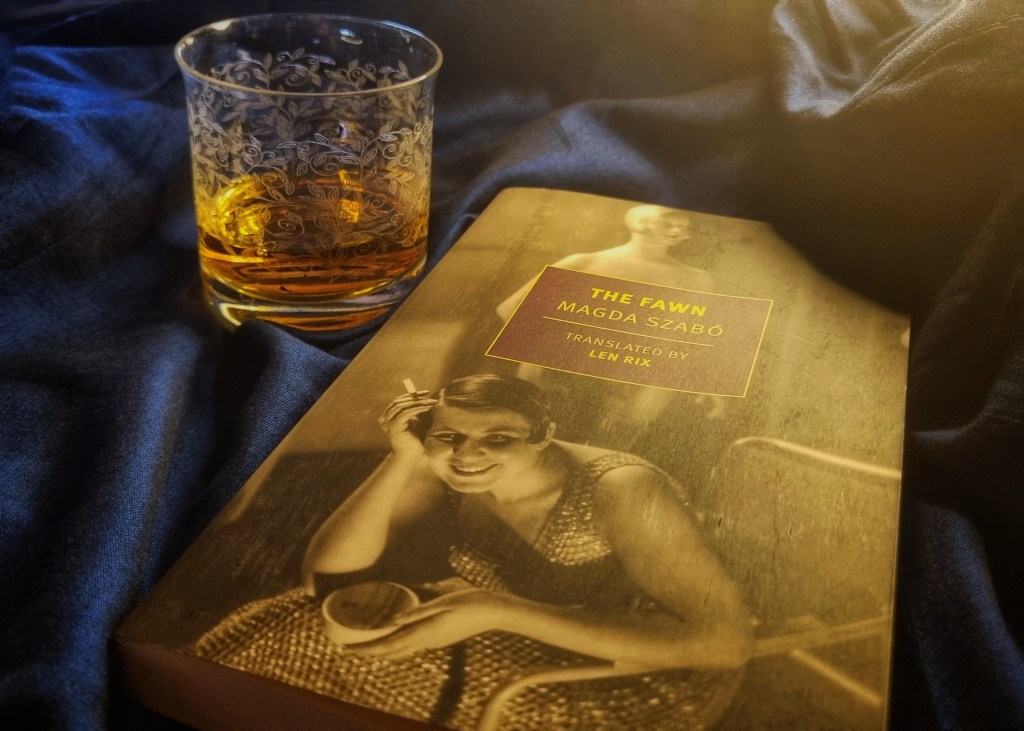
“I wanted to be with you sooner…” This first line, a faint melody, I imagine played by a solitary piano. This unwavering, melancholic undertone, suggesting that Eszter Encsy is addressing someone who is no longer in her life.
There is a calm, almost cold, but delicate aching to be accepted and understood. Recollections of childhood come across as confessions and explanations… including that time she did not mean to kill the fawn.
But how did that seemingly dispensable incident earn the title of the book? Perhaps the fawn is meant to symbolize the fragility of youth, and how easily it can be broken.
Magda Szabó, who died with a book in her hand, has bequeathed to the world novels that aim straight for the soul. She wrote of women; women who do not have to be faultless. She did not demand heroics from them or for them to be worthy of admiration or to be idealized. She only asked that they live — live intensely, and learn.
And yet, I did not expect her to go to the extent of Eszter. The moral puzzles are not vague here, it is made quite clear what kind of person we have as a central figure right from the beginning: “I could never have undertaken to be a good girl and never to tell lies…” “I lie so easily I could have made a career out of it…” “I was also laughing at the monster I really am…” “I wasn’t a very nice person and I wasn’t very friendly…”
We immediately get the picture. Appalled, we double-check the synopsis, even though Szabó readers know that her synopses hardly describe what one encounters between the pages. But we read on. Because Szabó is brilliant. Because we suspect that a gut punch or two awaits round the bend. Because oftentimes, nothing is what it initially seems. Because she writes of those difficult spaces between people that most of us are too inattentive, too timid, or too unimaginative to explore. Because we know that behind all her stories is a carefully woven leitmotif of a history she mourns. Because Szabó is always subtly reminding us of consequences, of how we cannot extricate our personal histories from that of our nation. Because she is eternally thought-provoking, and therefore, rewarding.
…and because those elegiac strains from that lonesome piano will linger long after you’ve turned the last page.
“Finally, I would like to say, I intended to write… not just in Turkish, but in the language of all who lament for the dead. And I intended to write it with the language of figs…”
The 1920 Treaty of Sèvres that was signed between the Allies of WWI and the Ottoman Empire is not explained here. There is nothing here that mentions how it marked the beginning of the partitioning of the empire, how Armenia was subsequently recognized as an independent state and a referendum was scheduled to decide the fate of the dream of a Kurdistan, but nothing of how the referendum never took place. No details of what exactly happened when the Kurds within Turkish borders clashed with Turkish nationalism; nothing of the decisions, events, or indecisions that led to the extermination of more than half of the Kurdish population in Turkey by 1938.
Throughout the book an unnamed and unidentified narrator addresses a woman muted by grief and coaxes her, not to speech, but to remembrance — a remembrance not of a specific event but of her spiritual and personal history, and the ancient mythology of her people; and I believe here lies the genius of this novel. Without explicitly saying that this book is about identity, Sema Kaygusuz makes this book wholly about identity.
Out of the silence roars a powerful voice that resists all attempts at wiping out Kurdish identity. I have come to understand that this book is, above anything else, a rallying cry for the Kurdish people: For them to never forget who they are. To never give in to the silencing, and to never allow grief to estrange them from who they really are.
What is between these pages is something that we won’t find in the chronologies of history. What is written here is more profound. In this novel that reads more like a lengthy poem, Kaygusuz achieves the impossible task of giving shape to grief and silence, and intimating a manner of history that can only be expressed through obmutescence or poetry.
“Finally, I would like to say, I intended to write not just in Turkish, but in the language of all who lament for the dead. And I intended to write it with the language of figs… the fig tree whose fruit has, over the course of the history of civilization, seduced and destroyed, poisoned and healed, struck panic in those captivated by its pleasure, and been served like jewels at the tables of kings, pharaohs, and sultans — in order that I might set aside its vitalizing force, its enviable adventure, in writing. What I mean to say is that, over the course of this novel, I am not only my grandmother who survived the massacre: I am also her granddaughter, I am Hizir, and I am a fig, with its countless tiny seeds. Each of us has written the others into being.” — from the Afterword of Every Fire You Tend by Sema Kaygusuz
Thank you for knowing exactly what I’d love to read and for lending me your copy, Gabi. Always grateful. 🤍
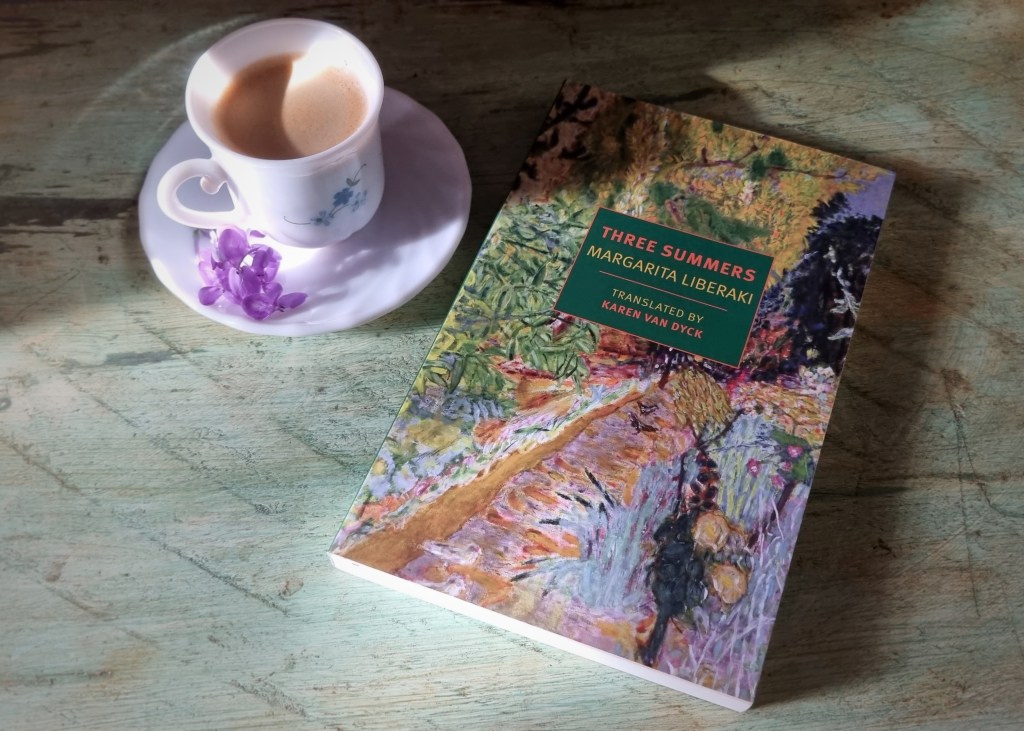
Fleeting patches of sunlight that decorate pieces of furniture linger on book pages furtively as I read, or momentarily set the crema of my espresso aglow, are lovely indications that summer is gently slipping into the Philippine islands after a sunless wet season.
But why do I even dare write this in the face of a Liberaki who is an authority on sunshine? This Liberaki who does not merely write about it but makes it so tangible that one’s heart becomes dappled with sunlight, too?
There is a little bit of the Little Women in Liberaki’s three sisters in that it portrays in each sister how Woman can make different choices, pursue different interests, hold different priorities, think differently and still remain Woman; portrays how Woman can mean, or can be, “A great many things,” in the words of Alcott’s Jo March. Or as Liberaki’s Katerina replies, “Not just two, but thousands, Maria, or one which could be a thousand,” when Maria remarks on how Katerina seems to want to live two lives.
But Liberaki, daughter of Dionysus that she is, has a certain sensuality that Alcott did not make space for in her conservative depiction, although we love her just the same. This Liberaki sensuality is an elegant one, however, and treats female sexuality as part of life.
What made me pick this up for Women’s History Month was the curious case of an author who insisted on transliterating her name as Liberaki, rather than the more accurate Lymberaki, so that it would correspond to liberation. It is rare to come across an author’s name that already alludes to an untethered mind and sets the tone for a book. But how wonderful to discover that the same author has a command of artistic laws and lavishes attention to detail while creating an exquisite balance of light and shadow!
This sensitivity to art was what enthralled me! For what is sensitivity to art but a reinforced sensitivity to life?
“The sun has disappeared from books these days. That’s why they hinder our attempts to live, instead of helping us. But the secret is still kept in your country, passed on from one initiate to another. You are one of those who pass it on.” — Albert Camus to Margarita Liberaki
Three Summers was originally published in France through his recommendation.
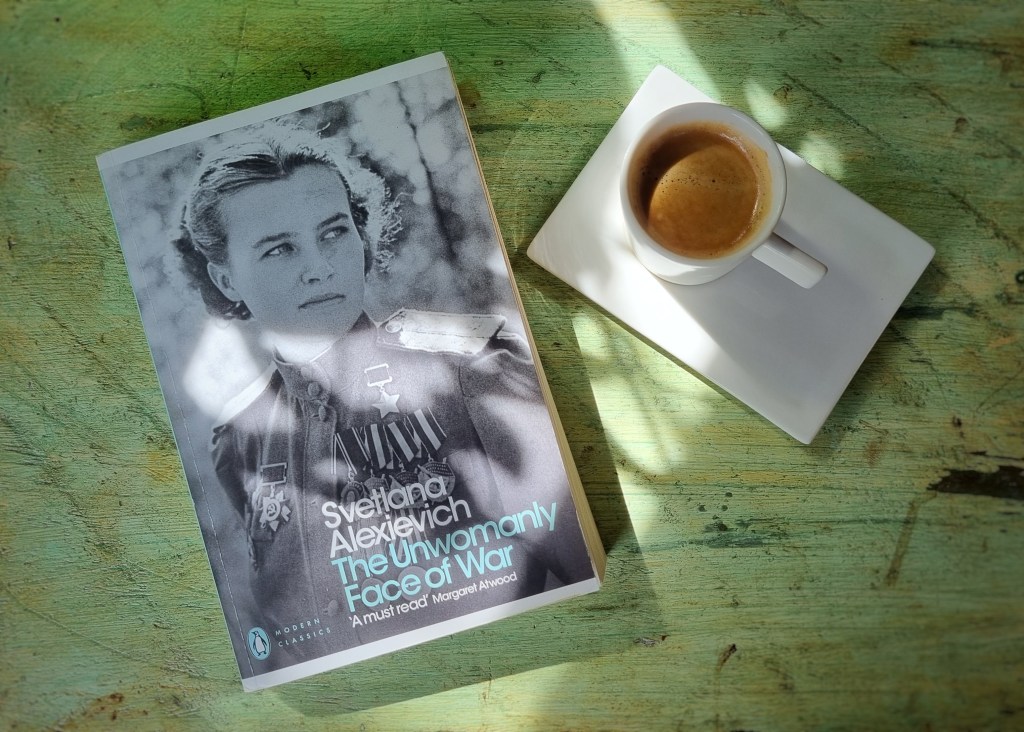
During WWII, women served in all branches of the military: 225,000 in the British, 450,000-500,000 in the American, and about a million in the Soviet army. The women in the Soviet army contributed to the German defeat, but little was known and little was said about them and the price they had to pay for victory.
Over the course of twenty six years, Svetlana Alexievich sought out many of these women and became the repository for their untold stories. This is part of the body of work that earns her a place as one of only seventeen women out of a hundred and fifteen Nobel Laureates in Literature.
Maybe it’s because Svetlana Alexievich says that she isn’t writing about war nor the history of a war, “but about human beings in a war… the history of feelings.” Maybe it’s because she is what she says she is, “A historian of the soul.” Maybe it’s because she believes, for good reason, that suffering is “a special kind of knowledge,” “the highest form of information,” that suffering has a direct connection with the mystery of life. (“All of Russian literature is about that. It has written more about suffering than about love. And these women tell me more about it…”) Maybe it’s because she makes this book of unburdening into an overwhelming choir of over two hundred voices singing a soulful rendition of an unsung threnody for the first time, that it answers my question as to why a piercing account of war can be so beautiful and so important.
Special thanks to Gabi for encouraging me to read this and for giving it to me as a birthday present last year. 🤍
Oh, what would it have been like to be Teffi, born into a remarkable time that made personal encounters with Tolstoy, Rasputin, Gorky, and Lenin possible, and to have made a name for herself as a writer in an androcentric literary world?
These delightful autobiographical essays answer that question. From childhood recollections, what her multipurpose desk was like, how her pseudonym came to be, to encounters with history’s formidable men, Teffi writes with a poetic simplicity that makes for light reading while never lacking depth.
“I adore oranges. They are round and golden, like the sun, and beneath their peel are thousands of tiny pockets bursting with sweet, fragrant juice. An orange is a joy. An orange is a thing of beauty.
And suddenly I thought of Ganka. She didn’t know about oranges. Warm tenderness and pity filled my heart.”
Stealing from the crate of oranges, she managed to give one to Ganka, who, in return, “Bit off a piece together with the peel, then suddenly opened her mouth wide, made a horrible face, spat everything out and hurled the orange far into the bushes.”
“I had become a thief in order to give her the best thing I knew in all the world. And she hadn’t understood, and she spat it out.”
And dear Teffi who apparently knew what it’s like to give one’s best and have it discarded just like that, called this short piece “Love”.
“I wanted to be with you sooner…” This first line, a faint melody, I imagine played by a solitary piano. This unwavering, melancholic undertone, suggesting that Eszter Encsy is addressing someone who is no longer in her life.
There is a calm, almost cold, but delicate aching to be accepted and understood. Recollections of childhood come across as confessions and explanations… including that time she did not mean to kill the fawn.
But how did that seemingly dispensable incident earn the title of the book? Perhaps the fawn is meant to symbolize the fragility of youth, and how easily it can be broken.
Magda Szabó, who died with a book in her hand, has bequeathed to the world novels that aim straight for the soul. She wrote of women; women who do not have to be faultless. She did not demand heroics from them or for them to be worthy of admiration or to be idealized. She only asked that they live — live intensely, and learn.
And yet, I did not expect her to go to the extent of Eszter. The moral puzzles are not vague here, it is made quite clear what kind of person we have as a central figure right from the beginning: “I could never have undertaken to be a good girl and never to tell lies…” “I lie so easily I could have made a career out of it…” “I was also laughing at the monster I really am…” “I wasn’t a very nice person and I wasn’t very friendly…”
We immediately get the picture. Appalled, we double-check the synopsis, even though Szabó readers know that her synopses hardly describe what one encounters between the pages. But we read on. Because Szabó is brilliant. Because we suspect that a gut punch or two awaits round the bend. Because oftentimes, nothing is what it initially seems. Because she writes of those difficult spaces between people that most of us are too inattentive, too timid, or too unimaginative to explore. Because we know that behind all her stories is a carefully woven leitmotif of a history she mourns. Because Szabó is always subtly reminding us of consequences, of how we cannot extricate our personal histories from that of our nation. Because she is eternally thought-provoking, and therefore, rewarding.
…and because those elegiac strains from that lonesome piano will linger long after you’ve turned the last page.
Katalin Street
October 13, 2022
Of the invasions of history into our lives; of moral intricacies, those shadowlands between right and wrong; of the love we give, we take, or do not receive — and a fatal overdose of any of the three; of faulty assumptions and miscalculations; of the tangled complexities of relationships between friends, family, and lovers, and even with ideologies and a nation; of the deaths we die before our real deaths; of things we realize too late; of the damage we wreak on those we love; and the irretrievable losses that time inflicts on us… Some books carry with them all that is unutterable and aim straight for your soul, not out of cruelty but out of an earnest art, and disclose that life will silence you… over and over again.
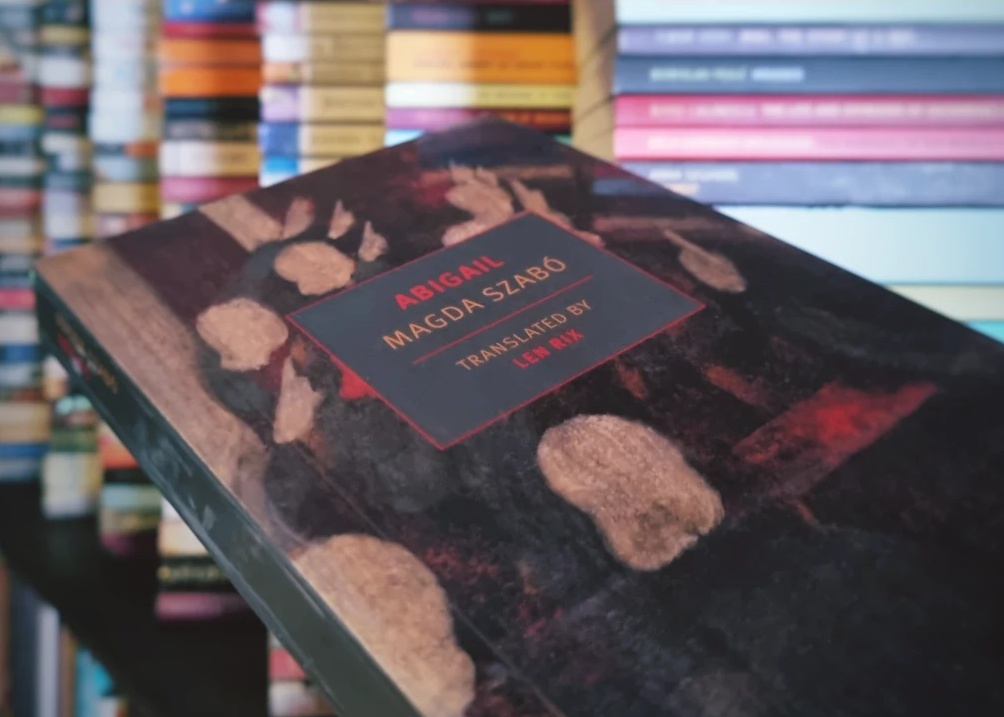
Abigail
September 22, 2022
“In any work of literature the most interesting bits are in the detail,” Kőnig had often said in his lessons. “Be sure to attend to them closely.”
If I had a daughter, she’d find this book in a collection I created for her.
Reading this, she’d be reminded that heroines do not have to be faultless; that the surest assumptions can often be wrong; that no matter how clever we think we are, there are people wiser still; that actions always have consequences; that friendship is precious; that even in the most repetitive of routines and what we deem the bleakest of days, life will find ways to astound or surprise us.
If she philosophizes and reads deeper into the book, as I suspect a daughter of mine will, she will venture to question where childhood ends and adulthood begins, and attempt to come up with answers of her own, or a hundred questions more.
If she develops an awareness of history and politics, as she must, she will be sensitive to Magda Szabo’s subtle activism and glean the lessons of sacrifice and duty.
And I imagine this book — so engaging and difficult to put down — will only fuel the love for reading in her.
Can you tell that I read this through the eyes of a wide-eyed adolescent, and not through the eyes of an adult still haunted by the painful and confounding strains from Iza’s Ballad and The Door but who, nonetheless, acknowledges that Magda Szabó has now become a favorite?
Iza’s Ballad and The Door gnaws at the soul. Abigail educates the heart.
The Door
September 2, 2022
“But a door can hint at so much more.” — Geetanjali Shree, Tomb of Sand
Having come fresh from a streak of world literature for Women in Translation Month, which included Tomb of Sand, I have become more attuned to the implication of doors being more than architectural features. Doors as metaphors for boundaries.
But in contrast to Geetanjali Shree’s doors where, ideally, anyone came and went; Magda Szabó’s door was meant to remain shut. The physical door of the latter was not only a boundary but the framework of a person’s dignity.
Szabó’sIza’s Balladturned out to be the most exquisitely written work from my WiTMonth selection, so I wasted no time in taking a peek into this door.
Curiously, Iza’s Ballad and The Door both have characters hired as household help who do not work for the money. One is a minor character in Iza’s Ballad, but in The Door it is the baffling, the imposing, elderly Emerence, one of the two central figures in the story. Adding to the intrigue is the younger and other main character, a writer, the author’s namesake.
Two decades of love-hate relationship yield misunderstandings and reconciliations, but also critiques on each other’s lives, on art, and on their clashing beliefs. At some point, the writer eventually achieves “the prize” and receives a prestigious recognition for her work, but not without the question of what it cost.
There is a challenge in talking about this book without giving away what the author meticulously wrapped in layers, because reading Szabó is like a careful and deliberate peeling of an onion. The core is shrouded in well-executed veneers where even the revelations continue to maintain a mystery that lead toward a confounding finality.
But she is yet another testament to my hunch that 20th century writers remain unsurpassed. Even with a tinge of absurdism, there is that deep exploration into the dark of interior characterization, a delving in the psychological, spiritual, and philosophical condition of its characters, if only to pose the argument of what it is that really matters in life.
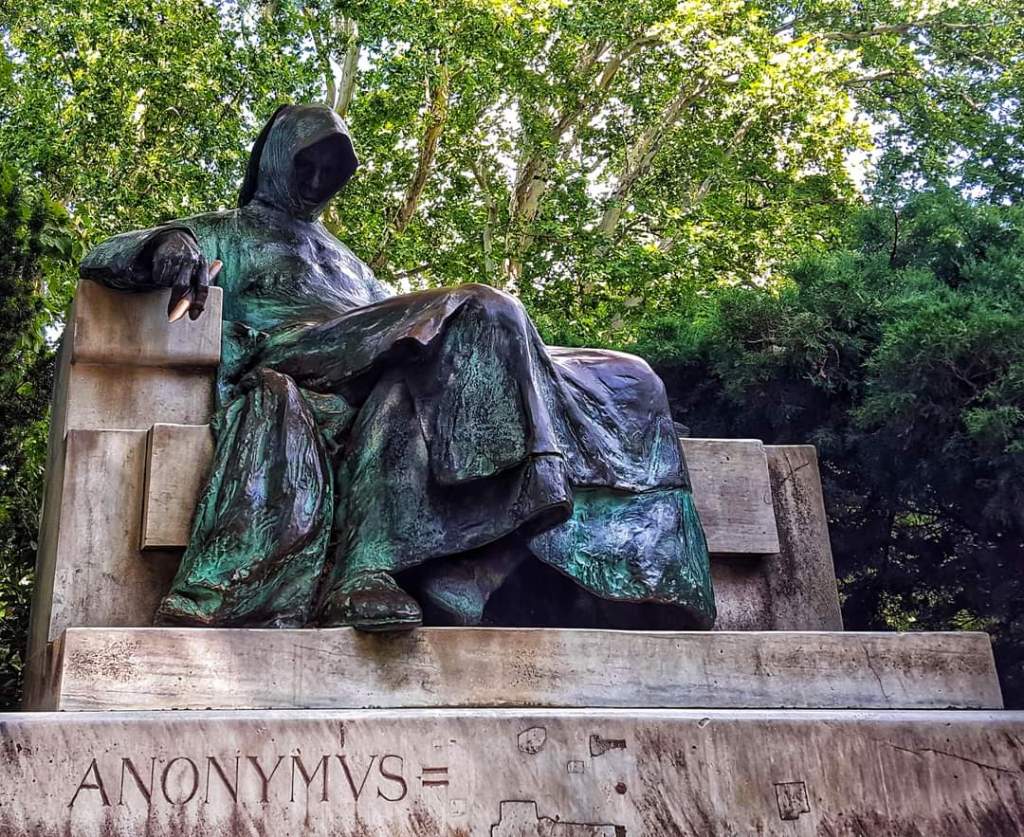
“As he spoke Lidia could see the schoolgirl Iza discussing the future with her father. She saw her as her father described her, as a pint-sized redeemer spreading out her school atlas and examining the map of Budapest because she wanted to see a major city, a really big city, and trying to work out where in City Park the statue of the historian Anonymous might stand. Iza loved the look of that hooded faceless figure. She saw it once when she was a young woman visiting Budapest…” – Magda Szabó, Iza’s Ballad
How pleased I was to have identified with Iza so much! There was even something close to a silent pride that I initially felt. It was as if I were reading my own mother’s description of myself – how Iza organized her life and her schedule, the tidiness, the discipline, the sense of responsibility, the restraint, her satisfaction in not having to give account of herself to anyone!
But how I trembled, as I turned the pages approaching the finale when I realized that it was because of this unrelenting self-discipline seeping into the cracks of her relationships that led to heartbreaking consequences.
It is for readers with aging parents. It is for every new generation that believes they are so much wiser than the previous one, so practical even in matters of the heart, and yet, unwittingly, so heartless.
It is for societies that reject the past and the old deeming these to be outdated and sentimental, failing to acknowledge that the past and the old hold the clues to the present and the new.
Although set in postwar Hungary, the spirit of this novel is contemporary: the timelessness of its message, its tragedies that are themselves the lessons, will gnaw at my soul for years to come.
Few books leave me feeling defeated. This one did. I felt so helpless under the influence of such simple but penetrating prose.
It is that dazed emotion one undergoes when someone so much wiser with experience sings in a pensive gasp, “I really don’t know life… at all…” Yes, someone like the inimitable Joni Mitchell, only Magda Szabó does it with an outstanding novel that she affectionately hands over to the reader saying, “You really don’t know life… at all…”
And in the presence of such masterful artistry and truth, what else can one do but applaud and weep?
“In any work of literature the most interesting bits are in the detail,” Kőnig had often said in his lessons. “Be sure to attend to them closely.”
If I had a daughter, she’d find this book in a collection I created for her.
Reading this, she’d be reminded that heroines do not have to be faultless; that the surest assumptions can often be wrong; that no matter how clever we think we are, there are people wiser still; that actions always have consequences; that friendship is precious; that even in the most repetitive of routines and what we deem the bleakest of days, life will find ways to astound or surprise us.
If she philosophizes and reads deeper into the book, as I suspect a daughter of mine will, she will venture to question where childhood ends and adulthood begins, and attempt to come up with answers of her own, or a hundred questions more.
If she develops an awareness of history and politics, as she must, she will be sensitive to Magda Szabo’s subtle activism and glean the lessons of sacrifice and duty.
And I imagine this book — so engaging and difficult to put down — will only fuel the love for reading in her.
Can you tell that I read this through the eyes of a wide-eyed adolescent, and not through the eyes of an adult still haunted by the painful and confounding strains from Iza’s Ballad and The Door but who, nonetheless, acknowledges that Magda Szabó has now become a favorite?
Iza’s Ballad and The Door gnaws at the soul. Abigail educates the heart.







 The Book-Butterfly